Viewing Posts by Carole Osterweil

When High Performance Turns Toxic


Whilst this CEO was interested in leadership on big budget infrastructure, engineering and IT projects, we see a similar pattern in many sectors. The lessons are universal. Toxic cultures stymie high performance – it’s hardly newsworthy. How come these dynamics persist – even when leaders are charged with monitoring well-being? What are we missing? What can leaders do to improve success rates?
The CEO was Collin Smith, of ICCPM (international Center for Complex Project Management). He was talking about the toxic cultures identified in ICCPM’s Roundtable Research.[1] Toxic cultures and mental health"Teams in bigger and more complex projects often have a battle rhythm characterized by cognitive overload, decision fatigue, day in day out conflict and excessive stress. This results in poor mental health or even PTSD like symptoms He continued, Unfortunately, there’s a trend: leaders in these projects keep pushing and pushing – to the detriment of their own mental health and that of their teams. And productivity suffers. Although these project leaders are responsible for monitoring staff well-being, at times they seem to exhibit a pride in the scar tissue they’ve acquired over decades. They tend to baton down the hatches, crack the whip and crank up the stress to get things done. Yet our research tells us, when complex projects really get tough the opposite is needed. We need leaders at their very best in terms of critical thinking, creativity, collaboration and adaptability. We need leaders who, despite the overload and stress, can slow down rather than becoming more transactional and process driven."
That’s where the ideas I introduced in my earlier blogs come in. SCARF a Brain–based Model for Managing People on Projects explores how the human brain works, and how our response to social threat takes our Thinking Brain offline. Change Requests and the Project Stress Cycle extends these ideas by demonstrating how excess stress increases complexity, and reduces the chances of project success. Now consider the project leaders Collin was referring to. They are no different from you and me. We know from the SCARF model, the human brain loves certainty. Yet they are dealing with masses of uncertainty and the stakes on their projects are incredibly high. This means many of them are under constant stress. In other words, their Thinking brains are offline. And we know from those earlier blogs, when our Thinking brains are offline, we see things less clearly. If we can’t really see what’s going on, we start making assumptions about what is actually happening. After all, we’re wired for survival. The fight/ flight reflex says it all. If we’re not going to run away, we may well start fighting. And that increases stress levels, and makes a brutal culture far more brutal. So what can we do about it? Breaking the toxic cycle starts with self-awarenessIn my view we need to take a new look at the skills for successful project leadership, and put self -awareness at the top of the list. I argue it's THE key skill. By this I mean you need to be able to ask, at any time – ‘what is going on for me right now?’
Note I use the Feeling word, which doesn’t feature in many business conversations, because answering this question helps to bring our Thinking brains online. Once you know how you’re feeling, you can consider how other people might be feeling too. You can then move on to consider what do you have to do to:
Thinking brains have to be online
They have to be online for us to inspire people and learn well. If you're cracking the whip, all you're doing is evoking a fight and flight response. Nobody will be able to think clearly, so they will make poor decisions. Project performance will suffer. The research is clear. We need leaders who, despite the overload and stress, can slow down rather than becoming more transactional and process driven. And that means leaders with a high degree of self awareness. References Project Leadership: The game changer in large scale complex projects Image by Sebaastian Stam on Unsplash |

Corona: Reducing Team Uncertainty
| Welcome to my second blog on dealing with Corona Uncertainty. The message in my first blog was clear We need Thinking brains online for high quality decision making. This means learning to contain anxiety so we don't get caught up in Project Stress Cycles. With Thinking Brains online we can have informed discussions and take high quality decisions about how to proceed. In this blog, I'm offering a tool to facilitate your discussions and decision making. This tool is designed to help keep your Thinking Brains online because it allows you to talk explicitly about uncertainty. Yes, you read that right! It's a tool for talking about uncertainty - not risk. The case for talking about uncertainty Project Managers love a business case - here's mine.
I unpacked the differences between risk and uncertainty with help from Elmer Kutsch and colleagues in Project Delivery, Uncertainty and Neuroscience [1]
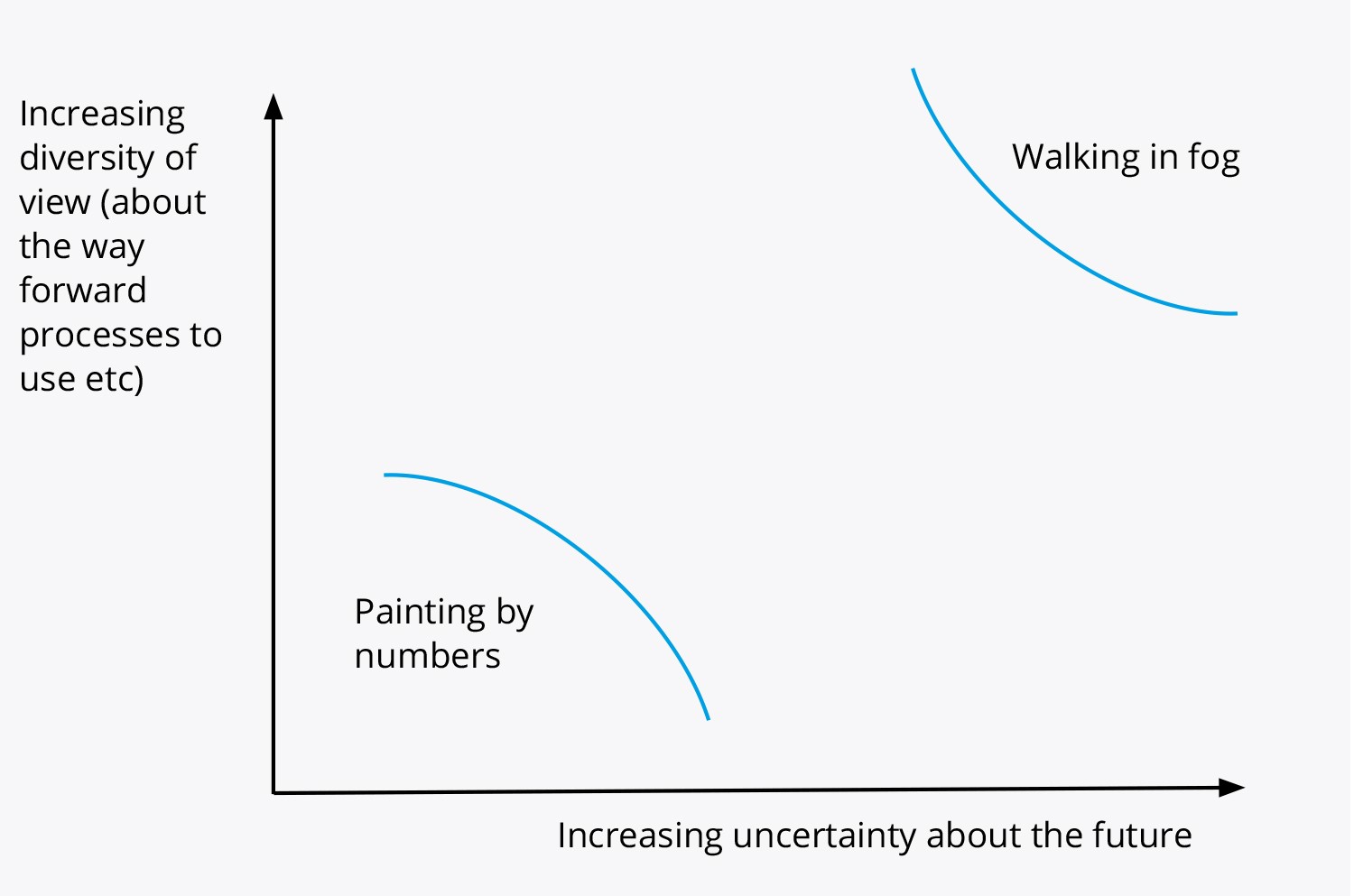
Corona is an uncertainty that has come to pass and it's bringing many more in its wake. We can't manage the risks away - no matter how much we want to! We simply don't have the past experience to draw on. Sticking our heads in the sand or pretending we can manage the risks away doesn't work. It doesn't contain anxiety - people can see straight through it - as our politicians are discovering. The only way to proceed is by being transparent and talking about uncertainty. Doing so reduces social threat and social contagion. When you use the tool below, talking about uncertainty it is quite straightforward. You'll find it makes a huge difference. Tool for Exploring UncertaintyMy tool is based on Eddie Obeng’s project typology and Ralph Stacey’s work on complexity
Source: Project Delivery, Uncertainty and Neuroscience © Visible Dynamics Try it now in three steps. Go on. Step 1 Use the graph to plot where you are today with a project to deliver and Corona looming. Put a cross in the top right if you feel like you’re Walking in Fog (very uncertain with little agreement on the way forward ). Put it in the bottom left if it’s more like Painting by Numbers (you know the kids’s game – where there's a clear outline and you just have to add the colours to make the picture) Step 2 Forget about Corona, think about your personal preferences. Where do you usually feel most comfortable? Top right, bottom left, somewhere in the middle? Step 3 What does this tell you about yourself and the impact of Corona Uncertainty on you and your Thinking Brain? I’m guessing that most of us are in the top right. I’m also guessing that it's a pretty uncomfortable place to be - even for those of us who like fog and are drawn to uncertainty. And I’m curious, what is it like to have these labels and to be explicit about your response to uncertainty? In my experience these labels help us make sense of uncertainty. They provide great clarity and help to bring our Thinking Brains online. Add to this the knowledge that Walking in Fog needs a completely different approach to Painting by Numbers and you have a way forward. Walking in Fog needs a completely different approach When you’re Walking in Fog the best approach is to set out to explore and understand the uncertainty. You make progress by explicitly exploring the terrain, aiming to put stakes in the ground as you gain clarity, and making informed decisions about where to look next to reduce the uncertainty further. Working in this way, you eventually develop enough experience of the terrain to make realistic risk assessments. When you reach this point it’s appropriate to adopt more traditional approaches to project planning and risk management. You can start Painting by Numbers. TAKEAWAYSThere is no way of escaping the fog! Pretending it’s not foggy, or confusing risk and uncertainty leads to all kinds of problems. If you don’t want to get caught out (and this applies to starting a new project or taking over an existing one) as well as responding to Corona:
And tell me how you get on! Other Blogs in this Series
References[1] Osterweil, C (2019) Project Delivery, Uncertainty and Neuroscience – a Leader’s Guide to Walking in Fog, London: Visible Dynamics |
Corona - Reducing Personal Uncertainty
| “It’s nuts. We’re in freefall. Business has dropped by 30% overnight. We’ve never seen anything like it. We don’t know if we’ll be here in 2 weeks”. This client, like many of us in the early days of the Corona outbreak, is in a spin. How can he deal with the uncertainty? It’s tempting to turn very British and tell him to Keep Calm and Carry On. But he, like many others needs more than that. In this, and the next blog of the series, I’ll be answering his question. How? By offering a route for containing anxiety and a tool for dealing with uncertainty so that you can be confident in the quality of your decision making and avoid getting caught up in a Project Stress Cycle. My recommendations build on the foundations set out in my previous blog SCARF a Brain–based Model for Managing People on Projects. If you have read that blog you will know
For high quality decisions we need our Thinking Brains online. With Corona dominating everything around us, our challenge is to get our Thinking Brains online and to keep them there.
How do we get our Thinking Brains online? Part of the answer is to label accurately how you are feeling. Now I may have trained in psychotherapy, but I am not going to put you on the couch or suggest you do lots of touchy-feely stuff! Instead, I’m offering you a Brain Hack for dealing with anxiety BRAIN HACKJudson Brewer a psychiatrist writing in the New York Times about the Corona virus, anxiety and social contagion (the fact that other people, seeing we are anxious, begin to feel anxious too), suggests this brain hack [1]. “To hack our brains and break the anxiety cycle, we need to become aware of two things: that we are getting anxious or panicking and what the result is. This helps us see if our behavior is actually helping us survive, or in fact moving us in the opposite direction — panic can lead to impulsive behaviors that are dangerous... Once we are aware of how unrewarding anxiety is, we can then deliberately bring in the “bigger better offer.” Since our brains will choose more rewarding behaviors simply because they feel better, we can practice replacing old habitual behaviors — such as worry — with those that are naturally more rewarding. For example, if we notice that we have a habit of touching our face, we can be on the lookout for when we act that behavior out. For example:
THE HACK SEQUENCELet me summarise the sequence for you
Neuroscience research tells us that this sequence helps to bring our Thinking brain online. It's a sequence I've used frequently in my coaching over the last five years. Clients are typically delighted with the clarity it brings to their decision making. They are often surprised too. Surprised because many of them had previously dismissed any suggestion of focusing on their breath/ feelings' as new age nonsense! I used to do the same. In fact, like many of my clients, when feeling anxious my reflex response used to be to ignore it - I'd carry on regardless. I didn't understand that my anxiety would leak out anyway, and other people would pick it up at a subconscious level. My anxiety would add to their anxiety levels and impact their decision making too. Learning to keep our Thinking brain online is a core skill Learning to keep our Thinking brain online is a core skill for every project professional. Using this sequence may fell clunky at first - in that respect it's just like learning any other skill. Persevere with it and teach it your families, colleagues and friends. Corona virus is unlike any challenge we've faced before. Dealing with it well requires us to contain anxiety and to keep our Thinking brains online. Do this and we can be confident of making informed decisions about what's required and how to behave. BLOGS IN THIS SERIES
and coming soon
REFERENCES [1] https://www.nytimes.com/2020/03/13/well/mind/a-brain-hack-to-break-the-coronavirus-anxiety-cycle.html A Brain Hack to Break the Coronavirus Anxiety Cycle, Judson A. Brewer, M.D. accessed March 14 Photo by Viktor Forgacs on Unsplash |

Change Requests and the Project Stress Cycle
| Welcome to the third in this series of blogs exploring what the project world can learn from neuroscience Handle a change request badly and you can trigger a stress cycle that adds layers of complexity to project delivery. Stakeholders changing their minds can be exasperating – especially when you think you’ve finally tied everything down! Everyone in the project profession recognises the risk of scope creep. Far fewer recognise that their response to a change request is important too. Your response to a change request mattersWhen a stakeholder changes their mind it’s crucial we don’t let it wind us up. Why? When we are stressed or upset we find it harder to regulate our emotions and keep our Thinking brain online [1]. This can lead to a chain reaction – a ‘project stress cycle’ – that amplifies stress levels and sets hares running – making it far more difficult to achieve successful project outcomes. Read on to find out how to spot a project stress cycle and what to do about it if you are caught in one. Then check out the video conversation for a summary.
What is a Project Stress Cycle?Picture Fred a senior project team member. Things are not going his way. He’s getting increasingly frazzled. He is holding it together but doesn’t realise how stressed he is. This most recent change request was last straw – he is snapping at everyone and finding it harder to act in a rational manner.
The Project Stress Cycle Source: Project Delivery, Uncertainty and Neuroscience - A Leader's Guide to Walking in Fog [2] The impact on those around him is palpable. No one wants to provoke an outburst, so they give him a wide berth. And of course, after a bruising meeting it’s hard to keep your own Thinking brain online. Trust is falling across the piece and relationships and communication are suffering. When the project started Fred and his colleagues went out of their way to highlight the need to invest time in building relationships and ensuring people worked well together. They repeatedly reminded the team ‘successful delivery relies on collaboration and creativity’. But now the pressure is on and metrics are the primary focus. As relationships get strained collaboration is more difficult. Rather than waste time struggling to work together people are falling back into old habits and old silos. They are relying on approaches that worked in the past. But without quality collaboration it’s hard to be truly creative. And the word on the street? The project is unlikely to achieve the desired outcomes – which does nothing for stress levels. Powerful stakeholders are getting nervous. They are demanding more and more information in slightly different formats to reassure themselves that things are under control. These demands distract the team from the work they should be doing and add to the stress. They have less time and less inclination to work collaboratively and the preoccupation with spreadsheets and metrics is forcing them to adopt behaviours that reduce the chance of success and multiply stress – right across the system. In telling this story I have illustrated how one person’s response to a change request can increase the complexity of delivery. Yet this is a simplification of what happens in real life. Real life involves many stakeholders and many responses to a single change request – not all of them proportionate or rational. I’m not suggesting that stress is a bad thing – a little goes a long way. (I don’t know about you, but I’m suspicious of dashboards that only show green flags). TAKEAWAYSWe need to be on the look out for signs of excess stress and we need to be looking for patterns. It’s not enough to keep an eye on how individuals, (including ourselves) are responding to change requests. We need to be checking how project boards and project teams are responding too. I’ve written elsewhere about the need for psychological safety [3]. A lack of it is often an indicator of things going awry.
Next time a stakeholder changes their mind
If you suspect there’s a project stress cycle at work,
You’ll be amazed at how quickly things can shift once you’ve got a way to describe what is really going on! SUMMARYCheck out this video clip for a summary. As this is the first time I've included a video clip in a blog here, please use the comments below to let me know whether it's helpful and whether I should do so again. BLOGS IN THIS SERIES
and coming soon
REFERENCES [1] Osterweil, C. (2016). Using Insights from Brain Science to Manage Projects and Influence Change -. [online] Visible Dynamics. Available at: https://www.visibledynamics.co.uk/using-insights-from-brain-science-to-manage-projects-and-influence-change/ [Accessed 21 Feb. 2020]. [2] Osterweil, C (2019) Project Delivery, Uncertainty and Neuroscience – a Leader’s Guide to Walking in Fog, London: Visible Dynamics [3] Osterweil, C. (2017). Self-protection is natural and psychological safety is king! -. [online] Visible Dynamics. Available at: https://www.visibledynamics.co.uk/project-psychological-safety-google/ [Accessed 21 Feb. 2020].
|

SCARF a Brain–based Model for Managing People on Projects
| Welcome to the second in this series of blogs exploring what the project world can learn from neuroscience. I set out my stall in the first blog - projects don’t behave the way textbooks say they should. Neither do people. How often have you seen a team member becoming defensive or a client getting wound up and quite aggressive over something relatively minor? Or perhaps you’ve sat in a meeting when you suspect that several others, like you, are convinced that the discussion is adding no value, or even worse it’s downright unhelpful – yet nobody does anything about it. Have you noticed how few people talk openly about finding project delivery, with its complexity and uncertainty, stressful and anxiety-provoking? Yet plenty do so in private! Neuroscience tells us stress and anxiety impact our ability to think clearlyNeuroscience tells us that stress and anxiety impact our ability to think clearly, increasing the chance that we’ll misread the situation and behave in ways which raise the stakes and add complexity. This blog sets out five Brain Basics and explains the SCARF model which will help you spot what’s going on beneath the surface in these highly charged moments. Read on and you'll see why I recommend that everyone involved in project delivery acquires a basic understanding of how the human brain works and uses this knowledge to inform their actions. 5 BRAIN BASICS
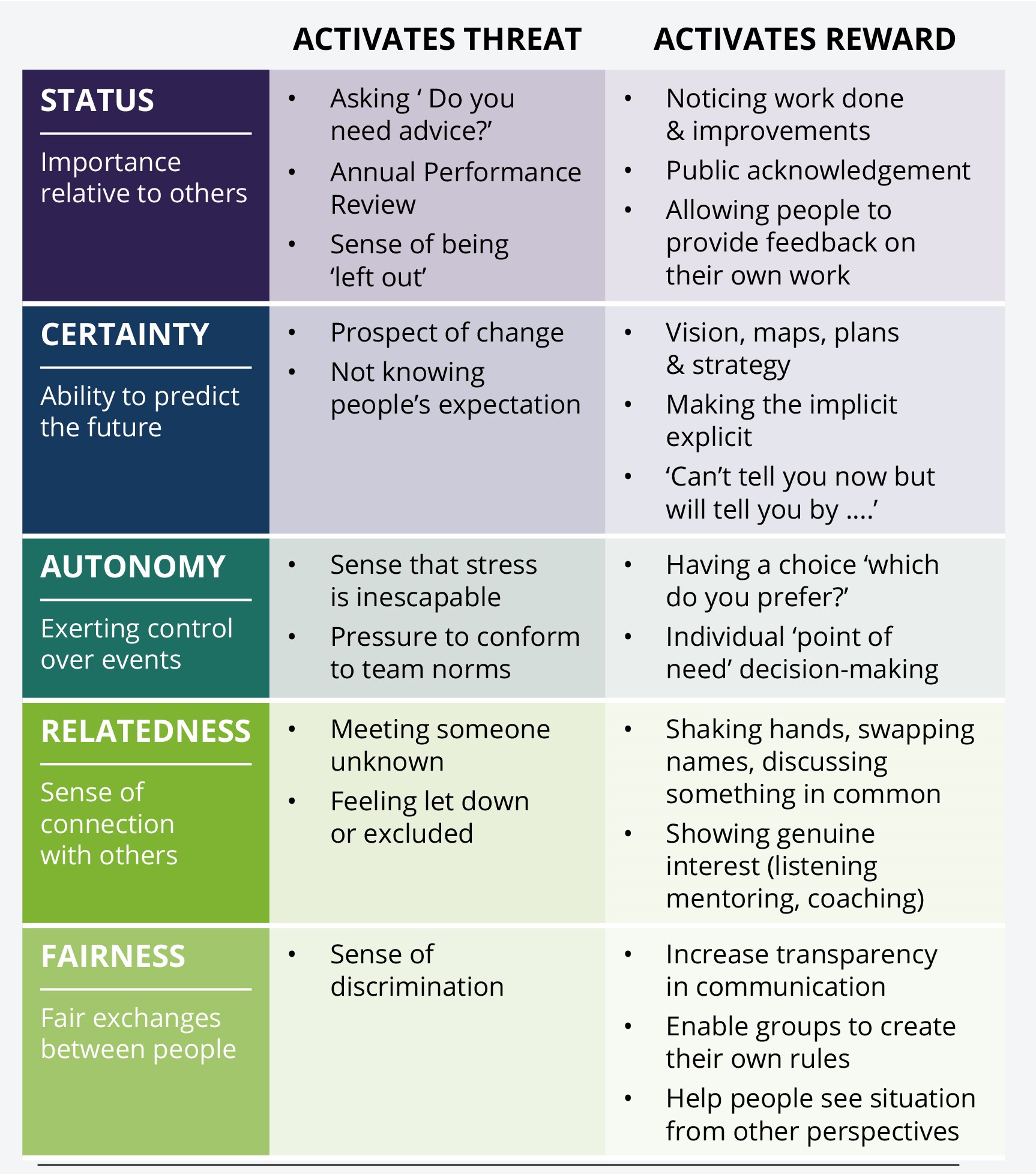
Source: Visible Dynamics Take a moment to reflect on charged moments you’ve been party to. Use the five Brain Basics to consider what might have been going on beneath the surface. How does thinking in terms of ‘avoidance’ and ‘approach’ emotions and behaviours help you make sense of the situation? Social threats cause avoidance behaviours, so we need to understand what they are and where they come from. That’s where SCARF comes in! What is the SCARF Model?There are five factors that the brain is always monitoring and they have a huge impact on how we behave. David Rock developed the SCARF model to explain these factors[i] We are acutely sensitised to look out for them. SCARF stands for:
When people sense a change in any one of the SCARF factors, it can activate an avoidance response - The bigger the change the stronger the response. An example of SCARF in action Source: Project Delivery, Uncertainty and Neuroscience - A Leader's Guide to Walking in Fog .[ii]
Responding to Social ThreatWe see and respond to social threat in the most mundane situations. These threats do not have to be explicit, intentional or real. We only have to perceive that our status has been reduced or that we are being treated unfairly and we will respond with avoidance behaviours. The converse is also true. When we believe we are being treated fairly and that we have a degree of control over the future it’s easier be highly productive. We want the feelings of excitement and trust that come with engagement. USING SCARF TO HELP MANAGE CHANGE ON PROJECTSUnderstanding how the brain works adds new perspectives to many good leadership practices. Take the adage ‘When dealing with change communicate, communicate, communicate!’ SCARF guides us to five areas that need to inform all our actions in organisational and project settings. For example, by highlighting our desire for certainty, SCARF tells us that the prospect of change – whether a tweak to the IT system or wholesale digital transformation is likely to activate a threat response. We need to include this knowledge in our project planning, and make sure that we prioritise activities to reduce the degree of uncertainty and counter the threat response. This means speaking to people about the vision for the future, and sharing plans for achieving objectives; it means explicitly discussing what you do know about the future and being willing to admit what you have yet to work out; and it means offering timescales or admitting ‘we can’t tell you now but we will tell you by …’ This table gives further examples for using SCARF in organisational and project settings.
Using SCARF on Projects Source: Project Delivery, Uncertainty and Neuroscience - A Leader's Guide to Walking in Fog We’ve seen from Brain Basics and the discussion of SCARF and that every interaction with another person triggers a change in the intensity and quality of our emotions. Most of us are unaware of the ebbs and flows of our emotions. Yet it’s these changes, driven by our innate need to survive, that determine how we behave.
KEY TAKEAWAYSOn projects we rarely work in isolation. There are as many sources of social interaction and emotional triggers as people in the proverbial room (which includes those we connect with digitally via email, video and social media). This means we must:
It will stop you adding to the volatility uncertainty, complexity and ambiguity of VUCA environments. It will bring down stress levels, reduce distractions and allow you to focus on what really matters - achieving your project goals. BLOGS IN THIS SERIES
[i] Rock, D (2009) Managing with the Brain in Mind Strategy +Business, Autumn 2009, Issue 56 Retrieved from: https://www.strategy-business.com/article/09306?gko=5df7f [ii] Osterweil, C (2019) Project Delivery, Uncertainty and Neuroscience – a Leader’s Guide to Walking in Fog, London: Visible Dynamics
|