
Viewing Posts by Luisa Cristini
Stakeholder management in research: How to keep people engaged and interested in your project


| Who are the stakeholders in your research project and why is it important to engage with them? How can you keep your project team and people outside interested in your project? How important is communication with your key stakeholders and how can you make sure your communication is effective? Stakeholder management is key to scientific research. Every project has stakeholders who can influence the project in a positive or negative way. The ability to manage stakeholders in an appropriate manner can mean the difference between success and failure. Stakeholder engagement is important to increase support and minimise resistance from key stakeholders. Identify your stakeholdersStakeholders are people, groups or organisations that could affect, be affected or perceive to be affected by any decision, activity or outcome of the project. It is important that all stakeholders are identified regardless of how major or minor they are. This is because they will be categorized after they are identified. If stakeholders are omitted there is a likelihood that they may become evident at some point during the project’s lifecycle and introduce delays or other obstacles to the project’s success. Stakeholder analysis is the process by which you identify your project’s stakeholders:
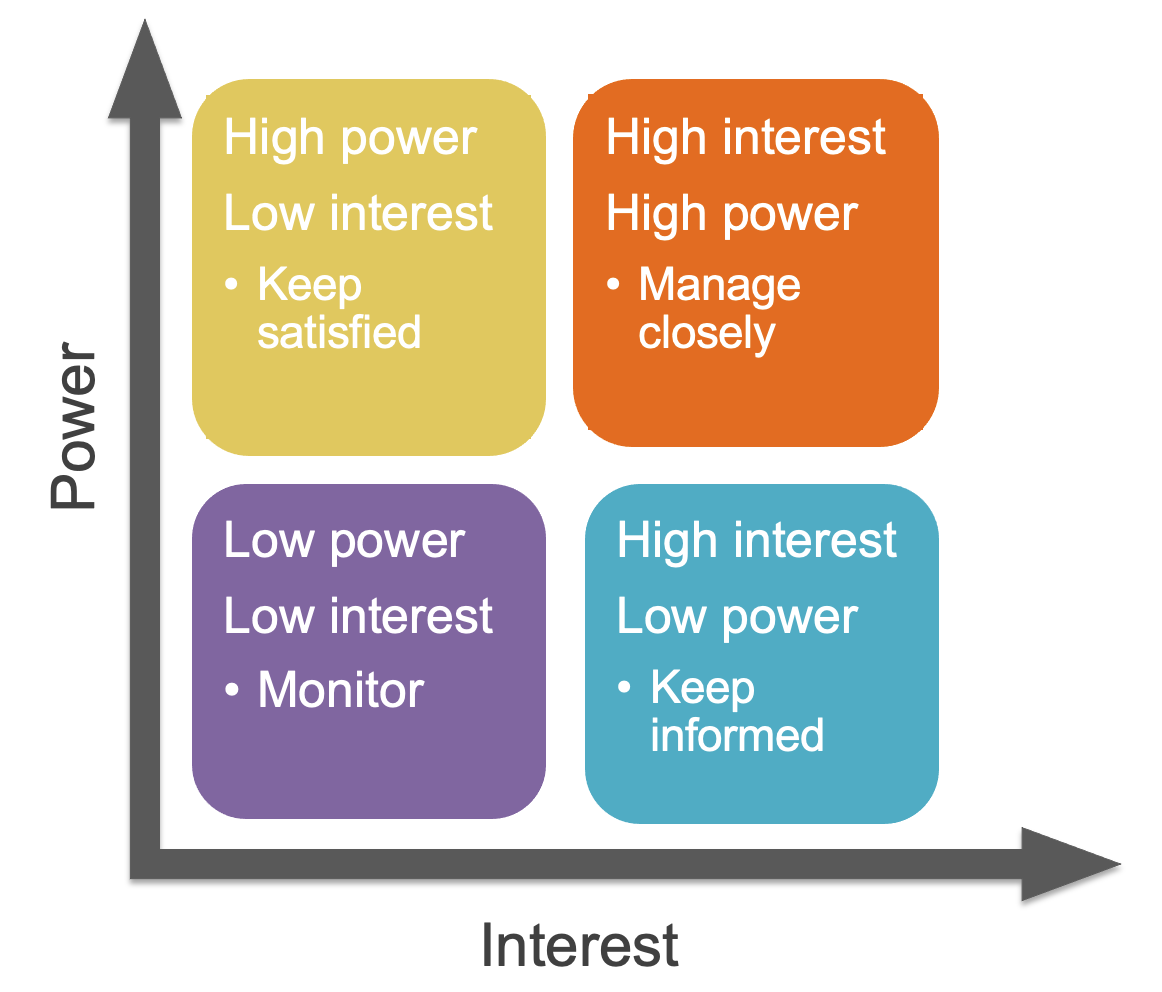
Any individual who meets one or more of the above criteria can be identified as a stakeholder. Stakeholders from the same organization can be grouped in order to simplify stakeholder management. Once you have identified your stakeholders you can analyse the list (your Stakeholder Register) and categorized or grouped them assigning a level of impact they may have based on their power, influence, and involvement in the project. You should also add any description which might be helpful to plan your stakeholder engagement. How could the project stakeholders identified in the previous section be impacted by the project? Do any of the stakeholders link/relate with each other? You can also visualise your project’s stakeholders on a power/interest grid and prioritise them based on the grid.
A stakeholder analysis is very beneficial because:
Plan your stakeholder engagementOnce you have identified and analysed your stakeholders in the stakeholder register, you can develop a Stakeholder Engagement Plan. In the plan you should describe how stakeholders will be approached and by whom in the project team, as well as how often the project team will communicate with them. First you need to carry out a stakeholder engagement assessment: what is the current level of engagement of each stakeholder? What is the desired engagement level? You will prioritise your stakeholder engagement based on the power/interest grid and your stakeholders’ engagement levels:
Once you have prioritised your stakeholders you need to decide how to engage with them, that is, how you will communicate with them throughout the project. What information about the project will be communicated to which stakeholders? How will the communication be delivered and when? Who will be in charge of the communication? How often will feedback be requested from the stakeholders? How will the feedback be implemented in the project? Receiving feedback from your stakeholder is crucial in research projects because engaging with your stakeholders by listening to their feedback and incorporating their needs in your research means co-production of knowledge, important to achieve results. Communication is key to stakeholder managementCommunication is crucial for stakeholder engagement because it is the most powerful tool:
You should communicate and work with your stakeholders often throughout the project to meet their expectations and needs, address issues as they occur and foster appropriate engagement strategies. The timing of your communication with your stakeholders is also important. Engagement at appropriate stages helps to obtain or confirm their commitment to the success of the project. Keep an agile mindsetResearch projects are a way to explore the unknown and in most cases, you do not know what to expect as a result. Keeping an agile mindset helps address changes that might occur along the way and overcome challenges. This is important also when engaging with your stakeholders so here are some points to keep in mind to embrace change:
References
|
Agile science or why we need a change of mindset about project management for academic research (and how)
|
Image from Pixabay Science advances through projects, and projects are the very basis of scientific research. From master and doctoral thesis involving a handful of people to large international collaborations with hundreds of team members, academia is full of examples of projects. Fieldwork campaign, satellite missions, laboratory analysis, numerical modelling experiments are only a few examples of the type of projects one can find in science. For scientists, project management is a tool that helps us carry out our research in an organised and sensible way to decrease the chances of errors and failure and increase the impact of our research. Scientific projects are most often international, interdisciplinary, intercultural and intersectoral and thus require tailored project management approaches. Research project management is pervasive and becomes more and more required by funding agencies as an integral part of research project proposals. Together with scientific creativity, good research project management is one of the keys for a successful project. Good management ensures a high impact and helps demonstrate the effective use of tax money within science. However, research project management is still not implemented as a standard procedure in science and is often also not properly acknowledged as instrumental for the success of a research project. In many contexts within science, in particular when it comes to training at the early stages of a scientific career, project management is often considered a “soft skill”, something that adds value to a curriculum, but not as essential as other more technical aspects of science (e.g., programming, laboratory methodologies, sampling or fieldwork). This needs a shift in the current cultural mindset and this shift is only possible if all science stakeholders, including project scientists, funding agencies representatives, organisation executives and project managers themselves, contribute. An interesting opportunity to change this mindset presented last February 2020 when I was invited to participate in a 2-days symposium organised by the German Project Management Association specifically aimed at exploring how some modern project management techniques popular in sectors outside academia could be implemented to boost scientific research. The symposium, first in its kind, was hosted at the German Research Centre for Environmental Health in Munich and opened by its scientific director Prof. Stephan Herzig who stressed the importance to combine world-class science with world-class project management to ensure scientific advancement and how investment in project management is needed to make science more effective. Modern project management uses appropriate methods depending on the situation. It can include traditional plan-based methods as well as agile management tools. Accordingly, the content of the symposium focused on five methodologies: design thinking (how to create new project ideas), project canvas (how to plan the project), lean start-up (how to start own company from your scientific idea), agile/scrum (how to develop services), and Kanban (how to manage the workflow). The format of the symposium included general introductions of the methodologies and activities in groups to practice how to implement them in scientific activities. The idea was to give the participants an overview of the techniques for us to pick the most appropriate depending on the project or context. Each of these methodologies has its strengths and can be applied to the many tasks of the researcher/science manager (e.g., write manuscript/prepare conference paper, write progress reports for a funding agency, review manuscripts and conference papers, develop a strategy for the research group, prepare and conduct lab experiment, work on PhD thesis, project team meetings, recruitment, write travel grants/proposals for a new project). Some project management tasks in science include structure, assign, and schedule tasks, organise meetings, ensure the quality of results, report on performance indicators, manage costs, facilitate creativity. Modern project management methodologies can be applied to each of these tasks and help save time for research. One major benefit I gained through this symposium is learning how to frame these methodologies in my daily work. I realised that I was already partly applying them to perform my tasks, but understanding the full methods made me appreciate their potential for more applications. Design thinking is extremely helpful to boost scientific creativity and guide the brainstorming process to develop new scientific ideas which will be the basis on which to build the research project. Design thinking is a structured process to come up with new ideas for solutions to existing problems so it is ideal to explain the motivation for scientific research. Project canvas is absolutely valuable when planning your project at a high level but detailed enough to appreciate its value. A canvas can be also used to explain your project in one page and have all the important information clearly visible. Many research results have the potential for start-ups so why not use lean startup methodologies to transform an idea into innovation and start-up (spin-off)? Personally I haven’t used this so far in my work but I can see that this method will become useful for example when identifying a project’s key exploitable results and their potential applications. Agile is the next frontier for science. As the academic world and research funding structures are by definition inflexible, there is huge potential to apply agile methodologies and scrum in particular in the smaller bits composing scientific research. For example, we apply agile methodologies for software project management in the context of Earth system modelling but also in the coordination teams of large international projects to coordinate the research in a work package leading to a defined deliverable. Kanban is a fantastic way to visualise and follow on the work to do and to collect new ideas. In the context of scientific management, we use it to develop the project communication and outreach strategy and to organise events. Not only Kanban is useful to guide brainstorming discussion about new ways to communicate science and our project results, but also to keep track of progress, manage the workflow and implement feedback. All these project management tools can be adapted to the type of problem we want to address. You might have a favourite methodology to manage your project but generally, and moreover in science research, project management methodologies need to be tailored to the project (e.g., size, budget, context) and the task, and it’s up to a (good) project manager to choose the most appropriate. Only good project management practices can turn ideas into solutions for scientific challenges. Project management has long been considered opposite to creativity and science, but innovation needs to be managed and supported in order to have an impact, therefore project management is, now more than ever, necessary to make science effective. |

Happy first birthday to us!
|
Our blog Shifting Change: Insider Tips from Project Leaders is turning one year old! Since the first welcome post on the 7 March 2019, we published a total of 34 articles (nearly 3/month!) for a total of almost six thousand views. This amazing result was made possible thanks to the 14 authors who occasionally or regularly wrote engaging articles on the topic of change management in all its shades. Our authors discuss a wide spectrum of topics ranging from creativity (our most-read article by Walter Vandervelde) to creating a culture of appreciation, from how to sponsor change to capability development, from personal resilience to how to be a rock star project manager on digital transformation. And many more! The response from the community has been wonderful with a total of 200 comments to the articles by blog readers. This shows the interest and need for engaging discussions around the topic of change management and the importance of sharing knowledge within the community. Huge thanks to our amazing authors for sharing their experiences and tips with us and to the change management community of practice team for editing the blog. We’re always open to new topics and authors so if you’re interested to contribute, please get in touch with Luisa Cristini. |

The Fertile Liaison between Creativity, Change and Innovation
Categories:
Walter Vandervelde
Categories: Walter Vandervelde
| By Walter Vandervelde Not that long ago, a somewhat mysterious cloud shrouded creativity on the work floor. Everybody seemed to have their own definition and understanding of the word. The connotation with more artistic professions or (applied) art forms was never far away. Designers, copywriters, architects, film makers, musicians, … yes, those by definition are creative professions and creativity belongs there. Of course. We live in a world that changes exponentially day after day. And one change brings about another (or a range of others) automatically. Change, taken literally, is nothing more than a kind of migration of status A to status B. In order to talk about change you have to be able to discern the two statuses. There is change that we can only experience, but some changes we can control very precisely. And all shades in between of course. So far, our premise has been the inevitability of change. In our example of the barbeque party, we couldn’t do anything else but accept the change in weather conditions and try using creativity to come up with the best solution. We didn’t choose this example by accident, because weather conditions are by their very nature something beyond an ordinary person’s control. But we can prepare for it. If we had listened to the weather report and checked the online weather forecast regularly, we would at least have had more time to maybe find even better solutions. In a professional context that is no different: by placing ‘barometers’, using analytics, staying alert and open for internal as well as external signals, we can buy ourselves time. Time needed to think up many creative ideas, pick the best one, let it mature, test it, alter it, and prepare for its implementation. Actually, we are already laying the foundation of what we call innovation here. Innovation, when it is carried out the way it should be, brings along an automatic positive change. It is a conscious process that is geared towards changing things to improve them. When we talk about innovation management, we are talking about directing a sequence of actions that result in an improvement. At the beginning of the chain there is the question. And that usually starts with the words “How can we make sure that …”. To answer that question, we have to come up with creative ideas. That means calling on creativity. That’s why creativity sometimes is called the ‘the front-end of innovation’. But also throughout further steps in the innovation process creativity remains important. |
Welcome to the change management community of practice blog!
| Today’s world is influenced by change. In so many different aspects of our work and lives we are constantly under the pressure of changing demands, time schedules and technology. Every day we are expected to give our best within our teams and our communities to stay afloat and keep the pace in highly competitive environments. Organisations need to adapt quickly to customers’ needs as well as modification of regulations. Project and programme managers are key players in their organisations and need to be able to embrace and sometimes drive changes. This is not an easy task, especially when there is a lack of training and skill development on the specific aspect of change management. With the support of PMI and through the www.projectmanagement.com platform we are excited to start this new blog series that addresses these very issues. How can we project and programme managers take advantage of change around us and drive our organisations to thrive through change itself? What can we learn from project leaders in our community? How can we help our organisations and teams to adapt and develop? What are the tools and best practices to do that? Every month through a guest blog, experienced leaders will share their experiences, tips and tools to manage and exploit changes, and take advantage of them. They are experts in change management who successfully brought their organisations and teams not only through changes, big or small, but also to thrive through the process. Some of them are the very symbol of change as they found the apex of their career in a very different capacity than where they started. The blog is complementary to the webinar series of the Change Management online community and is managed by the same team. We have titled the blog “Shifting Change: insider-tips from project leaders” to reflect how modern project leaders are able to embrace changes in their work context and shift the mindset from resistance to advantage. We hope you will enjoy these resources and welcome your feedback anytime especially on what topics you would like to see addressed in the blog. Happy reading!
|


