Evolving Disciplined Agile: Principles of the DA Mindset
From the Disciplined Agile Blog
by Tatsiana Balshakova,
Mark Lines, Mike Griffiths, Scott Ambler, Bjorn Gustafsson, Curtis Hibbs, James Trott

This blog contains details about various aspects of PMI's Disciplined Agile (DA) tool kit, including new and upcoming topics.
View Posts By:
Tatsiana Balshakova
Mark Lines
Mike Griffiths
Scott Ambler
Bjorn Gustafsson
Curtis Hibbs
James Trott
Past Contributors:
Joshua Barnes
Michael Richardson
Daniel Gagnon
Valentin Tudor Mocanu
Kashmir Birk
Glen Little
Klaus Boedker
Recent Posts
DA 5.6 is released
Disciplined Agile 5.5 Released
Choose Your WoW! Second Edition Is Now Available
Requisite Agility applied in Project Management
Disciplined Agile and PMBoK Guide 7th Edition
Categories
#ChoiceIsGood,
#ChooseYourWoW,
#ConsumableSolution,
#ContinuousImprovement,
#CoreAgilePractices,
#experiment,
#Experimentation,
#GuidedContinuousImprovement,
#Kaizen,
#LifeCycles,
#ProcessImprovement,
#TealOrganizations,
Adoption,
agile,
agile adoption,
Agile Alliance,
Agile Business Analyst,
Agile certification,
agile data,
agile governance,
agile lifecycle,
agile metrics,
agile principles,
agile transformation,
Agile2018,
Agile2019,
Agile20Reflect,
AgileData,
Analogy,
announcement,
Architecture,
architecture,
architecture owner,
Articles and publications,
Asset Management,
Atari,
Backlog,
Barclays,
being agile,
benefits,
bi,
blades,
book,
Branching strategies,
Browser,
Business Agility,
business intelligence,
business operations,
capex,
Case Study,
Certification,
certification,
charity,
Choose your WoW,
CMMI,
cmmi,
Coaching,
Collaboration,
Communications Management,
Compliance,
Compliancy,
Conference,
Construction,
Construction phase,
Context,
Continuous Improvement,
coordination,
COVID-19,
Culture,
culture,
Cutter,
DA,
DAD,
DAD Book,
DAD discussions,
DAD press,
DAD roles,
DAD supporters,
DAD webcast,
DADay2019,
Data Management,
database,
dependencies,
Deployment,
Development Strategies,
DevOps,
disaster,
Discipline,
discipline,
Disciplined Agile,
disciplined agile delivery,
disciplined agile delivery blog,
Disciplined Agile Enterprise,
disciplined devops,
Documentation,
Domain complexity,
dw,
DW/BI,
Energy Healing,
Enterprise Agile,
Enterprise Architecture,
Enterprise Awareness,
enterprise awareness,
Essence,
estimation,
Evolving DA,
Executive,
Experiment,
facilitation,
FailureBow,
feedback-cycle,
finance,
Financial,
FLEX,
Flow,
foundation layer,
Funding,
GCI,
GDD,
Geographic Distribution,
gladwell,
global development,
Goal-Driven,
goal-driven,
goals,
Governance,
GQM,
Guideline,
Hybrid,
Improvement,
inception,
Inception phase,
India,
information technology,
infosec,
Introduction,
iterations,
Kanban,
large teams,
layer,
lean,
Lean Startup,
learning,
Legal Project Management,
LeSS,
Lifecycle,
lifecycle,
Manifesto,
mark lines,
marketing,
MBI,
Metaphor,
Metrics,
metrics,
mindset,
Miscellaneous,
MVP,
News,
News and events,
Non-Functional Requirements,
non-functional requirements,
Non-solo development,
offshoring,
Operations,
opex,
Organization,
Outsourcing,
outsourcing,
paired programming,
pairing,
paper,
People,
People Management,
phases,
Philosophies,
Planning,
PMBoK,
PMI,
PMI and DA,
PMI Chapter,
Portfolio Management,
post-format-quote,
Practices,
practices,
Principle,
Process,
process improvement,
process tailoring,
Product Management,
product owner,
Product Owners,
productivity,
Program Management,
Project Management,
project-initiation,
Promise,
Quality,
quality,
rational unified process,
Refactoring,
Reiki,
Release Management,
release management,
Remote Training,
Remote Work,
repeatability,
requirements,
Requirements Management,
research&development,
responsibilities,
retrospectives,
Reuse,
Reuse Engineering,
ride for heart,
rights,
Risk Management,
Risk Management,
Risk management,
Roles,
RUP,
SAFe,
sales,
Scaling,
scaling,
scaling agile,
Scheduled Workshops,
SCM,
scorecard,
Scrum,
ScrumMaster,
SDLC,
Security,
security,
self-organization,
SEMAT,
serial,
skill,
solutions software consumable shippable,
Stakeholder Management,
strategy,
Support,
Surveys,
Teal organizations,
team development,
Team Lead,
team lead,
Teams,
Technical Debt,
Teleconferencing,
Terminology,
terraforming,
test strategy,
testing,
time tracking,
Tool kit,
Toolkit,
tools,
traditional,
Transformation,
Transition iteration,
transition phase,
Uncategorized,
Upmentors,
Using PMI Standards,
value stream,
velocity,
vendor management,
Virtual Training,
Workflow,
workflow,
workspaces
Date
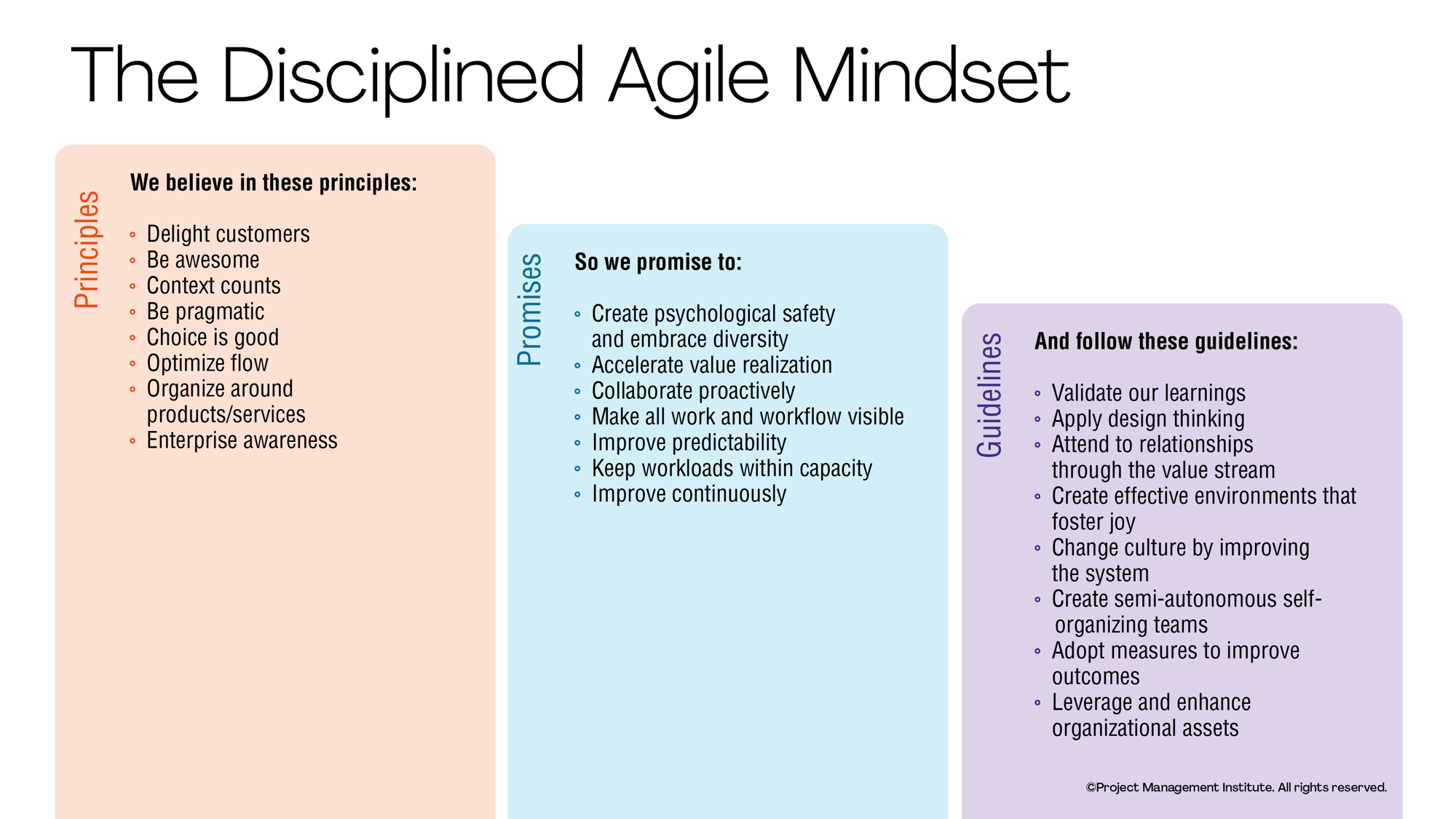
In the recent release of Choose Your WoW! we have evolved some aspects of the Disciplined Agile (DA) tool kit. One of the things we evolved is how we communicate the DA mindset (pictured above). The principles provide a philosophical foundation for business agility. They are based on both lean and flow concepts. In this blog posting we explore the eight principles.
- Delight customers. We need to go beyond satisfying our customers' needs, beyond meeting their expectations, and strive to delight them. If we don't then someone else will delight them and steal our customers away from us. This applies to both external customers as well as internal customers.
- Be awesome. We should always strive to be the best that we can, and to always get better. Who wouldn't want to work with awesome people, on an awesome team for an awesome organization?
- Context counts. Every person, every team, every organization is unique. We face unique situations that evolve over time. The implication is that we must choose our way of working (WoW) to reflect the context that we face, and then evolve our WoW as the situation evolves.
- Be pragmatic (reworded from Pragmatism). Our aim isn't to be agile, it's to be as effective as we can be and to improve from there. To do this we need to be pragmatic and adopt agile, lean, or even traditional strategies when they make the most sense for our context.
- Choice is good. To choose our WoW in a context-driven, pragmatic manner we need to select the best-fit technique given our situation. Having choices, and knowing the trade-offs associated with those choices, is critical to choosing our WoW that is best fit for our context.
- Optimize flow. We want to optimize flow across the value stream that we are part of, and better yet across our organization, and not just locally optimize our WoW within our team. Sometimes this will be a bit inconvenient for us, but overall we will be able to more effectively respond to our customers.
- Organize around products/services (new). To delight our customers we need to organize ourselves around producing the offerings, the products and services, that they need. We are in effect organizing around value streams because value streams produce value for customers, both external and internal, in the form of products and services. We chose to say organize around products/services, rather than offerings or value streams, as we felt this was more explicit.
- Enterprise awareness. Disciplined agilists look beyond the needs of their team to take the long-term needs of their organization into account. They adopt, and sometimes tailor, organizational guidance. They follow, and provide feedback too, organizational roadmaps. The leverage, and sometimes enhance, existing organizational assets. In short, they do what's best for the organization and not just what's convenient for them.
These principles are described in greater detail in chapter 2 of Choose Your WoW!. In the next blog in this series we will explore the promises of the DA mindset. Stay tuned!
Free Downloads
We have made several Disciplined Agile (DA) posters available to you for free download, including a Disciplined Agile Mindset poster.
Posted
by
Scott Ambler
on: April 24, 2020 12:00 AM |
Permalink
Comments (8)
Please login or join to subscribe to this item
Thanks for the deeper dive into the principles! Are we likely to be changing from seven hexagons to some other graphical representation of the eight principles?
Very interesting., thanks for sharing

Scott Ambler
Consulting Methodologist| Ambysoft Inc.
Toronto, Ontario, Canada
Kiron, great question. Yes. Moving forward we're reserving hexagons only for process blades.
Current incarnation of the rework of the principles slide is using a rounded rectangle for each principle (and promises and guidelines too, using the color scheme in the summary diagram above) and I suspect that will stick. But then again, our graphic artist may very well come up with a better idea.

Rami Kaibni
 Community Champion
Senior Projects Manager | Field & Marten Associates
New Westminster, British Columbia, Canada
Scott,
Great post and summary for the principles. I just have one take on this:
I am always cautious while applying the principle of “Delight Customers” because there is a thin line between Delighting your Customers and Gold Plating and many think that delighting your customers is achieved by delivering more than what the client requested in terms of specs, quality, and so on.
Delighting your customers by providing exceptional service, and value delivery is key but delivering products that have additional features that were not required comes at a cost and I am not sure the client will be happy to pay for those costs and even though if those additional features were provided for free, the client might not be happy either as they might have something else in mind.
Long story short, I think there should be more clarity about how to Delight your Customers and make it clear that there is a difference between this and Gold Plating.
Just my 2 cents.
Scott Ambler
Consulting Methodologist| Ambysoft Inc.
Toronto, Ontario, Canada
@Rami, fully agree. This is why the guideline of apply design thinking is so important. You need to work closely with customers, and potential customers for that matter, to gain an understanding of what they need. Otherwise you are likely to gold-plate.
The guideline Validate Our Learnings is also important so as to gain concrete feedback on whether we've delighted customers. Yes, sometimes we'll slip and gold-plate a bit, we're only human. But we'll soon detect that we have and then act accordingly if we've validated learning.
With the DA Mindset there is synergy between the principles, promises, and guidelines. You need to consider the whole, not just a single aspect of it.

Alexandre Costa
Scrum Master| Integer Consulting - Pictet technologies
Loures, Portugal
Scott,
The only thing that i can say , it's probably besides, Principles , Promises and Guidelines it would make sense add Ethics.
For me Ethics is the glue that bounds all this 3 pillars and is in fact a cornerstone of the Mindset.
But this is only a thought.
Alexandre Costa
Rami Kaibni
Community Champion
Senior Projects Manager | Field & Marten Associates
New Westminster, British Columbia, Canada
@Scott, thank you for your feedback. Considering the whole is key, totally agreed.
Scott Ambler
Consulting Methodologist| Ambysoft Inc.
Toronto, Ontario, Canada
Alexandre, that's an interesting observation. We'll have to think about that.
Please Login/Register to leave a comment.
|
"I know the meaning of life - it doesn't help me a bit."
- Howard Devoto
|




