Disciplined Agile
by Tatsiana Balshakova,
Mark Lines, Mike Griffiths, Scott Ambler, Bjorn Gustafsson, Curtis Hibbs, James Trott

This blog contains details about various aspects of PMI's Disciplined Agile (DA) tool kit, including new and upcoming topics.
View Posts By:
Tatsiana Balshakova
Mark Lines
Mike Griffiths
Scott Ambler
Bjorn Gustafsson
Curtis Hibbs
James Trott
Past Contributors:
Joshua Barnes
Michael Richardson
Daniel Gagnon
Valentin Tudor Mocanu
Kashmir Birk
Glen Little
Klaus Boedker
Recent Posts
DA 5.6 is released
Disciplined Agile 5.5 Released
Choose Your WoW! Second Edition Is Now Available
Requisite Agility applied in Project Management
Disciplined Agile and PMBoK Guide 7th Edition
Categories
#ChoiceIsGood,
#ChooseYourWoW,
#ConsumableSolution,
#ContinuousImprovement,
#CoreAgilePractices,
#experiment,
#Experimentation,
#GuidedContinuousImprovement,
#Kaizen,
#LifeCycles,
#ProcessImprovement,
#TealOrganizations,
Adoption,
agile,
agile adoption,
Agile Alliance,
Agile Business Analyst,
Agile certification,
agile data,
agile governance,
agile lifecycle,
agile metrics,
agile principles,
agile transformation,
Agile2018,
Agile2019,
Agile20Reflect,
AgileData,
Analogy,
announcement,
Architecture,
architecture,
architecture owner,
Articles and publications,
Asset Management,
Atari,
Backlog,
Barclays,
being agile,
benefits,
bi,
blades,
book,
Branching strategies,
Browser,
Business Agility,
business intelligence,
business operations,
capex,
Case Study,
Certification,
certification,
charity,
Choose your WoW,
CMMI,
cmmi,
Coaching,
Collaboration,
Communications Management,
Compliance,
Compliancy,
Conference,
Construction,
Construction phase,
Context,
Continuous Improvement,
coordination,
COVID-19,
Culture,
culture,
Cutter,
DA,
DAD,
DAD Book,
DAD discussions,
DAD press,
DAD roles,
DAD supporters,
DAD webcast,
DADay2019,
Data Management,
database,
dependencies,
Deployment,
Development Strategies,
DevOps,
disaster,
Discipline,
discipline,
Disciplined Agile,
disciplined agile delivery,
disciplined agile delivery blog,
Disciplined Agile Enterprise,
disciplined devops,
Documentation,
Domain complexity,
dw,
DW/BI,
Energy Healing,
Enterprise Agile,
Enterprise Architecture,
Enterprise Awareness,
enterprise awareness,
Essence,
estimation,
Evolving DA,
Executive,
Experiment,
facilitation,
FailureBow,
feedback-cycle,
finance,
Financial,
FLEX,
Flow,
foundation layer,
Funding,
GCI,
GDD,
Geographic Distribution,
gladwell,
global development,
Goal-Driven,
goal-driven,
goals,
Governance,
GQM,
Guideline,
Hybrid,
Improvement,
inception,
Inception phase,
India,
information technology,
infosec,
Introduction,
iterations,
Kanban,
large teams,
layer,
lean,
Lean Startup,
learning,
Legal Project Management,
LeSS,
Lifecycle,
lifecycle,
Manifesto,
mark lines,
marketing,
MBI,
Metaphor,
Metrics,
metrics,
mindset,
Miscellaneous,
MVP,
News,
News and events,
Non-Functional Requirements,
non-functional requirements,
Non-solo development,
offshoring,
Operations,
opex,
Organization,
Outsourcing,
outsourcing,
paired programming,
pairing,
paper,
People,
People Management,
phases,
Philosophies,
Planning,
PMBoK,
PMI,
PMI and DA,
PMI Chapter,
Portfolio Management,
post-format-quote,
Practices,
practices,
Principle,
Process,
process improvement,
process tailoring,
Product Management,
product owner,
Product Owners,
productivity,
Program Management,
Project Management,
project-initiation,
Promise,
Quality,
quality,
rational unified process,
Refactoring,
Reiki,
Release Management,
release management,
Remote Training,
Remote Work,
repeatability,
requirements,
Requirements Management,
research&development,
responsibilities,
retrospectives,
Reuse,
Reuse Engineering,
ride for heart,
rights,
Risk Management,
Risk Management,
Risk management,
Roles,
RUP,
SAFe,
sales,
Scaling,
scaling,
scaling agile,
Scheduled Workshops,
SCM,
scorecard,
Scrum,
ScrumMaster,
SDLC,
Security,
security,
self-organization,
SEMAT,
serial,
skill,
solutions software consumable shippable,
Stakeholder Management,
strategy,
Support,
Surveys,
Teal organizations,
team development,
Team Lead,
team lead,
Teams,
Technical Debt,
Teleconferencing,
Terminology,
terraforming,
test strategy,
testing,
time tracking,
Tool kit,
Toolkit,
tools,
traditional,
Transformation,
Transition iteration,
transition phase,
Uncategorized,
Upmentors,
Using PMI Standards,
value stream,
velocity,
vendor management,
Virtual Training,
Workflow,
workflow,
workspaces
Date
| 
Quick answer
The term predictive is deceptive.
Detailed answer
In the Disciplined Agile (DA) tool kit we use the term traditional or serial, rather than predictive or waterfall, to refer to the classic/linear ways of working. We feel that predictive is deceptive, more on this in a minute, and waterfall to be insulting (albeit still in common use within the IT community). Furthermore, we're starting to move away from using traditional as we're now seeing a generation of practitioners who feel that some of the older agile approaches, in particular Scrum, are traditional ways of working.
There are several reasons for why we feel the term "predictive" to be deceptive:
- "Predictive" implies predictable. Predictive is defined as "relating to the ability to predict" whereas predictable is "something that happens in a way or at a time that you know about before it happens." Something that is predictable is a sure thing, yet something that is predictive is not. This is an important difference, particularly given that we know that projects aren't completely predictable - otherwise we wouldn't need risk management.
- "Predictive" approaches to IT projects are a poor choice in most cases. Years ago I led a study for Dr. Dobb's Journal that investigated the effectiveness of different approaches (agile, lean, iterative, ad hoc, and traditional) to IT projects. We found that traditional strategies were less effective in practice than agile and lean approaches, and we weren't the only ones to have found this. We also investigated what was initially predicted at the beginning of the project and what actually happened by the end of the project, and once again traditional approaches didn't do as well as agile & lean. BUT, I must stress that the study focus was on IT projects only, not on projects in general.
- "Predictive" approaches to intangible projects are likely a poor choice DDJ found, in several studies in fact, that "predictive" strategies were less predictable in practice than agile/lean approaches in IT. I highly suspect that this is true of intangible projects in general although do not have hard data to back up that claim. We need to investigate this.
- "Predictive" approaches to tangible projects are likely a good choice, but I suspect we can do better. I suspect that "predictive" approaches are more appropriate for tangible projects, such as building houses or buildings, than agile/lean approaches. I also believe that a hybrid approach combining the best from traditional, agile, and lean strategies is likely better than traditional alone. Having said this, as with the previous point, I don't know of any research that has compared the various project management paradigms for tangible projects, so this too is something we need to investigate.
In short, we know that "predictive" is a deceptive term for a large category of projects and suspect this to be true for other project types. As a result the only use of the term predictive in DA is to tell you that we don't use it.
|
Posted
by
Scott Ambler
on: November 09, 2020 12:38 PM
|
Permalink |
Comments (9)
|

The term minimum viable product (MVP) has achieved buzzword status in recent times and I’m now hearing people throwing around the term MVP almost on a daily basis. The issue is that it’s common for people to say MVP when they are actually talking about is a minimum business increment (MBI), a minimum marketable feature (MMF), or a minimum marketable release (MMR). Having said that, I prefer the terms MVP and MBI, two different concepts, and rarely use terms like MMF or MMR other than to point people to the first two terms. Having said that, I'll still cover all four concepts in detail here.
There are several reasons why there is significant confusion in the marketplace:
- These are closely related concepts with very similar names.
- Various authors over the years have used these terms in different ways, thereby muddying the waters.
- Terms naturally evolve over time, and will blur into each other, via natural usage.
To clear things up, we address the following topics:
- Defining the terminology
- Answering common questions
- An example
- Summary
1. Defining the Terminology
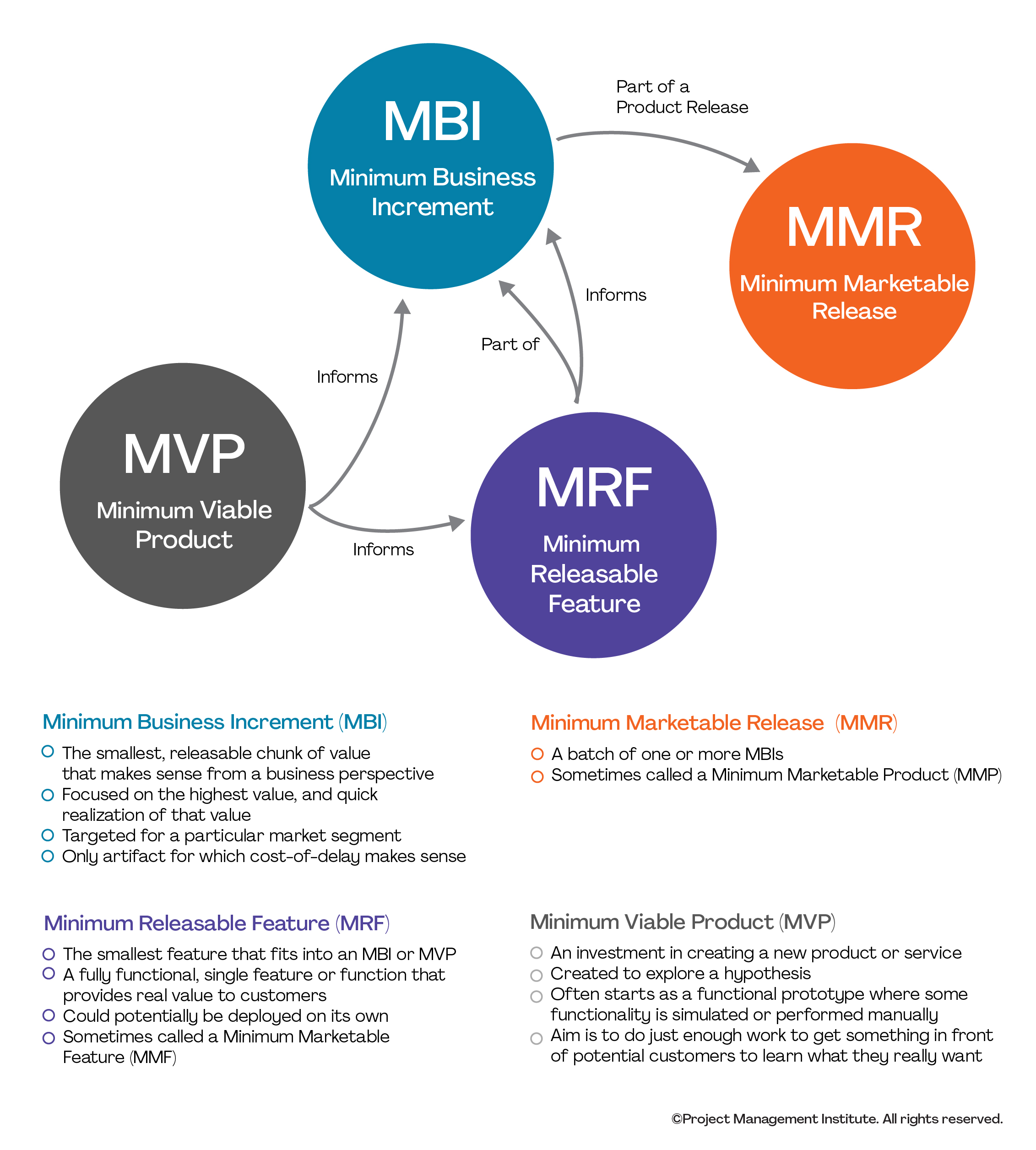
Figure 1 below overviews how the following terms relate to one another:
- Product. I'm using this term loosely to mean a product, a service, a combination of the two, or a new "big feature" of an existing product. I personally prefer the term offering, but product is the popular term.
- Minimum Viable Product (MVP). An MVP is an investment in learning, an experiment where your goal is to explore what a potential customer wants. To run this experiment you'll create a version of a product via the least effort possible so as to be used for validated learning about your potential customers. MVPs are experiments to explore a hypothesis about what your customers really want. They aren't to the “real” running version of your end product because they aren't at the level of quality or scale that you would produce for the end product. Having said that, I have seen MVPs evolve into a real product, or more accurately a real MBI, but more often than not they evolve into something more along the lines of a prototype (which is fine because they're an investment in learning and were never meant to be the real thing). A team typically runs the experiment with a subset of your potential customers to test a new idea, to collect data about it, and thereby discover customers are actually interested in. Note that the term MVP was coined by Frank Robinson at SyncDev in 2001 and popularized by Eric Ries in his book Lean Startup in 2011.
- Minimum business increment (MBI). An MBI is the smallest piece of value that can be realized by a customer (internal or external) that is consistent with the strategy of your organization. An MBI adds value for your customers and leads to valuable feedback to the product team that the right functionality is being built and is being built in the right way. An MBI is a solution that contains all of the pieces that are required for value realization by customers. An MBI, when it is done right, is both an MMF and an MMR. Note that the term MBI was coined by Al Shalloway.
- Minimum Marketable Feature (MMF). An MMF is the smallest piece of functionality that can be delivered that has value to its customers, and thereby value to your organization. An MMF is a part of an MMR. The term MMF was first proposed by Denne and Cleland-Huang.
- Minimum Marketable Release (MMR). Successful products are deployed incrementally into the marketplace over time, each “major” deployment being referred to as a release. An MMR is the release of a product that has the smallest possible feature set that addresses the current new needs of your customers. MMRs are used to reduce the time-to-market between releases by reducing the coherent feature set of each release to the smallest increment that offers new value to customers. An MMR is one or more MBIs (ideally it is one).
Figure 1. The relationship between MVP, MBI, MMR, and MMF.
2. Answering Common Questions
We often get asked several common questions around this topic:
- What are the key take-away points?
- Is it minimum or minimal?
- Why differentiate between MBI and MMR?
- Don't we just need the concepts of MVP and MBI?
What are the Key Take-Away Points?
The key take-away points of this article are:
- An MVP is an investment in learning.
- An MBI is an investment in value.
- Don't worry so much about the other terms
Is it Minimum or Minimal?
Given that I’m being picky about terminology, I realized that there isn’t agreement as to whether we should use the term MINIMUM viable product or MINIMAL viable product (and similarly for MBI, MMR, and MMF). Once again, the words are very close:
- Minimum. The refers to the least quantity or lowest possible amount.
- Minimal. This refers to barely adequate or sufficient (similar to the agile concept of just barely good enough (JBGE)). Minimal is an adjective derived from the word minimum.
As you can see, very nuanced. For better or worse, the industry has settled on the term minimum so that's what we're sticking with.
Why Differentiate Between MBI and MMR?
We wish we didn't have to. Ideally an MMR is a single MBI - your team wants to do just enough work to develop the minimum functionality that provides your customers with value and release it as quickly as you can. That's an MBI. Practically though you're sometimes forced to release more than a single MBI in a release. Perhaps you've decided to have a regular quarterly release cadence. Perhaps your customers prefer large releases (this still occurs in practice, although is becoming less common as your customers become more savvy with regards to incremental releases). These challenges can all be addressed in time, and they should be, but you may not be there yet.
Don't We Just Need The Concepts of MVP and MBI?
That's correct. When you've streamlined your way of working (WoW) you should be at the point where an MBI is an MMF that you release to your customers, so it is also an MMR. The concepts of MMF and MMR are stepping stones towards what you are really aiming for, MBIs. But you might not be there yet, and you may be working with people who are more familiar with older terminology such as MMF and MMR - as a result we recognize in DA that these older terms exist but we avoid them where we can.
3. An Example
Now let’s work through an example of the development of a fictional product using the concept of MVPs and MBIs. One day while shopping in the local mall my phone ran out of power. This proved to be a problem for me because I had a conference call that I had to be on, forcing me to cut my shopping trip short to go home and take the call there. This experience made me realize that there’s a potentially untapped market need as I would have been very willing to pay to charge my phone while at the mall. Note: I am fully aware that products such as Safecharge and Brightbox exist, but let’s pretend they don’t for the sake of this example.
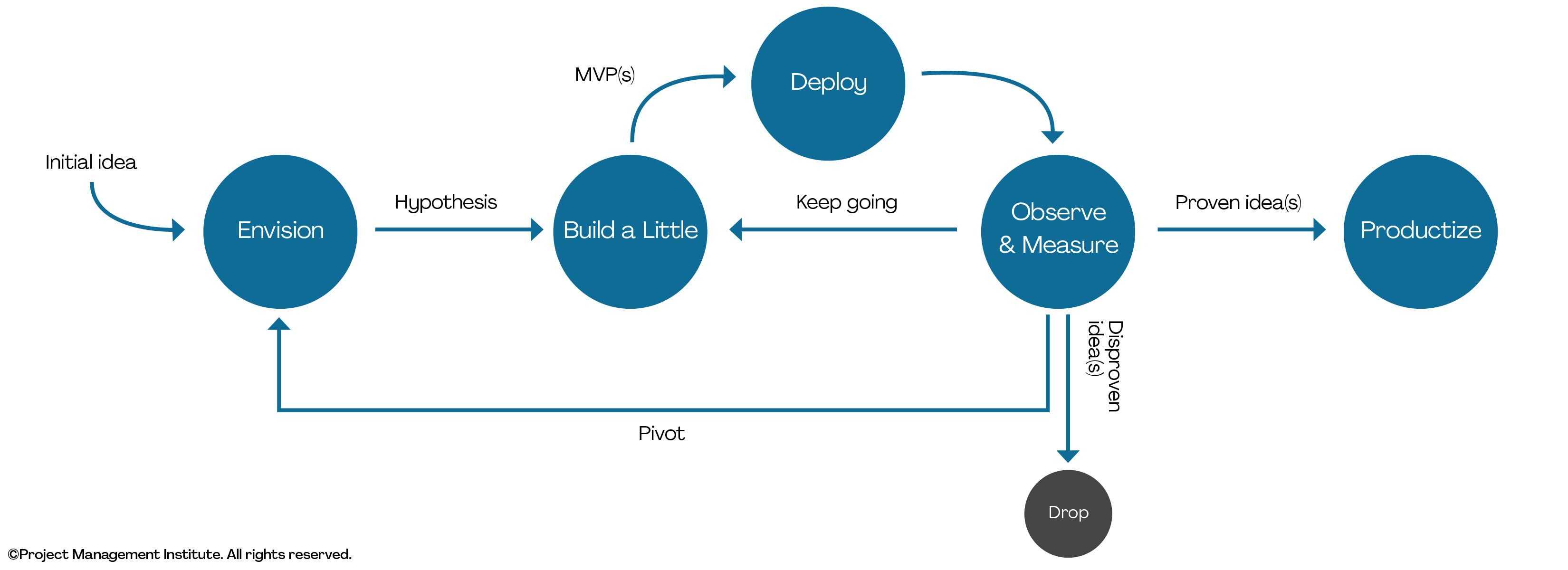
Just because I’m willing to pay for this doesn’t mean that others will. To determine whether this could be a profitable endeavour I decide to follow Disciplined Agile’s Exploratory Lifecycle (see Figure 2), which is based on Lean Startup’s hypothesis-driven approach. My plan is to iteratively run a series of experiments to explore this product idea.
Figure 2. The Exploratory Lifecycle.
Over a several week period I work through a series of minimum viable products (MVPs):
- Experiment #1: A power bar on a table. I start with a very simple approach: I talk the mall manager into allowing me to put a table against a wall for a one week period to run an experiment. I plug a power bar into a nearby outlet and put it on the table. On the wall I have a sign that indicates this is a phone charging station. Throughout the week I stand by the table telling people about the service and tell them I’ll keep an eye on their phone if they want to go shopping while it charges (I quickly discovered that nobody is willing to actually do that, or at least they’re not willing to trust me, hmmm….). For anyone willing, I have them take a short survey asking them what they think about the service.
- Experiment #2: I add several common power cords. On the first day several people indicated that they would use the service but unfortunately didn’t have their charging cable with them. So at the end of the first day I bought several power cables from an electronics store in the mall. Sure enough, over the next few days I had more people willing to charge their phones at my table. By the end of the week I had gathered a fair bit of data that showed there was general interest in the idea but that a major problem was the inability to safely leave a device to charge while they go off to shop.
- Experiment #3: I move to a cafe. The following week I run a similar experiment in a cafe a few blocks away from where I live. Interestingly, I have several people ask to borrow a power cable from me so that they could power their phone while sitting at their own table. The cafe already has power sockets for people to charge devices and it’s fairly common for people to camp out in the cafe for several hours with a laptop or table plugged into the wall. After several days it becomes clear to me that a cafe isn’t a good option for a charging station.
- MVP #4: I add lockable cubby holes. Over the next week I decide to build out a more sophisticated solution, a wood cabinet that has 16 cubby holes for charging devices. Each cubbyhole has a specific type of charge cable, so if you want to change a phone you need to use a cubby with the right type of cable. Each cubby has a door with a physical key lock. I go back to the mall, in the same location as I’d been in previously, and instead of a survey I interview people to discover what they they think, how they would make it better, and what they’d be willing to pay for such a service.
This series of experiments led me to identify a collection of features that this product should offer:
- Lockable cubby holes. People will only leave their phones and other devices if they’re safe. Each cubby hole needs to be locked in such a way that only the person who left their phone in the cubby can get access to it. This could be an electronic locks where people can type in a private code or a physical key-based system.
- Common phone power cords. We need to be able to support charging a range of devices. Each cubby should have several common power cord/cables as well as a normal power plug.
- Easily accessible location that doesn’t offer charging alternatives. Malls and restaurants are good options, but public areas that already support device charging (like cafes) are not.
- Payment processing. We want to support credit card and possibly blue-tooth payment strategies such as Apple Pay. Payment options need to be investigated still.
Over the next two months we built a minimum business increment (MBI). The MBI was a large box which had 16 cubby holes for small devices such as phones. We the each box from folded sheet metal with clear, thick plastic doors so that people can see their devices. For security and payment processing we built a device that used a small touch screen (it was a tablet) as an input device attached to a card swipe for capturing both credit and debit card payments. Over several weeks we built five of them, placing three boxes in the mall where we had run our initial experiments and two boxes in another smaller mall on the other side of the city.
Then we continued to evolve the product via a series of MVPs. We ran some experiments in a public library where we discovered that library patrons wanted to charge large devices such as tablets and laptops as well as smaller devices. So we developed a new MBI, a “Library Charging Station” that had eight small device cubbies and six large device cubbies. We also hired a designer to develop a sleeker looking box when one mall management chain told us that they loved the concept but wouldn’t allow our boxes into their more upscale locations until they were more attractive.
4. Summary
I'll say it again (a paraphrasing of Al Shalloway's advice):
- An MVP is an investment in learning.
- An MBI is an investment in value.
Here's the key difference between the two: With an MVP you are in entrepreneurial mode and need to discover what your customers actually want. MBIs are for when you have an existing product and have a good idea for how to extend it.
My hope is that this article has helped to clear up some of this confusion.
5. Related Resources
|
Posted
by
Scott Ambler
on: December 27, 2017 08:13 AM
|
Permalink |
Comments (8)
Posted
by
Scott Ambler
on: September 23, 2016 08:32 AM
|
Permalink |
Comments (4)
|

This brief article explains our thinking around our terminology choices in the Disciplined Agile (DA) toolkit. It overviews the terminology principles that we follow, discusses why Scrum terminology isn’t appropriate, and maps common Scrum terms to DA terms.
Our Principles Around Terminology
The following three principles drive our terminology decisions:
- Terms must be clear. If you need to explain the term, it likely isn’t the best. For example, how many times have you had to explain what a Scrum meeting is? Call it a coordination meeting instead, and people have a much better idea of what’s going on.
- Terms must be method neutral. Every team is unique and owns its own process. Part of owning your process is choosing the overall method, or lifecycle, that you’re following. Because the DA toolkit is a hybrid that leverages a variety of methods, were we to adopt one method’s terminology over another it would only make sense for people following that lifecycle. For example, Scrum terminology makes sense if you’re following the Scrum-based Agile/Basic lifecycle but not the Lean Continuous Delivery lifecycle.
- Terms should already be in use elsewhere. We are not in the business of creating new terms when existing ones are perfectly fine.
The Problem with Scrum Terminology
Many people ask us why we don’t simply use Scrum terminology. We originally wanted to, because that would be the easy thing to do, but we quickly realized that Scrum terminology just doesn’t get the job done for three reasons:
- It doesn’t apply in all situations. For example, the term “sprint retrospective” doesn’t really make sense when you’re following a lean lifecycle that doesn’t have the concept of sprints/iterations. Furthermore, it breaks principle #3 above in that the Scrum folks tacked “sprint “onto the front of the existing term “retrospective” to brand it with Scrum marketing.
- It was motivated by marketing reasons. The Scrum originators purposely chose unusual terms such as sprint, Scrum Master (later concatenated to ScrumMaster), and Scrum meeting to signal to people that Scrum was different. Well, in DA we’re purposely choosing pragmatic terminology to signal to people that it’s time to up our game as software professionals.
- It reflects 1990s thinking. There’s nothing wrong with that per se, other than the fact that we have learned a lot the following decades that we can apply.
Mapping Scrum to Disciplined Agile Terms
The following table maps common Scrum terms to the terms that we prefer in DA. As you can see, the mapping is very straightforward.
| Scrum Term |
DA Term |
DA Source |
Observations |
| Backlog refinement/grooming |
Look-ahead modeling |
- “Modeling” is common IT terminology.
- “Look-ahead modeling” is an existing Agile Modeling practice
|
- Not all teams have backlogs.
- The term isn’t clear (one reason why it evolved from backlog grooming to backlog refinement a few years ago)
|
| Mapping |
Modeling |
|
- Agilists really need to get over their cultural issues around modeling and documentation
- There is a wealth of material about effective modeling strategies that many agilists are unaware of because they search on terms such as mapping or grooming instead of modeling
|
| Scrum Master |
Team Lead |
|
- Only Scrum teams have Scrum Masters
- The term “Scrum Master” isn’t descriptive of what someone in that role does
- The responsibilities of a Team Lead are a bit more robust than those of a Scrum Master, so this mapping isn’t perfect
|
| Scrum meeting |
Coordination meeting |
|
- Coordination meeting is a much clearer term
|
| Sprint |
Iteration |
- Iteration is used as a term in XP, Agile Modeling, Unified Process and many others
|
- The term sprint is ok, but it doesn’t reflect the agile principle of maintaining a steady pace (you don’t sprint through a long race)
|
| Sprint demo |
Demo |
|
- You can hold a demo at any time, not just at the end of a sprint
|
| Sprint Retrospective |
Retrospective |
- Original term for the technique
|
- You can hold a retrospective at any time, not just at the end of a sprint
|
Parting Thoughts
There is no standard terminology in the agile world, nor will their ever be. Your team, as part of owning your process, will need to decide which terms they prefer to use. We’ve seen many DA teams choose to use Scrum terminology (e.g. sprint instead of iteration) because they originally started with Scrum and that’s what they’re familiar with. That’s their decision and as always our advice is for a team to do what they believe to be right for the situation that they find themselves in.
|
Posted
by
Scott Ambler
on: September 05, 2016 07:29 AM
|
Permalink |
Comments (0)
|
This brief article explains our thinking around our terminology choices in the Disciplined Agile (DA) toolkit. It overviews the terminology principles that we follow, discusses why Scrum terminology isn’t appropriate, and maps common Scrum terms to DA terms.
Our Principles Around Terminology
The following three principles drive our terminology decisions:
- Terms must be clear. If you need to explain the term, it likely isn’t the best. For example, how many times have you had to explain what a Scrum meeting is? Call it a coordination meeting instead, and people have a much better idea of what’s going on.
- Terms must be method neutral. Every team is unique and owns its own process. Part of owning your process is choosing the overall method, or lifecycle, that you’re following. Because the DA toolkit is a hybrid that leverages a variety of methods, were we to adopt one method’s terminology over another it would only make sense for people following that lifecycle. For example, Scrum terminology makes sense if you’re following the Scrum-based Agile/Basic lifecycle but not the Lean Continuous Delivery lifecycle.
- Terms should already be in use elsewhere. We are not in the business of creating new terms when existing ones are perfectly fine.
The Problem with Scrum Terminology
Many people ask us why we don’t simply use Scrum terminology. We originally wanted to, because that would be the easy thing to do, but we quickly realized that Scrum terminology just doesn’t get the job done for three reasons:
- It doesn’t apply in all situations. For example, the term “sprint retrospective” doesn’t really make sense when you’re following a lean lifecycle that doesn’t have the concept of sprints/iterations. Furthermore, it breaks principle #3 above in that the Scrum folks tacked “sprint “onto the front of the existing term “retrospective” to brand it with Scrum marketing.
- It was motivated by marketing reasons. The Scrum originators purposely chose unusual terms such as sprint, Scrum Master (later concatenated to ScrumMaster), and Scrum meeting to signal to people that Scrum was different. Well, in DA we’re purposely choosing pragmatic terminology to signal to people that it’s time to up our game as software professionals.
- It reflects 1990s thinking. There’s nothing wrong with that per se, other than the fact that we have learned a lot the following decades that we can apply.
Mapping Scrum to Disciplined Agile Terms
The following table maps common Scrum terms to the terms that we prefer in DA. As you can see, the mapping is very straightforward.
| Scrum Term |
DA Term |
DA Source |
Observations |
| Backlog refinement/grooming |
Look-ahead modeling |
- “Modeling” is common IT terminology.
- “Look-ahead modeling” is an existing Agile Modeling practice
|
- Not all teams have backlogs.
- The term isn’t clear (one reason why it evolved from backlog grooming to backlog refinement a few years ago)
|
| Mapping |
Modeling |
|
- Agilists really need to get over their cultural issues around modeling and documentation
- There is a wealth of material about effective modeling strategies that many agilists are unaware of because they search on terms such as mapping or grooming instead of modeling
|
| Scrum Master |
Team Lead |
|
- Only Scrum teams have Scrum Masters
- The term “Scrum Master” isn’t descriptive of what someone in that role does
- The responsibilities of a Team Lead are a bit more robust than those of a Scrum Master, so this mapping isn’t perfect
|
| Scrum meeting |
Coordination meeting |
|
- Coordination meeting is a much clearer term
|
| Sprint |
Iteration |
- Iteration is used as a term in XP, Agile Modeling, Unified Process and many others
|
- The term sprint is ok, but it doesn’t reflect the agile principle of maintaining a steady pace (you don’t sprint through a long race)
|
| Sprint demo |
Demo |
|
- You can hold a demo at any time, not just at the end of a sprint
|
| Sprint Retrospective |
Retrospective |
- Original term for the technique
|
- You can hold a retrospective at any time, not just at the end of a sprint
|
Parting Thoughts
There is no standard terminology in the agile world, nor will their ever be. Your team, as part of owning your process, will need to decide which terms they prefer to use. We’ve seen many DA teams choose to use Scrum terminology (e.g. sprint instead of iteration) because they originally started with Scrum and that’s what they’re familiar with. That’s their decision and as always our advice is for a team to do what they believe to be right for the situation that they find themselves in.
|
Posted
by
Scott Ambler
on: September 05, 2016 07:29 AM
|
Permalink |
Comments (0)
|
"Either he's dead or my watch has stopped."
- Groucho Marx
|





