Vendor Management in the Disciplined Agile Enterprise


| The overarching goal of the Disciplined Agile (DA) is to guide organizations on their path to business agility, sometimes called organizational agility. When organizations increase their overall agility, they are able to rapidly adapt to market and environmental changes in productive and cost-effective ways. This enables organizations to deliver more value in a shorter amount of time, predictably, sustainably, and with high quality. Looking at the Disciplined Agile (DA) tool kit in figure 1, we get an idea of the organizational areas that are involved in pursuing business agility. Figure 1: The Disciplined Agile (DA) tool kit
The DA tool kit shows us that it is not enough to focus on delivery-level agility represented by the Disciplined DevOps layer. To achieve business agility, the organization must pursue agile and lean ways of working at the Disciplined Agile Enterprise layer; like legal, finance, and vendor management. In this post, we focus on the role of vendor management and how it can contribute to the overall agility in the DA enterprise. The mindset of vendor management: partnerships are keyVendor management is a process blade in the DA tool kit. In other words, it represents a functional area inside the organization that serves a specific purpose. The purpose of vendor management is to help obtain products and services from other organizations. To do that successfully in a disciplined agile way, vendor management follows a set of philosophies that extend the DA mindset: Figure 2: A Disciplined Agile mindset for vendor management
1. Value through partnerships. We increase value through partnerships with other organizations. 2. Collaborative partnerships. We seek to build collaborative partnerships with other organizations, even when those organizations are our competitors or competitors to each other. 3. Mutually beneficial partnerships. We seek to build, maintain, and evolve mutually beneficial relationships with our suppliers and partners. 4. We co-create with our partners. We co-create throughout the entire vendor management life cycle, including procurement. This means that we may even have both our own experts and vendor experts actively involved in the procurement process. 5. We are trusted advisors. We are a trusted advisor inside the organization to present and guide both supplier and partnering options. 6. Organizational outcomes come first. We pursue organizational outcomes over local process conveniences, working in an enterprise aware manner. 7. We protect our organization. We have a fiduciary responsibility to protect the organization. 8. We address risk holistically. We address risk in an appropriate, proactive, and holistic manner. The flow of Vendor management: context countsOne of the DA principles is that "context counts". This principle is also applicable to the area of vendor management. Table 1 lists three different types of procurement situations. Table 1: Different procurement situations
Each of the situations requires a different flow or approach to successfully find the right partners that can deliver the good or service to the organization. The practices of vendor management: choice is goodAnother DA principle states that “choice is good”. In vendor management, we see this manifested in its goal diagram. Click here to see a larger version of the goal diagram. Figure 3: Vendor management goal diagram
The diagram covers the key decision points of vendor management: from how to manage intake requests, and how to select a procurement strategy, to ways of governing partnerships. Most of the decision points’ options are non-ordered, meaning they are equally preferrable. It is worth noting the two areas that have ordered options: select procurement strategy, and capture working agreements. The ordered options are called out with an upwards arrow, meaning the choices at the top are more desirable than the choices at the bottom from an agility standpoint. With the goal diagram, you have access to a suite of options, choices and strategies that are presented in architected way for easy access and navigation. The suite of options, choices and strategies allows you first of all to find your baseline today: what is our existing way of working (WoW) in procurement? Secondly, the suite of options, choices and strategies allows you to find areas where you can improve and tailor your way of procuring to better match the given context. Let’s look at an example. One of the vendor management decision points is to select potential partners. Figure 4: Decision point for "select potential partners"
The decision point offers a suite of options, ranging from short-listing potential partners, comparing submitted proposals, and holding a big-room event for multiple vendors. In our example, you are part of the company’s procurement team. Up until this point, your team has solely been relying on the option of “compare submitted proposals” to select vendors regardless of what you are procuring. That is your baseline way of working (WoW). If your team procures goods or services that less straightforward than, say printer paper and toner, you have likely come across some challenges in finding the right vendor. Taking advantage of the information in the vendor management goal diagram, you can now pick a more tailored WoW depending on your procurement context. For example, procuring a commodity (new paper and toner for the office printers), a straightforward comparison of submitted proposals will likely be sufficient. In fact, you may even go so far as to automate the buying decision completely, such as with printers placing an order for toner when it runs low. But faced with a more complicated context, such as procuring a new fleet of delivery trucks, you have the option to employ additional strategies to increase your chances of success. These strategies could be: shortlisting potential partners, interviewing potential partners, and then comparing submitted proposals. You may even hold a vendor bake off where the shortlisted vendors demonstrate their vehicles. In summary, context counts. The DA tool kit guides you in tailoring your WoW for vendor management to better match your context increasing your chances of success. |


Update: Scaling Factors of Tactical Agility
|
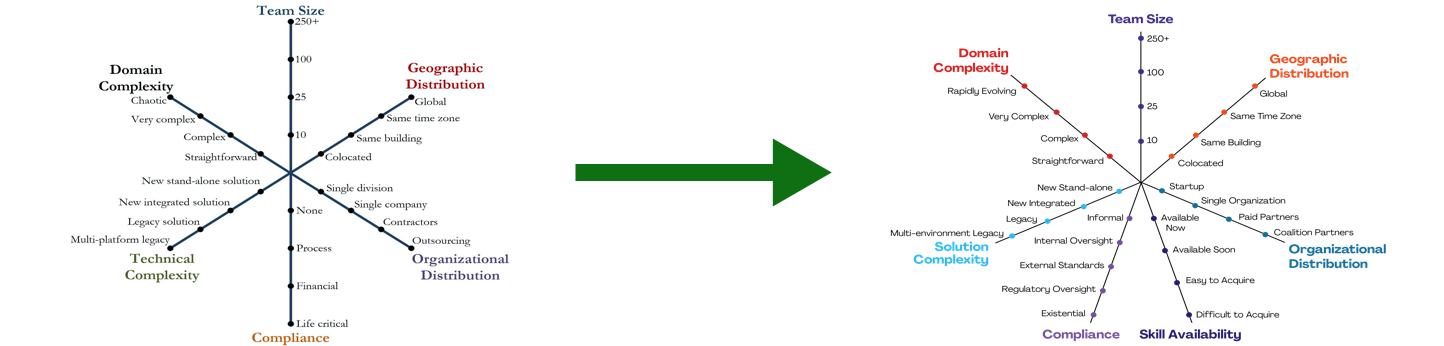
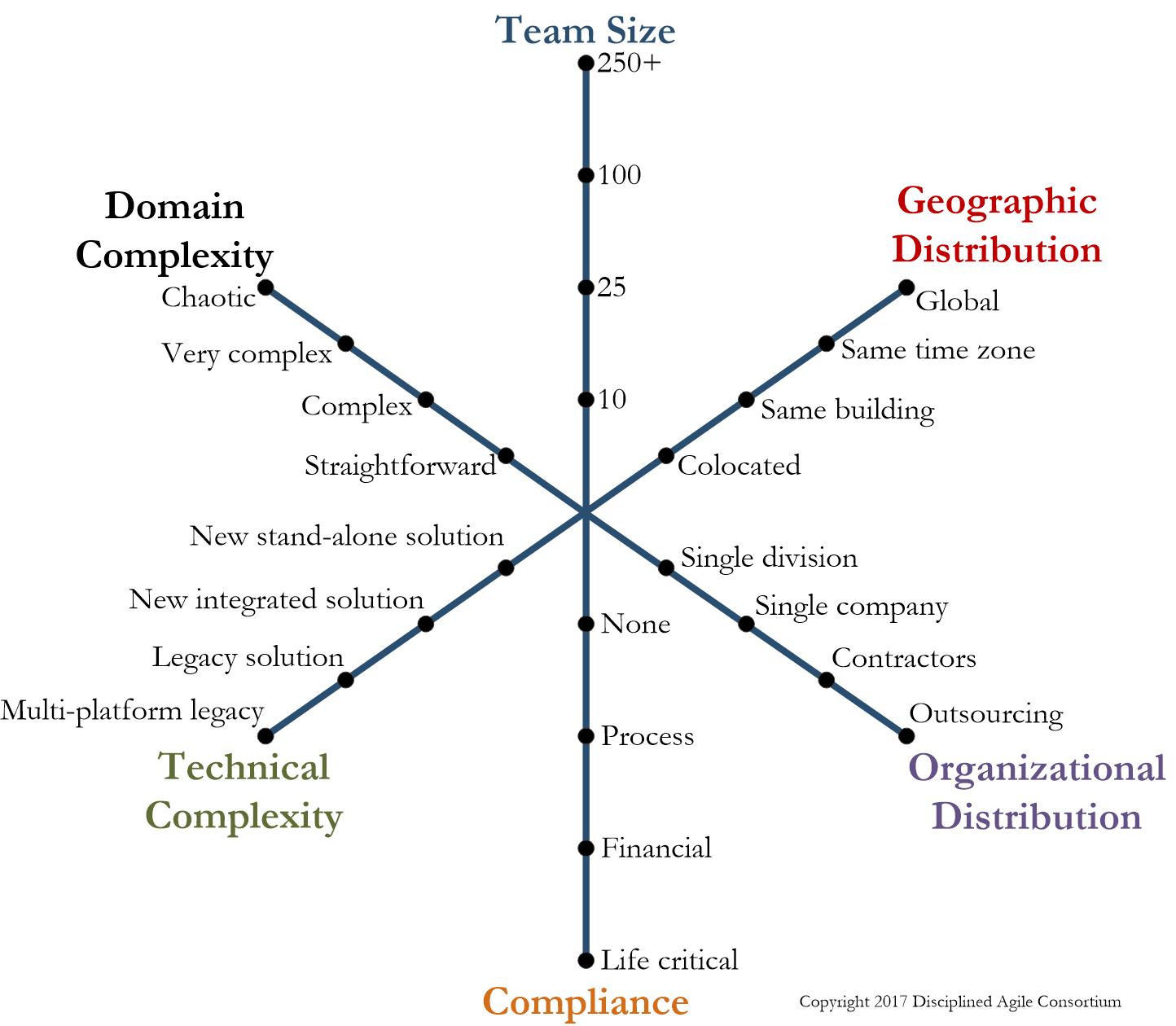
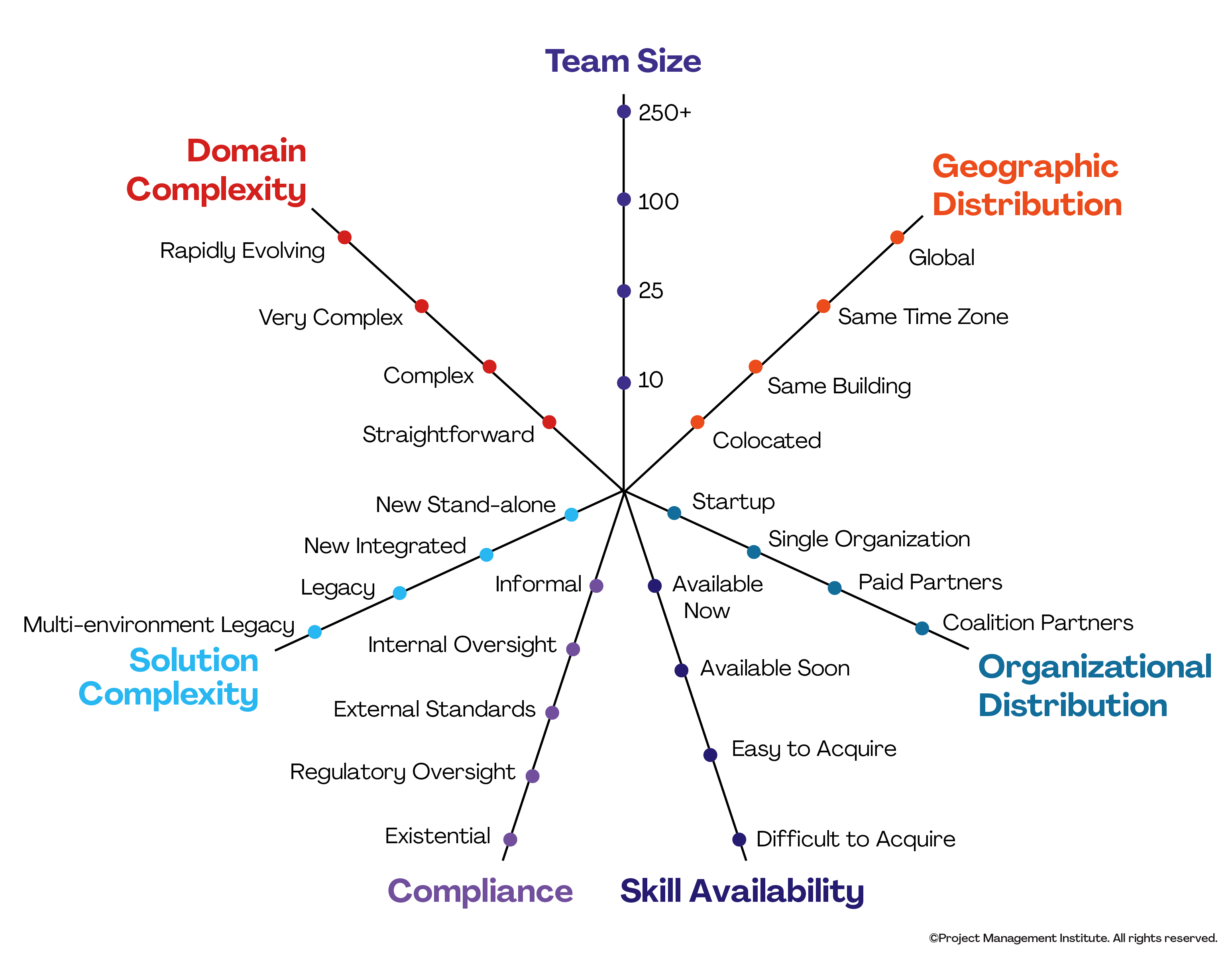
We've have recently updated our thinking around the tactical scaling factors that we apply in DA to help understand the context faced by a team or organization. Figure 1 depicts the original scaling factors and Figure 2 the new scaling factors. Below we discuss what changed and how this can affect anyone taking a Disciplined Agile (DA) certification exam.
Figure 1. The (original) scaling factors of the SDCF.
Figure 2. The scaling factors of the SCF.
What's Changed?The changes we made were motivated by our experiences applying the scaling factors outside of IT teams. Originally these scaling factors were described by the Software Development Context Framework (SDCF) which we evolved into the Situation Context Framework (SCF) in late 2020. Here is what has changed:
Implications for DA Certification ExamsAs you can see in Scaling Factors we have made it clear that the exam will test you for knowledge about the original version for now (in Figure 1) and that when we update the courseware and exam to reflect this update we will let you know. In general our intent is that whenever material on the web gets ahead of what is being tested for that we'll make it clear that this has happened. More on this in a future blog posting.
Further Reading
|
There is more to Agile Transformations than Implementing Scrum
Categories:
Metrics,
agile,
Adoption,
Enterprise Awareness,
Context,
Scaling,
Scrum,
Kanban,
lean,
Governance
Categories: Metrics, agile, Adoption, Enterprise Awareness, Context, Scaling, Scrum, Kanban, lean, Governance
|
For enterprise agile adoptions starting a few agile teams is the easy part and is just the beginning of your agile transformation. Proving the benefits and sustaining the change is significantly more challenging. For illustration purposes, let’s assume that over a six month period we have conducted a series of Disciplined Agile workshops and kickstarted twelve teams. The teams have separate product owners with their own work item lists. Some of the teams use the DAD basic Scrum-based lifecycle while others use the DAD Lean lifecycle. The Scrum teams adapt their lifecycle for their context with the simpler projects having a one week Inception phase while the more complex projects use a two week Inception. For the Construction phase novice Scrum teams use two week iterations while the more advanced teams chose one week iterations. The teams vary in size from four to twelve team members. By rolling out the teams in an incremental fashion, with some coaching the teams have learned the key DAD practices for being effective on both the Scrum and Lean teams. Word is spreading that the teams are impressing stakeholders with regular demonstrations of new functionality. However, after the honeymoon period is over, people start to ask some interesting questions such as:
These are all fair questions. For your agile adoption to be effective and sustainable you need a strategy to address all of these issues. The Disciplined Agile Manifesto adds a principle to the Agile Manifesto regarding the need to adapt your organizational ecosystem to be effective for enterprise agile adoptions: The organizational ecosystem must evolve to reflect and enhance the efforts of agile teams, yet be sufficiently flexible to still support non-agile or hybrid teamsThe need for good governance doesn’t go away with agile. Your stakeholders deserve the right to gauge the health of their investments in your agile initiatives just like any other project. There are indeed answers and various strategies for all of the above questions which will vary depending on the context of your situation. Like it or not, the reality is that effective and sustainable agile transformations can take several years in order to achieve the level of capability and maturity that you expect. A transformation is a journey, not a destination. Make sure that your agile coaches have answers to the questions above and know what to do after your Scrum honeymoon period is over. We will outline some DAD strategies for the questions above in future posts. For a more detailed discussion of how DAD extends Scrum, please read the whitepaper Going Beyond Scrum. |
 With some basic agile training and help from an agile coach it can be relatively straightforward to enable several teams to be able to produce increments of consumable software every two weeks. Unfortunately many organizations stop there, believing that they are “now agile”.
Does your team own its process or merely rent it?
Categories:
agile,
Adoption,
Context,
Scrum,
Philosophies,
Kanban,
lean,
culture,
process improvement,
goal-driven
Categories: agile, Adoption, Context, Scrum, Philosophies, Kanban, lean, culture, process improvement, goal-driven
|
An important philosophy within both the agile and lean communities is that a team should own its process. In fact, one of the principles behind the Agile Manifesto is “At regular intervals, the team reflects on how to become more effective, then tunes and adjusts its behavior accordingly.” The idea is that teams should be empowered to choose their way of working (WoW), to "own their process," including both their team structure and the process that they follow, to meet the unique needs of the situation that they find themselves in. Teams that own their process will tailor it over time as they learn how to work together, adopting new techniques and tweaking existing ones to increase their effectiveness. As with most philosophies this one is easy to proselytize but not so easy to actually adopt. When it comes to process improvement, teams will exhibit a range of behavior in practice. Some teams see process as a problem and actively seek to ignore process-related issues. Some teams are ambivalent towards process improvement and generally stick with what they’ve been told to do. And some teams see process improvement as an opportunity to become more effective both as a team and as individuals. This range of behaviors isn’t surprising from a psychology point of view although it can be a bit disappointing from an agile or lean point of view. It has led me to think that perhaps some teams choose to “own” their process but many more still seem to prefer to simple rent it. The behaviors of people who rent something are generally different than those who own something. Take flats for example. When you rent a flat (called an apartment in North America) you might do a bit of cosmetic work, such as painting and hanging curtains, to make it suitable for your needs. But people rarely put much more effort than that into tailoring their rental flat because they don’t want to invest money in something that isn’t theirs, even though they may live in the flat for several years. It isn’t perfect but it’s good enough. When you own a flat (called a condo in North America) you are much more likely to tailor it to meet your needs. Painting and window dressings are a good start, but you may also choose to renovate the kitchen and bathroom, update the flooring, and even reconfigure the layout by knocking down or moving some walls. One of the reasons why you choose to own a flat is so that you can modify it to meet your specific needs and taste. You can observe similar behaviors when it comes to software process. Teams that are merely “process renters” will invest a bit of time to adopt a process, perhaps taking a two-day course where they’re taught a few basic concepts. They may make a few initial tailorings of the process, adopt some new role names, and even rework their workspace to better fit the situation that they face. From then on they do little to change the way that they work together. They rarely hold process improvement sessions such as retrospectives, and if they do they typically adopt changes that require minimal effort. Harder improvements, particularly those requiring new skills that require time and effort to learn, are put off to some point in the distant future which never seems to come. Such behavior may be a sign that this “team” is not even be a team at all, but instead a group of individuals who are marginally working together on the same solution. They adopt the trappings of the method, perhaps they spout new terminology and hold the right meetings, but few meaningful changes are actually made. Process owners behave much differently. Teams that own their process will regularly reflect on how well they’re working and actively seek to get better. They experiment with new techniques and some teams will even measure how successful they are implementing the change. Teams that are process owners will often get coaching to help them improve, both at the individual and at the team level. Process owners strive to understand their process options, even the ones that are not perfectly agile or lean, and choose the ones that are best for the situation they find themselves in. The Disciplined Agile (DA) tool kit is geared for teams that want to own their process. The DA tool kit is process goal-driven, not prescriptive, making your process choices explicit and more importantly providing guidance for selecting the options that make the most sense for your team. This guidance helps your team to get going in the right direction and provides options when you realize that you need to improve. DA also supports multiple life cycles because we realize that teams find themselves in a range of situations – sometimes a Scrum-based life cycle makes sense, sometimes a lean life cycle is a better fit, sometimes a continuous delivery approach is best, and sometimes you find yourself in a situation where an exploratory (or “Lean Startup”) life cycle is the way to go. You have choices, and DA helps guide you to making the choices that are right for you in your given context. By providing process guidance DAD enables your team to more easily own its own process and thereby increase the benefit of following agile or lean approaches. |

Exploring Scope on Disciplined Agile Teams
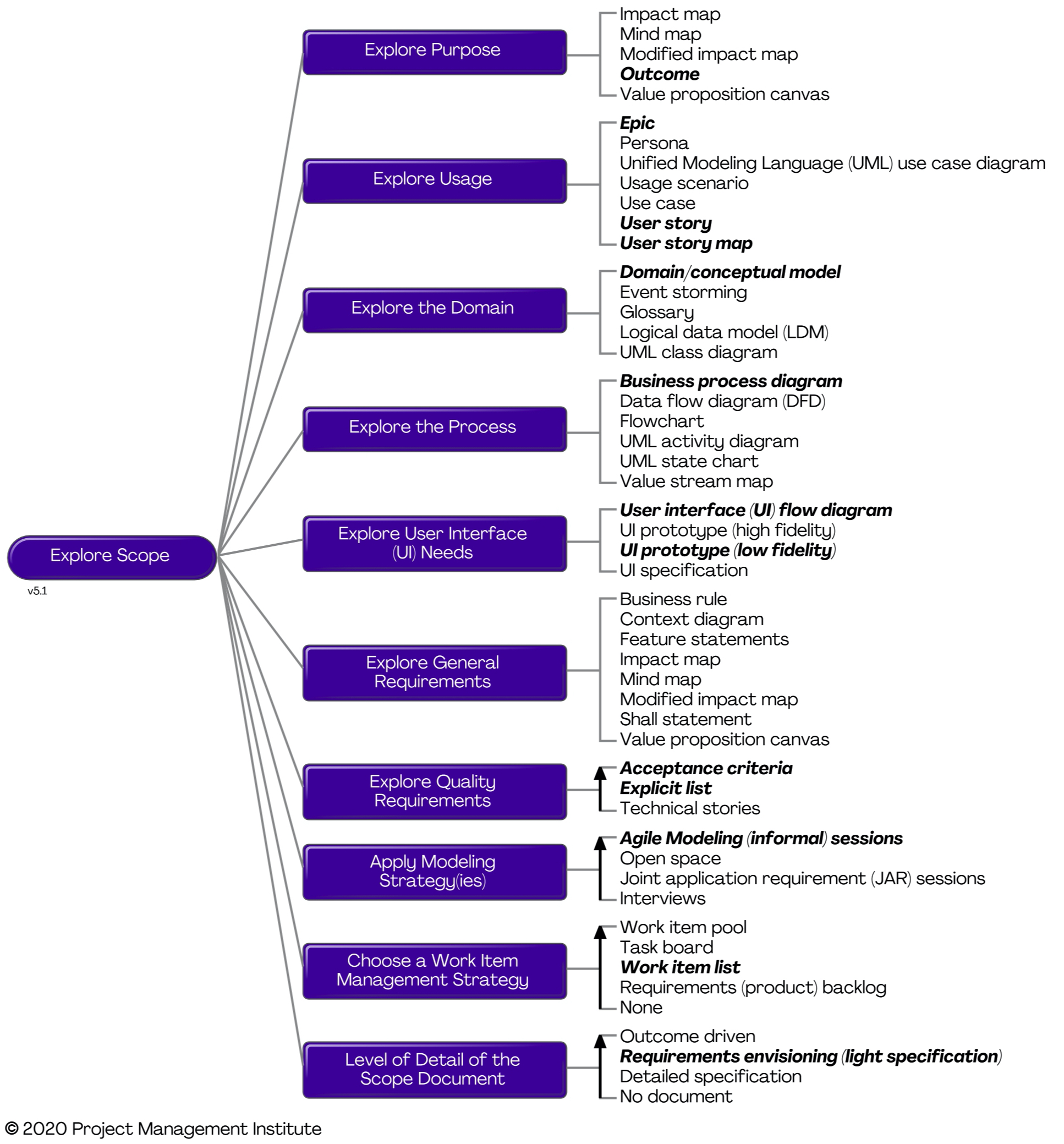
| When a disciplined agile project or product team starts one of the process goals which they will likely need to address is Explore Initial Scope. This is sometimes referred to as initially populating the backlog in the Scrum community, but as you’ll soon see there is far more to it than just doing that. This is an important goal for several reasons. First, your team needs to have at least a high level understanding of what they’re trying to achieve, they just don’t start coding. Second, in the vast majority of organizations IT delivery teams are asked fundamental questions such as what are you trying to achieve, how long will it take, and how much will it cost. Having an understanding of the scope of your effort is important input into answering those sorts of questions. The process goal diagram for Explore Scope is shown below. The rounded rectangle indicates the goal, the squared rectangles indicate issues or process factors that you may need to consider, and the lists in the right hand column represent potential strategies or practices that you may choose to adopt to address those issues. The lists with an arrow to the left are ordered, indicating that in general the options at the top of the list are more preferable from an agile point of view than the options towards the bottom. The highlighted options (bolded and italicized) indicate default starting points for teams looking for a good place to start but who don’t want to invest a lot of time in process tailoring right now. Each of these practices/strategies has advantages and disadvantages, and none are perfect in all situations, which is why it is important to understand the options you have available to you.
Let’s consider each process intent/decision point:
I wanted to share two important observations about this goal. First, this goal, along with Identify Architecture Strategy, Coordinate Activities, and Accelerate Value Delivery seem to take the brunt of your process tailoring efforts when working at scale. It really does seem to be one of those Pareto situations where 20% addresses 80% of the work, more on this in a future blog posting. As you saw in the discussion of the process issues, the process tailoring decisions that you make regarding this goal will vary greatly based on the various scaling factors. Second, as with all process goal diagrams, the one above doesn’t provide an exhaustive list of options although it does provide a pretty good start. I’m a firm believer that a team should choose their own way of working, including their team structure, their work environment, and their process, to reflect the situation that they find themselves in. When it comes to process tailoring, process goal diagrams not only help teams to identify the issues they need to consider they also summarize potential options available to them. Agile teams with a minimal bit of process guidance such as this are in a much better situation to tailor their approach that teams that are trying to figure it out on their own. The DA tool kit provides this guidance.
Related Reading |