Disciplined Agile
by Tatsiana Balshakova,
Mark Lines, Mike Griffiths, Scott Ambler, Bjorn Gustafsson, Curtis Hibbs, James Trott

This blog contains details about various aspects of PMI's Disciplined Agile (DA) tool kit, including new and upcoming topics.
View Posts By:
Tatsiana Balshakova
Mark Lines
Mike Griffiths
Scott Ambler
Bjorn Gustafsson
Curtis Hibbs
James Trott
Past Contributors:
Joshua Barnes
Michael Richardson
Daniel Gagnon
Valentin Tudor Mocanu
Kashmir Birk
Glen Little
Klaus Boedker
Recent Posts
DA 5.6 is released
Disciplined Agile 5.5 Released
Choose Your WoW! Second Edition Is Now Available
Requisite Agility applied in Project Management
Disciplined Agile and PMBoK Guide 7th Edition
Categories
#ChoiceIsGood,
#ChooseYourWoW,
#ConsumableSolution,
#ContinuousImprovement,
#CoreAgilePractices,
#experiment,
#Experimentation,
#GuidedContinuousImprovement,
#Kaizen,
#LifeCycles,
#ProcessImprovement,
#TealOrganizations,
Adoption,
agile,
agile adoption,
Agile Alliance,
Agile Business Analyst,
Agile certification,
agile data,
agile governance,
agile lifecycle,
agile metrics,
agile principles,
agile transformation,
Agile2018,
Agile2019,
Agile20Reflect,
AgileData,
Analogy,
announcement,
Architecture,
architecture,
architecture owner,
Articles and publications,
Asset Management,
Atari,
Backlog,
Barclays,
being agile,
benefits,
bi,
blades,
book,
Branching strategies,
Browser,
Business Agility,
business intelligence,
business operations,
capex,
Case Study,
Certification,
certification,
charity,
Choose your WoW,
CMMI,
cmmi,
Coaching,
Collaboration,
Communications Management,
Compliance,
Compliancy,
Conference,
Construction,
Construction phase,
Context,
Continuous Improvement,
coordination,
COVID-19,
Culture,
culture,
Cutter,
DA,
DAD,
DAD Book,
DAD discussions,
DAD press,
DAD roles,
DAD supporters,
DAD webcast,
DADay2019,
Data Management,
database,
dependencies,
Deployment,
Development Strategies,
DevOps,
disaster,
Discipline,
discipline,
Disciplined Agile,
disciplined agile delivery,
disciplined agile delivery blog,
Disciplined Agile Enterprise,
disciplined devops,
Documentation,
Domain complexity,
dw,
DW/BI,
Energy Healing,
Enterprise Agile,
Enterprise Architecture,
Enterprise Awareness,
enterprise awareness,
Essence,
estimation,
Evolving DA,
Executive,
Experiment,
facilitation,
FailureBow,
feedback-cycle,
finance,
Financial,
FLEX,
Flow,
foundation layer,
Funding,
GCI,
GDD,
Geographic Distribution,
gladwell,
global development,
Goal-Driven,
goal-driven,
goals,
Governance,
GQM,
Guideline,
Hybrid,
Improvement,
inception,
Inception phase,
India,
information technology,
infosec,
Introduction,
iterations,
Kanban,
large teams,
layer,
lean,
Lean Startup,
learning,
Legal Project Management,
LeSS,
Lifecycle,
lifecycle,
Manifesto,
mark lines,
marketing,
MBI,
Metaphor,
Metrics,
metrics,
mindset,
Miscellaneous,
MVP,
News,
News and events,
Non-Functional Requirements,
non-functional requirements,
Non-solo development,
offshoring,
Operations,
opex,
Organization,
Outsourcing,
outsourcing,
paired programming,
pairing,
paper,
People,
People Management,
phases,
Philosophies,
Planning,
PMBoK,
PMI,
PMI and DA,
PMI Chapter,
Portfolio Management,
post-format-quote,
Practices,
practices,
Principle,
Process,
process improvement,
process tailoring,
Product Management,
product owner,
Product Owners,
productivity,
Program Management,
Project Management,
project-initiation,
Promise,
Quality,
quality,
rational unified process,
Refactoring,
Reiki,
Release Management,
release management,
Remote Training,
Remote Work,
repeatability,
requirements,
Requirements Management,
research&development,
responsibilities,
retrospectives,
Reuse,
Reuse Engineering,
ride for heart,
rights,
Risk Management,
Risk Management,
Risk management,
Roles,
RUP,
SAFe,
sales,
Scaling,
scaling,
scaling agile,
Scheduled Workshops,
SCM,
scorecard,
Scrum,
ScrumMaster,
SDLC,
Security,
security,
self-organization,
SEMAT,
serial,
skill,
solutions software consumable shippable,
Stakeholder Management,
strategy,
Support,
Surveys,
Teal organizations,
team development,
Team Lead,
team lead,
Teams,
Technical Debt,
Teleconferencing,
Terminology,
terraforming,
test strategy,
testing,
time tracking,
Tool kit,
Toolkit,
tools,
traditional,
Transformation,
Transition iteration,
transition phase,
Uncategorized,
Upmentors,
Using PMI Standards,
value stream,
velocity,
vendor management,
Virtual Training,
Workflow,
workflow,
workspaces
Date
| A Disciplined Agile Enterprise (DAE) is able to sense and respond swiftly to changes in the marketplace. It does this through an organizational culture and structure that facilitates change within the context of the situation that it faces. Such organizations require a learning mindset in the mainstream business and underlying lean and agile processes to drive innovation.
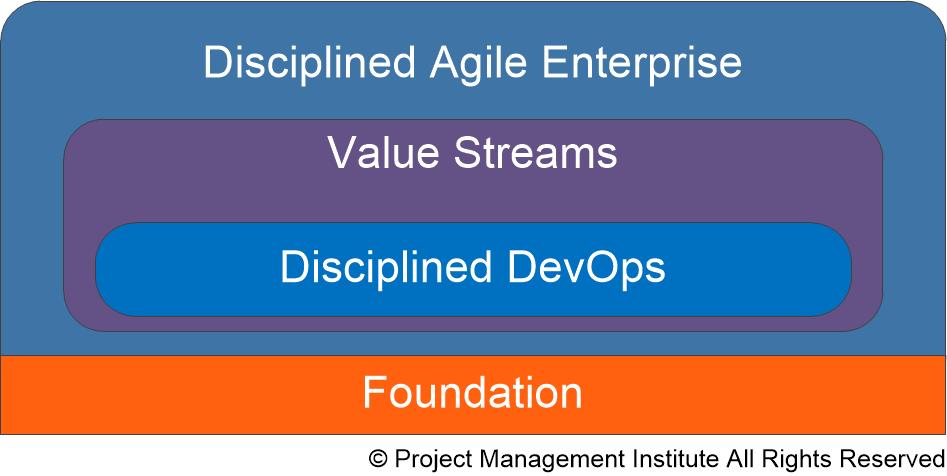
The DAE layer is one of the four layers of the Disciplined Agile (DA) tool kit, overviewed in Figure 1. These layers are: Foundation, Disciplined DevOps, Value Streams, and Disciplined Agile Enterprise (DAE). This blog focuses on the DAE layer.
Figure 1. The layers of the DA tool kit.
The Disciplined Agile Enterprise (DAE) layer encompasses the capabilities required to guide your organization, to coordinate the teams/groups within your organization, and to support the value streams offered by it. Figure 2 summarizes the DA tool kit and Figure 3 overviews the process blades that are specific to the DAE layer. Several process blades of the DAE layer - Research & Development, Business Operations, Strategy, Governance, Marketing, Continuous Improvement, and Sales - are shared with the value streams layer. The are "shared" in that the scope of these process blades may focus on both the entire organization and specifically on individual value streams. For example, a financial institution may execute an organization-wide marketing strategy as well as specific strategies for their retail and corporate value streams.
Figure 2. The Disciplined Agile (DA) tool kit.
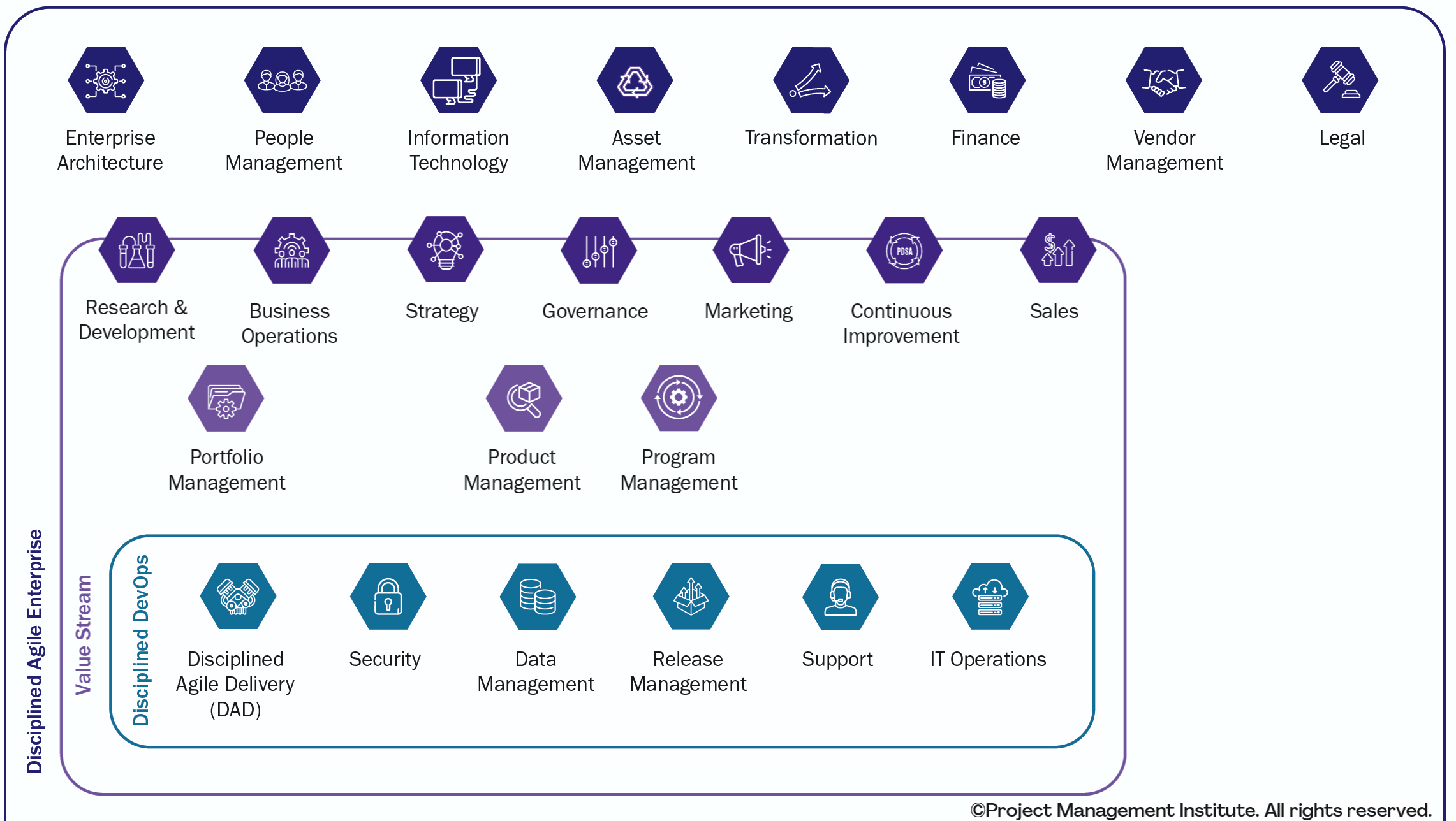
Figure 3. The process blades specific to the DAE layer.
Expanding upon the value streams layer, the DAE layer adds the following blades:
Asset management
The asset management process blade addresses the purposeful creation (or rescue), management, support, and governance of organizational assets. This includes financial, inventory, contractual, risk management, and strategic decisions of these organizational assets.
Enterprise architecture
The enterprise architecture (EA) process blade overviews how a Disciplined Agile EA team will work. An agile enterprise architecture is flexible, easily extended, and easily evolved collection of structures and processes upon which your organization is built. The act of agile enterprise architecture is the collaborative and evolutionary exploration and potential capture of an organization’s architectural ecosystem in a context-sensitive manner. The implications are that enterprise architects must be willing to work in a collaborative and flexible manner and that delivery teams must be willing to work closely with enterprise architects.
Finance
The finance process blade addresses a collection of potentially competing goals, such as ensuring cash flow within your organization, ensuring your money is being spent well, taxes are minimized, spending is properly tracked and recorded, and legal financial reporting is being performed properly. All of this will be performed in a manner that is compliant with applicable financial regulations, such as Financial Accounting Standards Board (FASB) and International Accounting Standards Board (IASB) guidelines.
Information technology
The information technology (IT) process blade encapsulates the activities required to provide IT capabilities to the rest of the organization. This includes managing information technologies, data resources, applications, and IT infrastructure.
Legal
The aim of the Legal process blade is to ensure that your organization works within the parameters of the law of any and all legal territories in which you operate. Your legal team will work closely with your vendor management people on (Agile) contracts; with your people management team to ensure that their strategies reflect the local statutes and to help educate staff in legal concerns; with your marketing team to guide what they’re legally able to promise; with your strategy team to ensure the direction they're taking the organization is legally viable; and with governance to understand the legal implications of applicable regulations.
People management
The aim of the people management process blade is to attract and retain great people who work on awesome teams. People management goes by many names, including human resource (HR) management, human relations (HR) management, talent management, staff management, people operations, and work force management to name a few. This process blade addresses strategies for forming teams; helping people to manage their careers; training, coaching, and educating people; human resource planning within your organization; managing movement of people within your organization; reward structures; and governing people management efforts.
Transformation
The transformation process blade captures advice for how to redefine, and then reengineer, your organization. This includes understand the current context, identifying the desired future, identifying how to measure the success of the transformation, identifying a likely strategy for moving towards the desired state, and then executing on that strategy. Throughout a transformation you will constantly gauge your progress and the desired target state and adjust according. This process blade leverages the advice of PMI's Brightline Initiative.
Vendor management
The aim of the vendor management process blade, sometimes called supplier management, is to help obtain and then manage offerings (products, services, and intellectual property) from other organizations. To do this your vendor management team will collaborate with other parts of the organization to help them understand their needs (if any), identify potential vendors that can fulfill those needs, work with legal to develop appropriate contracts, address vendor-related risks, help monitor and manage vendors, and eventually close out any contracts.
|
Posted
by
Scott Ambler
on: October 12, 2020 06:24 PM
|
Permalink |
Comments (7)
| 
On Monday I attended a talk by Mike Rosen about successful Digital Transformation. As always, Mike’s presentation was very insightful. One of many points that he made is that most organizations are struggling with the current talent shortage, something that in my experience has been a problem worldwide for several years and will continue to be so.
There are many reasons for why there is a talent shortage:
- It takes years to master your craft. In the distant past, the 1980s, I had to go to university for four years to become a junior programmer. Then I had to work for years to gain the experience and skills to become a developer. And things are certainly more complex now than it was back then. My point is that it takes years, not days or weeks, to gain the skills and experience that organizations are looking for.
- Organization’s planning horizons are too short. Demand has outstripped supply for many years within IT, and we’re clearly seeing this within the agile space. Having said that, the growth of IT has followed a steady and predictable curve for years that organizations could have planned for, and more importantly executed on, had they chosen to. But, the multi-year time frame to grow talent doesn’t mesh well with the quarterly-results focus of most organizations.
- Organizations have cut back on training. In the 1980s and most of the 1990s it was common for IT people to be given two or more weeks of training every year. This was slowly whittled away down now many people are lucky to be given the funding to attend a single workshop or one-day conference each year. Yes, there are some great resources online that can provide a substitute for training, so that’s bit of help. Unfortunately most organizations expect people to learn on their own time. Some people do in fact do that, but many do not. I regularly meet people at conferences who have taken a vacation day and spent their own money to attend the event – it’s laudable that they’re doing this, but incredibly frustrating that they’ve had to resort to doing so. My point is that if your organization has not been investing in its people it seems disingenuous for it to complain about the lack of skilled people available to it.
- Apprenticing is virtually non-existent in IT. Many other professions have a culture of apprenticing to help bring new people in and help them to gain the skills and experience required. Although I have seen several organizations attempt to institute a mentorship program, and have seen limited successes at doing so, I have never run into an organization with active apprenticing. Non-solo work practices such as pair programming, mob programming, and modeling with others are arguably the start at apprenticing practices within the agile space so perhaps this is how it begins in IT. Time will tell.
Here are a few things that your organization can do to start addressing its talent shortage:
- Become an attractive place to work. It’s important to note that attractive organizations, the ones that are known for doing interesting work and for providing their people with autonomy to learn and to choose their way of working (WoW), don’t seem to have problems attracting and retaining good people. Granted, this doesn’t grow the pool of talented people but it does help to address your challenge.
- Start investing in your people long term. If you want talented people in your organization you need to grow and nurture them yourself. You can do so by providing coaching, mentoring, training, and education opportunities. You can support the creation of communities of practice (CoPs), also called guilds, and create centres of excellence (CoEs). Motivating teams to experiment with non-solo work practices such as pairing and mobbing will enable them to learn from each other. And of course all of these strategies require investment of time and money.
- Become a learning organization. If you want people to grow their skills you have to allow them to do so. Allow them to experiment with new ways of working (WoW), recognizing that some of those experiments will “fail” and you’ll discover what doesn’t work for you in your context. Also recognize that individuals and teams have to be allowed to choose their WoW, and to evolve it as they learn, so that they can improve.
The primary reason why there is a shortage of talented people is because organizations are underinvesting in the learning paths of their staff. If you want talented people you’re going to have to help create them.
Related reading:
|
Posted
by
Scott Ambler
on: November 14, 2018 08:25 AM
|
Permalink |
Comments (0)
|
"In three words I can sum up everything I've learned about life. It goes on."
- Robert Frost
|




