Disciplined Agile
by Tatsiana Balshakova,
Mark Lines, Mike Griffiths, Scott Ambler, Bjorn Gustafsson, Curtis Hibbs, James Trott

This blog contains details about various aspects of PMI's Disciplined Agile (DA) tool kit, including new and upcoming topics.
View Posts By:
Tatsiana Balshakova
Mark Lines
Mike Griffiths
Scott Ambler
Bjorn Gustafsson
Curtis Hibbs
James Trott
Past Contributors:
Joshua Barnes
Michael Richardson
Daniel Gagnon
Valentin Tudor Mocanu
Kashmir Birk
Glen Little
Klaus Boedker
Recent Posts
DA 5.6 is released
Disciplined Agile 5.5 Released
Choose Your WoW! Second Edition Is Now Available
Requisite Agility applied in Project Management
Disciplined Agile and PMBoK Guide 7th Edition
Categories
#ChoiceIsGood,
#ChooseYourWoW,
#ConsumableSolution,
#ContinuousImprovement,
#CoreAgilePractices,
#experiment,
#Experimentation,
#GuidedContinuousImprovement,
#Kaizen,
#LifeCycles,
#ProcessImprovement,
#TealOrganizations,
Adoption,
agile,
agile adoption,
Agile Alliance,
Agile Business Analyst,
Agile certification,
agile data,
agile governance,
agile lifecycle,
agile metrics,
agile principles,
agile transformation,
Agile2018,
Agile2019,
Agile20Reflect,
AgileData,
Analogy,
announcement,
Architecture,
architecture,
architecture owner,
Articles and publications,
Asset Management,
Atari,
Backlog,
Barclays,
being agile,
benefits,
bi,
blades,
book,
Branching strategies,
Browser,
Business Agility,
business intelligence,
business operations,
capex,
Case Study,
Certification,
certification,
charity,
Choose your WoW,
CMMI,
cmmi,
Coaching,
Collaboration,
Communications Management,
Compliance,
Compliancy,
Conference,
Construction,
Construction phase,
Context,
Continuous Improvement,
coordination,
COVID-19,
Culture,
culture,
Cutter,
DA,
DAD,
DAD Book,
DAD discussions,
DAD press,
DAD roles,
DAD supporters,
DAD webcast,
DADay2019,
Data Management,
database,
dependencies,
Deployment,
Development Strategies,
DevOps,
disaster,
Discipline,
discipline,
Disciplined Agile,
disciplined agile delivery,
disciplined agile delivery blog,
Disciplined Agile Enterprise,
disciplined devops,
Documentation,
Domain complexity,
dw,
DW/BI,
Energy Healing,
Enterprise Agile,
Enterprise Architecture,
Enterprise Awareness,
enterprise awareness,
Essence,
estimation,
Evolving DA,
Executive,
Experiment,
facilitation,
FailureBow,
feedback-cycle,
finance,
Financial,
FLEX,
Flow,
foundation layer,
Funding,
GCI,
GDD,
Geographic Distribution,
gladwell,
global development,
Goal-Driven,
goal-driven,
goals,
Governance,
GQM,
Guideline,
Hybrid,
Improvement,
inception,
Inception phase,
India,
information technology,
infosec,
Introduction,
iterations,
Kanban,
large teams,
layer,
lean,
Lean Startup,
learning,
Legal Project Management,
LeSS,
Lifecycle,
lifecycle,
Manifesto,
mark lines,
marketing,
MBI,
Metaphor,
Metrics,
metrics,
mindset,
Miscellaneous,
MVP,
News,
News and events,
Non-Functional Requirements,
non-functional requirements,
Non-solo development,
offshoring,
Operations,
opex,
Organization,
Outsourcing,
outsourcing,
paired programming,
pairing,
paper,
People,
People Management,
phases,
Philosophies,
Planning,
PMBoK,
PMI,
PMI and DA,
PMI Chapter,
Portfolio Management,
post-format-quote,
Practices,
practices,
Principle,
Process,
process improvement,
process tailoring,
Product Management,
product owner,
Product Owners,
productivity,
Program Management,
Project Management,
project-initiation,
Promise,
Quality,
quality,
rational unified process,
Refactoring,
Reiki,
Release Management,
release management,
Remote Training,
Remote Work,
repeatability,
requirements,
Requirements Management,
research&development,
responsibilities,
retrospectives,
Reuse,
Reuse Engineering,
ride for heart,
rights,
Risk Management,
Risk Management,
Risk management,
Roles,
RUP,
SAFe,
sales,
Scaling,
scaling,
scaling agile,
Scheduled Workshops,
SCM,
scorecard,
Scrum,
ScrumMaster,
SDLC,
Security,
security,
self-organization,
SEMAT,
serial,
skill,
solutions software consumable shippable,
Stakeholder Management,
strategy,
Support,
Surveys,
Teal organizations,
team development,
Team Lead,
team lead,
Teams,
Technical Debt,
Teleconferencing,
Terminology,
terraforming,
test strategy,
testing,
time tracking,
Tool kit,
Toolkit,
tools,
traditional,
Transformation,
Transition iteration,
transition phase,
Uncategorized,
Upmentors,
Using PMI Standards,
value stream,
velocity,
vendor management,
Virtual Training,
Workflow,
workflow,
workspaces
Date
| The Disciplined Agile (DA) tool kit has always been a hybrid of great strategies from the very beginning, with the focus being on how all of these strategies fit together in practice. In the current release of DA we made its hybrid nature explicit when we refactored the foundation, depicted in Figure 1, into its own layer. You can see this in that we clearly indicate that Agile, Lean, and Serial (traditional) strategies are all foundational aspects of DA.
Figure 1. The foundation of DA is fundamentally hybrid in nature.

We like to say that DA does the heavy process lifting so that you don’t have to. We’ve mined the various methods, frameworks, and other sources to identify potential practices and strategies that your team may want to experiment with and adopt. DA puts these techniques into context, exploring fundamental concepts such as what are the advantages and disadvantages of the technique, when would you apply the technique, when wouldn’t you apply the technique, and to what extent would you apply it? Answers to these questions are critical when a team is choosing its way of working (WoW). Figure 2 shows that DA is a hybrid tool kit that puts great ideas from PMBOK Guide, Scrum, SAFe, Spotify, Agile Modeling (AM), Kanban, and several other methods into context.
Figure 2. Some of the process sources leveraged by DA.
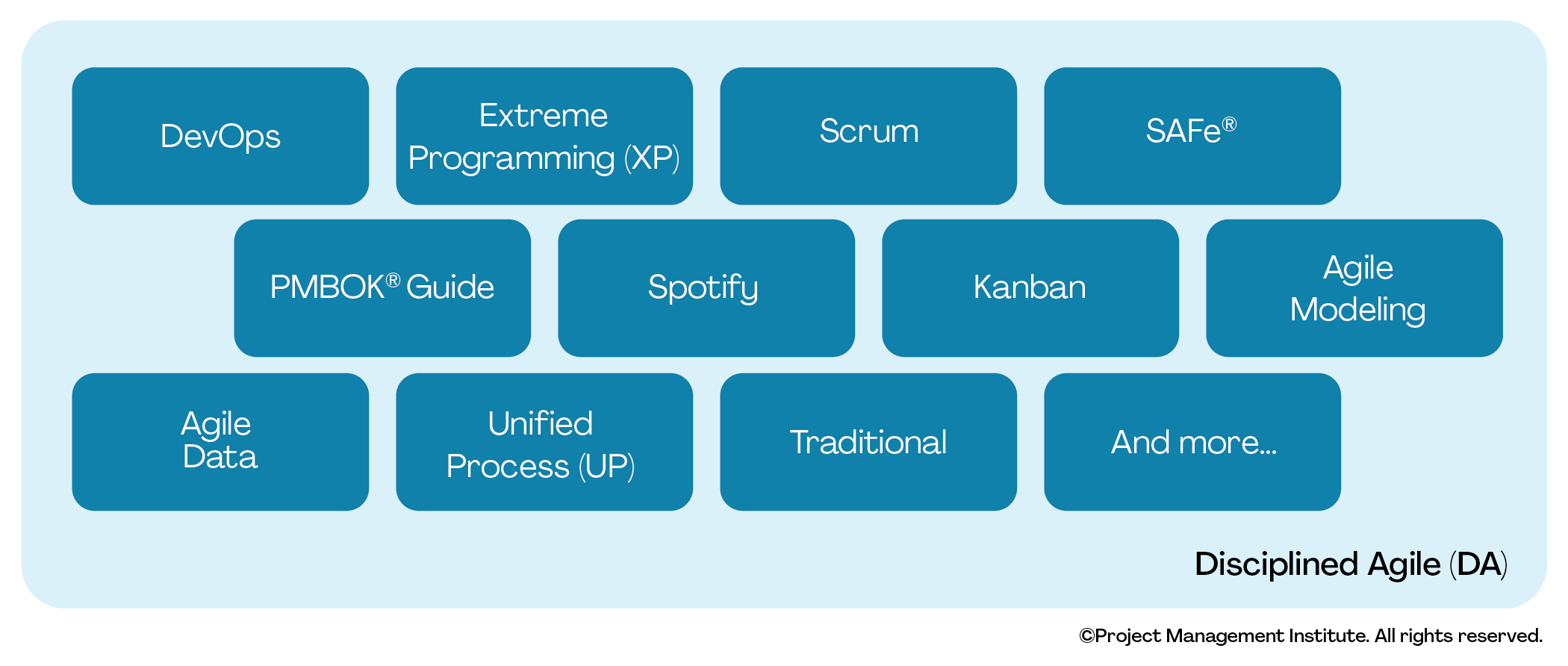
DA has taken this approach because no framework, no book of knowledge (BoK), is complete. For example, XP is the source of technical practices such as test-driven development (TDD), refactoring, and pair programming but has nothing to say about project management. The PMBoK Guide has great strategies for project managers, but has nothing to say about data analytics. The Agile Data (AD) method has great strategies for creating and evolving data sources but has nothing to say about organizing agile teams. Scrum offers great strategies such as product backlogs, sprint/iteration planning, and daily coordination meetings for organizing agile teams but has nothing to say about documentation strategies. Agile Modeling gives us model storming, architecture envisioning, and continuous documentation strategies but has nothing to say about governance. You get the point.
Each framework, each BoK, has its specific focus and thus is not sufficient on its own. The upside is that there are great strategies presented by each, often in great detail. The downside is that each source is locally optimize, they are inconsistent with one another, and there is very little advice for how to integrate these sources. This is where DA steps in - DA is hybrid that combines and puts these great ideas into context, providing advice for how to apply them effectively when you choose your WoW.
|
Posted
by
Scott Ambler
on: July 07, 2020 09:05 AM
|
Permalink |
Comments (3)
|  Not a week goes by where we are not asked to contrast DAD to SAFe. In this short blog I would like to point out some things to consider as you decide whether to implement SAFe, DAD, or both. First of all, a review of some quick facts about DAD: Not a week goes by where we are not asked to contrast DAD to SAFe. In this short blog I would like to point out some things to consider as you decide whether to implement SAFe, DAD, or both. First of all, a review of some quick facts about DAD:
- DAD is a process decision framework, not a methodology. It is a hybrid of leading agile and lean methods with guidance on how to make better choices when applying strategies for the situation that you find yourself in. DAD can be summed up as “pragmatic agile“, giving you the flexibility to adapt your approach for your unique context.
- DAD is not a scaling framework per se. Indeed it can be equally effective on one small team as it is for agile at scale. However mastering the DAD fundamentals of agile and lean in the enterprise dramatically increases your probability of sustainable success at scale.
- Unlike other frameworks, DAD supports four lifecycles: Agile/Scrum, Lean, Continuous Delivery, and Exploratory/Lean Startup. Most if not all large organizations will find each of these lifecycles to be necessary in some situations.
SAFe provides a largely prescriptive approach to decomposing large initiatives into smaller streams of work which can be implemented by a number of teams in parallel with periodic integrations of their work and delivery to stakeholders. SAFe does fill a need as our industry had been lacking such a pattern for scaling these large initiatives. In our opinion, it is suitable for situations for large agile teams (say 100+) and are working on a cohesive product ideally based upon a shared architecture. The teams should also be very competent and can be depended on to reliably deliver functionality on a common cadence with the other teams in their release train. SAFe is definitely not a good fit for teams new to agile.
In the last few weeks I reached out to a couple of our customers at very large organizations to find out in their words why they selected DAD over SAFe. In the first company, although they had been doing some agile in pockets over the last eight or so years, they were lacking consistency in their approach and struggling to achieve the promised benefits of agile. They initially chose to rollout SAFe. However, after training 120+ practitioners they stopped the training and chose to pivot to DAD. They realized that SAFe was a poor fit for their organization for the following reasons:
- The level of disruption required to roll out SAFe across the organization was not palatable
- The investment in training and the overhead associated with running the SAFe program would be too high
- SAFe would not be applicable to all types of projects so they would need another framework anyway.
In the second example, we spoke with a Fortune 100 company that is farther along in their agile journey with many highly advanced agile teams. Their agile community of practice has over 1,700 members and they use many flavours of agile and lean. They made a choice to go with DAD across the company rather than SAFe. They do use SAFe in one area of business that has a large yet highly cohesive development team working on a common product. But beyond this line of business they have a vast array of projects, technologies, and skill sets. They chose DAD for the following reasons:
- Enterprise practicality
- A choice of four lifecycles supporting all flavors of agile yet having some consistency that a toolkit provides
- Built-in, lightweight agile governance
- Most of their development teams are geographically dispersed which would make SAFe impractical
- Support for projects using more traditional approaches (Note: In the majority of large enterprises agile teams need to collaborate with traditional teams)
We of course understand DAD’s value proposition but it is particularly useful to hear it from real customers. While we are pleased that SAFe has given us a pattern for scaling agile initiatives albeit in a largely rigid and prescriptive fashion, we encourage you to consider the following points before rolling it out aggressively across your organization:
- Do you really need to have large projects? A large organization does not necessarily equate to large development teams. In fact you should try to reduce the size of your projects and product teams whenever possible to reduce overall risk. In short, your first approach should be to “descale” to whatever degree possible because large projects typically fail.
- DAD provides the foundation for scaling. Without a solid base of enterprise agile capability it will be difficult to successfully adopt scaling frameworks such as SAFe or LeSS. If you’re still struggling to succeed consistently on small agile teams, what makes you think you can succeed on large agile teams?
- Agile governance built in. Your sponsors don’t care what agile “religion” you follow. They would however like to see consistent views on the health and status of your projects regardless of the implementation approach. DAD provides guidance on lightweight governance in a consistent fashion.
- DAD is pragmatic agile. The framework provides rich and flexible guidance for the vast array of situations that your organization faces. DAD does this through its process goal driven approach. Choice is good.
- One process does not fit all. Beware the hype. There is no silver-bullet process. Even if you find a place to utilize SAFe, you will need other approaches. So beware of hitting all projects with the SAFe sledgehammer. It simply doesn’t fit in many if not most situations.
In a nutshell, our recommendation is to adopt DAD to support the diversity of people, processes, and technologies found in any large organization. Then apply the SAFe scaling pattern if and when it makes sense. Not the other way around.
In an upcoming article we will be describing how you could apply DAD to help you be more successful in your SAFe implementations.
|
Posted
by
Mark Lines
on: June 17, 2015 10:37 AM
|
Permalink |
Comments (0)
|
Egotism is the anesthetic that dulls the pain of stupidity.
- Frank Leahy
|




