Disciplined Agile (DA)'s Value Streams Layer
Categories:
layer,
value stream,
strategy,
sales,
research&development,
marketing,
agile,
Scrum,
Kanban,
lean,
Portfolio Management,
Product Management,
#ContinuousImprovement,
,
Program Management
Categories: layer, value stream, strategy, sales, research&development, marketing, agile, Scrum, Kanban, lean, Portfolio Management, Product Management, #ContinuousImprovement, , Program Management


|
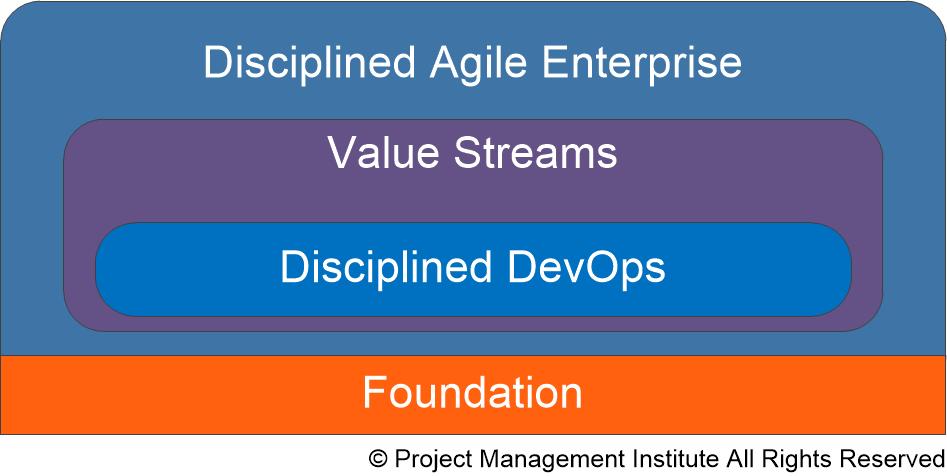
The value streams layer encompasses the capabilities required to provide value streams to your customers. A value stream begins, ends, and hopefully continues with a customer. A value stream is the set of actions that take place to add value for customers from the initial request through realization of value by the customers. The value streams layer is one of the four layers of the Disciplined Agile (DA) tool kit, overviewed in Figure 1. These layers are: Foundation, Disciplined DevOps, Value Streams, and Disciplined Agile Enterprise (DAE). This blog focuses on the value streams layer. Figure 1. The layers of the DA tool kit.
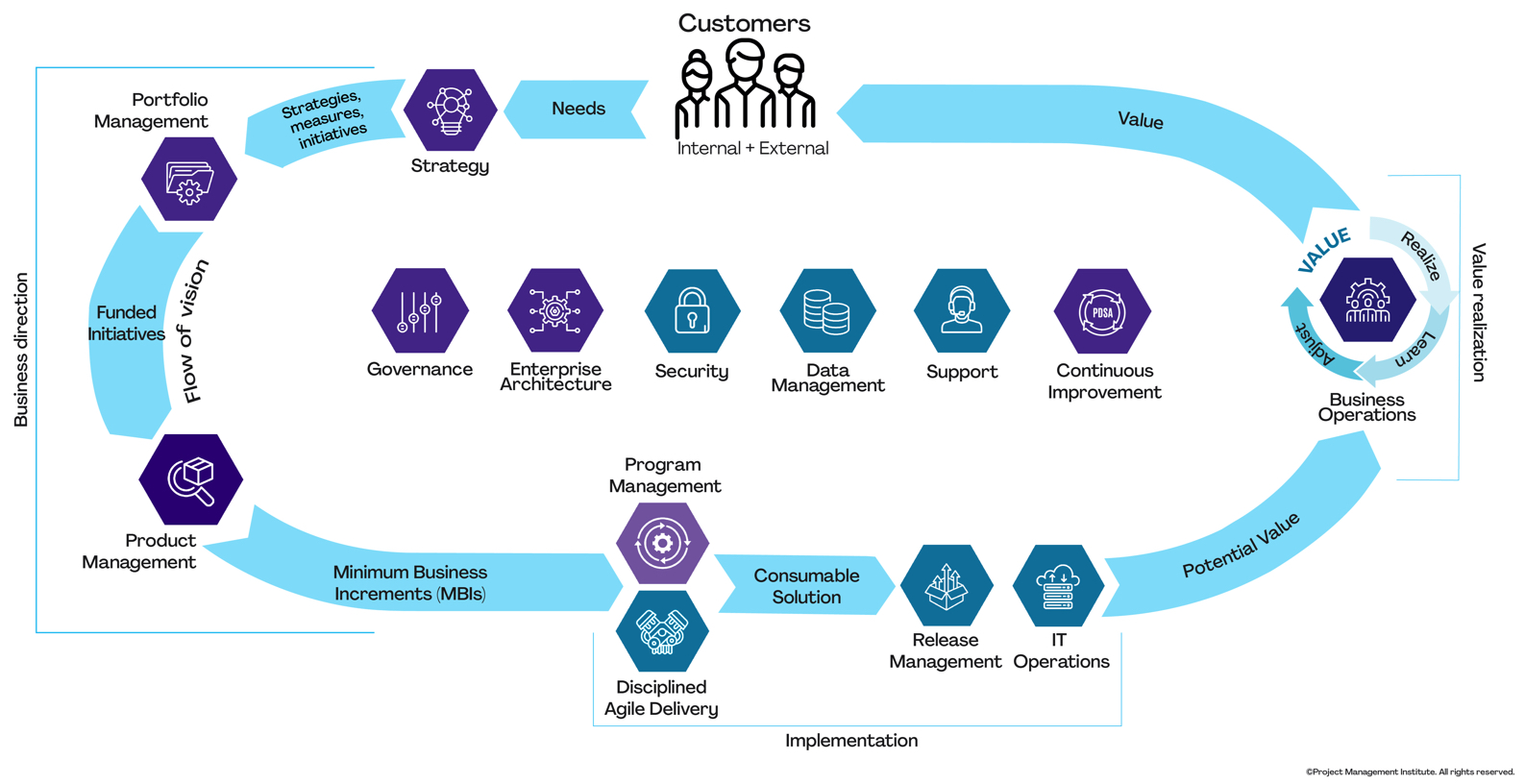
Figure 2 depicts the DA FLEX lifecycle, overviewing the high-level workflow for a value stream. As you can see, a value stream begins with the initial concept, moves through various stages for one or more development teams, and on through final delivery into business operations. Figure 2. The DA FLEX lifecycle for value streams.
Let's explore the components of Disciplined Agile's value stream layer. The hexes in Figure 2 and Figure 3 represent process blades, sometimes called process areas. A process blade encompasses a cohesive collection of process options, such as practices and strategies, that should be chosen and then applied in a context sensitive manner. Process blades also describe functional roles specific to that domain as well as extensions to the DA mindset specific to that domain. Figure 3. The process blades of Disciplined Agile's value stream layer.
You can see in Figure 3 that some process blades, such as Product Management and Program Management, are specific to this layer. Other process blades, such as Strategy and Marketing, are shared between the value streams layer and the disciplined agile enterprise (DAE) layer. This is an indication that you may choose to implement those process blades at both the enterprise level as well as the level of a single value stream - do what is right for your situation. Expanding upon the Disciplined DevOps layer, the value stream layer adds the following blades:
Business operationsBusiness operations focuses on the activities required to provide services to customers and to support your products. The implementation of business operations will vary by value stream, in a bank retail account services is implemented in a very different manner than brokerage services for example. Business operations includes help desk and support services (integrated in with IT support where appropriate) as well as any technical sales support activities such as training, product installation, and product customization. As you can imagine close collaboration with both your Sales and Marketing efforts is required to successfully Delight Customers. Continuous improvementThe continuous improvement process blade describes how people within your organization can share their improvement learnings with one another in a systematic way. There are many strategies for doing so, including centers of excellence (CoEs), communities of practice (CoPs) which are also known as guilds, techniques for exploring existing ways of working (WoW), identifying new WoW, and sharing techniques. GovernanceGovernance is the leadership, organizational structures, and strategies to enable you to sustain and extend your organization’s ability to produce meaningful value for your customers. Lean governance promotes strategies such as motivating people to do the right thing, enabling them to do so (often via automation), communicating organizational objectives, and preferring visibility over reporting. MarketingThe goal of marketing is to ensure successful interactions between your organization and the outside world. Disciplined Agile marketing applies data and analytics to continuously source promising opportunities or solutions to problems in real time, deploying tests quickly, evaluating the results, and rapidly iterating. It also means taking a validated learning approach, being customer focused, working in a collaborative and flexible manner, and working in an evolutionary (iterative and incremental) manner. Your marketing efforts will represent your organization and your offerings, both products and services, to the outside world and conversely will represent external stakeholders, and potential stakeholders, to the rest of the organization. In conjunction with product management, Marketing will be actively involved with long-term visioning for your organization’s offerings. Marketing is sometimes called brand management Portfolio managementPortfolio management addresses how an your organization goes about identifying, prioritizing, organizing, and governing their various endeavors. Disciplined Agile portfolio management seeks to do this in a lightweight and streamlined manner that maximizes the creation of business value in a long-term sustainable manner. Potential endeavors include solution delivery initiatives/projects, stable product development teams, business experiments (along the lines of a lean startup strategy), and the operation of existing solutions. Product managementProduct management is the art of taking strategic objectives and turning them into tactical activities. Disciplined agile product management is performed in a collaborative and evolutionary manner that reflects the context of your organization. Disciplined agile product management includes the acts of:
Program managementA program is a large team composed of two or more sub-teams (also called squads). The purpose of program management is to coordinate the efforts of the sub-teams to ensure they work together effectively towards the common goals of the overall endeavor. Program management encompasses financial activities, vendor management, coordination of people/staffiing concerns, coordination of the evolution of the solution, and coordination of requirements management issues across the sub-teams within the program. Research & developmentResearch & development (R&D) encompasses the innovative activities undertaken by your organization to identify potential new offerings (services or products), or to identify potential improvements to existing offerings. R&D constitutes the first stage of development of a potential new offering. R&D activities are an important part of both product management and solution development to help explore potential ideas and strategies. SalesThe aim of your sales efforts is to, you guessed it, sell your organization’s offerings (both products and services) to customers. Your sales people, if any, will work very closely with your marketing team to ensure they are focused on selling offerings that reflect your organizations’ overall strategy. They will also work closely with product management to ensure that what they’re selling is available or can be built in a timely manner. Organizationally Sales is often combined with marketing or may even be matrixed into business operations. StrategyStrategy is what you do now, and what you intend to do in the future. The focus of the strategy process blade is to identify, evolve, and then drive the execution of your organization’s vision. Your vision is driven by the perceived needs of your customers and influenced by the environment in which you operate.
|


Spotlight on Product Portfolio Funding
|
By Jeev Chugh, CDAP | CDAI and Joshua Barnes CDAC | CDAI Enterprise agile transformation roadmaps using Lean Change are often fueled by the desire to deliver value faster with increased flexibility. They start with replacing traditional (waterfall) delivery methods with an Agile way of working, using pilot teams to validate early decisions on how to experiment with aspects such as team formation, lifecycle (agile, lean, continuous delivery, etc.) practices and techniques, and so on. What team members and business and technology leaders alike quickly glean is that the mind shift to collective ownership of the work, decentralized decision making, and all the energy to shift to self-organizing teams is just the first step. A big step, but one in a long journey. To truly achieve the sizable outcomes from these enterprise transformations, many aspects beyond that of individual agile teams achieving a good level of maturity in “their” agile ways of working are needed. One of the shifts that enables such outcomes is adopting a Product Portfolio operating model. In this model, we transition from assembling a team to deliver a fixed scope via a project and then disband as the project ends to a long-lasting stable team delivering business outcomes via continual improvement of a product. Along with this change comes the realization that traditional waterfall methods of budgeting and project cost accounting that requires upfront plans and budgets, is in inherent conflict with Agile ways of working; especially so when the agile approach uses a Lean Kanban-based lifecycle (very small batches) or Lean Continuous Delivery (no batches) lifecycle. Thus, to successfully scale Agile, enterprises must work with business and Finance partners to move beyond traditional project-centric funding models and adopt a product-centric funding model that enables rolling-wave planning, dynamic resource allocation, and accelerated delivery. Moving from funding project scope to funding teams is a seminal part of product centric funding. However, a clear understanding and alignment on “Product” and “Product Portfolio” terminology is imperative before delving into the product-based funding model and financial governance. It is often surprising to agile team members through all levels of leadership how hard it can be to all agree on what a “product” is. We often start by getting an agreement on what a product isn’t, such as a platform or other part of the technology stack or a corporate function such as marketing. What is a Product?A product is designed to continuously create business value for the customer by solving their problem or providing a benefit. Products have more permanence, and are living entities that we continuously iterate to meet market needs and finally are retired when the demand for it diminishes. On the other hand, a project is a temporary endeavor, with a clear definition of the work that needs to be delivered, within a defined budget and by a specified date in time. Key characteristics of a Product and a Project are elaborated below:
So, what are the benefits of pivoting to a product mode?High Performing TeamsStanding Projects up and down is Inefficient and runs the risk of disbanding teams just as they enter the norming or performing phase. Organizations often underestimate the staff onboarding costs and ramp up time. Most product-centric organizations try to keep the same people working on a product through the lifespan of the product. Overtime, these teams build the stakeholder relationships and business domain knowledge, being stable and long-lived can benefit from a long performing phase. Maintain Strategic FocusProjects are funded independently and investments tend to be quite scattered and fragmented. Often, this leads to executives not having enough confidence that much of their investments are committed to top strategic priorities. Moreover, it really slows the organization’s response to change in business priorities. Product Roadmaps are aligned with business capabilities and deliver measurable business outcomes. Further, funding is continuous with frequent checkpoints, allowing to dynamically reposition investments should the business priorities change Ability to Truly IterateProjects are funded in one go, the entire agreed upon scope is funded to deliver the projected benefits. These un-validated hypotheses of benefits in the business case are based on a lot of assumptions, and it is often not feasible to clarify the entire scope upfront, despite the significant investment routinely made with traditional approaches. The reality is that many projects regularly miss the mark in terms of delivering benefits, and organizations often don’t have an effective process in place to validate actual benefits post every release. On the other hand, product funding is continuous and flow based on validated learning of short timelines. This is a truly iterative approach that allows to pivot or preserve strategy to maximize the value delivery. Customer focusedProject teams measure success as the delivery of agreed up-front scope, on time and in budget. This often means that they get too solution focused and lose sight of whether appropriate value is being delivered to the stakeholders. There is no point in delivering the entire upfront agreed scope if it doesn’t cater to the stakeholder needs anymore. We all work to create value for our stakeholders as well as the organization. Business outcomes allow us to define value in a measurable way, thus focusing on what matters most from the customer perspective. For product teams, success equals improvement directly related to a business outcome. Hence, rather than seeing their job as delivering a task, product teams focus on delighting and adding value for their customers (internal or external). Knowledge RetentionProject teams ramp up quickly to build a solution over one or more releases, hand it over to an operations team in the “run” organization and are then disbanded, and the members move on to other project teams. With project teams being continually dragged onto new things, it gets very difficult to retain knowledge in legacy systems and often results in unmaintainable code, making it much harder to support such systems. On the other hand, knowledge grows in product teams that allows team members to focus on a given business area for much longer. Overtime, these teams build strong stakeholder relationships and business domain knowledge, and can better understand the stakeholder problems and serve to their needs. System Integrity and Continuous ImprovementProject teams are in constant pressure to deliver the agreed scope in defined timelines. This often leads to cutting corners and applying tactical fixes, increasing technical debt and neglecting long term architectural integrity in favor of short-term feature delivery. As the project team doesn’t face the long-term consequences of these tradeoffs, they are more likely to take such decisions for short-term gain. Over a period, this phenomenon compromises stability of systems, lowering quality and worsens the seed of value delivery. On the other hand, Product teams have complete and collective ownership of the code and systems. There are no handovers, BAU or Operations team. The same team builds, runs and fixes any defects over the lifespan of the product, allowing them to evolve the system continuously and in a more sustainable manner. This also fosters a mindset that promotes taking responsibility for their product and the decisions they are empowered to make. Making the shift to a Product Centric Organization ModelAccording to a recent Gartner survey, 85% of the organizations have adopted or plans to adopt a product-centric organization model. To enable accelerated value delivery, adaptive planning, and flexibility required to achieve the digital priorities, many organizations are shifting towards a product centric model. In a product centric model, organizations align funding & resources to product portfolios that support their key business capabilities. A business capability is the ability of an organization to do things effectively to achieve desired business outcomes and measurable benefits. Each business capability is independent from other business capabilities and realized by combining different functions of an organization to fulfil one functionality. Example, for an FMCG, key business capabilities are often: Direct to Consumer, Wholesale and Retail.
The key primary constructs of translating Enterprise Strategy into traceable User Stories, via Features and Business Outcomes are:
Adaptive Funding of Products and Product Portfolios: From Annual to Quarterly CycleOrganizing work by Products and Product Portfolios is a good starting point to accelerate the delivery of value to one’s customers. However, that enough won’t suffice if the work is still funded through projects on an annual basis.
An annual investment process simply can’t keep up with the pace of change. Under an annual planning approach, entire funding is allocated at the start of the fiscal year. Significant effort is spent upfront to create a detailed business case required to win the funding approval. Changes in stakeholder priorities or market demand often render a lot of early requirements captured in the business case as obsolete, creating a lot of waste and requiring significant rework. Thus, to achieve their digital ambitions, enterprises must work with business and Finance partners to move beyond traditional project-centric funding models and adopt a product-centric funding model that enables rolling-wave planning, accelerated delivery of value, and validated learning to make much more informed decisions. Moving from funding project scope to funding teams is a seminal part of product centric funding.
(Re)allocation of Funds across Product PortfoliosInitial annual funding allocations to individual product portfolios are based on un-validated hypothesis of benefits, which must be tested over the course of the year against changing priorities and proven value. The Portfolio Management Board meets on a recurring basis (Quarterly plus any market triggered event) to assess the allocation at the product-line level and reallocating funds as necessary to reflect changes to strategic enterprise priorities. (Re)allocation of Funds within a Product PortfolioThe Product Line Council has the autonomy and the empowerment to reprioritize and reallocate funds across all products within the product line. Each product team within a product line are allocated funds on a quarterly basis based on proven value (unless it’s the first quarter where funding is based on projected benefits). The business value is measured by hitting a set of KPIs tied to the business outcomes such as increasing revenues, reducing costs, and improving customer satisfaction. This level of decentralization in decision making is possible when an organization implements a consistent, standardized and predictable cadence to support governance, offering frequent opportunities for key stakeholders to provide input on the roadmap. Impediments to adopt Product-based Funding ModelThe shift from a project-based funding model to a product-based funding model requires a major cultural and mindset change, as different stakeholders will have different reservations about the new approach. Some of the challenges to adopt a product-based funding model include:
Business & Finance partners reluctant to cede control of budgetsSome CFOs and business leaders are reluctant to cede control of budgets. In response, they must be made to understand that the reality is that they are gaining a lot more control by not allocating the entire funding based on the un-validated hypothesis of projected benefits and with no benefits tracking in place most cases. Also, by offering them visibility into product portfolio performance on quarterly basis with the option to pivot or preserve funding strategy based on proven value and/or change in priorities, we can significantly reduce the risk of financial loss.
Product Managers lacking finance expertise to manage product budgetsIdentifying Product Managers with sufficient expertise to manage large budgets is often challenging and requires significant effort and commitment from the organization to build the financial competencies.
Resistance to funding not” fully detailed” requirements or outcomesBusiness partners feel a comfort factor with a detailed business case based on projected benefits, even if it is based on a lot of assumptions and uncertainty upfront. To get business partners fully on board, product leaders need to craft a pitch that provides tangible examples of how adaptive funding model leads to better business outcomes.
Requires structural changes to support product-centric organizationMost companies we work with are organized around functions. Organizational structure change is required to adopt a product-centric operation model. Organizations are reluctant to Org design changes as it can be very difficult and expensive to implement. Parting ThoughtsWe have endeavored to shed some light on a very complex topic, balancing the amount of context we can provide in a blog entry. If you have any questions please do use the comments section below. Joshua Barnes, CDAC | CDAIJeev Chugh, CDAP | CDAI |


Product Owners vs. Product Managers
|
A common question that we get is what is the difference between Product Owners (POs) and Product Managers? From a Disciplined Agile (DA) perspective, it’s a matter of strategy vs. tactics:
We Need to CollaborateAs you can see in the following diagram, the role of Product Manager is different, yet overlapping, with that of a Product Owner (PO). The PO will spend the majority of their time on tactical activities, including working with the team to communicate stakeholder needs to them and working with stakeholders to elicit and prioritize their needs. The Product Manager, on the other hand, spends most of their time on more strategic issues, collaborating closely with customers (and potential customers) to identify their potential needs. Figure 1. Example of rolling wave planning for product functionality (click on image for larger version).
There is clearly overlap between strategic, long-term thinking and tactical, short-term implementation. Product Owners are responsible for the Product Backlog in Scrum, what Disciplined Agile DAD (DAD) teams might refer to as a Work Item List or in the case of teams who have adopted one of the lean lifecycles a Work Item Pool, and some of the items in the backlog/list/pool might be several months away from being implemented (if ever). In Figure 1, these are items that fall into the yellow or red timing areas, or even the grey area. Product Managers, being responsible for strategic thinking, will be focused on high-level outcomes or themes for the product. They may even be focused on more concrete, yet still high level, epics or features. So we see overlap in the Product Manager’s high-level strategic focus and the Product Owner’s tactical focus, indicating the need for collaboration between the two roles so that the tactical decisions reflect the overall strategy, and the overall strategy is informed by the realities faced on the ground by the delivery team. Please note that the timing of “short term” and “long term” will vary by product. In the case of Figure 1 the long-term planning horizon is around the three month point (where the diagram shifts from yellow to red). That’s just an example, from one team. We’ve worked with some teams where the long-term planning horizon was anything more than a month. We’ve also worked with other teams where the long-term planning horizon was closer to a year (they’ve since shortened that considerably).
Shouldn’t Product Owners Also Address Strategic Issues?Here are a few thoughts to help answer this question:
So, as usual, the answer is “it depends.” As we like to say in DA, context counts which is why choice is good.
Related Reading |


The Disciplined Agile Product Management Mindset
|
Being a Product Manager is an interesting and exciting role. We hope that this blog has been valuable for you. |

Defining MVP, MBI, MMF, and MMR
|
The term minimum viable product (MVP) has achieved buzzword status in recent times and I’m now hearing people throwing around the term MVP almost on a daily basis. The issue is that it’s common for people to say MVP when they are actually talking about is a minimum business increment (MBI), a minimum marketable feature (MMF), or a minimum marketable release (MMR). Having said that, I prefer the terms MVP and MBI, two different concepts, and rarely use terms like MMF or MMR other than to point people to the first two terms. Having said that, I'll still cover all four concepts in detail here. There are several reasons why there is significant confusion in the marketplace:
To clear things up, we address the following topics:
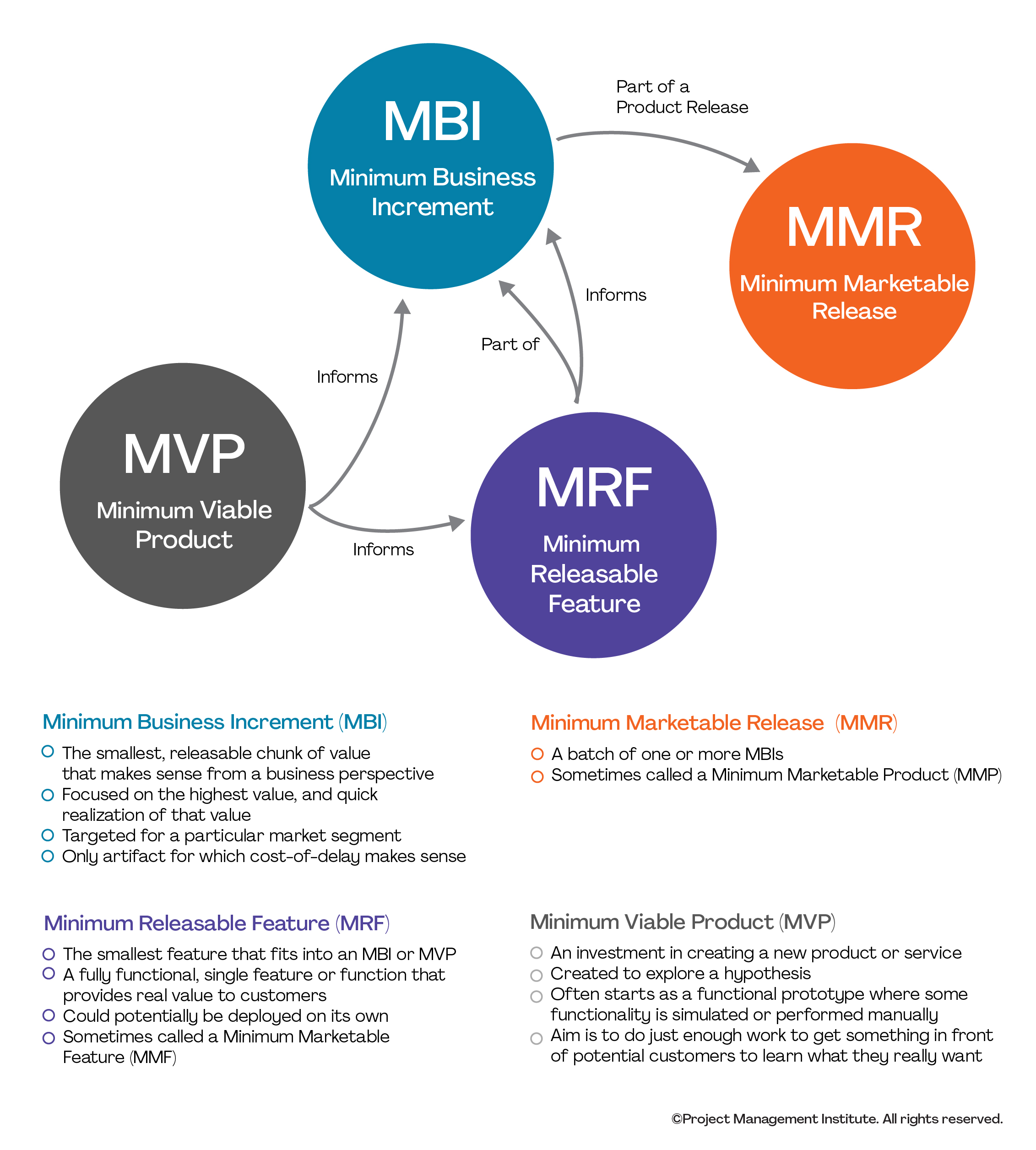
1. Defining the TerminologyFigure 1 below overviews how the following terms relate to one another:
Figure 1. The relationship between MVP, MBI, MMR, and MMF.
2. Answering Common QuestionsWe often get asked several common questions around this topic:
What are the Key Take-Away Points?The key take-away points of this article are:
Is it Minimum or Minimal?Given that I’m being picky about terminology, I realized that there isn’t agreement as to whether we should use the term MINIMUM viable product or MINIMAL viable product (and similarly for MBI, MMR, and MMF). Once again, the words are very close:
As you can see, very nuanced. For better or worse, the industry has settled on the term minimum so that's what we're sticking with.
Why Differentiate Between MBI and MMR?We wish we didn't have to. Ideally an MMR is a single MBI - your team wants to do just enough work to develop the minimum functionality that provides your customers with value and release it as quickly as you can. That's an MBI. Practically though you're sometimes forced to release more than a single MBI in a release. Perhaps you've decided to have a regular quarterly release cadence. Perhaps your customers prefer large releases (this still occurs in practice, although is becoming less common as your customers become more savvy with regards to incremental releases). These challenges can all be addressed in time, and they should be, but you may not be there yet.
Don't We Just Need The Concepts of MVP and MBI?That's correct. When you've streamlined your way of working (WoW) you should be at the point where an MBI is an MMF that you release to your customers, so it is also an MMR. The concepts of MMF and MMR are stepping stones towards what you are really aiming for, MBIs. But you might not be there yet, and you may be working with people who are more familiar with older terminology such as MMF and MMR - as a result we recognize in DA that these older terms exist but we avoid them where we can.
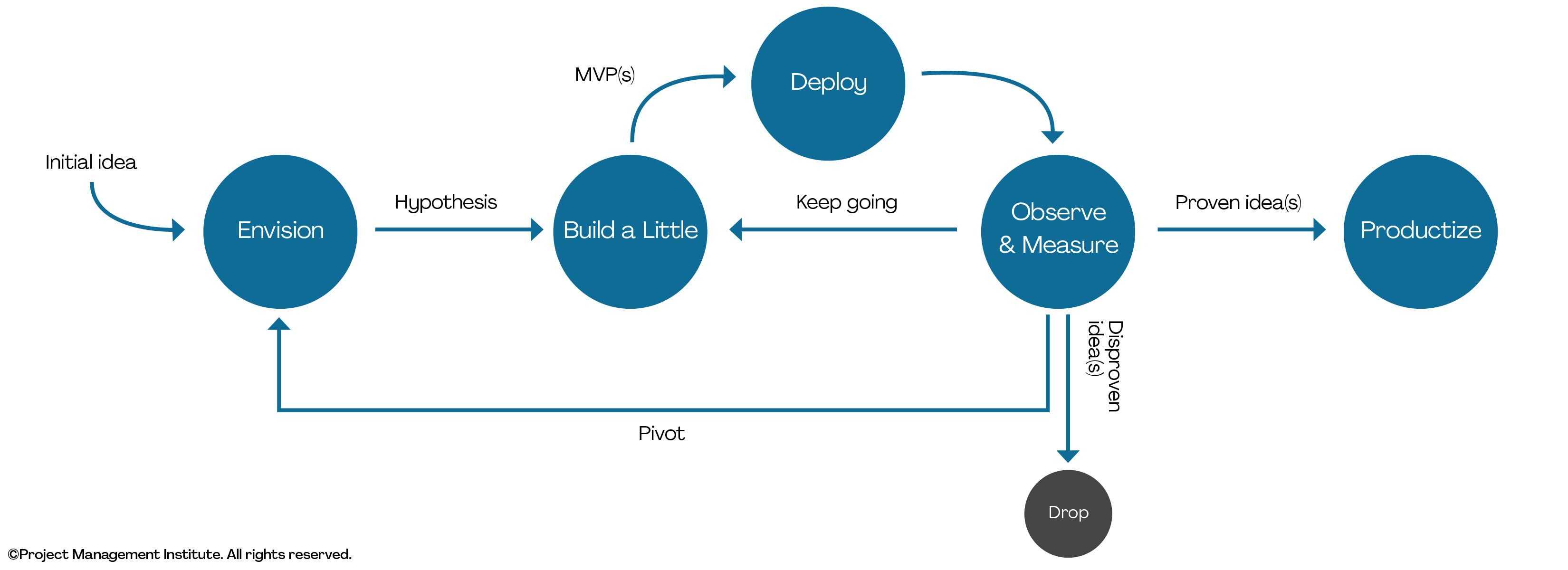
3. An ExampleNow let’s work through an example of the development of a fictional product using the concept of MVPs and MBIs. One day while shopping in the local mall my phone ran out of power. This proved to be a problem for me because I had a conference call that I had to be on, forcing me to cut my shopping trip short to go home and take the call there. This experience made me realize that there’s a potentially untapped market need as I would have been very willing to pay to charge my phone while at the mall. Note: I am fully aware that products such as Safecharge and Brightbox exist, but let’s pretend they don’t for the sake of this example. Just because I’m willing to pay for this doesn’t mean that others will. To determine whether this could be a profitable endeavour I decide to follow Disciplined Agile’s Exploratory Lifecycle (see Figure 2), which is based on Lean Startup’s hypothesis-driven approach. My plan is to iteratively run a series of experiments to explore this product idea. Figure 2. The Exploratory Lifecycle.
Over a several week period I work through a series of minimum viable products (MVPs):
This series of experiments led me to identify a collection of features that this product should offer:
Over the next two months we built a minimum business increment (MBI). The MBI was a large box which had 16 cubby holes for small devices such as phones. We the each box from folded sheet metal with clear, thick plastic doors so that people can see their devices. For security and payment processing we built a device that used a small touch screen (it was a tablet) as an input device attached to a card swipe for capturing both credit and debit card payments. Over several weeks we built five of them, placing three boxes in the mall where we had run our initial experiments and two boxes in another smaller mall on the other side of the city. Then we continued to evolve the product via a series of MVPs. We ran some experiments in a public library where we discovered that library patrons wanted to charge large devices such as tablets and laptops as well as smaller devices. So we developed a new MBI, a “Library Charging Station” that had eight small device cubbies and six large device cubbies. We also hired a designer to develop a sleeker looking box when one mall management chain told us that they loved the concept but wouldn’t allow our boxes into their more upscale locations until they were more attractive.
4. SummaryI'll say it again (a paraphrasing of Al Shalloway's advice):
Here's the key difference between the two: With an MVP you are in entrepreneurial mode and need to discover what your customers actually want. MBIs are for when you have an existing product and have a good idea for how to extend it. My hope is that this article has helped to clear up some of this confusion.
5. Related Resources |