


Categories: , #ContinuousImprovement, agile, Kanban, layer, lean, marketing, Portfolio Management, Product Management, Program Management, research&development, sales, Scrum, strategy, value stream

The value streams layer encompasses the capabilities required to provide value streams to your customers. A value stream begins, ends, and hopefully continues with a customer. A value stream is the set of actions that take place to add value for customers from the initial request through realization of value by the customers. The value streams layer is one of the four layers of the Disciplined Agile (DA) tool kit, overviewed in Figure 1. These layers are: Foundation, Disciplined DevOps, Value Streams, and Disciplined Agile Enterprise (DAE). This blog focuses on the value streams layer.
Figure 1. The layers of the DA tool kit.
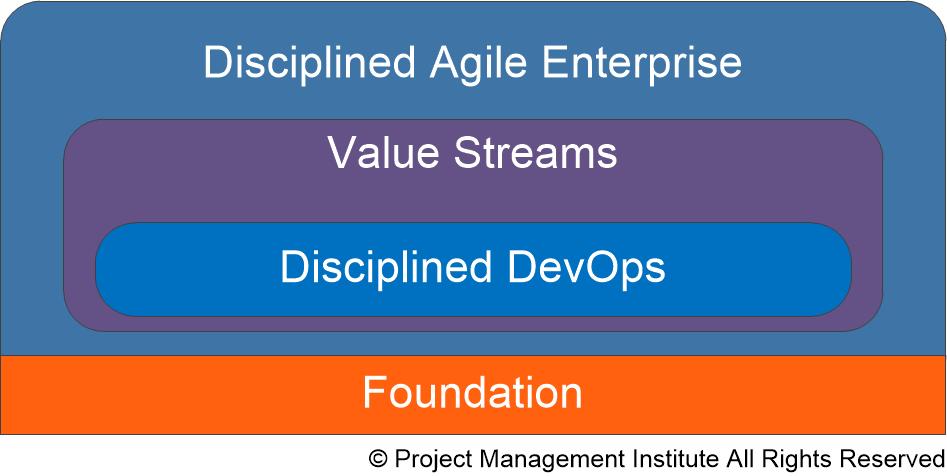
Figure 2 depicts the DA FLEX lifecycle, overviewing the high-level workflow for a value stream. As you can see, a value stream begins with the initial concept, moves through various stages for one or more development teams, and on through final delivery into business operations.
Figure 2. The DA FLEX lifecycle for value streams.
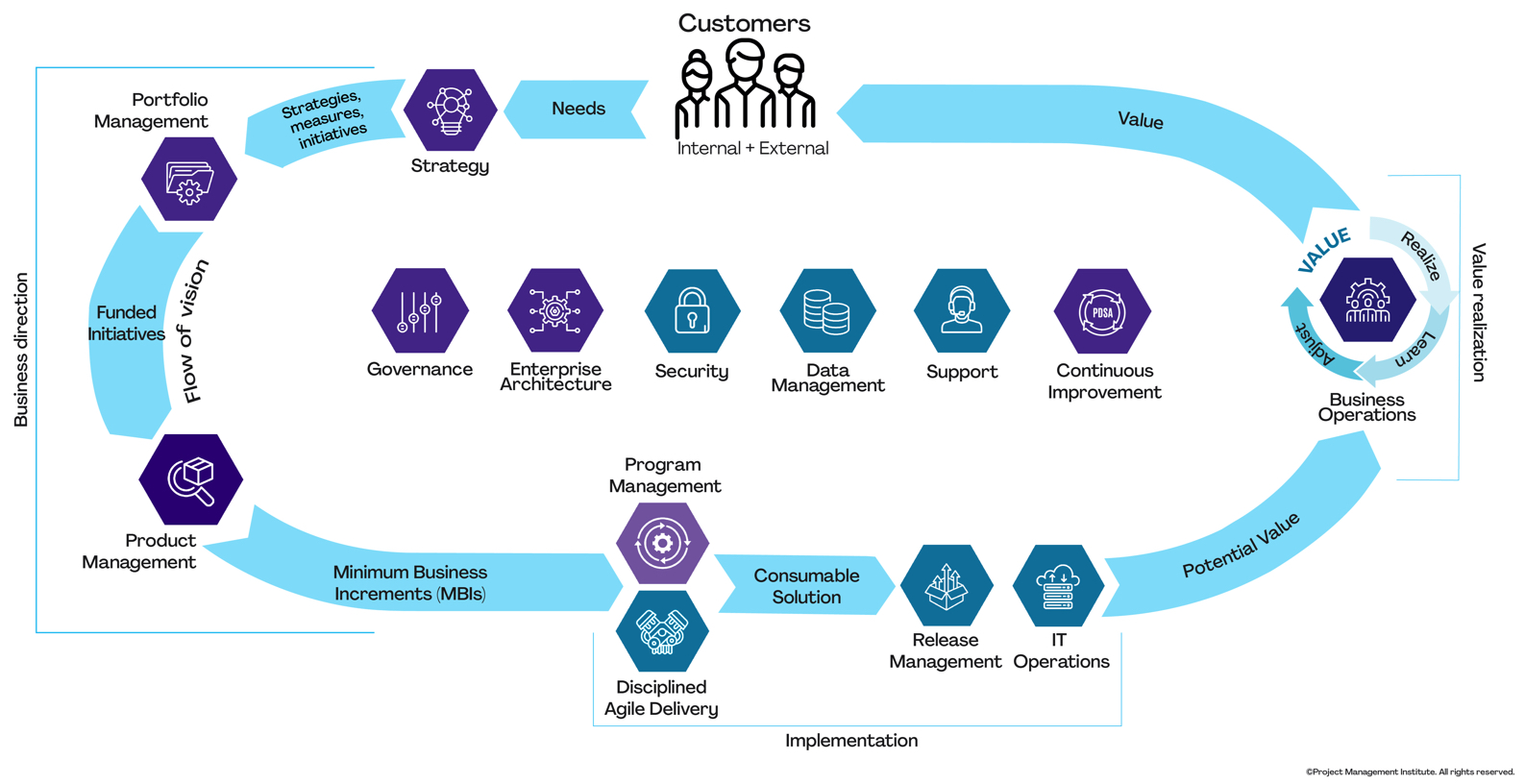
Let's explore the components of Disciplined Agile's value stream layer. The hexes in Figure 2 and Figure 3 represent process blades, sometimes called process areas. A process blade encompasses a cohesive collection of process options, such as practices and strategies, that should be chosen and then applied in a context sensitive manner. Process blades also describe functional roles specific to that domain as well as extensions to the DA mindset specific to that domain.
Figure 3. The process blades of Disciplined Agile's value stream layer.

You can see in Figure 3 that some process blades, such as Product Management and Program Management, are specific to this layer. Other process blades, such as Strategy and Marketing, are shared between the value streams layer and the disciplined agile enterprise (DAE) layer. This is an indication that you may choose to implement those process blades at both the enterprise level as well as the level of a single value stream - do what is right for your situation.
Expanding upon the Disciplined DevOps layer, the value stream layer adds the following blades:
- Business operations
- Continuous improvement
- Governance
- Marketing
- Portfolio management
- Product management
- Program management
- Research & development
- Sales
- Strategy
Business operations
Business operations focuses on the activities required to provide services to customers and to support your products. The implementation of business operations will vary by value stream, in a bank retail account services is implemented in a very different manner than brokerage services for example. Business operations includes help desk and support services (integrated in with IT support where appropriate) as well as any technical sales support activities such as training, product installation, and product customization. As you can imagine close collaboration with both your Sales and Marketing efforts is required to successfully Delight Customers.
Continuous improvement
The continuous improvement process blade describes how people within your organization can share their improvement learnings with one another in a systematic way. There are many strategies for doing so, including centers of excellence (CoEs), communities of practice (CoPs) which are also known as guilds, techniques for exploring existing ways of working (WoW), identifying new WoW, and sharing techniques.
Governance
Governance is the leadership, organizational structures, and strategies to enable you to sustain and extend your organization’s ability to produce meaningful value for your customers. Lean governance promotes strategies such as motivating people to do the right thing, enabling them to do so (often via automation), communicating organizational objectives, and preferring visibility over reporting.
Marketing
The goal of marketing is to ensure successful interactions between your organization and the outside world. Disciplined Agile marketing applies data and analytics to continuously source promising opportunities or solutions to problems in real time, deploying tests quickly, evaluating the results, and rapidly iterating. It also means taking a validated learning approach, being customer focused, working in a collaborative and flexible manner, and working in an evolutionary (iterative and incremental) manner. Your marketing efforts will represent your organization and your offerings, both products and services, to the outside world and conversely will represent external stakeholders, and potential stakeholders, to the rest of the organization. In conjunction with product management, Marketing will be actively involved with long-term visioning for your organization’s offerings. Marketing is sometimes called brand management
Portfolio management
Portfolio management addresses how an your organization goes about identifying, prioritizing, organizing, and governing their various endeavors. Disciplined Agile portfolio management seeks to do this in a lightweight and streamlined manner that maximizes the creation of business value in a long-term sustainable manner. Potential endeavors include solution delivery initiatives/projects, stable product development teams, business experiments (along the lines of a lean startup strategy), and the operation of existing solutions.
Product management
Product management is the art of taking strategic objectives and turning them into tactical activities. Disciplined agile product management is performed in a collaborative and evolutionary manner that reflects the context of your organization. Disciplined agile product management includes the acts of:
- Identifying and prioritizing potential products/solutions to support your organization's vision;
- Identifying, prioritizing, and allocating features to products under development;
- Managing functional dependencies between products;
- Marketing those products to their potential customers;
- Exploring the needs of existing and potential customers;
- Identifying minimum business increments (MBIs) for delivery teams to work on.
Program management
A program is a large team composed of two or more sub-teams (also called squads). The purpose of program management is to coordinate the efforts of the sub-teams to ensure they work together effectively towards the common goals of the overall endeavor. Program management encompasses financial activities, vendor management, coordination of people/staffiing concerns, coordination of the evolution of the solution, and coordination of requirements management issues across the sub-teams within the program.
Research & development
Research & development (R&D) encompasses the innovative activities undertaken by your organization to identify potential new offerings (services or products), or to identify potential improvements to existing offerings. R&D constitutes the first stage of development of a potential new offering. R&D activities are an important part of both product management and solution development to help explore potential ideas and strategies.
Sales
The aim of your sales efforts is to, you guessed it, sell your organization’s offerings (both products and services) to customers. Your sales people, if any, will work very closely with your marketing team to ensure they are focused on selling offerings that reflect your organizations’ overall strategy. They will also work closely with product management to ensure that what they’re selling is available or can be built in a timely manner. Organizationally Sales is often combined with marketing or may even be matrixed into business operations.
Strategy
Strategy is what you do now, and what you intend to do in the future. The focus of the strategy process blade is to identify, evolve, and then drive the execution of your organization’s vision. Your vision is driven by the perceived needs of your customers and influenced by the environment in which you operate.

 Community Champion




