


4 Easy Steps To Understanding Project Management Certifications


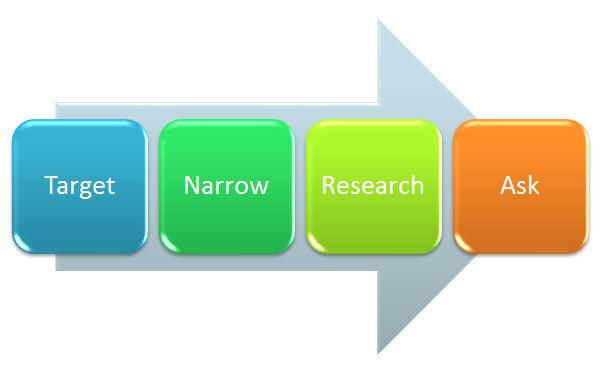
| I get this question a lot. "Please can you tell me the difference between the PMP and Prince2 and the advantages and disadvantages thereof." Or something similar. Look, it's not a bad idea to research the various options out there for certification or even degree programs. But you shouldn't start there in my no-so-humble opinion. Perhaps a completely different focus of your time and energy is a better ROI than pursuit of a certification. But how can you know? Here are four easy steps to understanding which certification or degree you should pursue.
Step 1 - Target OrganizationsThink of yourself as a business. You are trying to figure out what product to develop (which certification to pursue). You don't start with the product. You start with your target market - the people who will potentially buy your product if only you can make it solve a problem they experience and make their lives better. So first thing's first. Who is your target market? If you don't know who you are trying to serve, you are only taking a wild guess about where to put your efforts. Who is your target market (potential employers)? Step 2 - Narrow Your FocusIt's likely you have some rather broad category of potential employers from the last step. Something like "software development companies" or "telecommunications". Not good enough. I want you to think deeply about the organizations in which you thrive. Not just exist, but THRIVE.
Step 3 - Research And Narrow Your Focus MoreNow that you understand what you want, let's find a candidate list of potential fits. The internet is such an awesome tool, and not just for posting what you just ate for breakfast to your Facebook friends (who knew?) Using sites like LinkedIn, Gantthead, and just a good 'ol Google search you can find out amazing things about companies in your area and if they might be a potential fit for YOU. Get creative. Use company searches, Chamber of Commerce information, and asking around your professional network (you've got a well-maintained network of professional relationships, right?) to find out more about these organizations. In the end, narrow down your list to 3-10 target organizations. You can broaden this list later if you want, but for now let's keep the focus as narrow as possible. By the way - if the company you already work for is on that list of 3-10 organizations, congratulations! You may not want to switch companies. But if it's not, maybe it's time for a change. Step 4 - AskGeeeez Josh, I thought this article was supposed to be about project management certifications? It is. But if you expected me to talk about certifications in Step 1 it's because you've been thinking about this bass-ackwards, pal. Now that you have a small, targeted list of 3-5 organizations that are a good fit for you, guess what you can do now? Ask. Just ask them - what certifications, if any, does your organization value? (Hint: some organizations DESPISE certifications - it's true!) Hopefully you've already expanded your professional network towards these 3-10 organizations. If not, now's the time. It can take some time to do it right. This is slow-roasted goodness, not a microwave entre. Even if you can't seem to find a connection you can approach these organizations so you can get to know them. And for them to get to know you. What If You Still Don't Understand?Well, you messed one of these steps up, bucco. If your candidate list of companies isn't 3-10 narrowly focused ones, do steps 1-3 again. This time, with FEELING. If you are confident about which companies you've put on your short list, but still don't understand if they value project management certifications or which ones, you've got some networking to do. Look at step 4 and get your hands on every book, article, and training program you can find on professional networking. Most of all, practice the heck out of it. And the best part? In the process of trying to understand about project management certifications, you learned a heck of a lot more about something else. Your career. |
PMP Exam - Which Version Of The PMBOK Guide Should I Study With?
Categories:
PMP
Categories: PMP
The exam isn't going to change until mid to late summer of 2013 - the 5th edition will be released around the end of this year according to the PMI. So as long as you plan to take the exam in the next 9 months, you can stick with the 4th edition. It will be interesting to see what the changes are in the 5th edition. Personally, I am hoping to see more focus on Lean/Agile enablers in the framework. While the PMBOK Guide is a framework and not a methodology, many companies unfortunately try to use it as a methodology. In doing so they come out with many formal documents and processes, many of which are unnecessarily difficult to get any value out of, if it's possible to derive value at all from them. In doing so they build and buy tools which look great theoretically but are so bulky and untailored that they become the bane of project managers who are forced to use them. We'll see how it goes. I'm looking forward to checking out the 5th edition. |
Your PM Experience For the PMP Application
Categories:
PMP
Categories: PMP
| <rant> /* open rant tag */ This gets my blood boiling every time. People with honest questions about the PMP exam getting led astray.
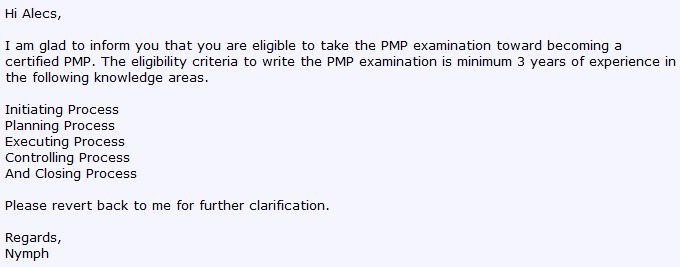
It's a Good QuestionAlex has a good chance of having the experience required since he stated he has managed projects - but how many hours of actually managing projects? It's unclear. Then this response comes in:
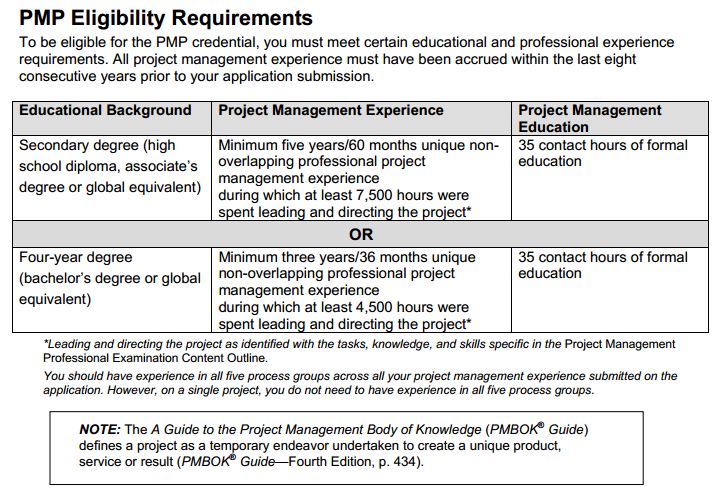
Really?I don't know if this is just ignorance or if Nymph is a PMP training provider trying to snag a new student. And frankly I don't care - this is the wrong answer. There is no way from Alex' question that anyone could say "I am glad to inform you that you are eligible to take the PMP examination..." It's clear from Alex' initial question that not all of his experience is directly managing projects, perhaps even less than half. We don't have enough information to tell. From Page 8 of the PMP Handbook (http://www.pmi.org/Certification/~/media/PDF/Certifications/pdc_pmphandbook.ashx):
The only way you'll know if you qualify or not is by documenting your specific experience and total it up. My experience log template helps with that, and there are many others available with a quick google search. http://pmstudent.com/pmp-experience-log/
So PleaseTraining providers and people just trying to be helpful, make sure you aren't over-reaching. Make sure you have your facts straight. Direct people to the sources of information like the PMI website and PMP Handbook. Don't make declarations and give people false hope ( or false negatory statements) when you can't possibly know what you're talking about with respect to their specific career experiences. Give them the tools so they can figure this out for themselves. It's the only real way to do it. </rant> /* close rant tag */
<shameless comments begging> Leave a comment and tell me I'm full of it, or agree with me. Whatever. I'm just glad to have gotten that off my chest. :-) </shameless comments begging> |

Sometimes, Project Management Sucks
Categories:
Leadership
Categories: Leadership
|
Like when you are developing a product using technologies that are relatively new and totally new to your team and stakeholders. While it is fun to be learning new things, it's damn hard to estimate effectively and stick to a schedule. Especially when the culture around you isn't used to new technologies or R&D-style projects. I mean, really. Like when programming languages that went out of style 20 years ago are still the core of most new development. Sometimes it seems like every day brings yet another unforeseen problem you weren't expecting at all. And you work with smart people. You're smart. Why is this happening? BreatheThe first step is to breathe. You may have to pivot, educate stakeholders, negotiate extensions. There are worse things in the world. You are the project manager after all, and you can get your team through this. Plus when you keep your head up and continue to be a role model for your team during tough times, something amazing can happen. Team GrowthThis situation can be turned to your advantage. There have been times I've been struggling like described above, and I was pleasantly surprised when my team took the pressure of our situation and used it as a tool to come together and execute. It can accelerate the storming phase of team formation when a strong leader on the team demonstrates optimism in the fact of adversity. When people see that 'can do' attitude, it becomes contagious. So, I say to myself and anyone else in this situation right now. Stop crying, little baby. Be a leader and show 'em what you're made of. |
 Do you know what I mean?
Switching Domains As a Project Manager
Categories:
Career Development
Categories: Career Development
|
I have a burning question that may or may not only affect me and my job searching experience. I have a PMP, and a higher education that includes a degree with a focus in project management. However my work experience has not been in the IT area and I have not been able to break this mold. Do you have any suggests on how to highlight cross transferable skills? I have worked in construction but not in the commercial area. It is not that I would not feel comfortable managing an IT project only most lean towards someone with a degree in computer science or someone that is considered an expert in the field. Please advise. I think it's true that in order to successfully manage projects in a particular domain the PM must have at least a foundation of technical knowledge about that domain. Someone who had only experience in IT but none in construction would be hard pressed to land a construction PM job, for example. Depending on the area of expertise, you can focus your efforts to maximum benefit. If general IT infrastructure projects are what you are going for, look into ITIL and use the process of studying to become more knowledgeable about IT. You may have to do something like I did when I moved into the Aerospace field - take a step down in responsibility in a role that is more of an analyst or coordinator role first to get your feet wet in the new domain - then in a year or so you'll be much better placed to transition to an IT PM role if you've done a good job of networking internally and proving your value. |
 Abdul asks:

