


Your Value Stream
Categories:
Kanban
Categories: Kanban


| Tweet
Every Team Has A Value StreamWhether you know it or not, your team has a value stream. Some teams have several value streams depending on the varied type of work they do. It is the process by which your team takes input and turns out the product at the end. That process is a value stream. It's nothing fancy or complicated. Each Step Adds ValueWell, every step should add value anyway. If it doesn't, why is it a part of your process? You will also find after using Kanban for awhile that the more time between steps, the lower value you acheive and the more waste is introduced into your system. This is why cycle time is so important in any system; the longer product in the system lay dormant, the more waste you introduce. People start forgetting what happened to the product in the last step, and so they have to spend some time reviewing it again before they can try to add more value to it. This process introduces the potential for human error, and in software it means more bugs. Start Where You Are AtThe benefit comes from visualizing your true value stream and facing it. Look it square in the eyes. You have to fully understand and accept where you are starting from before you can move forward. This is why visualization with something like Kanban is so astoundingly beneficial. It acts as the mirror you can look at to reflect reality. Only once you know thyself can you truly improve. Kaizen (Continuous Improvement)After you start using Kanban for awhile, you will soon start noticing problems with your value stream. Or rather, opportunities for improvement. There are no steps I can give you to make this happen. It just will. I never have had to have any retrospectives or set times to consider lessons learned. Every second we use Kanban we are in a retrospective process, evaluating our performance and process in a continuous manner. You can't help it. Questions about Kanban? Leave a comment below or check out http://KanbanSchool.com. Tweet |
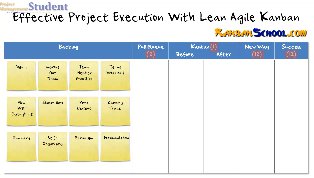 When I teach people about Kanban for the first time one of several key concepts must be fully understood before I proceed into the details of executing with a Kanban-enabled process.
Difficult Decisions
Categories:
Leadership
Categories: Leadership
| Tweet
In projects and in life, difficult choices come up all the time.
The conflict was a local conference regarding education and advocacy for disabled children and adults. I'm very active in this area and was recently appointed to the South Dakota Council on Developmental Disabilities. Attending the RehabACTion & Transition Conference would be educational for me and help me do a better job in my role on the council. What To Do?As project managers, we are also faced with difficult decisions all the time. Here are some helpful techniques I use on a daily basis to make decisions. Engage Team Members and Encourage Dissenting ViewsOne of the most important things you can do is listen to the opinions of others who have a stake in the decision and know something about the options involved. Even if the final decision is yours, listening to diverse perspectives on the topic helps clarify your own thinking. The Vatican used to have a 'devils advocate' policy where someone was assigned to get as much 'dirt' on a candidate for the Papacy. This encouraged dissenting views. On my teams, I've found in some cases I need not actively pursue dissenting opinions. One of my teams just has the culture of personalities that everyone makes their own views known and are not afraid to pronounce them aggressively. This is awesome, but not all teams gel like this naturally where everyone is friends and pokes fun at each other, etc. On another team I do have to actively seek out dissenting views. My favorite technique for this is to read the tone and body language of team members when discussing a decision that needs to be made. I select a few who I think may not like my preference by asking them directly but with a gentle smile, "[name], I would like you to tell me why this is not the right decision. I want to know why this is a bad idea, because it might be." It can take new teams awhile to adjust to this, because almost no project manager actively seeks out dissenting views. They will likely be hesitant at first, and may even feel like you are picking on them. With a new team, I will sometimes tell everyone ahead of time that I want them to come up with at least 1 reason why each option is a bad idea. I do the same. Then we share our negative opinions of each option. This makes the team comfortable with voicing their opinions by demonstrating that I value their input, regardless of whether they agree with me or not. The most dangerous thing a project manager can have is a team of 'yes' people. Write It DownI also love the process of writing down pros and cons of each option in a decision. The act of writing it down helps me ensure I've thought thoroughly about each option. In many cases I discover questions I hadn't thought of previously when I go to write the context, pros and cons of each option down. Specifically, I like to think in terms of value. What value is added or taken away with each option? If you don't use something like value-added as a criteria, you can still end up deciding on what 'feels' better, which is a bad idea. Human intuition can be great, but it goes wrong with complex decisions more often than it goes right. In The EndI decided that I'll add more value to the world by attending the disabilities conference than I would by presenting and attending the PMI Global Congress. It was a difficult decision still, but I'm confident I made the right one. My team members in this case were my wife and some close family members. When I wrote the options down, it became clear the primary benefits for attending the PMI conference were networking with people there and the prestige of speaking again at a large project management conference. However, the majority of the people I interact with at the PMI Congress are not engaged with my target audience for pmStudent, which is new and aspiring project managers. The majority of the companies and people in this space focus on things like delivering PDUs, consulting for companies, etc. When it was written down, it became evident that I can add more value at the disabilities conference - especially in terms of value to others. So while I'm sorry to miss this year's PMI event, I'm also confident I've made the right decision. Will you leave a comment and tell me how you make difficult decisions? Tweet |
 I had a schedule conflict with the
 When A Team Feels Micromanaged
|
|
How To Find Great Information Specific To Your Needs on Gantthead
Categories:
Misc
Categories: Misc
How to use Gantthead.com to find useful information quickly that is pertinent to your needs! | ||||||


When Testing Becomes A Dog And Pony Show
Categories:
Leadership
Categories: Leadership
|
It's a simple question. What is testing for? Some people seem to think that testing is for display purposes only. These people would expect your testing phase to consist of showcasing your product instead of actually testing it. I don't think so I think the best definition of true testing is this: Try to break the product. That's right, the only value in testing your product is to try to poke as many holes in it as you can. If you're testing phase consists of trying to look good in front of your customer, your stakeholders, your sponsors, then you are doing it wrong. Get this. Earlier this week I was actually asked this question. "Next time, could we do integration testing before the official integration testing?" That's right folks. We are talking about testing before we do testing. How sad is that? Now let me make sure I'm clear. We did dry run testing before the official testing. So it's not that we didn't test fully, or have ample preparation before the official testing. No, this is about looking good politically in a testing cycle. This type of showmanship has absolutely no place in effective project management. Period. |
 I'm going to ask you a question.

