


Making Big Projects Lean: Responsive Management
Categories:
Lean
Categories: Lean


| Management of projects is an important role, however in many cases it is overrated. We project managers tend to exaggerate our discipline to the extent that observers may conclude we feel management is the goal of projects. That our role is the most important one. How arrogant. Unfortunately, this leads to several troublesome trends I’ve seen time and time again on projects of all kinds. It creates roadblocks to progress which are codified and made a part of the project organization. And yet we think we are helping our teams get things done. PlanningProgressive elaboration can be utilized to great benefit even within a waterfall approach to managing projects, but it doesn’t seem to happen well as often as it should. Even within ‘agile’ projects managers will approach planning with a hubris allowing them to believe their crystal ball magically allows for detailed plans way out into the future.The world doesn’t operate that way, unless you are cranking out very similar products over and over again, for the same end-users. And yet large projects commonly go through a design phase in which requirements are elicited, detailed Work Breakdown Structures are drawn up, rather detailed designs are created, etc. In aerospace, we have a several planning milestones as a standard process way before teams actually start doing real work:
This process can take a long time (years in some cases) and only afterward do development teams start working on releases of the systems. Each of these releases are generally fairly large, primarily (in my opinion) because of the high overhead and coordination costs involved due to what is mostly waste; busy work that does not add value to the end products. Months and years can pass between the time requirements are elicited, designs are made, and something is actually implemented. And yet managers are surprised and disappointed when designs change before and during the course of implementation. Change ManagementChanges happen constantly on projects. Going back to the arrogance of thinking we can successfully plan in detail way in advance, many managers see change as a bad thing. This includes project managers, sponsors, executives, etc.What is typical about change management implementations, especially on large projects?
Configuration ManagementPrimarily, the problem here is confusing configuration management with change management. Many organizations see this as the same activity, the same discipline. It’s not.Configuration is about controlling what version of a product is deployed in a specific environment. This applies to documentation, code, COTS packages, hardware, and anything else that is part of the products being produced or the tools for getting the project done. The same criticisms of change management apply to configuration management as well on large projects. Many times the method for configuring an item in a baseline or in a specific environment (a specific test environment for example) is so long and painful that we tend to like large releases so we don’t have to deal with configuration management that often. Risk ManagementRisk management is important, and having a system in place to encourage the identification and proactive tackling of risks is critical -- especially on large projects. However just as noted with the other management disciplines, on large projects risk management tends to be a behemoth time-suck in which more time is spent over the course of months on valueless pieces of busywork that could have been better spent actually mitigating or avoiding the negative risk.We spend months on templates, automation, fancy prioritization schemes, etc. When it comes down to it, all you need is to define the risk in a sentence, figure out how to address it if it’s worth it, and go do it. 1. Define: [Given] {condition} [there is a possibility] {risk event} [resulting in] {consequence} 2. Decide: Mitigate/Accept/Avoid/Exploit -- How? 3. Take Action Know Your Place, ManagersThese management practices and more exist for the project team and stakeholders, not the other way around. They are not ends in and of themselves, they are part of the means to the end only. Especially on large projects, these disciplines can sprout little fiefdoms whereby leads or managers over these areas believe the project exists for them and not the other way around. This leads to initiatives to create a slew of standardized templates, convoluted processes that try to manage every exception to the rule, and a separation from reality as team members focused on these management areas disassociate themselves with the people doing the real work of producing products for the end users. In my experience, if you view your role as a manager to facilitate the ability of the people involved with actual product creation (developers, end users, team members), it’s much easier to contribute real value to the team. |
Making Big Projects Lean: The Series
Categories:
Lean
Categories: Lean
|
Over the years I have worked with teams on large systems projects in various industries. These have all tended to be managed with ‘traditional’ project management practices including a waterfall development cycle.
I have observed some key areas for improvement in these projects. They tend to have a lot of waste. This manifests as long delays between value-adding activities, rework, and local optimization instead of system-wide improvements. It also comes in the form of lots of busy work that doesn’t add any real value to the final products. PMOs in general are a big contributor of non-value added busy work in my experience and in my opinion. They’ll spend months revising management plans, project processes on flowcharts, etc. -- usually in a detached way from the actual work that is being done and thus the actual value being created by the project teams. We’ve all seen it -- a new process document comes down from on high and all the developers and other team members groan as they try to figure out how they can appear to be in compliance with this nonsensical new process and still manage to get some real work done. They tend to undervalue the creativity of project team members.The single most valuable resource on any project is the project team members. Big projects with waterfall development in particular tend to view people as ‘widgets’ or ‘resources’ that are interchangeable and simply get assigned tasks to get done. People are treated as being outside the systems...people are seen as operators of processes instead of part of the processes themselves. This is a big mistake. When we see people as operators of cogs in a machine simply producing output, we are leaving a great deal of untapped potential on the table. In my experience not only do people want to do good work they can be proud of, they want to contribute intellectually and creatively to the project as a whole. This includes ideas for improving product creation, management and development processes, and a whole host of other attributes that go on in any project. They demand cutting corners.Milestones and inertia drive project decisions and the focus tends to be on requirements verification, not validation. Delivery to specs is more important than ensuring the specs actually meet the needs and desires of the end users. The tendency for this to happen increases as a function of time. The cost of making changes increases over time, and because most large projects with a waterfall approach neglect the importance of continuous learning and feedback as being integral to everything they do, many changes are discovered as necessary late in the project and then need to be negotiated down or completely away. Of course as we all know, customers and end-users don’t really know exactly what they want until they see it. They have a vague idea in the beginning, and most large projects codify this vague understanding into requirements that are increasingly resistant to change as time goes on. In the end, you have a product which may meet most of the end-user needs but you’ve probably had to negotiate and sacrifice those needs to avoid costly rework. Another phenomenon that is common to see is cutting corners on activities like testing and validation processes -- settling in the end for ‘good enough’. They force multitasking on the project teams.There is usually little to no focus on, well, focus. Project team members and project managers are always trying to juggle ten tasks at once, and when things fall on the floor we put our fire-fighting hats on. I know you’ve seen it just as often as I have -- the project has a handful of things in work simultaneously, and team members are bouncing back and forth. They start lots of things, but those items only get completed when management decides they are the ‘red alert’ of the week. This holds especially true for critical resources with a specialized skill. They get bombarded from all directions to help with this little thing, that little thing. They end up working from home at off hours to get their ‘real work’ done when they aren’t being disturbed every ten minutes. About This Series
In This Series: |
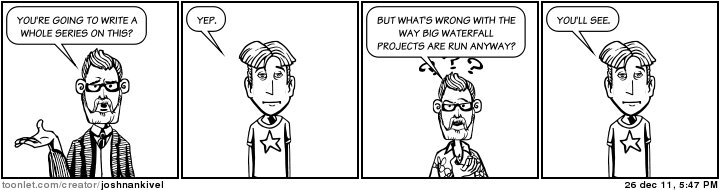
Project Management Is Not About Getting Work Done
|
He was doing everything he had been taught to manage projects effectively, and yet it seemed as if more time was being spent on rework and just getting things done. A fellow colleague was doing well. Her projects were not only going well, but she and her team seemed much less stressed. "I'm in trouble here, I need to know your secret. Can we chat?" he asked. "Of course," she replied. The struggling project manager laid out his problems, one after the other. "I'm working my tail off, and so is my team. Yet every day is like putting out one fire after another. We are always re-working something because it wasn't what the customer really wanted. And all of our tasks seem to take so long, especially when I compare my team to yours. Heck, even updating a document seems to be a monumental effort. My team is very skilled, just as good as yours. What am I doing wrong?" "You want to know what I think?" she asked. "Yes! Tell me!" he replied with exasperation. "You are focused on getting work done." "Aaaaand? Isn't that what I am supposed to do, get things done?" "No. That shouldn't be your goal. You should be adding value." she replied. "Oh come on! What's the difference?" he whined. "Work which does not add value is wasted, and non-valuable work usually ends up causing even more waste work. Stop looking at what your team is doing as a collection of tasks. Start questioning what is adding value from the customer's perspective. If it doesn't add value, why are you doing it? Also, start seeking out waste and eliminating it. Time lags between steps on an individual feature or item is a form of waste. It takes your team longer to update documentation because they have to go back and remember what they did with their code in order to make the updates. The longer it takes for anything to go from initial design to being delivered to the customer, the more waste you incur and the less value your customer gets." "I never thought of it that way" he said. "Think about it. Observe your processes in action and you'll start to see what I mean. Well, I've got to run, but it's been nice talking with you." she said with a wave as she walked away. He thought about her words for a moment. Immediately, his mind was inundated with examples from what his team had been doing just in the last week which fit her definition of waste perfectly. "Oh crap" he thought. "We have got to do something about this. Now!" |
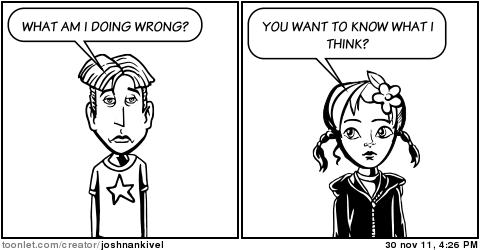 A project manager was struggling deeply with his project.
Sub-Optimize Your Way To Failure
|
Or rather, been reminded of it. Sub-Optimization SucksThe only way to acheive a truely lean organization or even a lean project is for the entire value stream to be bought into lean thinking. Because of this fact, senior leadership in any organization must be fully supportive and invested in moving an organization to lean and agile thinking and process. My teams are gaining clear benefits from the methods we've implemented with Kanban. However, because we are the only teams running this way, the benefits are also very limited. BlockedFor example, in some cases my team members need external validation from other teams before we can move a particular feature forward in the value stream. When those external parties are not bought into lean thinking (single-piece flow, limited WIP, continous deployment) they can very quickly become a block, causing a bottleneck in the value stream. Pushing For ChangeSo, I am trying to develop interest from the other teams we interface with. Who knows, maybe I'll be successful in 'converting' them. Perhaps not. Even better, I'm formulating plans for a method of convincing senior leadership that for our next program, a lean/agile approach is superior to our waterfall SDLC. We'll see. Wish me luck. |
 I've realized something lately.
EVM - Earned Value Tutorial For Iterative Planning
Categories:
Earned Value Management
Categories: Earned Value Management
|
What level do you track earned value for your projects? Too high is a problem, and trying to decompose work packages prematurely is problematic too. So how do you get the best of both worlds? Here's how. I suggest you view this in 720 HD, full screen so you can see everything in the tutorial clearly. Note: Around 5:30 you'll notice in Step 3 I mis-labeled the last column. It should be PV (Planned Value) and not EV (Earned Value).
|


