





Guessing is not a strategy: How to build decision velocity with AI and real-time data
June 10, 2026 | Live Webinar

How to do a webinar in our Change Management Community - Updated 2023!
Call for Volunteer - Transformation & Leadership
Why Projects Fail Due to Lack of Sponsorship
PM - A cheerleader, a manager or the captain of the team?
Stakeholder management in research: How to keep people engaged and interested in your project
3-generational workforce, Agile, Agility, Authenticity, Carole Osterweil, change, Change Management, Change Resistance, Character Strengths, character strengths, CIO, communications management, creative organization, creativity, creatvity, Crisis management, Culture, curiosity, Decision Making, Design Thinking, Digital Transformation, Disruptive change, Embracing change, emotional intelligence, Employee engagement, Exponential, first birthday, Fourth Industrial Revolution, Future-readiness, Humanizing workplace interactions, ideas, Innovation, innovation management, innovative organization, inovation, Joe Pusz, Leadership, Leadership in 21st century, Leading change, Listening, Luisa Cristini, Management, managing crisis, Mental Maturity, mentalhealth, Mindsets, modern project management, Neuroscience, New normal, perspective, PM, PMI, PMO, pmo, PMO Joe, Project Delivery, Project Management, project management, research and development, Resilience, risk management, science management, self-esteem, Self-evolution, social intelligence, Sponsorship, Stakeholder Management, stakeholder management, Stakeholder Management; Engagement; Appreciation, Strengths-Based Project Management, Sustainability, systems thinking, Teams, Technologies, The Great Reset, Thought Leadership, Transformant, Transformative Leadership, Transformative leadership, Uncertainty, Upskilling, VUCA, Walter Vandervelde, Wise passivity, Workspace dynamics


| Updates on the earlier post by Nic Jain on the same topic. We have some updates on our process for Change Management webinar and we hope this update will help for future speakers to have a better understanding on the changes. Key changes are highlighted and as follows: Step 1) Reach out to us. DM @Nic Jain, @Aung Sint, @Praveena Pentakota, @Kimberly Whitby with a proposed topic. Step 2) After we decide on the date, get ready to provide us the following at least 60 days before the scheduled date:
Step 3) We send you an agreement and you sign and send it back to us along with Step 2 information - 2 months ahead of the scheduled date Step 4) Send us the PowerPoint slide the Friday before the scheduled date Step 5) We perform a practice session 2 days prior to the scheduled date (usually on Mondays), so be ready to wear your practice shoes. For a more detailed view on the process, please watch the updated video walk-through attached. Our volunteers are sharing knowledge through a zoom call. Video and content by Aung Sint, Nic Jain and Praveena Pentakota.
|
| This is an active post as of Feb. 20, 2022. Within PMI’s online community, ProjectManagement.com, a group of volunteers organizes monthly webinars on the topic of Change Management. To complement this webinar series, they also maintain a blog, Transformation & Leadership – Insider Tips, featuring lessons learned and diverse perspectives from experienced professionals. This team is currently looking for someone to assist with their endeavors to advance conversations around change management and provide tips and tools to the online community (in a volunteer capacity). The volunteer blog & webinar coordinator is responsible for sourcing, working with, and facilitating presenters through: 1) the webinar development process; and 2) the blogging process for the Transformation & Leadership blog He/she will host practice sessions for presenters and help facilitate live webinars for the team in the area of Change Management. The volunteer will also work with presenters to contribute change management content to the blog. The volunteer should be an active team member who is enthusiastic about providing great webinars and blog posts to the community on ProjectManagement.com. This volunteer will: • Meet with team on a regular basis to discuss plans for webinar & blog program • Assist in planning webinars and provide updates as necessary • Coordinate scheduling of webinars and complete PMI presenter forms for each webinar • Coordinate and facilitate presenter practice sessions • Host live webinar sessions (about one webinar per month) • Coordinate scheduling of blog posts for the Transformation & Leadership blog, and review blog content to ensure compliance with User Guidelines The estimated time commitment is 4-5 hours per month with weekly team meetings - all virtual. The volunteer should have strong project, program, and/or portfolio management skills and understand and commit to PMI’s objectives and goals around increasing member value and knowledge delivery. PMI membership is required for this role. This is a team of volunteers, so flexibility is needed, and experience with Webex is strongly encouraged. PDUs for Giving Back can be claimed in accordance with the policies outlined in your credential's handbook. If you are interesting in volunteering, please contact Laura Schofield via the Inbox on ProjectManagement.com with: -your statement of interest -an explanation of any experience that you have facilitating webinars by 15 March 2022. An interview with shortlisted candidates and the volunteer team will be conducted. |
|
Without a sponsor, your project will fail.
One company I worked with a few years ago initiated a large-scale, transformative change, which would impact how they went to market with some of their products and services. They had a great project structure, with project managers, administrators, and well-qualified technical support. They had a change and communications team that was well positioned to help them communicate about the change and prepare the organization. Ultimately, though, the project struggled for 2-3 years before senior executives decided to cancel the project. It failed to achieve most of the benefits they sought after.
What went wrong? There was insufficient leadership involvement. Yes, there were lower-level leaders who had an interest in the success of the project, but there was no single sponsor or sponsor coalition to hold the team accountable for results and mitigate project risks. One of the greatest risks which ultimately led to the end of the project was conflicting requirements of low-level leaders. I call this cross functional dysfunction.
Projects that have solid project management and change management teams cannot be successful without adequate sponsorship. They will suffer from these conditions:
Every project, regardless of size, requires a sponsor who is clear on their role as ultimate spokespersons for the change, and holds the project team accountable for delivery. The activities of a great sponsor include:
The organizational level of the sponsor depends on the breadth of the change. The rule of thumb is that ultimately, everyone significantly impacted by the change should have a direct reporting relationship to the sponsor. For example, if the change impacts everyone in the manufacturing operation, then the VP of Manufacturing would be the likely sponsor. If the change impacts everyone in accounting, then the Accounting Executive is the sponsor. You get the idea.
When your project structure includes solid sponsorship, at the right level, you will have a much better chance of achieving the intended results, thus driving the value you planned.
|
| What is the leadership role that a project manager needs to play to navigate the complexities in today’s business environment? A cheerleader, a manager or the captain of the team. Is that a constant or needs to be adapted according to the situation? In order to answer these questions, let’s take a cue from the medical industry. A varying ECG shows we are healthy and a seemingly straight line shows we aren’t. Even an ECG has to keep changing to show everything is fine, so how about ourselves: do we change or remain the same? When we internalise change, we would be less anxious about the external changes as we are countering the external changes by our own internal force of change, so instead of showing inertia as in the Newton’s First Law, we are actually playing along with the change activating a Force multiplier! Having established beyond doubt that change is vital, we could explore the reality that we have reached a point of inflection, wherein technology adoption has increased so exponentially that human processes have not been able to catch up. In all this, what does the Project Manager do or change to make his projects click? Well, the key lies in making the human connections work! No matter what structures we put in place, what latest technologies we adopt, what new management principles we adopt, the improvisations will fall flat if the human factor is discounted. A Gallup study in 2020, showed that only around 15% of global workforce is effectively engaged at work. So how do Project Managers address this huge gap? How do they keep the team engaged, improve team productivity at the office or in a Work-from-home scenario and ensure fulfilment of project outcomes?
It all boils down to the Project Manager’s relationship with the team. It becomes all the more important that the PM is capable of seamlessly transitioning across the roles as a cheerleader, a manager and the captain of the team so that the team feels more engaged, empowered at all times and never feels let down. A Project Manager as a cheerleader encourages the team to keep looking for ideas and solutions for challenges, cheers them on and creates a supportive work environment. As a Manager, the PM establishes the structure of work, working on the communications, allocating resources, exhibiting accountability and responsibility for the Team performance. As a Captain of the Team, the PM leads the Team from the front, navigating effectively through conflicts, facing challenges head on gaining the Team’s trust and respect. These roles keep evolving and the Project Manager also needs to evolve as per the situations at hand, humanizing their interactions so they become more collaborative rather than transactional in nature. Instead of the conventional roles and responsibilities, the new age roles equip the new age leaders better to complete their projects successfully and lead their teams to success. |
| Who are the stakeholders in your research project and why is it important to engage with them? How can you keep your project team and people outside interested in your project? How important is communication with your key stakeholders and how can you make sure your communication is effective? Stakeholder management is key to scientific research. Every project has stakeholders who can influence the project in a positive or negative way. The ability to manage stakeholders in an appropriate manner can mean the difference between success and failure. Stakeholder engagement is important to increase support and minimise resistance from key stakeholders. Identify your stakeholdersStakeholders are people, groups or organisations that could affect, be affected or perceive to be affected by any decision, activity or outcome of the project. It is important that all stakeholders are identified regardless of how major or minor they are. This is because they will be categorized after they are identified. If stakeholders are omitted there is a likelihood that they may become evident at some point during the project’s lifecycle and introduce delays or other obstacles to the project’s success. Stakeholder analysis is the process by which you identify your project’s stakeholders:
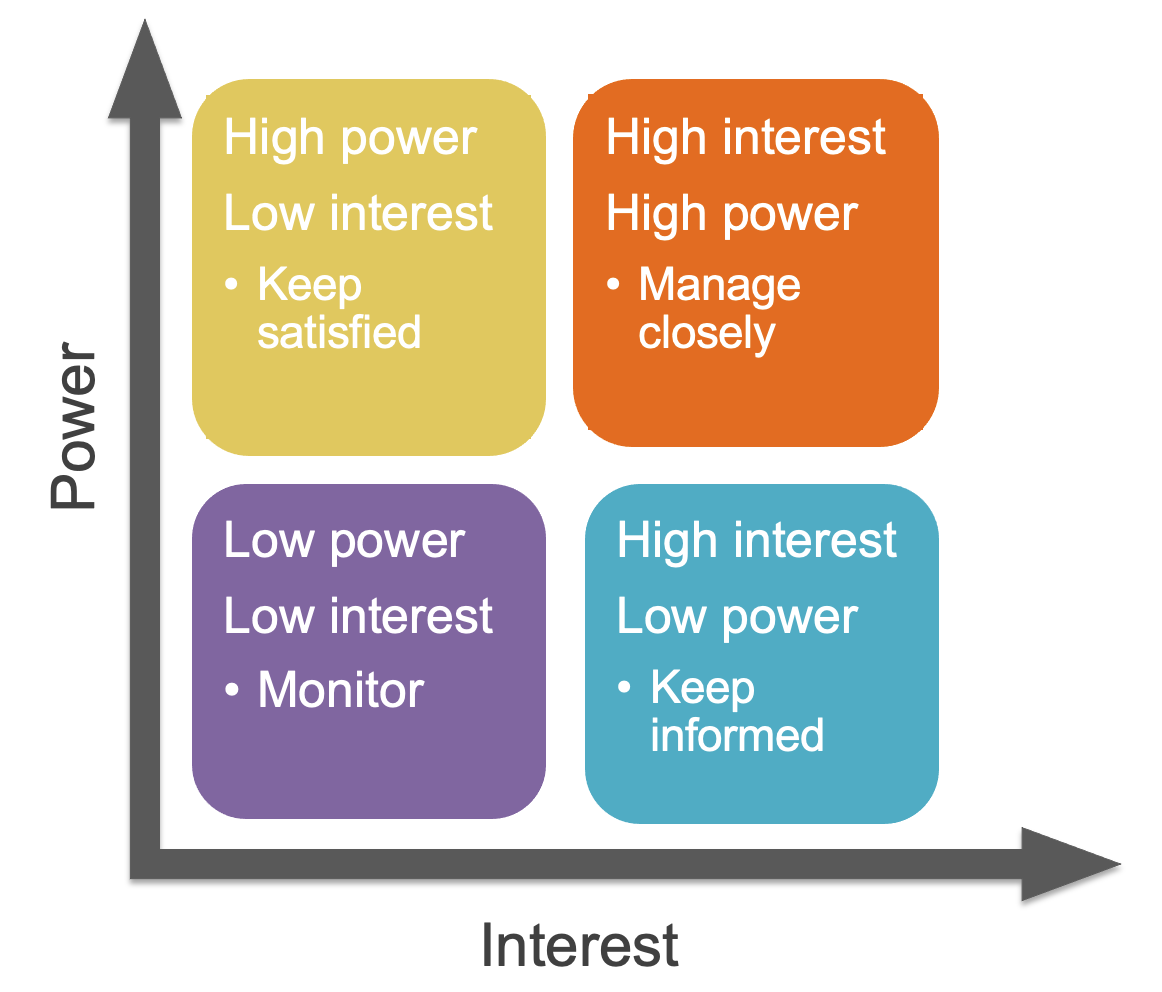
Any individual who meets one or more of the above criteria can be identified as a stakeholder. Stakeholders from the same organization can be grouped in order to simplify stakeholder management. Once you have identified your stakeholders you can analyse the list (your Stakeholder Register) and categorized or grouped them assigning a level of impact they may have based on their power, influence, and involvement in the project. You should also add any description which might be helpful to plan your stakeholder engagement. How could the project stakeholders identified in the previous section be impacted by the project? Do any of the stakeholders link/relate with each other? You can also visualise your project’s stakeholders on a power/interest grid and prioritise them based on the grid.
A stakeholder analysis is very beneficial because:
Plan your stakeholder engagementOnce you have identified and analysed your stakeholders in the stakeholder register, you can develop a Stakeholder Engagement Plan. In the plan you should describe how stakeholders will be approached and by whom in the project team, as well as how often the project team will communicate with them. First you need to carry out a stakeholder engagement assessment: what is the current level of engagement of each stakeholder? What is the desired engagement level? You will prioritise your stakeholder engagement based on the power/interest grid and your stakeholders’ engagement levels:
Once you have prioritised your stakeholders you need to decide how to engage with them, that is, how you will communicate with them throughout the project. What information about the project will be communicated to which stakeholders? How will the communication be delivered and when? Who will be in charge of the communication? How often will feedback be requested from the stakeholders? How will the feedback be implemented in the project? Receiving feedback from your stakeholder is crucial in research projects because engaging with your stakeholders by listening to their feedback and incorporating their needs in your research means co-production of knowledge, important to achieve results. Communication is key to stakeholder managementCommunication is crucial for stakeholder engagement because it is the most powerful tool:
You should communicate and work with your stakeholders often throughout the project to meet their expectations and needs, address issues as they occur and foster appropriate engagement strategies. The timing of your communication with your stakeholders is also important. Engagement at appropriate stages helps to obtain or confirm their commitment to the success of the project. Keep an agile mindsetResearch projects are a way to explore the unknown and in most cases, you do not know what to expect as a result. Keeping an agile mindset helps address changes that might occur along the way and overcome challenges. This is important also when engaging with your stakeholders so here are some points to keep in mind to embrace change:
References
|
|
"When you want to test the depths of a stream, don't use both feet." - Chinese Proverb |