




Guessing is not a strategy: How to build decision velocity with AI and real-time data
June 10, 2026 | Live Webinar

The Emerging Tensions of Adaptive Governance
From Statistical Patterns to Operational Judgment
ORGANIZATIONAL MEMORY & DECISION CONTINUITY
RESPONSIBLE DECISION ARCHITECTURE™
Decision Architecture Under Pressure
Agile, Career Development, Career Development, Career Development, Career Development, Career Development, Career Development, Career Development, Career Development, Career Development, Career Development, Career Development, Career Development, Career Development, Career Development, Career Development, Career Development, Career Development, Career Development, Career Development, Career Development, Career Development, Career Development, Career Development, Career Development, Career Development, Career Development, Career Development, Career Development, Career Development, Career Development, Career Development, Career Development, Career Development, Career Development, Career Development, Career Development, Career Development, Career Development, Career Development, Career Development, Career Development, Career Development, Career Development, Career Development, Career Development, Career Development, Career Development, Career Development, Career Development, Career Development, Career Development, Career Development, Career Development, Career Development, Career Development, Career Development, Career Development, Career Development, Career Development, Career Development, Career Development, Career Development, Career Development, Career Development, Career Development, Career Development, Career Development, Career Development, Career Development, Career Development, Career Development, Career Development, Career Development, Career Development, Career Development, Career Development, Interpersonal Skills, Interpersonal Skills, Interpersonal Skills, Interpersonal Skills, Interpersonal Skills, Interpersonal Skills, Interpersonal Skills, Interpersonal Skills, Interpersonal Skills, Interpersonal Skills, Interpersonal Skills, Interpersonal Skills, Interpersonal Skills, Interpersonal Skills, Interpersonal Skills, Interpersonal Skills, Interpersonal Skills, Interpersonal Skills, Interpersonal Skills, Interpersonal Skills, Interpersonal Skills, Interpersonal Skills, Interpersonal Skills, Interpersonal Skills, Interpersonal Skills, Interpersonal Skills, Interpersonal Skills, Interpersonal Skills, Interpersonal Skills, Interpersonal Skills, Interpersonal Skills, Interpersonal Skills, Interpersonal Skills, Interpersonal Skills, Interpersonal Skills, Interpersonal Skills, Interpersonal Skills, Interpersonal Skills, Interpersonal Skills, Interpersonal Skills, Interpersonal Skills, Interpersonal Skills, Interpersonal Skills, Interpersonal Skills, Interpersonal Skills, Interpersonal Skills, Interpersonal Skills, Interpersonal Skills, Interpersonal Skills, Interpersonal Skills, Interpersonal Skills, Interpersonal Skills, Interpersonal Skills, Interpersonal Skills, Interpersonal Skills, Interpersonal Skills, Interpersonal Skills, Interpersonal Skills, Interpersonal Skills, Interpersonal Skills, Interpersonal Skills, Interpersonal Skills, Interpersonal Skills, Interpersonal Skills, Interpersonal Skills, Interpersonal Skills, Interpersonal Skills, Interpersonal Skills, Interpersonal Skills, Interpersonal Skills, Interpersonal Skills, Interpersonal Skills, Interpersonal Skills, Interpersonal Skills, Interpersonal Skills, Interpersonal Skills, Leadership, Leadership, Leadership, Leadership, Leadership, Leadership, Leadership, Leadership, Leadership, Leadership, Leadership, Leadership, Leadership, Leadership, Leadership, Leadership, Leadership, Leadership, Leadership, Leadership, Leadership, Leadership, Leadership, Leadership, Leadership, Leadership, Leadership, Leadership, Leadership, Leadership, Leadership, Leadership, Leadership, Leadership, Leadership, Leadership, Leadership, Leadership, Leadership, Leadership, Leadership, Leadership, Leadership, Leadership, Leadership, Leadership, Leadership, Leadership, Leadership, Leadership, Leadership, Leadership, Leadership, Leadership, Leadership, Leadership, Leadership, Leadership, Leadership, Leadership, Leadership, Leadership, Leadership, Leadership, Leadership, Leadership, Leadership, Leadership, Leadership, Leadership, Leadership, Leadership, Leadership, Leadership, Leadership, Leadership, Leadership, Strategy, Strategy, Strategy, Strategy, Strategy, Strategy, Strategy, Strategy, Strategy, Strategy, Strategy, Strategy, Strategy, Strategy, Strategy, Strategy, Strategy, Strategy, Strategy, Strategy, Strategy, Strategy, Strategy, Strategy, Strategy, Strategy, Strategy, Strategy, Strategy, Strategy, Strategy, Strategy, Strategy, Strategy, Strategy, Strategy, Strategy, Strategy, Strategy, Strategy, Strategy, Strategy, Strategy, Strategy, Strategy, Strategy, Strategy, Strategy, Strategy, Strategy, Strategy, Strategy, Strategy, Strategy, Strategy, Strategy, Strategy, Strategy, Strategy, Strategy, Strategy, Strategy, Strategy, Strategy, Strategy, Strategy, Strategy, Strategy, Strategy, Strategy, Strategy, Strategy, Strategy, Strategy, Strategy, Strategy, Sustainability, Talent Management, Talent Management, Talent Management, Talent Management, Talent Management, Talent Management, Talent Management, Talent Management, Talent Management, Talent Management, Talent Management, Talent Management, Talent Management, Talent Management, Talent Management, Talent Management, Talent Management, Talent Management, Talent Management, Talent Management, Talent Management, Talent Management, Talent Management, Talent Management, Talent Management, Talent Management, Talent Management, Talent Management, Talent Management, Talent Management, Talent Management, Talent Management, Talent Management, Talent Management, Talent Management, Talent Management, Talent Management, Talent Management, Talent Management, Talent Management, Talent Management, Talent Management, Talent Management, Talent Management, Talent Management, Talent Management, Talent Management, Talent Management, Talent Management, Talent Management, Talent Management, Talent Management, Talent Management, Talent Management, Talent Management, Talent Management, Talent Management, Talent Management, Talent Management, Talent Management, Talent Management, Talent Management, Talent Management, Talent Management, Talent Management, Talent Management, Talent Management, Talent Management, Talent Management, Talent Management, Talent Management, Talent Management, Talent Management, Talent Management, Talent Management, Talent Management


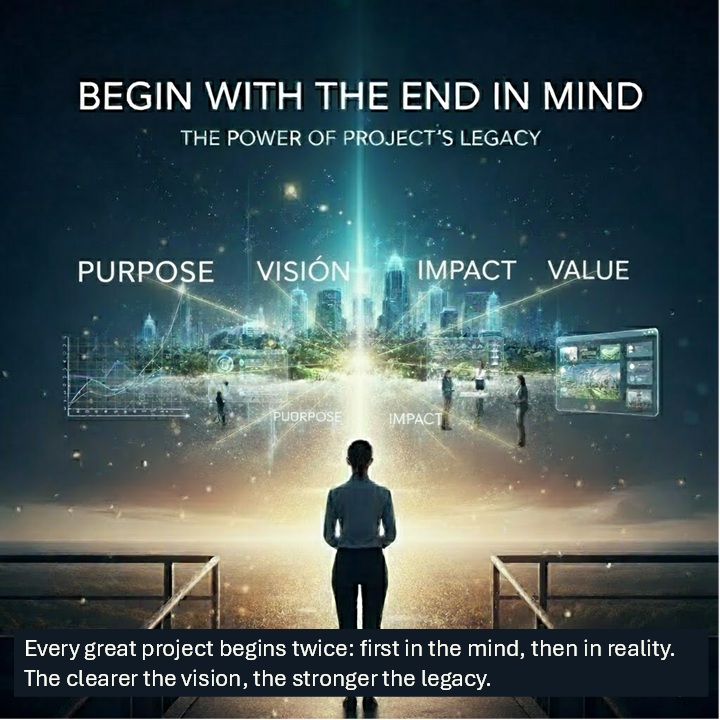 Application in Project Management The Original Meaning Stephen R. Covey teaches that everything is created twice: 1. First in the mind (mental creation) 2. Then in reality (physical creation) In project management, this means that every plan, decision, and deliverable must be born from a clear vision of the desired outcome, not from schedules, pressure, or routine execution. But the principle goes deeper. The entire project itself must also begin with the end in mind. Before defining activities, it’s essential to visualize the ultimate impact, the legacy the project will leave on the system it serves. The End in Mind at the Project Level A project is not merely a sequence of deliverables. It is an intention transformed into reality. Applying Habit 2 to the project as a whole means clarifying its systemic purpose:
“A project with purpose inspires coherent decisions even under pressure.” Translating Covey’s Principle into Project Practice 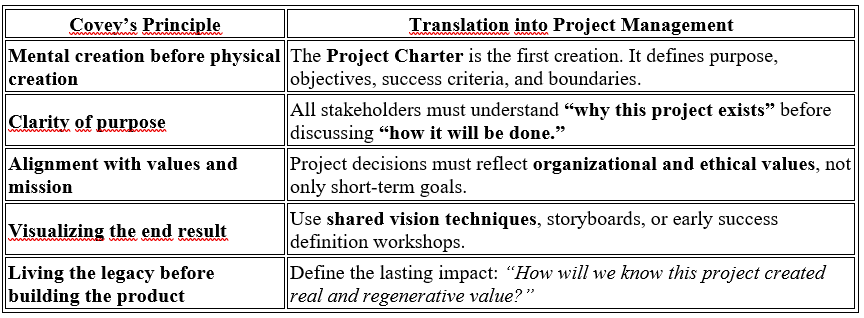 Key Questions for a Conscious Project Leader 1.What is the true purpose of this project? (Why did we start it? What problem or opportunity are we addressing?) 2.What will success look like? (What should be functioning, changing, or existing by the end?) 3.Which principles and values will guide our toughest decisions? 4.Who needs to believe in this vision and why? 5.What legacy will this project leave for the organization, team, or community? Tools and Practices that Bring the Habit to Life 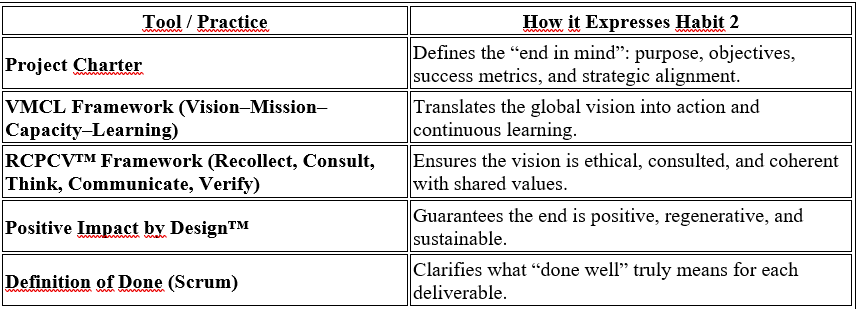 Practical Example Project: Implementation of a new Quality Management System (ISO 9001) End in Mind (Global): “To build a living culture of continuous improvement, not just obtain a certificate on the wall.” How to apply:
In a regenerative context, the “end” is more than a result, it’s a future we choose to create. Each decision, sprint, and milestone should move the system closer to that desired future. Such projects don’t just deliver; they endure. “The true success of a project is when the system continues to thrive even after the project is complete.” Core Message “Begin with the end in mind” means leading projects from purpose, not from the schedule. Habit 2 reminds us that every project is created twice: First in the vision that inspires it, then in the reality that confirms it. When purpose is clear, every plan, risk, and deliverable becomes a conscious step toward the impact we want to see in the system. Inspirational Closing So, does your next project begin with tasks or with vision? The real starting point isn’t the plan; it’s the purpose. Because only those who can clearly see the end can lead the path with consciousness. |
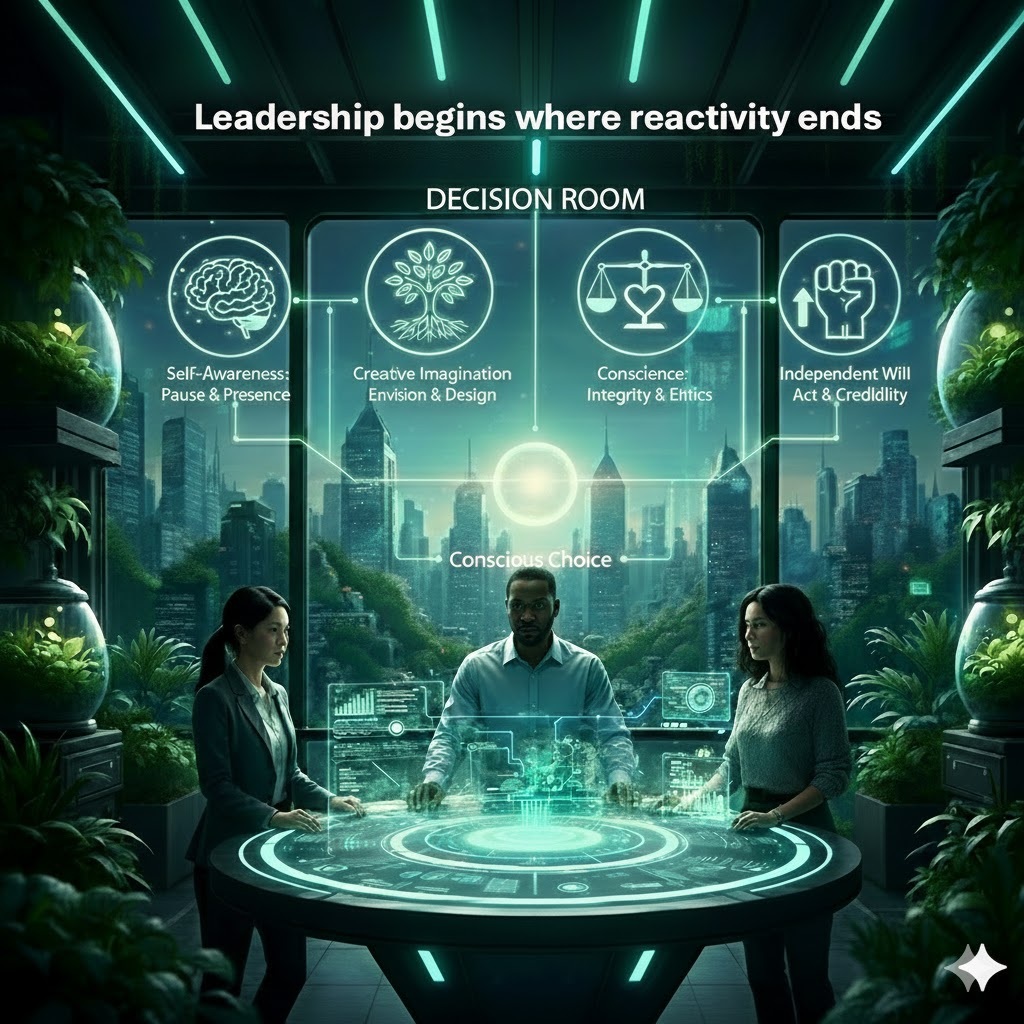 Using the Four Human Endowments to Lead with Awareness “Between stimulus and response, there is a space. In that space lies our power to choose our response. In our response lies our growth and our freedom.” — Stephen R. Covey The Foundation of Regenerative Leadership Not every delay comes from the schedule. Some come from how we react. Being proactive is more than acting fast, it’s acting consciously. It’s choosing a response with intention, not reacting by impulse. Proactivity, in its deepest sense, is leadership in motion: The ability to create, not merely to respond. Stephen R. Covey reminds us that true freedom lies in the space between stimulus and response, and within that space live four human endowments, the inner tools that transform reaction into leadership. The Four Human Endowments in Project Leadership 🔸Self-awareness - the ability to pause before reacting; to recognize emotions, biases, and patterns that cloud judgment. It transforms pressure into presence. 🔸Creative Imagination - the capacity to envision new possibilities and regenerative solutions before problems escalate. It transforms limitation into design. 🔸Conscience - the moral compass that guides action by values, not convenience; choosing integrity over comfort. It transforms ambition into ethics. 🔸Independent Will - the discipline to act on what is right, even when it’s difficult. It transforms intention into credibility. Together, these four endowments allow a project leader to navigate complexity with clarity to lead the context, not be led by it. Proactivity Across the Project Cycle In every phase - initiation, planning, execution, monitoring, and closure - proactivity turns management into conscious design: 🔸 Initiation: Anticipate stakeholder expectations and align purpose early. 🔸 Planning: Identify critical risks and define adaptive responses before they occur. 🔸 Execution: Take ownership for results and foster transparent communication. 🔸 Monitoring: Transform data into insight; adjust with agility and ethics. 🔸 Closure: Capture lessons learned, to regenerate improvement, not repeat mistakes. Each project phase is an opportunity to lead consciously, to replace reaction with reflection, and activity with awareness. The Decision Room Imagine the space between stimulus and response as your project’s decision room, a place of reflection, integrity, and creative imagination. It’s where data meets conscience, where choices align with values, and where leadership becomes regeneration. Key Insight To be proactive is to activate our four human endowments in every decision. It is the art of transforming reaction into responsibility. The first step of regenerative leadership, where every conscious choice leaves a positive imprint on the system. Key Message: “Leadership begins where reactivity ends, in the space of conscious choice.” |
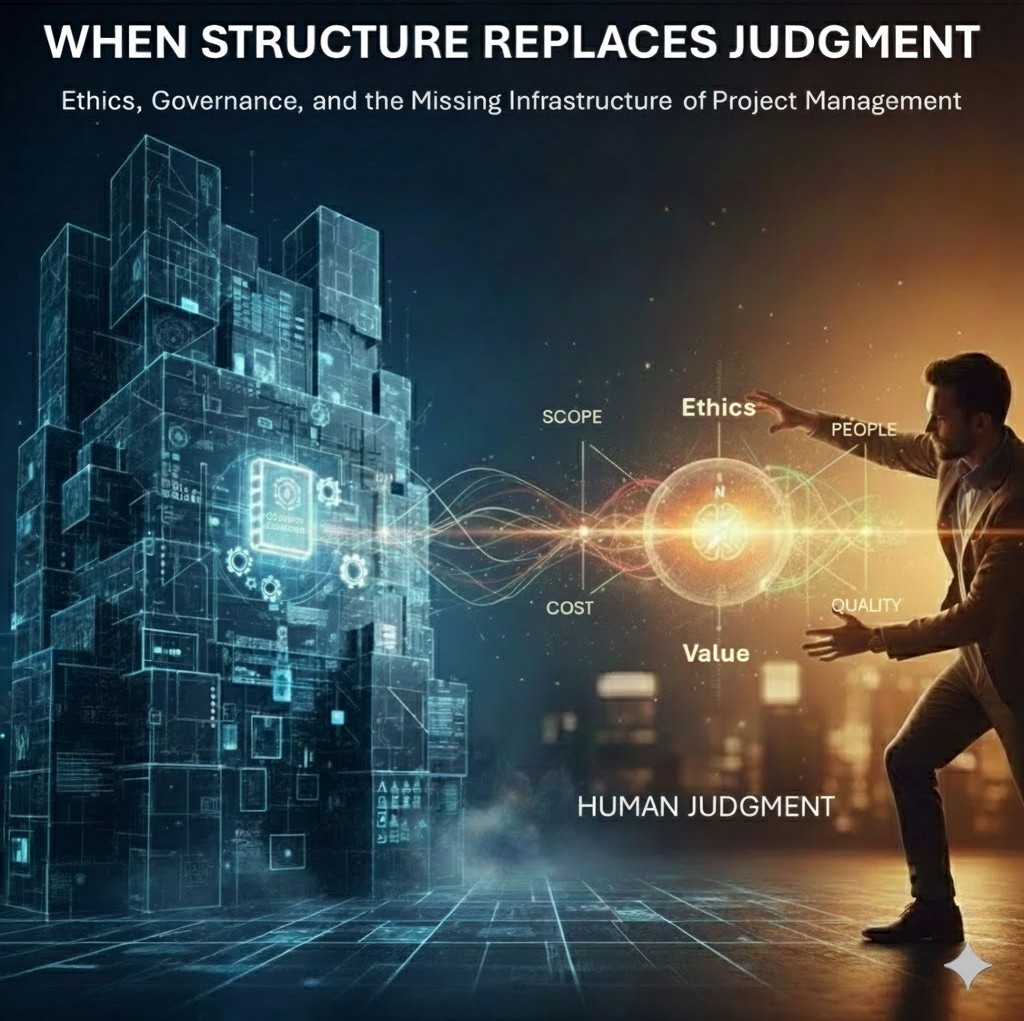 Why Ethics, Governance, and Integration Are Becoming the Missing Infrastructure of Project Management Introduction: A Shift We Rarely Name Project management is evolving. But not all change is visible in new frameworks, domains, or terminology. Alongside the rise of governance models, ethical toolkits, and decision frameworks, something quieter has been happening: Decision ownership and integration have been progressively displaced by structure. This shift is rarely presented as a loss. It is often framed as modernization, maturity, or inclusiveness. Yet beneath that narrative lies a structural risk. When ethics, governance, and integration are blurred into a single conceptual space, leadership does not evolve. It risks dissolving. Ethics Is Not Governance. Governance Is Not Integration. To understand what is at stake, we must restore conceptual clarity. The renewed ethical ecosystem published by the Project Management Institute is strong and necessary. But its elements operate at different systemic levels. This distinction is not about hierarchy, but about function. Ethics, in the strict sense, is normative. It defines values, obligations, limits, and professional conduct. This role belongs to the Code of Ethics and Professional Conduct. Governance is structural. It defines how decisions are framed, disciplined, documented, and protected. This is the role played by:
They govern how decisions should be made, reviewed, and justified. Integration, however, is neither ethics nor governance. Integration is management in action. Integration Is the Act Governance Cannot Perform Governance defines the frame:
Integration does. Integration is the human act of:
From Explicit Responsibility to Silent Assumption Integration has not disappeared because projects became simpler. Complex work requires integration more than ever. What changed was its status. Integration moved:
It loses its owner. The result is familiar:
It is distance between decision and execution. Governance Without Integration Creates Entropy Projects rarely fail because governance is weak. They fail because no one integrates decisions across the system. Without explicit integration:
Only integration prevents it. This is not an argument against governance. It is an argument against confusing governance with leadership. Hybrid Work Exposes the Cost of Avoiding Judgment Modern project environments are increasingly hybrid. Humans, cognitive agents, and automated systems operate together. In these systems:
It exposes unresolved ones. The Ethical Decision-Making Framework governs how ethical reflection should occur. Toolkits govern how behavior and governance should be structured. But none of these can replace:
Governance disciplines process. Integration remains a human responsibility. The Project Leader as Ethical Integrator The modern project leader is not defined by methodology ownership or compliance. Their core role is systemic:
It is taking responsibility for the final decision when reality does not fit cleanly into structure. Conclusion: Structure Cannot Replace Conscience The profession does not suffer from a lack of frameworks. It suffers from a lack of explicit decision ownership. Ethics provides direction. Governance provides discipline. Integration provides coherence. When structure replaces judgment, projects continue. But leadership weakens where decisions must be owned. Governance is essential. Integration is indispensable. Confusing the two does not strengthen project management. It weakens the very leadership that projects depend on. Note: This reflection is personal and independent, based on publicly available PMI materials, and does not represent an official PMI position. |
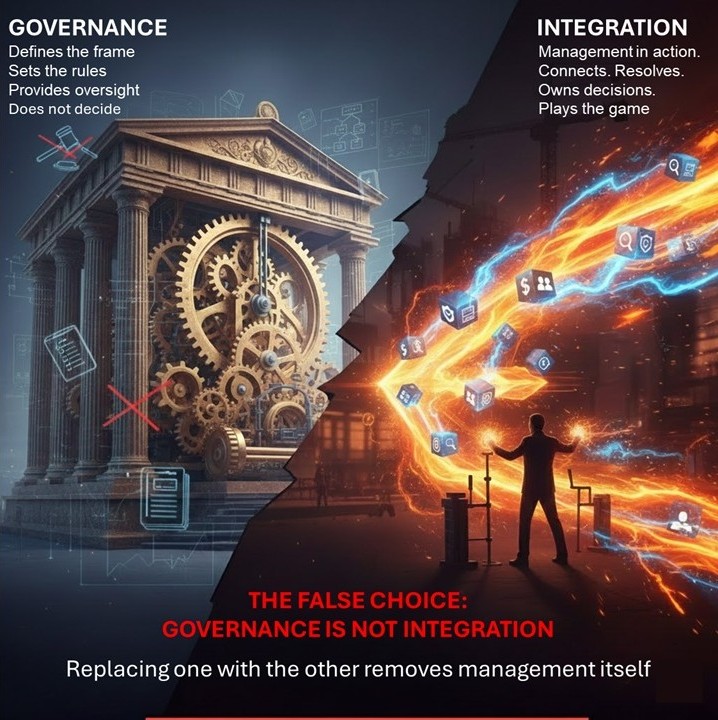 Why Replacing Integration with Governance Weakens Project Management In recent evolutions of project management standards, governance has gained prominence, while integration has faded as an explicit leadership function. This shift is often presented as modern, flexible, and inclusive. But beneath that narrative lies a critical conceptual error. Governance is not integration. And confusing the two does not strengthen project management, it quietly removes management itself. Governance Defines the Frame, It Does Not Act Governance plays an essential role in projects and organizations. It:
But governance does not decide in the moment. It does not resolve daily trade-offs, reconcile competing constraints, or integrate decisions under pressure. It does not sit at the intersection of scope, schedule, cost, risk, people, and value when reality forces a choice. Governance creates the conditions for decision-making, it does not perform decision-making. Integration Is Management in Action Integration is not a structure. It is not a forum. It is not an escalation path. Integration is management in action. It is the function that:
It is situated, continuous, and accountable decision-making. Where governance sets the rules, integration plays the game. From Action to Assumption Integration has not disappeared as a systemic need in projects. Complex work still requires integration, more than ever. What has changed is its status. Integration has moved:
It loses its owner. The Risk of Substitution When integration is removed as an explicit management function and implicitly replaced by governance:
It is distance between decision and execution. Governance expands. Decision latency grows. Leadership dissolves into coordination. Governance Without Integration Creates Entropy Projects rarely fail because governance is weak. They fail because no one integrates decisions across the system. Without explicit integration:
Only integration prevents it. A False Choice This is not a choice between old and new. It is not predictive versus adaptive. Modern project management does not require abandoning integration. It requires stronger integration across multiple approaches. The real evolution is not structural, it is leadership clarity. The project manager remains the integrator of the system, now with the ability to consciously choose and combine multiple delivery approaches within a governed frame. Governance enables. Integration decides. Conclusion Governance is essential. Integration is indispensable. One defines the architecture of power. The other exercises that power in the living system of the project. Replacing integration with governance does not modernize project management. It quietly removes management itself. Governance is not integration, and never was. |
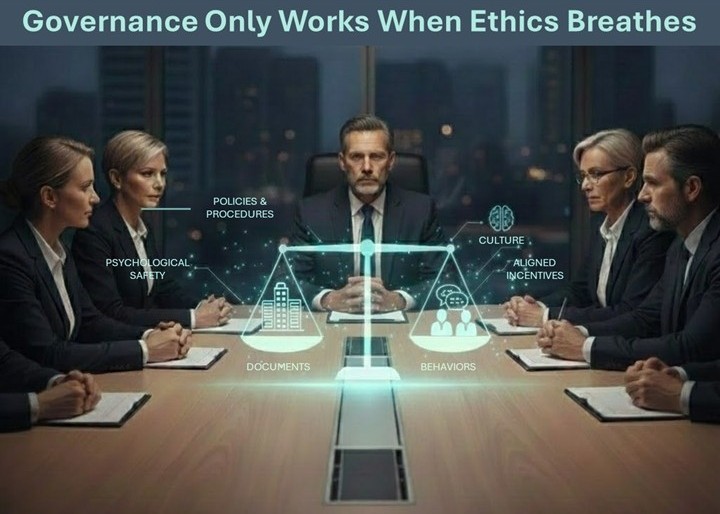 From Structure to a Living Ethical Culture in Modern Organizations Introduction Governance and ethics are two inseparable pillars of organizational maturity. But even the most sophisticated structures - policies, processes, committees, org charts- do not guarantee ethical behavior. When governance exists on paper but is not lived by people, the risks are predictable:
It requires ethical behaviors that are internalized, practiced, and protected by culture. 1. Governance Today: Beyond Structure and Compliance Classic governance references - Cadbury, King, OECD - remain essential foundations. But modern organizations must go further. Current global standards, such as:
It is about creating sustainable value, enabling transparency, ensuring accountability, and making decisions grounded in information, ethics, and impact. Formal Governance vs. Living Governance
The smaller the gap, the stronger the governance. 2. Ethics: The Energy System That Makes Governance Work Governance does not function without an ethical foundation. Ethics is not a document, it is a behavior. Traditional ethical frameworks continue to be relevant:
3. Why Structure Fails: The Gap Between Policy and Practice Organizations can have impeccable policies and still fail ethically. The reasons are well known:
It fails in the behavior. 4. How to Build a Living Ethical Culture A strong ethical culture is not accidental, it is intentional and systematic. A. Create living, practical Codes of Conduct Grounded in real cases, updated frequently, and easy to apply. B. Provide continuous ethics training Workshops, simulations, real-world dilemmas, scenario-based discussions. C. Use structured decision-making models These reduce ambiguity and impulsivity:
People must feel safe to raise concerns, challenge assumptions, and report risks. E. Align incentives with values Behavior follows incentives — positively or negatively. F. Create regular spaces for ethical dialogue Ethics is strengthened through reflection, not enforcement. 5. Learning from Real-World Cases Wells Fargo - Toxic Incentives From 2011 to 2016, unrealistic sales targets led employees to open millions of unauthorized accounts. Incentives rewarded volume but punished integrity. Leadership ignored early signals. Lesson: Misaligned incentives can destroy culture and make governance ineffective. Boeing 737-MAX - Silence Over Safety Competitive pressure led to rushed decisions, fragmented communication, and concealment of technical risks. Engineers feared challenging management decisions. Lesson: Technical governance collapses when transparency and psychological safety are absent. Volkswagen Dieselgate - Fear and Conformity To meet impossible emission targets, teams installed fraudulent software. A culture of fear silenced voices of integrity. Lesson: When honesty is punished or discouraged, governance becomes a systemic risk factor. Across all cases, one conclusion stands out: Governance that ignores culture is doomed, because culture drives real behavior. 6. Measuring Ethical and Governance Maturity Governance must be measurable, not aspirational. Key indicators include:
7. Governance and Ethics in the Age of AI Artificial intelligence introduces new ethical and governance challenges:
8. Conclusion - Governance Only Works When Ethics Breathes True governance maturity arises when:
The Unified VMCL™ model illustrates this:
Call to Action for Project Leaders Ask yourself and your team:
|
|
"We don't like their sound, and guitar music is on the way out." - Decca Recording Company, rejecting the Beatles, 1961 |