Governance and Ethics
From the Support to Develop Blog
by Luis Branco

This blog addresses management-related topics and has three areas of focus: 1. Technical skills; 2. Competencies in the field of interpersonal relations and communication (including personal organization and delegation, leadership, teamwork, conflict resolution, conducting meetings, and negotiation); and 3. Strategy (including diagnosis, strategic guidelines, and implementation).4.Technology
Recent Posts
RCPCV™: A Method for Decision-Making and Continuous Improvement
The Same Change Can Succeed and Fail at the Same Time
What Must Exist Even When No Single Role Owns the Whole?
PHASE 4 – THE EMERGENCE
When Structural Drift Becomes Consequential
Categories
Agile,
Career Development,
Career Development,
Career Development,
Career Development,
Career Development,
Career Development,
Career Development,
Career Development,
Career Development,
Career Development,
Career Development,
Career Development,
Career Development,
Career Development,
Career Development,
Career Development,
Career Development,
Career Development,
Career Development,
Career Development,
Career Development,
Career Development,
Career Development,
Career Development,
Career Development,
Career Development,
Career Development,
Career Development,
Career Development,
Career Development,
Career Development,
Career Development,
Career Development,
Career Development,
Career Development,
Career Development,
Career Development,
Career Development,
Career Development,
Career Development,
Career Development,
Career Development,
Career Development,
Career Development,
Career Development,
Career Development,
Career Development,
Career Development,
Career Development,
Career Development,
Career Development,
Career Development,
Career Development,
Career Development,
Career Development,
Career Development,
Career Development,
Career Development,
Career Development,
Career Development,
Career Development,
Career Development,
Career Development,
Career Development,
Career Development,
Career Development,
Career Development,
Career Development,
Career Development,
Career Development,
Career Development,
Career Development,
Career Development,
Career Development,
Career Development,
Career Development,
Career Development,
Career Development,
Career Development,
Career Development,
Career Development,
Career Development,
Career Development,
Career Development,
Career Development,
Career Development,
Career Development,
Career Development,
Career Development,
Career Development,
Career Development,
Career Development,
Career Development,
Career Development,
Career Development,
Career Development,
Career Development,
Career Development,
Career Development,
Career Development,
Career Development,
Career Development,
Career Development,
Career Development,
Career Development,
Career Development,
Career Development,
Career Development,
Career Development,
Career Development,
Career Development,
Career Development,
Career Development,
Career Development,
Career Development,
Career Development,
Career Development,
Career Development,
Career Development,
Career Development,
Career Development,
Career Development,
Education,
Governance,
Governance,
Governance,
Governance,
Governance,
Governance,
Governance,
Governance,
Governance,
Governance,
Governance,
Governance,
Governance,
Governance,
Governance,
Governance,
Governance,
Governance,
Governance,
Governance,
Governance,
In,
Integration Management,
Interpersonal Skills,
Interpersonal Skills,
Interpersonal Skills,
Interpersonal Skills,
Interpersonal Skills,
Interpersonal Skills,
Interpersonal Skills,
Interpersonal Skills,
Interpersonal Skills,
Interpersonal Skills,
Interpersonal Skills,
Interpersonal Skills,
Interpersonal Skills,
Interpersonal Skills,
Interpersonal Skills,
Interpersonal Skills,
Interpersonal Skills,
Interpersonal Skills,
Interpersonal Skills,
Interpersonal Skills,
Interpersonal Skills,
Interpersonal Skills,
Interpersonal Skills,
Interpersonal Skills,
Interpersonal Skills,
Interpersonal Skills,
Interpersonal Skills,
Interpersonal Skills,
Interpersonal Skills,
Interpersonal Skills,
Interpersonal Skills,
Interpersonal Skills,
Interpersonal Skills,
Interpersonal Skills,
Interpersonal Skills,
Interpersonal Skills,
Interpersonal Skills,
Interpersonal Skills,
Interpersonal Skills,
Interpersonal Skills,
Interpersonal Skills,
Interpersonal Skills,
Interpersonal Skills,
Interpersonal Skills,
Interpersonal Skills,
Interpersonal Skills,
Interpersonal Skills,
Interpersonal Skills,
Interpersonal Skills,
Interpersonal Skills,
Interpersonal Skills,
Interpersonal Skills,
Interpersonal Skills,
Interpersonal Skills,
Interpersonal Skills,
Interpersonal Skills,
Interpersonal Skills,
Interpersonal Skills,
Interpersonal Skills,
Interpersonal Skills,
Interpersonal Skills,
Interpersonal Skills,
Interpersonal Skills,
Interpersonal Skills,
Interpersonal Skills,
Interpersonal Skills,
Interpersonal Skills,
Interpersonal Skills,
Interpersonal Skills,
Interpersonal Skills,
Interpersonal Skills,
Interpersonal Skills,
Interpersonal Skills,
Interpersonal Skills,
Interpersonal Skills,
Interpersonal Skills,
Interpersonal Skills,
Interpersonal Skills,
Interpersonal Skills,
Interpersonal Skills,
Interpersonal Skills,
Interpersonal Skills,
Interpersonal Skills,
Interpersonal Skills,
Interpersonal Skills,
Interpersonal Skills,
Interpersonal Skills,
Interpersonal Skills,
Interpersonal Skills,
Interpersonal Skills,
Interpersonal Skills,
Interpersonal Skills,
Interpersonal Skills,
Interpersonal Skills,
Interpersonal Skills,
Interpersonal Skills,
Interpersonal Skills,
Interpersonal Skills,
Interpersonal Skills,
Interpersonal Skills,
Interpersonal Skills,
Interpersonal Skills,
Interpersonal Skills,
Interpersonal Skills,
Interpersonal Skills,
Interpersonal Skills,
Interpersonal Skills,
Interpersonal Skills,
Interpersonal Skills,
Interpersonal Skills,
Interpersonal Skills,
Interpersonal Skills,
Interpersonal Skills,
Interpersonal Skills,
Interpersonal Skills,
Interpersonal Skills,
Interpersonal Skills,
Interpersonal Skills,
Interpersonal Skills,
Interpersonal Skills,
Interpersonal Skills,
Interpersonal Skills,
Knowledge Management,
le,
lea,
Leadership,
Leadership,
Leadership,
Leadership,
Leadership,
Leadership,
Leadership,
Leadership,
Leadership,
Leadership,
Leadership,
Leadership,
Leadership,
Leadership,
Leadership,
Leadership,
Leadership,
Leadership,
Leadership,
Leadership,
Leadership,
Leadership,
Leadership,
Leadership,
Leadership,
Leadership,
Leadership,
Leadership,
Leadership,
Leadership,
Leadership,
Leadership,
Leadership,
Leadership,
Leadership,
Leadership,
Leadership,
Leadership,
Leadership,
Leadership,
Leadership,
Leadership,
Leadership,
Leadership,
Leadership,
Leadership,
Leadership,
Leadership,
Leadership,
Leadership,
Leadership,
Leadership,
Leadership,
Leadership,
Leadership,
Leadership,
Leadership,
Leadership,
Leadership,
Leadership,
Leadership,
Leadership,
Leadership,
Leadership,
Leadership,
Leadership,
Leadership,
Leadership,
Leadership,
Leadership,
Leadership,
Leadership,
Leadership,
Leadership,
Leadership,
Leadership,
Leadership,
Leadership,
Leadership,
Leadership,
Leadership,
Leadership,
Leadership,
Leadership,
Leadership,
Leadership,
Leadership,
Leadership,
Leadership,
Leadership,
Leadership,
Leadership,
Leadership,
Leadership,
Leadership,
Leadership,
Leadership,
Leadership,
Leadership,
Leadership,
Leadership,
Leadership,
Leadership,
Leadership,
Leadership,
Leadership,
Leadership,
Leadership,
Leadership,
Leadership,
Leadership,
Leadership,
Leadership,
Leadership,
Leadership,
Leadership,
Leadership,
Leadership,
Leadership,
Leadership,
Leadership,
Leadership,
Leadership,
or,
Organizational Project Management,
Portfolio Management,
Program,
Program Management,
Strategy,
Strategy,
Strategy,
Strategy,
Strategy,
Strategy,
Strategy,
Strategy,
Strategy,
Strategy,
Strategy,
Strategy,
Strategy,
Strategy,
Strategy,
Strategy,
Strategy,
Strategy,
Strategy,
Strategy,
Strategy,
Strategy,
Strategy,
Strategy,
Strategy,
Strategy,
Strategy,
Strategy,
Strategy,
Strategy,
Strategy,
Strategy,
Strategy,
Strategy,
Strategy,
Strategy,
Strategy,
Strategy,
Strategy,
Strategy,
Strategy,
Strategy,
Strategy,
Strategy,
Strategy,
Strategy,
Strategy,
Strategy,
Strategy,
Strategy,
Strategy,
Strategy,
Strategy,
Strategy,
Strategy,
Strategy,
Strategy,
Strategy,
Strategy,
Strategy,
Strategy,
Strategy,
Strategy,
Strategy,
Strategy,
Strategy,
Strategy,
Strategy,
Strategy,
Strategy,
Strategy,
Strategy,
Strategy,
Strategy,
Strategy,
Strategy,
Strategy,
Strategy,
Strategy,
Strategy,
Strategy,
Strategy,
Strategy,
Strategy,
Strategy,
Strategy,
Strategy,
Strategy,
Strategy,
Strategy,
Strategy,
Strategy,
Strategy,
Strategy,
Strategy,
Strategy,
Strategy,
Strategy,
Strategy,
Strategy,
Strategy,
Strategy,
Strategy,
Strategy,
Strategy,
Strategy,
Strategy,
Strategy,
Strategy,
Strategy,
Strategy,
Strategy,
Strategy,
Strategy,
Strategy,
Strategy,
Strategy,
Strategy,
Strategy,
Strategy,
Strategy,
Strategy,
Strategy,
Sustainability,
Talent Management,
Talent Management,
Talent Management,
Talent Management,
Talent Management,
Talent Management,
Talent Management,
Talent Management,
Talent Management,
Talent Management,
Talent Management,
Talent Management,
Talent Management,
Talent Management,
Talent Management,
Talent Management,
Talent Management,
Talent Management,
Talent Management,
Talent Management,
Talent Management,
Talent Management,
Talent Management,
Talent Management,
Talent Management,
Talent Management,
Talent Management,
Talent Management,
Talent Management,
Talent Management,
Talent Management,
Talent Management,
Talent Management,
Talent Management,
Talent Management,
Talent Management,
Talent Management,
Talent Management,
Talent Management,
Talent Management,
Talent Management,
Talent Management,
Talent Management,
Talent Management,
Talent Management,
Talent Management,
Talent Management,
Talent Management,
Talent Management,
Talent Management,
Talent Management,
Talent Management,
Talent Management,
Talent Management,
Talent Management,
Talent Management,
Talent Management,
Talent Management,
Talent Management,
Talent Management,
Talent Management,
Talent Management,
Talent Management,
Talent Management,
Talent Management,
Talent Management,
Talent Management,
Talent Management,
Talent Management,
Talent Management,
Talent Management,
Talent Management,
Talent Management,
Talent Management,
Talent Management,
Talent Management,
Talent Management,
Talent Management,
Talent Management,
Talent Management,
Talent Management,
Talent Management,
Talent Management,
Talent Management,
Talent Management,
Talent Management,
Talent Management,
Talent Management,
Talent Management,
Talent Management,
Talent Management,
Talent Management,
Talent Management,
Talent Management,
Talent Management,
Talent Management,
Talent Management,
Talent Management,
Talent Management,
Talent Management,
Talent Management,
Talent Management,
Talent Management,
Talent Management,
Talent Management,
Talent Management,
Talent Management,
Talent Management,
Talent Management,
Talent Management,
Talent Management,
Talent Management,
Talent Management,
Talent Management,
Talent Management,
Talent Management,
Talent Management,
Talent Management,
Talent Management,
Talent Management,
Talent Management,
Talent Management,
Talent Management
Date
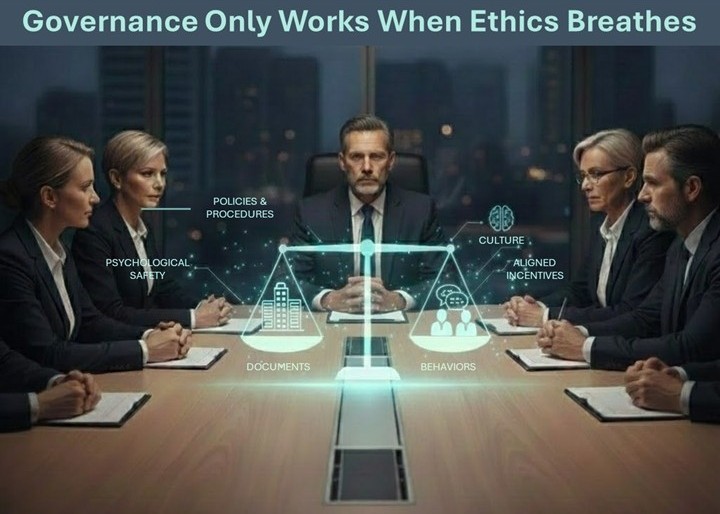 From Structure to a Living Ethical Culture in Modern OrganizationsIntroduction
Governance and ethics are two inseparable pillars of organizational maturity.
But even the most sophisticated structures - policies, processes, committees, org charts- do not guarantee ethical behavior.
When governance exists on paper but is not lived by people, the risks are predictable:
- Loss of trust,
- Inconsistent decisions,
- Internal conflict,
- Technical and operational failures,
- Reputational damage,
- And in extreme cases, systemic collapse.
In today’s fast-paced, high-pressure, technology-driven environment,
effective governance requires more than structure.
It requires
ethical behaviors that are internalized, practiced, and protected by culture.
1. Governance Today: Beyond Structure and ComplianceClassic governance references - Cadbury, King, OECD - remain essential foundations.
But modern organizations must go further.
Current global standards, such as:
- ISO 37000 – Governance of Organizations (2021)
- OECD Corporate Governance Principles (2023 revision)
- IFC Corporate Governance Methodology
Highlight that governance is not simply about control.
It is about
creating sustainable value, enabling transparency, ensuring accountability, and making decisions grounded in information, ethics, and impact.
Formal Governance vs. Living Governance- Formal governance defines roles, responsibilities, and the decision-making structure.
- Living governance reflects what truly happens under pressure — behaviors, incentives, motivation, and culture.
Organizational maturity is measured by the distance between the two.The smaller the gap, the stronger the governance.
2. Ethics: The Energy System That Makes Governance WorkGovernance does not function without an ethical foundation.
Ethics is not a document, it is a behavior.
Traditional ethical frameworks continue to be relevant:
- Deontology - doing what is right because it is right.
- Utilitarianism - analyzing impacts and consequences.
- Virtue ethics - character, integrity, prudence.
But the reality of modern organizations introduces additional dimensions:
- Kahneman- fast thinking under pressure leads to errors.
- Thaler & Sunstein - incentives and nudges shape behavior.
- Amy Edmondson - psychological safety is a prerequisite for ethical behavior.
- Jonathan Haidt - moral values differ across people and cultures.
When ethics is lived, not merely defined, it becomes the
force that energizes governance.
3. Why Structure Fails: The Gap Between Policy and PracticeOrganizations can have impeccable policies and still fail ethically.
The reasons are well known:
- Misaligned incentives,
- Inconsistent leadership,
- Fear, silence, or retaliation culture,
- “we’ve always done it this way” mentality,
- Lack of ethical decision-making models,
- Normalization of small deviations that grow over time.
This gap creates visible consequences:
- Toxic work climate,
- Erratic decisions,
- Favoritism or bias,
- Technical and operational risk,
- Erosion of trust,
- Ethical failures and sometimes fraud.
Governance does not fail in the document.It fails in the behavior.4. How to Build a Living Ethical CultureA strong ethical culture is not accidental, it is intentional and systematic.
A. Create living, practical Codes of ConductGrounded in real cases, updated frequently, and easy to apply.
B. Provide continuous ethics trainingWorkshops, simulations, real-world dilemmas, scenario-based discussions.
C. Use structured decision-making modelsThese reduce ambiguity and impulsivity:
- PMI Ethical Decision-Making Framework (EDMF)
- RCPCV™ – Collect, Consult, Think, Communicate, Verify
- Regenerative Consciousness Cycle™
- Deontological, utilitarian, and virtue-based analysis
D. Build psychological safetyPeople must feel safe to raise concerns, challenge assumptions, and report risks.
E. Align incentives with valuesBehavior follows incentives — positively or negatively.
F. Create regular spaces for ethical dialogueEthics is strengthened through reflection, not enforcement.
5. Learning from Real-World CasesWells Fargo - Toxic IncentivesFrom 2011 to 2016, unrealistic sales targets led employees to open millions of unauthorized accounts.
Incentives rewarded volume but punished integrity.
Leadership ignored early signals.
Lesson: Misaligned incentives can destroy culture and make governance ineffective.
Boeing 737-MAX - Silence Over SafetyCompetitive pressure led to rushed decisions, fragmented communication, and concealment of technical risks.
Engineers feared challenging management decisions.
Lesson: Technical governance collapses when transparency and psychological safety are absent.
Volkswagen Dieselgate - Fear and ConformityTo meet impossible emission targets, teams installed fraudulent software.
A culture of fear silenced voices of integrity.
Lesson: When honesty is punished or discouraged, governance becomes a systemic risk factor.
Across all cases, one conclusion stands out:Governance that ignores culture is doomed, because culture drives real behavior.6. Measuring Ethical and Governance MaturityGovernance must be
measurable, not aspirational.
Key indicators include:
- Compliance Rate
- Ethical Risk Heatmap
- Psychological Safety Index
- ISO 37000 Governance Maturity Model
- Ethics Pulse Surveys
- Stakeholder Trust Index
What is not measured cannot be improved — or protected.
7. Governance and Ethics in the Age of AIArtificial intelligence introduces new ethical and governance challenges:
- Algorithmic bias,
- Opaque decision pathways,
- Autonomous decisions without human context,
- Misuse of data,
- Shared decision responsibility between humans and AI.
Modern organizations require:
- Ethical AI audits,
- Transparency in algorithms and data use,
- Responsible human–AI collaboration practices,
- Digital ethical literacy,
- Hybrid governance models including AI oversight.
Technology without ethics accelerates risk – not progress.8. Conclusion - Governance Only Works When Ethics BreathesTrue governance maturity arises when:
- Structure (formal governance)
- meets
- Behavior (lived ethics)
and the two reinforce each other daily.
The
Unified VMCL™ model illustrates this:
- Vision → ethical purpose
- Mission → disciplined, value-driven action
- Capacity → culture, competence, safety
- Learning → reflection and continuous improvement
Governance is ultimately a commitment to coherence, a living practice, renewed in every decision, every interaction, every choice.
Call to Action for Project LeadersAsk yourself and your team:
- Are governance structures really being lived?
- Do we have clear decision-making frameworks for ethical dilemmas?
- Does our culture encourage truth, transparency, and accountability?
- Are our incentives aligned with our values?
- Is our use of technology, especially AI, ethically governed?
- Can we measure the alignment between governance and ethics?
Because
governance is not what is written — it is what happens when no one is watching.
Posted on: December 26, 2025 09:03 AM |
Permalink
Comments (2)
Please login or join to subscribe to this item

Kwiyuh Michael Wepngong
 Community Champion
Financial Management Specialist | US Peace Corps
Yaounde, Centre, Cameroon
Thank you Sir,
The last phrase "Because governance is not what is written — it is what happens when no one is watching" is so captivating and insightful

Luis Branco
CEO| Business Insight, Consultores de Gestão, Ldª
Carcavelos, Lisboa, Portugal
Kwiyuh Michael Wepngong
Thank you for that thoughtful reaction.
I am glad that sentence stood out to you.
That line is deliberately simple because it points to something many organizations prefer not to confront.
Governance is often evaluated through documents, frameworks, and compliance artefacts.
But its real test appears in moments without supervision, when incentives conflict with values and when pressure is high.
In those moments, structure steps aside and culture takes over. What people do then is shaped by habits, psychological safety, leadership signals, and ethical muscle memory.
This is why governance cannot be reduced to what is written or approved.
It must be lived, rehearsed, and protected daily.
If the phrase feels powerful, it is likely because we have all seen the opposite.
Beautiful governance on paper, and very different behavior in practice.
Bridging that gap is not a technical exercise.
It is a leadership responsibility.
Your comment reinforces the central message of the article. Mature governance is not enforced.
It is internalized.
And when that happens, organizations do not just comply.
They become coherent.
Please Login/Register to leave a comment.
|
You may have to fight a battle more than once to win it.
- Margaret Thatcher
|




