Governance is not Integration
From the Support to Develop Blog
by Luis Branco

This blog addresses management-related topics and has three areas of focus: 1. Technical skills; 2. Competencies in the field of interpersonal relations and communication (including personal organization and delegation, leadership, teamwork, conflict resolution, conducting meetings, and negotiation); and 3. Strategy (including diagnosis, strategic guidelines, and implementation).4.Technology
Recent Posts
RCPCV™: A Method for Decision-Making and Continuous Improvement
The Same Change Can Succeed and Fail at the Same Time
What Must Exist Even When No Single Role Owns the Whole?
PHASE 4 – THE EMERGENCE
When Structural Drift Becomes Consequential
Categories
Agile,
Career Development,
Career Development,
Career Development,
Career Development,
Career Development,
Career Development,
Career Development,
Career Development,
Career Development,
Career Development,
Career Development,
Career Development,
Career Development,
Career Development,
Career Development,
Career Development,
Career Development,
Career Development,
Career Development,
Career Development,
Career Development,
Career Development,
Career Development,
Career Development,
Career Development,
Career Development,
Career Development,
Career Development,
Career Development,
Career Development,
Career Development,
Career Development,
Career Development,
Career Development,
Career Development,
Career Development,
Career Development,
Career Development,
Career Development,
Career Development,
Career Development,
Career Development,
Career Development,
Career Development,
Career Development,
Career Development,
Career Development,
Career Development,
Career Development,
Career Development,
Career Development,
Career Development,
Career Development,
Career Development,
Career Development,
Career Development,
Career Development,
Career Development,
Career Development,
Career Development,
Career Development,
Career Development,
Career Development,
Career Development,
Career Development,
Career Development,
Career Development,
Career Development,
Career Development,
Career Development,
Career Development,
Career Development,
Career Development,
Career Development,
Career Development,
Career Development,
Career Development,
Career Development,
Career Development,
Career Development,
Career Development,
Career Development,
Career Development,
Career Development,
Career Development,
Career Development,
Career Development,
Career Development,
Career Development,
Career Development,
Career Development,
Career Development,
Career Development,
Career Development,
Career Development,
Career Development,
Career Development,
Career Development,
Career Development,
Career Development,
Career Development,
Career Development,
Career Development,
Career Development,
Career Development,
Career Development,
Career Development,
Career Development,
Career Development,
Career Development,
Career Development,
Career Development,
Career Development,
Career Development,
Career Development,
Career Development,
Career Development,
Career Development,
Career Development,
Career Development,
Career Development,
Career Development,
Education,
Governance,
Governance,
Governance,
Governance,
Governance,
Governance,
Governance,
Governance,
Governance,
Governance,
Governance,
Governance,
Governance,
Governance,
Governance,
Governance,
Governance,
Governance,
Governance,
Governance,
Governance,
In,
Integration Management,
Interpersonal Skills,
Interpersonal Skills,
Interpersonal Skills,
Interpersonal Skills,
Interpersonal Skills,
Interpersonal Skills,
Interpersonal Skills,
Interpersonal Skills,
Interpersonal Skills,
Interpersonal Skills,
Interpersonal Skills,
Interpersonal Skills,
Interpersonal Skills,
Interpersonal Skills,
Interpersonal Skills,
Interpersonal Skills,
Interpersonal Skills,
Interpersonal Skills,
Interpersonal Skills,
Interpersonal Skills,
Interpersonal Skills,
Interpersonal Skills,
Interpersonal Skills,
Interpersonal Skills,
Interpersonal Skills,
Interpersonal Skills,
Interpersonal Skills,
Interpersonal Skills,
Interpersonal Skills,
Interpersonal Skills,
Interpersonal Skills,
Interpersonal Skills,
Interpersonal Skills,
Interpersonal Skills,
Interpersonal Skills,
Interpersonal Skills,
Interpersonal Skills,
Interpersonal Skills,
Interpersonal Skills,
Interpersonal Skills,
Interpersonal Skills,
Interpersonal Skills,
Interpersonal Skills,
Interpersonal Skills,
Interpersonal Skills,
Interpersonal Skills,
Interpersonal Skills,
Interpersonal Skills,
Interpersonal Skills,
Interpersonal Skills,
Interpersonal Skills,
Interpersonal Skills,
Interpersonal Skills,
Interpersonal Skills,
Interpersonal Skills,
Interpersonal Skills,
Interpersonal Skills,
Interpersonal Skills,
Interpersonal Skills,
Interpersonal Skills,
Interpersonal Skills,
Interpersonal Skills,
Interpersonal Skills,
Interpersonal Skills,
Interpersonal Skills,
Interpersonal Skills,
Interpersonal Skills,
Interpersonal Skills,
Interpersonal Skills,
Interpersonal Skills,
Interpersonal Skills,
Interpersonal Skills,
Interpersonal Skills,
Interpersonal Skills,
Interpersonal Skills,
Interpersonal Skills,
Interpersonal Skills,
Interpersonal Skills,
Interpersonal Skills,
Interpersonal Skills,
Interpersonal Skills,
Interpersonal Skills,
Interpersonal Skills,
Interpersonal Skills,
Interpersonal Skills,
Interpersonal Skills,
Interpersonal Skills,
Interpersonal Skills,
Interpersonal Skills,
Interpersonal Skills,
Interpersonal Skills,
Interpersonal Skills,
Interpersonal Skills,
Interpersonal Skills,
Interpersonal Skills,
Interpersonal Skills,
Interpersonal Skills,
Interpersonal Skills,
Interpersonal Skills,
Interpersonal Skills,
Interpersonal Skills,
Interpersonal Skills,
Interpersonal Skills,
Interpersonal Skills,
Interpersonal Skills,
Interpersonal Skills,
Interpersonal Skills,
Interpersonal Skills,
Interpersonal Skills,
Interpersonal Skills,
Interpersonal Skills,
Interpersonal Skills,
Interpersonal Skills,
Interpersonal Skills,
Interpersonal Skills,
Interpersonal Skills,
Interpersonal Skills,
Interpersonal Skills,
Interpersonal Skills,
Interpersonal Skills,
Interpersonal Skills,
Interpersonal Skills,
Knowledge Management,
le,
lea,
Leadership,
Leadership,
Leadership,
Leadership,
Leadership,
Leadership,
Leadership,
Leadership,
Leadership,
Leadership,
Leadership,
Leadership,
Leadership,
Leadership,
Leadership,
Leadership,
Leadership,
Leadership,
Leadership,
Leadership,
Leadership,
Leadership,
Leadership,
Leadership,
Leadership,
Leadership,
Leadership,
Leadership,
Leadership,
Leadership,
Leadership,
Leadership,
Leadership,
Leadership,
Leadership,
Leadership,
Leadership,
Leadership,
Leadership,
Leadership,
Leadership,
Leadership,
Leadership,
Leadership,
Leadership,
Leadership,
Leadership,
Leadership,
Leadership,
Leadership,
Leadership,
Leadership,
Leadership,
Leadership,
Leadership,
Leadership,
Leadership,
Leadership,
Leadership,
Leadership,
Leadership,
Leadership,
Leadership,
Leadership,
Leadership,
Leadership,
Leadership,
Leadership,
Leadership,
Leadership,
Leadership,
Leadership,
Leadership,
Leadership,
Leadership,
Leadership,
Leadership,
Leadership,
Leadership,
Leadership,
Leadership,
Leadership,
Leadership,
Leadership,
Leadership,
Leadership,
Leadership,
Leadership,
Leadership,
Leadership,
Leadership,
Leadership,
Leadership,
Leadership,
Leadership,
Leadership,
Leadership,
Leadership,
Leadership,
Leadership,
Leadership,
Leadership,
Leadership,
Leadership,
Leadership,
Leadership,
Leadership,
Leadership,
Leadership,
Leadership,
Leadership,
Leadership,
Leadership,
Leadership,
Leadership,
Leadership,
Leadership,
Leadership,
Leadership,
Leadership,
Leadership,
Leadership,
Leadership,
or,
Organizational Project Management,
Portfolio Management,
Program,
Program Management,
Strategy,
Strategy,
Strategy,
Strategy,
Strategy,
Strategy,
Strategy,
Strategy,
Strategy,
Strategy,
Strategy,
Strategy,
Strategy,
Strategy,
Strategy,
Strategy,
Strategy,
Strategy,
Strategy,
Strategy,
Strategy,
Strategy,
Strategy,
Strategy,
Strategy,
Strategy,
Strategy,
Strategy,
Strategy,
Strategy,
Strategy,
Strategy,
Strategy,
Strategy,
Strategy,
Strategy,
Strategy,
Strategy,
Strategy,
Strategy,
Strategy,
Strategy,
Strategy,
Strategy,
Strategy,
Strategy,
Strategy,
Strategy,
Strategy,
Strategy,
Strategy,
Strategy,
Strategy,
Strategy,
Strategy,
Strategy,
Strategy,
Strategy,
Strategy,
Strategy,
Strategy,
Strategy,
Strategy,
Strategy,
Strategy,
Strategy,
Strategy,
Strategy,
Strategy,
Strategy,
Strategy,
Strategy,
Strategy,
Strategy,
Strategy,
Strategy,
Strategy,
Strategy,
Strategy,
Strategy,
Strategy,
Strategy,
Strategy,
Strategy,
Strategy,
Strategy,
Strategy,
Strategy,
Strategy,
Strategy,
Strategy,
Strategy,
Strategy,
Strategy,
Strategy,
Strategy,
Strategy,
Strategy,
Strategy,
Strategy,
Strategy,
Strategy,
Strategy,
Strategy,
Strategy,
Strategy,
Strategy,
Strategy,
Strategy,
Strategy,
Strategy,
Strategy,
Strategy,
Strategy,
Strategy,
Strategy,
Strategy,
Strategy,
Strategy,
Strategy,
Strategy,
Strategy,
Strategy,
Sustainability,
Talent Management,
Talent Management,
Talent Management,
Talent Management,
Talent Management,
Talent Management,
Talent Management,
Talent Management,
Talent Management,
Talent Management,
Talent Management,
Talent Management,
Talent Management,
Talent Management,
Talent Management,
Talent Management,
Talent Management,
Talent Management,
Talent Management,
Talent Management,
Talent Management,
Talent Management,
Talent Management,
Talent Management,
Talent Management,
Talent Management,
Talent Management,
Talent Management,
Talent Management,
Talent Management,
Talent Management,
Talent Management,
Talent Management,
Talent Management,
Talent Management,
Talent Management,
Talent Management,
Talent Management,
Talent Management,
Talent Management,
Talent Management,
Talent Management,
Talent Management,
Talent Management,
Talent Management,
Talent Management,
Talent Management,
Talent Management,
Talent Management,
Talent Management,
Talent Management,
Talent Management,
Talent Management,
Talent Management,
Talent Management,
Talent Management,
Talent Management,
Talent Management,
Talent Management,
Talent Management,
Talent Management,
Talent Management,
Talent Management,
Talent Management,
Talent Management,
Talent Management,
Talent Management,
Talent Management,
Talent Management,
Talent Management,
Talent Management,
Talent Management,
Talent Management,
Talent Management,
Talent Management,
Talent Management,
Talent Management,
Talent Management,
Talent Management,
Talent Management,
Talent Management,
Talent Management,
Talent Management,
Talent Management,
Talent Management,
Talent Management,
Talent Management,
Talent Management,
Talent Management,
Talent Management,
Talent Management,
Talent Management,
Talent Management,
Talent Management,
Talent Management,
Talent Management,
Talent Management,
Talent Management,
Talent Management,
Talent Management,
Talent Management,
Talent Management,
Talent Management,
Talent Management,
Talent Management,
Talent Management,
Talent Management,
Talent Management,
Talent Management,
Talent Management,
Talent Management,
Talent Management,
Talent Management,
Talent Management,
Talent Management,
Talent Management,
Talent Management,
Talent Management,
Talent Management,
Talent Management,
Talent Management,
Talent Management,
Talent Management
Date
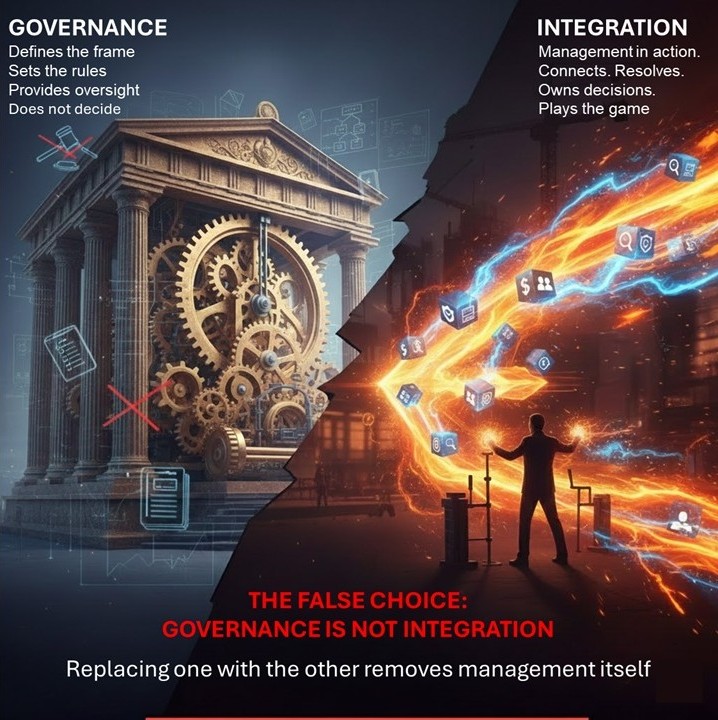 Why Replacing Integration with Governance Weakens Project Management
In recent evolutions of project management standards,
governance has gained prominence, while
integration has faded as an explicit leadership function.
This shift is often presented as modern, flexible, and inclusive.
But beneath that narrative lies a
critical conceptual error.
Governance is not integration. And confusing the two does not strengthen project management, it quietly
removes management itself.
Governance Defines the Frame, It Does Not ActGovernance plays an essential role in projects and organizations. It:
- Defines decision rights and boundaries,
- Establishes principles, policies, and guardrails,
- Aligns initiatives with strategy,
- Provides oversight and accountability mechanisms.
Governance
defines the architecture of power.
But governance does not decide
in the moment.
It does not resolve daily trade-offs, reconcile competing constraints, or integrate decisions under pressure.
It does not sit at the intersection of scope, schedule, cost, risk, people, and value when reality forces a choice.
Governance
creates the conditions for decision-making, it does
not perform decision-making.
Integration Is Management in ActionIntegration is not a structure.
It is not a forum.
It is not an escalation path.
Integration is management in action.It is the function that:
- Sees the project as a single system,
- Connects scope, schedule, cost, risk, quality, people, and value,
- Resolves conflicts between incompatible options,
- Protects the whole from local optimizations,
- Assumes responsibility at the moment a decision is made.
Integration is not bureaucracy.
It is
situated, continuous, and accountable decision-making.
Where governance sets the rules,
integration plays the game.
From Action to AssumptionIntegration has not disappeared as a systemic need in projects.
Complex work still requires integration, more than ever.
What has changed is its
status.
Integration has moved:
- From action to assumption,
- From explicit responsibility to implicit expectation,
- From a named leadership function to a distributed belief that “the system will integrate itself.”
When something critical moves from action to assumption, it does not mature.
It
loses its owner.
The Risk of SubstitutionWhen integration is removed as an explicit management function and implicitly replaced by governance:
- Decisions move away from project reality and into forums,
- Authority becomes negotiable rather than clear,
- Responsibility fragments across silos, pmos, or committees,
- Project managers are asked to own outcomes without owning decisions.
The result is not agility.
It is
distance between decision and execution.
Governance expands.
Decision latency grows.
Leadership dissolves into coordination.
Governance Without Integration Creates EntropyProjects rarely fail because governance is weak.
They fail because
no one integrates decisions across the system.
Without explicit integration:
- Conflicts are escalated instead of resolved,
- Trade-offs are delayed instead of decided,
- Learning is fragmented instead of accumulated.
Governance can supervise fragmentation.
Only integration prevents it.A False ChoiceThis is not a choice between old and new.
It is not predictive versus adaptive.
Modern project management does not require abandoning integration.
It requires
stronger integration across multiple approaches.
The real evolution is not structural, it is
leadership clarity.
The project manager remains the integrator of the system, now with the ability to consciously choose and combine multiple delivery approaches within a governed frame.
Governance enables.
Integration decides.
ConclusionGovernance is essential.
Integration is indispensable.
One defines the architecture of power.
The other
exercises that power in the living system of the project.
Replacing integration with governance does not modernize project management.
It quietly removes
management itself.
Governance is not integration, and never was.
Posted on: December 29, 2025 09:39 AM |
Permalink
Comments (5)
Please login or join to subscribe to this item
This hits on a massive blind spot in current PM standards. We've become so obsessed with building robust frames (Governance) that we've forgotten that someone actually has to drive the car (Integration).
The point about integration moving from an action to an assumption is particularly sharp. In many orgs, integration has become this ghost-function, everyone expects the system to just click because the rules are there, but when trade-offs get messy, the governance forums just create more lag instead of providing a path forward. Replacing a decisive leader with a comitee isn't an upgrade, it's a hedge against accountability.
Brilliant breakdown of why we're seeing so much leadership dissolution in the field today.

Luis Branco
CEO| Business Insight, Consultores de Gestão, Ldª
Carcavelos, Lisboa, Portugal
Vitor Tolomelli
Thank you for the thoughtful reflection.
The driver metaphor makes the risk very visible.
When integration shifts from an explicit act of leadership to an implicit system expectation, clarity does not increase.
It erodes.
The issue is not governance itself, but what happens when integration is no longer owned.
In complex environments, rules and forums can frame and protect decisions, but they cannot replace situated judgment and responsibility at the moment real trade-offs must be made.
The challenge for the profession is not choosing between strong structures and decisive leadership.
It is ensuring that structure never becomes a silent substitute for leadership, and that someone remains consciously accountable for integrating the system when reality forces a choice.
Exactly. Structure should be a tool for leadership, not a hiding place. When integration becomes as assumption rather than a duty, the project stops being managed and starts being merely watched. Governance can oversee a failure, but only integration can prevent one.
Governance constitutes the institutional framework for top-level design, while integration represents resource coordination at the implementation level. Governance focuses on strategic-level institutional design, such as establishing management models and contractual mechanisms; integration emphasizes resource coordination at the execution level, including breaking down data silos and optimizing processes.
The author's analysis is sharp and penetrating.
Luis Branco
CEO| Business Insight, Consultores de Gestão, Ldª
Carcavelos, Lisboa, Portugal
Bingchen Gao
Thank you for the thoughtful framing and for the positive reading of the article.
Your distinction between institutional design and execution is helpful, and it highlights an important point of convergence.
Governance indeed operates primarily at the level of institutional architecture. Integration, however, is not limited to resource coordination at execution.
Integration becomes critical precisely at the boundary between strategy and execution, where intent must be translated into situated decisions under constraint.
It is less about optimizing processes and more about holding the system together when trade-offs cannot be avoided.
In practice, many of the most consequential decisions are neither purely strategic nor purely operational.
They emerge in the middle, when scope, risk, people, value, and timing collide.
That is where integration acts as a leadership function, not merely as coordination.
The core concern of the article is not the differentiation of levels, but the risk that integration is reduced to an execution detail rather than preserved as an explicit act of accountable decision-making across levels.
Governance designs the system.
Integration keeps it coherent when reality intervenes.
Please Login/Register to leave a comment.
|
"I have often regretted my speech, never my silence."
- Xenocrates
|





