




Guessing is not a strategy: How to build decision velocity with AI and real-time data
June 10, 2026 | Live Webinar

The Emerging Tensions of Adaptive Governance
From Statistical Patterns to Operational Judgment
ORGANIZATIONAL MEMORY & DECISION CONTINUITY
RESPONSIBLE DECISION ARCHITECTURE™
Decision Architecture Under Pressure
Agile, Career Development, Career Development, Career Development, Career Development, Career Development, Career Development, Career Development, Career Development, Career Development, Career Development, Career Development, Career Development, Career Development, Career Development, Career Development, Career Development, Career Development, Career Development, Career Development, Career Development, Career Development, Career Development, Career Development, Career Development, Career Development, Career Development, Career Development, Career Development, Career Development, Career Development, Career Development, Career Development, Career Development, Career Development, Career Development, Career Development, Career Development, Career Development, Career Development, Career Development, Career Development, Career Development, Career Development, Career Development, Career Development, Career Development, Career Development, Career Development, Career Development, Career Development, Career Development, Career Development, Career Development, Career Development, Career Development, Career Development, Career Development, Career Development, Career Development, Career Development, Career Development, Career Development, Career Development, Career Development, Career Development, Career Development, Career Development, Career Development, Career Development, Career Development, Career Development, Career Development, Career Development, Career Development, Career Development, Career Development, Interpersonal Skills, Interpersonal Skills, Interpersonal Skills, Interpersonal Skills, Interpersonal Skills, Interpersonal Skills, Interpersonal Skills, Interpersonal Skills, Interpersonal Skills, Interpersonal Skills, Interpersonal Skills, Interpersonal Skills, Interpersonal Skills, Interpersonal Skills, Interpersonal Skills, Interpersonal Skills, Interpersonal Skills, Interpersonal Skills, Interpersonal Skills, Interpersonal Skills, Interpersonal Skills, Interpersonal Skills, Interpersonal Skills, Interpersonal Skills, Interpersonal Skills, Interpersonal Skills, Interpersonal Skills, Interpersonal Skills, Interpersonal Skills, Interpersonal Skills, Interpersonal Skills, Interpersonal Skills, Interpersonal Skills, Interpersonal Skills, Interpersonal Skills, Interpersonal Skills, Interpersonal Skills, Interpersonal Skills, Interpersonal Skills, Interpersonal Skills, Interpersonal Skills, Interpersonal Skills, Interpersonal Skills, Interpersonal Skills, Interpersonal Skills, Interpersonal Skills, Interpersonal Skills, Interpersonal Skills, Interpersonal Skills, Interpersonal Skills, Interpersonal Skills, Interpersonal Skills, Interpersonal Skills, Interpersonal Skills, Interpersonal Skills, Interpersonal Skills, Interpersonal Skills, Interpersonal Skills, Interpersonal Skills, Interpersonal Skills, Interpersonal Skills, Interpersonal Skills, Interpersonal Skills, Interpersonal Skills, Interpersonal Skills, Interpersonal Skills, Interpersonal Skills, Interpersonal Skills, Interpersonal Skills, Interpersonal Skills, Interpersonal Skills, Interpersonal Skills, Interpersonal Skills, Interpersonal Skills, Interpersonal Skills, Interpersonal Skills, Leadership, Leadership, Leadership, Leadership, Leadership, Leadership, Leadership, Leadership, Leadership, Leadership, Leadership, Leadership, Leadership, Leadership, Leadership, Leadership, Leadership, Leadership, Leadership, Leadership, Leadership, Leadership, Leadership, Leadership, Leadership, Leadership, Leadership, Leadership, Leadership, Leadership, Leadership, Leadership, Leadership, Leadership, Leadership, Leadership, Leadership, Leadership, Leadership, Leadership, Leadership, Leadership, Leadership, Leadership, Leadership, Leadership, Leadership, Leadership, Leadership, Leadership, Leadership, Leadership, Leadership, Leadership, Leadership, Leadership, Leadership, Leadership, Leadership, Leadership, Leadership, Leadership, Leadership, Leadership, Leadership, Leadership, Leadership, Leadership, Leadership, Leadership, Leadership, Leadership, Leadership, Leadership, Leadership, Leadership, Leadership, Strategy, Strategy, Strategy, Strategy, Strategy, Strategy, Strategy, Strategy, Strategy, Strategy, Strategy, Strategy, Strategy, Strategy, Strategy, Strategy, Strategy, Strategy, Strategy, Strategy, Strategy, Strategy, Strategy, Strategy, Strategy, Strategy, Strategy, Strategy, Strategy, Strategy, Strategy, Strategy, Strategy, Strategy, Strategy, Strategy, Strategy, Strategy, Strategy, Strategy, Strategy, Strategy, Strategy, Strategy, Strategy, Strategy, Strategy, Strategy, Strategy, Strategy, Strategy, Strategy, Strategy, Strategy, Strategy, Strategy, Strategy, Strategy, Strategy, Strategy, Strategy, Strategy, Strategy, Strategy, Strategy, Strategy, Strategy, Strategy, Strategy, Strategy, Strategy, Strategy, Strategy, Strategy, Strategy, Strategy, Sustainability, Talent Management, Talent Management, Talent Management, Talent Management, Talent Management, Talent Management, Talent Management, Talent Management, Talent Management, Talent Management, Talent Management, Talent Management, Talent Management, Talent Management, Talent Management, Talent Management, Talent Management, Talent Management, Talent Management, Talent Management, Talent Management, Talent Management, Talent Management, Talent Management, Talent Management, Talent Management, Talent Management, Talent Management, Talent Management, Talent Management, Talent Management, Talent Management, Talent Management, Talent Management, Talent Management, Talent Management, Talent Management, Talent Management, Talent Management, Talent Management, Talent Management, Talent Management, Talent Management, Talent Management, Talent Management, Talent Management, Talent Management, Talent Management, Talent Management, Talent Management, Talent Management, Talent Management, Talent Management, Talent Management, Talent Management, Talent Management, Talent Management, Talent Management, Talent Management, Talent Management, Talent Management, Talent Management, Talent Management, Talent Management, Talent Management, Talent Management, Talent Management, Talent Management, Talent Management, Talent Management, Talent Management, Talent Management, Talent Management, Talent Management, Talent Management, Talent Management


 As we come to the close of another year, I would like to extend my warmest wishes to all members of the ProjectManagement.com community. This has been a year of significant change, reflection, and learning for our profession. Across different regions, industries, and roles, project professionals have continued to navigate complexity, adapt to new realities, and deliver value in increasingly dynamic environments. May the holiday season offer a moment to pause, reconnect, and reflect on the lessons learned throughout the year. And may the year ahead bring clarity, resilience, and renewed purpose to the work we do together. Thank you for being part of this global community and for contributing to the ongoing evolution of project management. Wishing you happy holidays and a strong, meaningful year ahead. Kind regards, Luis Abreu Branco |
|
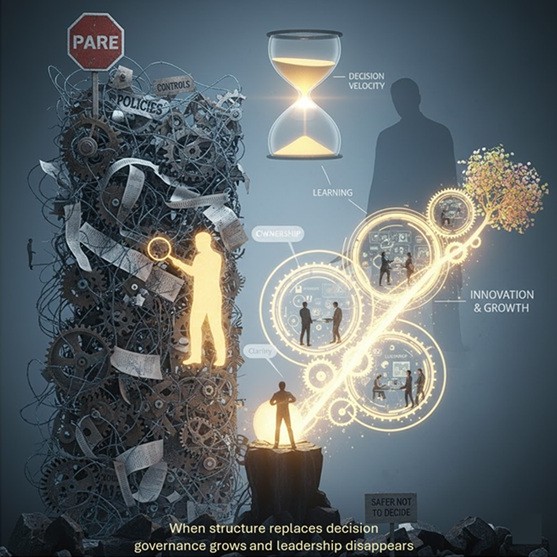
How Organizations Replaced Decision with Structure and What It Cost ThemIntroduction: A Silent Organizational Trade-Off Across modern organizations, a paradox has become impossible to ignore. We have never had:
Governance has grown precisely as leadership has retreated. And in many organizations, structure has quietly replaced decision. The Comfort of Structure, the Discomfort of Leadership Leadership is uncomfortable by nature. It requires:
Structure feels safer than leadership. So they invested heavily in governance, not to enable leadership, but to reduce exposure to it. How Decision Was Replaced by Structure The substitution did not happen overnight. It happened through a series of subtle shifts: 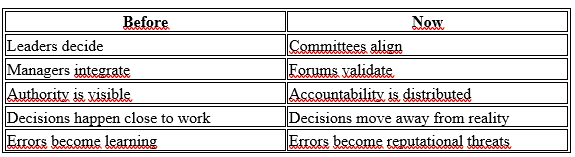 The language changed too:
What was lost was ownership. Why Leadership Shrinks in Governed Systems Leadership shrinks when systems send one clear signal: “It is safer not to decide.” This happens when:
It crowds it out. Governance as a Defense Mechanism In theory, governance exists to:
It becomes a defense mechanism.
More process appears where trust erodes. The organization becomes safe, but also slow, reactive, and inward-looking. The Hidden Costs of Replacing Leadership The costs are rarely immediate, but they are systemic:
Governance keeps expanding, trying to compensate for the very capability it helped suppress. Governance Is Not the Enemy, Confusion Is This is not an argument against governance. Strong governance is necessary:
Governance defines the frame. Leadership exercises judgment within it. When that distinction collapses, organizations confuse control with competence, and process with purpose. Reclaiming Leadership Without Abandoning Governance The way forward is not less governance. It is clearer leadership. That requires:
It is responsibility for decisions that cannot be deferred. Conclusion: What Is at Stake Governance grows when leadership retreats. But organizations do not thrive on structure alone. They thrive when:
With leadership, governance becomes what it was always meant to be: An enabler of responsible, human judgment in complex systems. |
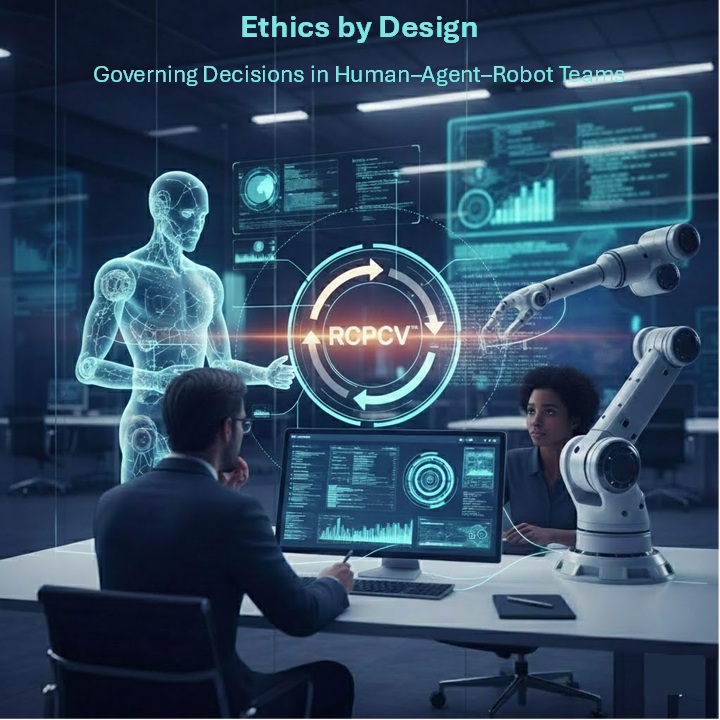 Work is no longer defined solely by human action. Today, value is created inside hybrid systems where humans, cognitive agents (AI), and robots operate together, sensing, deciding, acting, and learning at different speeds and with different forms of autonomy. This transformation is not theoretical. It is already shaping how projects are planned, how decisions are made, and how responsibility is distributed. And it raises a question most organizations are still avoiding: If work is now designed as a hybrid system, why is ethics still treated as an afterthought? 1. New Forms of Work Create New Moral Surfaces When AI and automation become active participants in workflows, ethics does not disappear, it multiplies. Hybrid Human–Agent–Robot teams introduce:
It creates unmanaged ethical risk. 2. Why Traditional Ethics Approaches Are No Longer Enough Most professional ethics frameworks were built for a different reality:
3. Ethics as Work Design, Not Compliance In modern work environments:
Ethics is no longer something we “apply” after decisions. It is something we build into how decisions happen. 4. Agentic AI Makes Ethical Design Non-Optional Agentic AI introduces contextual autonomy:
5. Ethical Operating Loops for Hybrid Teams In hybrid environments, decisions occur at multiple speeds:
One example is the RCPCV™ decision cycle:
As project professionals, we certify:
Technique without ethics is risk. Ethics without practice is fragile. The evolution of work naturally leads to a new question:
It is a consequence of structural change. 7. Conclusion — Ethics Is the Missing Infrastructure of Hybrid Work AI does not eliminate the need for ethics. It amplifies the consequences of its absence. The future of work will not be decided by tools alone, but by:
It is core infrastructure. AI scales capability. Ethics scales trust. And without trust, there is no team, only coordinated risk. Final Reflection As work becomes more intelligent, autonomous, and hybrid, one question remains unavoidable:
References:
|
 Work is changing faster than organizations can process, and often faster than leaders can adapt. We are entering a new era: Hybrid Human–Agent–Robot Teams™. Technology is no longer a tool that sits outside the workflow. It has become an active member of the team, with presence, agency, and autonomous influence in the flow of value. So the core question is no longer: “How do we use AI?” The real question is: “How do we work - and lead - when AI has voice, agency, and contextual autonomy inside the team?” This is the new anatomy of work. And it demands a new mindset, a new ethical foundation, and a new approach to Work Design. 1. Human–Agent–Robot: The New Anatomy of Work Modern work blends three complementary forms of intelligence: Humans -Consciousness, Ethics, Creativity Intention • Purpose • Meaning • Context • Ethical judgment • Deep collaboration • Cultural sense-making • Relational learning Cognitive Agents (AI) - Prediction, Analysis, Coordination Language interpretation • Pattern recognition • Risk anticipation • Real-time decision support • Living documentation • Human–robot orchestration Robots - Execution, Precision, Cadence Physical/digital automation • High-frequency reliability • Safety • Repeatability • Elimination of dangerous or exhausting tasks This is not science fiction. It is the present becoming visible. 2. New Forms of Work = Intelligent Work Design The integration of humans, agents, and robots is not a technology problem. It is a Work Design problem. New Forms of Work require: • Flexible and reconfigurable teams • Adaptive, living workflows • Short learning cycles • Dynamic roles (initiator, checker, explainer, arbiter, synthesizer) • Clear autonomy boundaries for agents and robots • Intentional alignment rituals • Psychological safety • Embedded ethical governance • Transparency in algorithmic decisions • Coherent organizational intent New forms of work do not “happen.” They are designed and redesigned continuously. 3. Agentic AI: The Nervous System of Modern Teams AI no longer simply responds to commands. It acts with contextual autonomy, across three levels: Level 1 - Assistive Zero autonomy. AI responds, summarizes, executes. Level 2 - Collaborative Partial autonomy. AI suggests, anticipates patterns, identifies tensions and risks. Level 3 - Contextually Autonomous AI interprets intent, reads variables, acts within ethical and operational boundaries — always with human fallback. AI does not replace teams. AI amplifies teams. 4. Copilots, Chatbots, and NLP - Language Is the New Operating System With advanced NLP, language becomes the universal interface of collaboration: • Copilots capture knowledge in real time • Meetings turn into structured documentation • Ideas become visual maps • Misalignment becomes clarity • Cognitive noise becomes shared understanding • Humans, agents, and robots connect into one workflow Language is now the operating system of intelligent collaboration. 5. SECI 2.0™ + AI - Knowledge That Breathes The SECI 2.0™ model transforms knowledge into an organizational breathing cycle: Socialization → AI captures signals, tensions, and context Externalization → copilots turn conversations into structured knowledge Combination → agents merge data, narratives, and scenarios Internalization → real-time learning embedded into work itself Knowledge stops being static documentation. It becomes living, adaptive, continuous. 6. Cognitive Agility™ - The Essential Competence of Hybrid Work Hybrid teams require a new mental fluency: • Pattern recognition • Clarity amid complexity • Intentional action • Rapid adaptation • Integrating AI without losing humanity • Balancing data with meaning • Navigating paradoxes Cognitive Agility™ is the core muscle of future-ready teams. 7. RCPCV™ — Ethical Decision-Making in Hybrid Environments Decisions now occur at multiple speeds: human, robotic, and algorithmic. RCPCV™ ensures moral coherence: R — Recollect → data, weak signals, perceptions, context C — Consult → affected people + AI-generated insights P — Process (Think) → critical reasoning, foresight, bias awareness C — Communicate → clarity, intent, responsibility V — Verify → real-world impact, learning, regeneration AI accelerates. RCPCV™ protects. Leadership integrates. 8. The Human Edge - The Competitive Advantage AI Cannot Replace Even in an AI-augmented world, human capabilities define outcomes: Purpose • Ethics • Trust • Deep Learning • Psychological Safety • Sensibility • Discernment • Culture • Intention • Impact •Technology amplifies. Humans direct. 9. The Human–Agent–Robot Ethical Contract Hybrid teams require a living ethical contract built on:
Without trust, there is no team. 10. Conclusion - Work Has Changed. Leadership Must Change Too. AI does not replace teams. It replaces outdated ways of working. The future belongs to those who can: Design intelligent work Integrate humans, agents, and robots Cultivate the human edge Learn continuously Make ethical decisions Lead with consciousness Create sustainable, regenerative value So the central question becomes: Is AI in your organization just a tool, or already a team member? References: Nonaka, I., & Takeuchi, H. (1995). The Knowledge-Creating Company. Oxford University Press. Senge, P. (2006). The Fifth Discipline. Doubleday. Siemens, G. (2005). Connectivism: A learning theory for the digital age. IJITDL. Edmondson, A. (1999). Psychological safety and learning behavior. ASQ. Jurafsky, D., & Martin, J. (2023). Speech and Language Processing (3rd ed.). Vaswani, A., et al. (2017). Attention is all you need. NeurIPS. Valentine, M., & Bernstein, M. (2025). Flash Teams 2.0. MIT Work Design Lab. Appelo, J. (2025). Human–Robot–Agent. Meadows, D. (2008). Thinking in Systems. Chelsea Green. Laloux, F. (2014). Reinventing Organizations. Nelson Parker. Covey, S. (2006). The Speed of Trust. Free Press. Project Management Institute. (2025). PMI Code of Ethics. National Institute of Standards and Technology. (2023). AI Risk Management Framework. McKinsey & Company. (2024). Future of Work Report. Boston Consulting Group. (2023). Adaptive Work Design. European Union. (2025). Artificial Intelligence Act (Regulation (EU). |
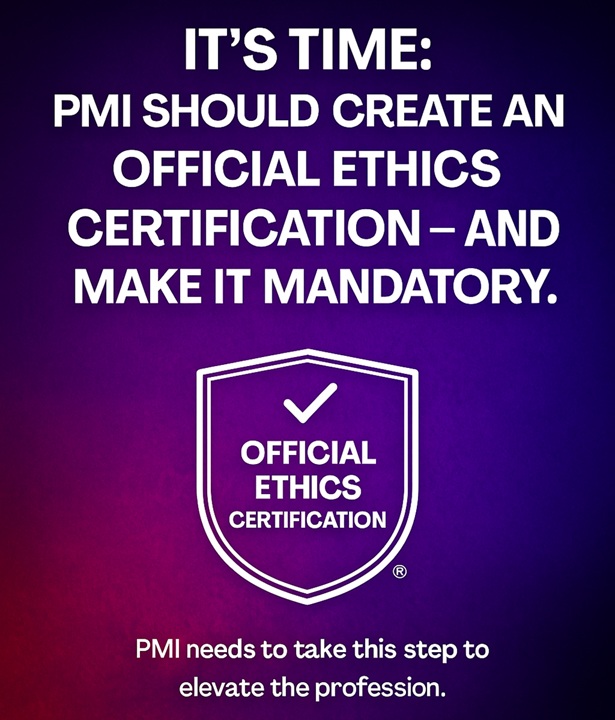 We now have the 2025 Code of Ethics, the EDMF, the Practitioner Ethics Toolkit, and the Chapter Board Ethics Toolkit. This is, without question, the strongest ethical ecosystem PMI has ever published. But one decisive step is still missing. Ethics must stop being just a document, and become a certification. And PMI should lead that change. It makes little sense for our profession to have highly rigorous technical certifications (PMP®, PMI-ACP® PMI-PMOCP™) while the foundation that sustains everything - ethical conduct - has no formal certification at all. The time has come for a structural shift: 1. PMI should create an Official Ethics Certification. A certification based on the 2025 Code, the EDMF, real dilemmas, conflicts of interest, Chapter governance, AI ethics, and sustainability ethics. 2. This certification should be mandatory for ALL other PMI certifications. Before becoming PMP, ACP, RMP, or PMO-CP, every professional should demonstrate: - Ethical maturity - Critical judgement - Conscious decision-making - Responsibility and integrity Technique without ethics is risk. Ethics without technique can be developed. The hierarchy is obvious. 3. All Chapter Board members MUST be certified in Ethics. Leading a Chapter is not only about delivering activities, it is about stewarding trust, fairness, ethical communication, conflicts of interest, and responsible governance. Making ethics certification mandatory for Board Members would: - Protect the community - Increase transparency - Reduce internal conflicts - Professionalize volunteer leadership - Build global institutional maturity - Strengthen PMI’s reputation worldwide 4. This is the natural next step in the evolution of our profession. If we want ethics to be more than words, we must treat it the same way we treat methodology: - With learning, rigor, evaluation, and continuous practice. The profession does not advance by updating guides alone. It advances when we elevate conscience, conduct, and responsibility. PMI now has a historic opportunity: To make ethics its most important certification. To explore PMI’s official ethics resources: PMI members’ ethics commitments Note: This reflection is personal and independent, based on my study of PMI’s published materials, and does not represent an official PMI position. |
|
"He felt that his whole life was some kind of dream, and he sometimes wondered whose it was and whether they were enjoying it." - Douglas Adams |