Ethics by Design: Why New Forms of Work Demand New Ethical Architecture
From the Support to Develop Blog
by Luis Branco

This blog addresses management-related topics and has three areas of focus: 1. Technical skills; 2. Competencies in the field of interpersonal relations and communication (including personal organization and delegation, leadership, teamwork, conflict resolution, conducting meetings, and negotiation); and 3. Strategy (including diagnosis, strategic guidelines, and implementation).4.Technology
Recent Posts
RCPCV™: A Method for Decision-Making and Continuous Improvement
The Same Change Can Succeed and Fail at the Same Time
What Must Exist Even When No Single Role Owns the Whole?
PHASE 4 – THE EMERGENCE
When Structural Drift Becomes Consequential
Categories
Agile,
Career Development,
Career Development,
Career Development,
Career Development,
Career Development,
Career Development,
Career Development,
Career Development,
Career Development,
Career Development,
Career Development,
Career Development,
Career Development,
Career Development,
Career Development,
Career Development,
Career Development,
Career Development,
Career Development,
Career Development,
Career Development,
Career Development,
Career Development,
Career Development,
Career Development,
Career Development,
Career Development,
Career Development,
Career Development,
Career Development,
Career Development,
Career Development,
Career Development,
Career Development,
Career Development,
Career Development,
Career Development,
Career Development,
Career Development,
Career Development,
Career Development,
Career Development,
Career Development,
Career Development,
Career Development,
Career Development,
Career Development,
Career Development,
Career Development,
Career Development,
Career Development,
Career Development,
Career Development,
Career Development,
Career Development,
Career Development,
Career Development,
Career Development,
Career Development,
Career Development,
Career Development,
Career Development,
Career Development,
Career Development,
Career Development,
Career Development,
Career Development,
Career Development,
Career Development,
Career Development,
Career Development,
Career Development,
Career Development,
Career Development,
Career Development,
Career Development,
Career Development,
Career Development,
Career Development,
Career Development,
Career Development,
Career Development,
Career Development,
Career Development,
Career Development,
Career Development,
Career Development,
Career Development,
Career Development,
Career Development,
Career Development,
Career Development,
Career Development,
Career Development,
Career Development,
Career Development,
Career Development,
Career Development,
Career Development,
Career Development,
Career Development,
Career Development,
Career Development,
Career Development,
Career Development,
Career Development,
Career Development,
Career Development,
Career Development,
Career Development,
Career Development,
Career Development,
Career Development,
Career Development,
Career Development,
Career Development,
Career Development,
Career Development,
Career Development,
Career Development,
Career Development,
Career Development,
Education,
Governance,
Governance,
Governance,
Governance,
Governance,
Governance,
Governance,
Governance,
Governance,
Governance,
Governance,
Governance,
Governance,
Governance,
Governance,
Governance,
Governance,
Governance,
Governance,
Governance,
Governance,
In,
Integration Management,
Interpersonal Skills,
Interpersonal Skills,
Interpersonal Skills,
Interpersonal Skills,
Interpersonal Skills,
Interpersonal Skills,
Interpersonal Skills,
Interpersonal Skills,
Interpersonal Skills,
Interpersonal Skills,
Interpersonal Skills,
Interpersonal Skills,
Interpersonal Skills,
Interpersonal Skills,
Interpersonal Skills,
Interpersonal Skills,
Interpersonal Skills,
Interpersonal Skills,
Interpersonal Skills,
Interpersonal Skills,
Interpersonal Skills,
Interpersonal Skills,
Interpersonal Skills,
Interpersonal Skills,
Interpersonal Skills,
Interpersonal Skills,
Interpersonal Skills,
Interpersonal Skills,
Interpersonal Skills,
Interpersonal Skills,
Interpersonal Skills,
Interpersonal Skills,
Interpersonal Skills,
Interpersonal Skills,
Interpersonal Skills,
Interpersonal Skills,
Interpersonal Skills,
Interpersonal Skills,
Interpersonal Skills,
Interpersonal Skills,
Interpersonal Skills,
Interpersonal Skills,
Interpersonal Skills,
Interpersonal Skills,
Interpersonal Skills,
Interpersonal Skills,
Interpersonal Skills,
Interpersonal Skills,
Interpersonal Skills,
Interpersonal Skills,
Interpersonal Skills,
Interpersonal Skills,
Interpersonal Skills,
Interpersonal Skills,
Interpersonal Skills,
Interpersonal Skills,
Interpersonal Skills,
Interpersonal Skills,
Interpersonal Skills,
Interpersonal Skills,
Interpersonal Skills,
Interpersonal Skills,
Interpersonal Skills,
Interpersonal Skills,
Interpersonal Skills,
Interpersonal Skills,
Interpersonal Skills,
Interpersonal Skills,
Interpersonal Skills,
Interpersonal Skills,
Interpersonal Skills,
Interpersonal Skills,
Interpersonal Skills,
Interpersonal Skills,
Interpersonal Skills,
Interpersonal Skills,
Interpersonal Skills,
Interpersonal Skills,
Interpersonal Skills,
Interpersonal Skills,
Interpersonal Skills,
Interpersonal Skills,
Interpersonal Skills,
Interpersonal Skills,
Interpersonal Skills,
Interpersonal Skills,
Interpersonal Skills,
Interpersonal Skills,
Interpersonal Skills,
Interpersonal Skills,
Interpersonal Skills,
Interpersonal Skills,
Interpersonal Skills,
Interpersonal Skills,
Interpersonal Skills,
Interpersonal Skills,
Interpersonal Skills,
Interpersonal Skills,
Interpersonal Skills,
Interpersonal Skills,
Interpersonal Skills,
Interpersonal Skills,
Interpersonal Skills,
Interpersonal Skills,
Interpersonal Skills,
Interpersonal Skills,
Interpersonal Skills,
Interpersonal Skills,
Interpersonal Skills,
Interpersonal Skills,
Interpersonal Skills,
Interpersonal Skills,
Interpersonal Skills,
Interpersonal Skills,
Interpersonal Skills,
Interpersonal Skills,
Interpersonal Skills,
Interpersonal Skills,
Interpersonal Skills,
Interpersonal Skills,
Interpersonal Skills,
Interpersonal Skills,
Knowledge Management,
le,
lea,
Leadership,
Leadership,
Leadership,
Leadership,
Leadership,
Leadership,
Leadership,
Leadership,
Leadership,
Leadership,
Leadership,
Leadership,
Leadership,
Leadership,
Leadership,
Leadership,
Leadership,
Leadership,
Leadership,
Leadership,
Leadership,
Leadership,
Leadership,
Leadership,
Leadership,
Leadership,
Leadership,
Leadership,
Leadership,
Leadership,
Leadership,
Leadership,
Leadership,
Leadership,
Leadership,
Leadership,
Leadership,
Leadership,
Leadership,
Leadership,
Leadership,
Leadership,
Leadership,
Leadership,
Leadership,
Leadership,
Leadership,
Leadership,
Leadership,
Leadership,
Leadership,
Leadership,
Leadership,
Leadership,
Leadership,
Leadership,
Leadership,
Leadership,
Leadership,
Leadership,
Leadership,
Leadership,
Leadership,
Leadership,
Leadership,
Leadership,
Leadership,
Leadership,
Leadership,
Leadership,
Leadership,
Leadership,
Leadership,
Leadership,
Leadership,
Leadership,
Leadership,
Leadership,
Leadership,
Leadership,
Leadership,
Leadership,
Leadership,
Leadership,
Leadership,
Leadership,
Leadership,
Leadership,
Leadership,
Leadership,
Leadership,
Leadership,
Leadership,
Leadership,
Leadership,
Leadership,
Leadership,
Leadership,
Leadership,
Leadership,
Leadership,
Leadership,
Leadership,
Leadership,
Leadership,
Leadership,
Leadership,
Leadership,
Leadership,
Leadership,
Leadership,
Leadership,
Leadership,
Leadership,
Leadership,
Leadership,
Leadership,
Leadership,
Leadership,
Leadership,
Leadership,
Leadership,
Leadership,
or,
Organizational Project Management,
Portfolio Management,
Program,
Program Management,
Strategy,
Strategy,
Strategy,
Strategy,
Strategy,
Strategy,
Strategy,
Strategy,
Strategy,
Strategy,
Strategy,
Strategy,
Strategy,
Strategy,
Strategy,
Strategy,
Strategy,
Strategy,
Strategy,
Strategy,
Strategy,
Strategy,
Strategy,
Strategy,
Strategy,
Strategy,
Strategy,
Strategy,
Strategy,
Strategy,
Strategy,
Strategy,
Strategy,
Strategy,
Strategy,
Strategy,
Strategy,
Strategy,
Strategy,
Strategy,
Strategy,
Strategy,
Strategy,
Strategy,
Strategy,
Strategy,
Strategy,
Strategy,
Strategy,
Strategy,
Strategy,
Strategy,
Strategy,
Strategy,
Strategy,
Strategy,
Strategy,
Strategy,
Strategy,
Strategy,
Strategy,
Strategy,
Strategy,
Strategy,
Strategy,
Strategy,
Strategy,
Strategy,
Strategy,
Strategy,
Strategy,
Strategy,
Strategy,
Strategy,
Strategy,
Strategy,
Strategy,
Strategy,
Strategy,
Strategy,
Strategy,
Strategy,
Strategy,
Strategy,
Strategy,
Strategy,
Strategy,
Strategy,
Strategy,
Strategy,
Strategy,
Strategy,
Strategy,
Strategy,
Strategy,
Strategy,
Strategy,
Strategy,
Strategy,
Strategy,
Strategy,
Strategy,
Strategy,
Strategy,
Strategy,
Strategy,
Strategy,
Strategy,
Strategy,
Strategy,
Strategy,
Strategy,
Strategy,
Strategy,
Strategy,
Strategy,
Strategy,
Strategy,
Strategy,
Strategy,
Strategy,
Strategy,
Strategy,
Sustainability,
Talent Management,
Talent Management,
Talent Management,
Talent Management,
Talent Management,
Talent Management,
Talent Management,
Talent Management,
Talent Management,
Talent Management,
Talent Management,
Talent Management,
Talent Management,
Talent Management,
Talent Management,
Talent Management,
Talent Management,
Talent Management,
Talent Management,
Talent Management,
Talent Management,
Talent Management,
Talent Management,
Talent Management,
Talent Management,
Talent Management,
Talent Management,
Talent Management,
Talent Management,
Talent Management,
Talent Management,
Talent Management,
Talent Management,
Talent Management,
Talent Management,
Talent Management,
Talent Management,
Talent Management,
Talent Management,
Talent Management,
Talent Management,
Talent Management,
Talent Management,
Talent Management,
Talent Management,
Talent Management,
Talent Management,
Talent Management,
Talent Management,
Talent Management,
Talent Management,
Talent Management,
Talent Management,
Talent Management,
Talent Management,
Talent Management,
Talent Management,
Talent Management,
Talent Management,
Talent Management,
Talent Management,
Talent Management,
Talent Management,
Talent Management,
Talent Management,
Talent Management,
Talent Management,
Talent Management,
Talent Management,
Talent Management,
Talent Management,
Talent Management,
Talent Management,
Talent Management,
Talent Management,
Talent Management,
Talent Management,
Talent Management,
Talent Management,
Talent Management,
Talent Management,
Talent Management,
Talent Management,
Talent Management,
Talent Management,
Talent Management,
Talent Management,
Talent Management,
Talent Management,
Talent Management,
Talent Management,
Talent Management,
Talent Management,
Talent Management,
Talent Management,
Talent Management,
Talent Management,
Talent Management,
Talent Management,
Talent Management,
Talent Management,
Talent Management,
Talent Management,
Talent Management,
Talent Management,
Talent Management,
Talent Management,
Talent Management,
Talent Management,
Talent Management,
Talent Management,
Talent Management,
Talent Management,
Talent Management,
Talent Management,
Talent Management,
Talent Management,
Talent Management,
Talent Management,
Talent Management,
Talent Management,
Talent Management,
Talent Management
Date
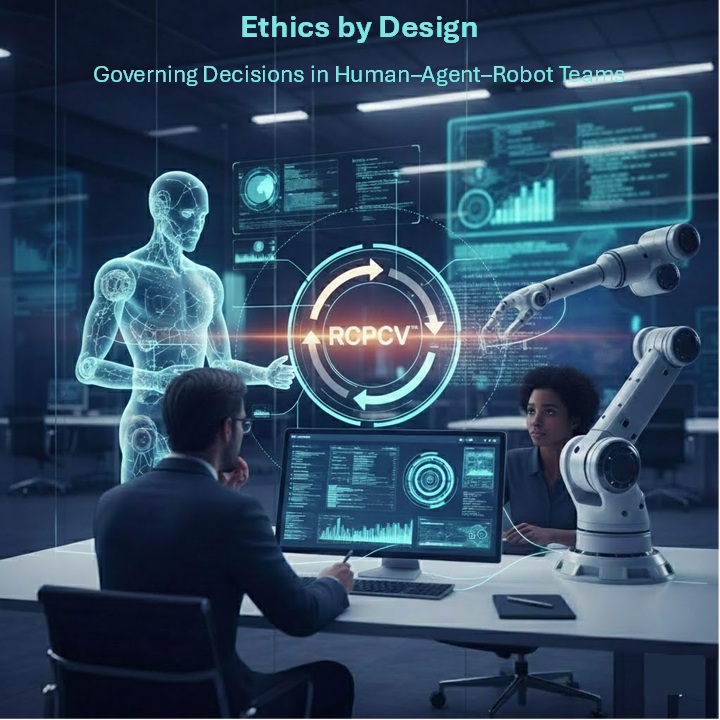
Work is no longer defined solely by human action.
Today, value is created inside
hybrid systems where humans, cognitive agents (AI), and robots operate together, sensing, deciding, acting, and learning at different speeds and with different forms of autonomy.
This transformation is not theoretical.
It is already shaping how projects are planned, how decisions are made, and how responsibility is distributed.
And it raises a question most organizations are still avoiding:
If work is now designed as a hybrid system, why is ethics still treated as an afterthought?1. New Forms of Work Create New Moral SurfacesWhen AI and automation become active participants in workflows, ethics does not disappear, it
multiplies.
Hybrid Human–Agent–Robot teams introduce:
- Distributed decision-making
- Algorithmic influence without explicit intent
- Actions executed faster than human reflection
- Responsibility spread across humans, agents, and systems
These conditions create what we can call
new moral surfaces:
- Points where decisions affect people, trust, safety, fairness, or outcomes, even when no single human consciously chose the result.
The absence of ethical design does not create neutrality.
It creates
unmanaged ethical risk.2. Why Traditional Ethics Approaches Are No Longer EnoughMost professional ethics frameworks were built for a different reality:
- Human-led decisions
- Clear chains of authority
- Linear accountability
- Post-action evaluation
But hybrid work environments are:
- Continuous
- Non-linear
- Distributed
- Accelerated by AI
In this context, ethics cannot remain:
- A static document
- A compliance checklist
- A once-a-year training
- A personal virtue disconnected from system design
Ethics must evolve from guidance to architecture.3. Ethics as Work Design, Not ComplianceIn modern work environments:
- Autonomy without ethical boundaries becomes risk
- Speed without reflection amplifies errors
- Intelligence without accountability erodes trust
That is why ethics must be
embedded by design:
- In workflows
- In decision loops
- In AI autonomy boundaries
- In escalation rules
- In feedback and learning cycles
Just as we design for performance, safety, or quality, we must now
design for ethical coherence.
Ethics is no longer something we “apply” after decisions.
It is something we
build into how decisions happen.
4. Agentic AI Makes Ethical Design Non-OptionalAgentic AI introduces contextual autonomy:
- Systems that interpret intent, anticipate risks, and act within predefined boundaries.
This makes three principles unavoidable:
- Transparency - decisions must be explainable
- Human accountability - responsibility cannot be delegated to algorithms
- Continuous verification - ethical impact must be reviewed, not assumed
Without these principles embedded into work design, organizations risk creating systems that are efficient, but ethically blind.
5. Ethical Operating Loops for Hybrid TeamsIn hybrid environments, decisions occur at multiple speeds:
- Human
- Algorithmic
- Automated
This requires
ethical operating loops, not ethical slogans.
One example is the RCPCV™ decision cycle:
- Recollect — data, signals, context
- Consult — affected people and AI insights
- Process (Think) — critical reasoning and bias awareness
- Communicate — clarity, intent, responsibility
- Verify — real-world impact and learning
Such loops align naturally with:
- PMI’s 2025 Code of Ethics
- Ethical Decision-Making Frameworks
- NIST AI Risk Management principles
- Emerging regulatory expectations (e.g., EU AI Act)
The key is not the label, it is the
design intent:
- Ethics operating at the same speed as work.
6. From Ethics Awareness to Ethics CapabilityAs project professionals, we certify:
- Methodologies
- Tools
- Delivery competence
- Governance structures
Yet in environments where:
- AI influences decisions
- Automation executes actions
- Teams operate across human–machine boundaries
Ethical maturity becomes a core professional capability, not a personal preference.
Technique without ethics is risk.
Ethics without practice is fragile.
The evolution of work naturally leads to a new question:
- Should ethical capability be treated with the same rigor as technical capability?
This is not a critique.
It is a consequence of structural change.
7. Conclusion — Ethics Is the Missing Infrastructure of Hybrid WorkAI does not eliminate the need for ethics.
It
amplifies the consequences of its absence.
The future of work will not be decided by tools alone, but by:
- How responsibility is designed
- How decisions are governed
- How trust is protected
- How learning is embedded
Ethics is no longer a boundary condition.
It is
core infrastructure.
AI scales capability.
Ethics scales trust.
And without trust, there is no team, only coordinated risk.
Final ReflectionAs work becomes more intelligent, autonomous, and hybrid, one question remains unavoidable:
- Is ethics in your organization a document, or is it designed into how work actually happens?
Note: This reflection is personal and independent, based on my study of PMI’s published materials, and does not represent an official PMI position.References:- Project Management Institute. (2025). PMI Code of Ethics and Professional Conduct
- National Institute of Standards and Technology. (2023). AI Risk Management Framework
- European Union. (2025). Artificial Intelligence Act
- Nonaka, I., & Takeuchi, H. (1995). The Knowledge-Creating Company
- Senge, P. (2006). The Fifth Discipline
- Edmondson, A. (1999). Psychological Safety and Learning Behavior
- Meadows, D. (2008). Thinking in Systems
- Laloux, F. (2014). Reinventing Organizations
Posted on: December 19, 2025 09:08 AM |
Permalink
Comments (1)
Please login or join to subscribe to this item
Very insightful. Thank you for sharing.
Please Login/Register to leave a comment.
|
Necessity is the mother of taking chances.
- Mark Twain
|




