It’s Time: PMI Should Create an Official Ethics Certification, and Make It Mandatory.
From the Support to Develop Blog
by Luis Branco

This blog addresses management-related topics and has three areas of focus: 1. Technical skills; 2. Competencies in the field of interpersonal relations and communication (including personal organization and delegation, leadership, teamwork, conflict resolution, conducting meetings, and negotiation); and 3. Strategy (including diagnosis, strategic guidelines, and implementation).4.Technology
Recent Posts
RCPCV™: A Method for Decision-Making and Continuous Improvement
The Same Change Can Succeed and Fail at the Same Time
What Must Exist Even When No Single Role Owns the Whole?
PHASE 4 – THE EMERGENCE
When Structural Drift Becomes Consequential
Categories
Agile,
Career Development,
Career Development,
Career Development,
Career Development,
Career Development,
Career Development,
Career Development,
Career Development,
Career Development,
Career Development,
Career Development,
Career Development,
Career Development,
Career Development,
Career Development,
Career Development,
Career Development,
Career Development,
Career Development,
Career Development,
Career Development,
Career Development,
Career Development,
Career Development,
Career Development,
Career Development,
Career Development,
Career Development,
Career Development,
Career Development,
Career Development,
Career Development,
Career Development,
Career Development,
Career Development,
Career Development,
Career Development,
Career Development,
Career Development,
Career Development,
Career Development,
Career Development,
Career Development,
Career Development,
Career Development,
Career Development,
Career Development,
Career Development,
Career Development,
Career Development,
Career Development,
Career Development,
Career Development,
Career Development,
Career Development,
Career Development,
Career Development,
Career Development,
Career Development,
Career Development,
Career Development,
Career Development,
Career Development,
Career Development,
Career Development,
Career Development,
Career Development,
Career Development,
Career Development,
Career Development,
Career Development,
Career Development,
Career Development,
Career Development,
Career Development,
Career Development,
Career Development,
Career Development,
Career Development,
Career Development,
Career Development,
Career Development,
Career Development,
Career Development,
Career Development,
Career Development,
Career Development,
Career Development,
Career Development,
Career Development,
Career Development,
Career Development,
Career Development,
Career Development,
Career Development,
Career Development,
Career Development,
Career Development,
Career Development,
Career Development,
Career Development,
Career Development,
Career Development,
Career Development,
Career Development,
Career Development,
Career Development,
Career Development,
Career Development,
Career Development,
Career Development,
Career Development,
Career Development,
Career Development,
Career Development,
Career Development,
Career Development,
Career Development,
Career Development,
Career Development,
Career Development,
Career Development,
Education,
Governance,
Governance,
Governance,
Governance,
Governance,
Governance,
Governance,
Governance,
Governance,
Governance,
Governance,
Governance,
Governance,
Governance,
Governance,
Governance,
Governance,
Governance,
Governance,
Governance,
Governance,
In,
Integration Management,
Interpersonal Skills,
Interpersonal Skills,
Interpersonal Skills,
Interpersonal Skills,
Interpersonal Skills,
Interpersonal Skills,
Interpersonal Skills,
Interpersonal Skills,
Interpersonal Skills,
Interpersonal Skills,
Interpersonal Skills,
Interpersonal Skills,
Interpersonal Skills,
Interpersonal Skills,
Interpersonal Skills,
Interpersonal Skills,
Interpersonal Skills,
Interpersonal Skills,
Interpersonal Skills,
Interpersonal Skills,
Interpersonal Skills,
Interpersonal Skills,
Interpersonal Skills,
Interpersonal Skills,
Interpersonal Skills,
Interpersonal Skills,
Interpersonal Skills,
Interpersonal Skills,
Interpersonal Skills,
Interpersonal Skills,
Interpersonal Skills,
Interpersonal Skills,
Interpersonal Skills,
Interpersonal Skills,
Interpersonal Skills,
Interpersonal Skills,
Interpersonal Skills,
Interpersonal Skills,
Interpersonal Skills,
Interpersonal Skills,
Interpersonal Skills,
Interpersonal Skills,
Interpersonal Skills,
Interpersonal Skills,
Interpersonal Skills,
Interpersonal Skills,
Interpersonal Skills,
Interpersonal Skills,
Interpersonal Skills,
Interpersonal Skills,
Interpersonal Skills,
Interpersonal Skills,
Interpersonal Skills,
Interpersonal Skills,
Interpersonal Skills,
Interpersonal Skills,
Interpersonal Skills,
Interpersonal Skills,
Interpersonal Skills,
Interpersonal Skills,
Interpersonal Skills,
Interpersonal Skills,
Interpersonal Skills,
Interpersonal Skills,
Interpersonal Skills,
Interpersonal Skills,
Interpersonal Skills,
Interpersonal Skills,
Interpersonal Skills,
Interpersonal Skills,
Interpersonal Skills,
Interpersonal Skills,
Interpersonal Skills,
Interpersonal Skills,
Interpersonal Skills,
Interpersonal Skills,
Interpersonal Skills,
Interpersonal Skills,
Interpersonal Skills,
Interpersonal Skills,
Interpersonal Skills,
Interpersonal Skills,
Interpersonal Skills,
Interpersonal Skills,
Interpersonal Skills,
Interpersonal Skills,
Interpersonal Skills,
Interpersonal Skills,
Interpersonal Skills,
Interpersonal Skills,
Interpersonal Skills,
Interpersonal Skills,
Interpersonal Skills,
Interpersonal Skills,
Interpersonal Skills,
Interpersonal Skills,
Interpersonal Skills,
Interpersonal Skills,
Interpersonal Skills,
Interpersonal Skills,
Interpersonal Skills,
Interpersonal Skills,
Interpersonal Skills,
Interpersonal Skills,
Interpersonal Skills,
Interpersonal Skills,
Interpersonal Skills,
Interpersonal Skills,
Interpersonal Skills,
Interpersonal Skills,
Interpersonal Skills,
Interpersonal Skills,
Interpersonal Skills,
Interpersonal Skills,
Interpersonal Skills,
Interpersonal Skills,
Interpersonal Skills,
Interpersonal Skills,
Interpersonal Skills,
Interpersonal Skills,
Interpersonal Skills,
Interpersonal Skills,
Knowledge Management,
le,
lea,
Leadership,
Leadership,
Leadership,
Leadership,
Leadership,
Leadership,
Leadership,
Leadership,
Leadership,
Leadership,
Leadership,
Leadership,
Leadership,
Leadership,
Leadership,
Leadership,
Leadership,
Leadership,
Leadership,
Leadership,
Leadership,
Leadership,
Leadership,
Leadership,
Leadership,
Leadership,
Leadership,
Leadership,
Leadership,
Leadership,
Leadership,
Leadership,
Leadership,
Leadership,
Leadership,
Leadership,
Leadership,
Leadership,
Leadership,
Leadership,
Leadership,
Leadership,
Leadership,
Leadership,
Leadership,
Leadership,
Leadership,
Leadership,
Leadership,
Leadership,
Leadership,
Leadership,
Leadership,
Leadership,
Leadership,
Leadership,
Leadership,
Leadership,
Leadership,
Leadership,
Leadership,
Leadership,
Leadership,
Leadership,
Leadership,
Leadership,
Leadership,
Leadership,
Leadership,
Leadership,
Leadership,
Leadership,
Leadership,
Leadership,
Leadership,
Leadership,
Leadership,
Leadership,
Leadership,
Leadership,
Leadership,
Leadership,
Leadership,
Leadership,
Leadership,
Leadership,
Leadership,
Leadership,
Leadership,
Leadership,
Leadership,
Leadership,
Leadership,
Leadership,
Leadership,
Leadership,
Leadership,
Leadership,
Leadership,
Leadership,
Leadership,
Leadership,
Leadership,
Leadership,
Leadership,
Leadership,
Leadership,
Leadership,
Leadership,
Leadership,
Leadership,
Leadership,
Leadership,
Leadership,
Leadership,
Leadership,
Leadership,
Leadership,
Leadership,
Leadership,
Leadership,
Leadership,
Leadership,
or,
Organizational Project Management,
Portfolio Management,
Program,
Program Management,
Strategy,
Strategy,
Strategy,
Strategy,
Strategy,
Strategy,
Strategy,
Strategy,
Strategy,
Strategy,
Strategy,
Strategy,
Strategy,
Strategy,
Strategy,
Strategy,
Strategy,
Strategy,
Strategy,
Strategy,
Strategy,
Strategy,
Strategy,
Strategy,
Strategy,
Strategy,
Strategy,
Strategy,
Strategy,
Strategy,
Strategy,
Strategy,
Strategy,
Strategy,
Strategy,
Strategy,
Strategy,
Strategy,
Strategy,
Strategy,
Strategy,
Strategy,
Strategy,
Strategy,
Strategy,
Strategy,
Strategy,
Strategy,
Strategy,
Strategy,
Strategy,
Strategy,
Strategy,
Strategy,
Strategy,
Strategy,
Strategy,
Strategy,
Strategy,
Strategy,
Strategy,
Strategy,
Strategy,
Strategy,
Strategy,
Strategy,
Strategy,
Strategy,
Strategy,
Strategy,
Strategy,
Strategy,
Strategy,
Strategy,
Strategy,
Strategy,
Strategy,
Strategy,
Strategy,
Strategy,
Strategy,
Strategy,
Strategy,
Strategy,
Strategy,
Strategy,
Strategy,
Strategy,
Strategy,
Strategy,
Strategy,
Strategy,
Strategy,
Strategy,
Strategy,
Strategy,
Strategy,
Strategy,
Strategy,
Strategy,
Strategy,
Strategy,
Strategy,
Strategy,
Strategy,
Strategy,
Strategy,
Strategy,
Strategy,
Strategy,
Strategy,
Strategy,
Strategy,
Strategy,
Strategy,
Strategy,
Strategy,
Strategy,
Strategy,
Strategy,
Strategy,
Strategy,
Strategy,
Sustainability,
Talent Management,
Talent Management,
Talent Management,
Talent Management,
Talent Management,
Talent Management,
Talent Management,
Talent Management,
Talent Management,
Talent Management,
Talent Management,
Talent Management,
Talent Management,
Talent Management,
Talent Management,
Talent Management,
Talent Management,
Talent Management,
Talent Management,
Talent Management,
Talent Management,
Talent Management,
Talent Management,
Talent Management,
Talent Management,
Talent Management,
Talent Management,
Talent Management,
Talent Management,
Talent Management,
Talent Management,
Talent Management,
Talent Management,
Talent Management,
Talent Management,
Talent Management,
Talent Management,
Talent Management,
Talent Management,
Talent Management,
Talent Management,
Talent Management,
Talent Management,
Talent Management,
Talent Management,
Talent Management,
Talent Management,
Talent Management,
Talent Management,
Talent Management,
Talent Management,
Talent Management,
Talent Management,
Talent Management,
Talent Management,
Talent Management,
Talent Management,
Talent Management,
Talent Management,
Talent Management,
Talent Management,
Talent Management,
Talent Management,
Talent Management,
Talent Management,
Talent Management,
Talent Management,
Talent Management,
Talent Management,
Talent Management,
Talent Management,
Talent Management,
Talent Management,
Talent Management,
Talent Management,
Talent Management,
Talent Management,
Talent Management,
Talent Management,
Talent Management,
Talent Management,
Talent Management,
Talent Management,
Talent Management,
Talent Management,
Talent Management,
Talent Management,
Talent Management,
Talent Management,
Talent Management,
Talent Management,
Talent Management,
Talent Management,
Talent Management,
Talent Management,
Talent Management,
Talent Management,
Talent Management,
Talent Management,
Talent Management,
Talent Management,
Talent Management,
Talent Management,
Talent Management,
Talent Management,
Talent Management,
Talent Management,
Talent Management,
Talent Management,
Talent Management,
Talent Management,
Talent Management,
Talent Management,
Talent Management,
Talent Management,
Talent Management,
Talent Management,
Talent Management,
Talent Management,
Talent Management,
Talent Management,
Talent Management,
Talent Management
Date
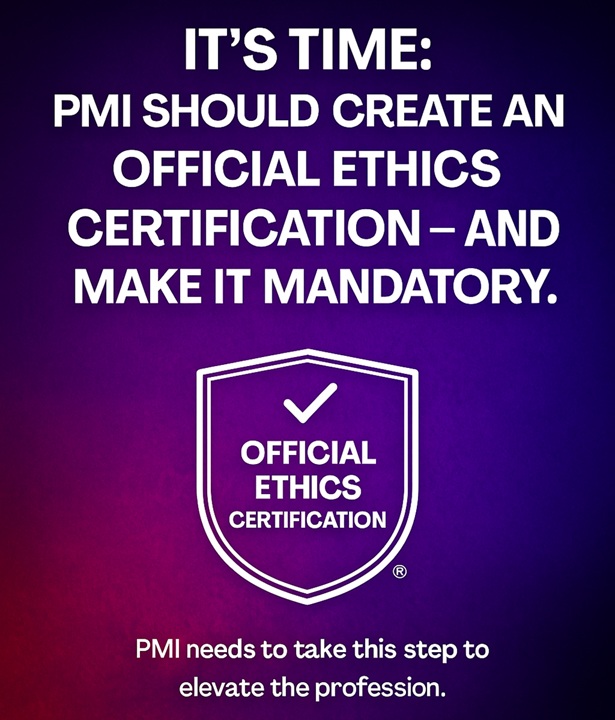 We now have the 2025 Code of Ethics, the EDMF, the Practitioner Ethics Toolkit, and the Chapter Board Ethics Toolkit.This is, without question, the strongest ethical ecosystem PMI has ever published.But one decisive step is still missing.Ethics must stop being just a document, and become a certification.And PMI should lead that change.It makes little sense for our profession to have highly rigorous technical certifications (PMP®, PMI-ACP® PMI-PMOCP™) while the foundation that sustains everything - ethical conduct - has no formal certification at all.The time has come for a structural shift:1. PMI should create an Official Ethics Certification.A certification based on the 2025 Code, the EDMF, real dilemmas, conflicts of interest, Chapter governance, AI ethics, and sustainability ethics.2. This certification should be mandatory for ALL other PMI certifications.Before becoming PMP, ACP, RMP, or PMO-CP, every professional should demonstrate:- Ethical maturity- Critical judgement- Conscious decision-making- Responsibility and integrityTechnique without ethics is risk.Ethics without technique can be developed.The hierarchy is obvious.3. All Chapter Board members MUST be certified in Ethics.Leading a Chapter is not only about delivering activities, it is about stewarding trust, fairness, ethical communication, conflicts of interest, and responsible governance.Making ethics certification mandatory for Board Members would:- Protect the community- Increase transparency- Reduce internal conflicts- Professionalize volunteer leadership- Build global institutional maturity- Strengthen PMI’s reputation worldwide4. This is the natural next step in the evolution of our profession.If we want ethics to be more than words, we must treat it the same way we treat methodology:- With learning, rigor, evaluation, and continuous practice.The profession does not advance by updating guides alone.It advances when we elevate conscience, conduct, and responsibility.PMI now has a historic opportunity:To make ethics its most important certification.To explore PMI’s official ethics resources:PMI members’ ethics commitmentsNote: This reflection is personal and independent, based on my study of PMI’s published materials, and does not represent an official PMI position.
Posted on: December 15, 2025 09:03 AM |
Permalink
Comments (8)
Please login or join to subscribe to this item

Kwiyuh Michael Wepngong
 Community Champion
Financial Management Specialist | US Peace Corps
Yaounde, Centre, Cameroon
Quite an insightful and bold request

Luis Branco
CEO| Business Insight, Consultores de Gestão, Ldª
Carcavelos, Lisboa, Portugal
Kwiyuh Michael Wepngong
Thank you.
Technique can be taught.
Ethics must be cultivated, deliberately, rigorously, and continuously.
That is how a profession moves from competence to maturity.

Aaron Porter
Community Champion
IT Director| Blade HQ
Payson, UT, United States
In the spirit of my analyst roots, I have to ask, why?
Ethics is already part of PMI certification. You can currently lose your certification or have it suspended for an ethics violation. What additional value do I, as a practitioner, get out of a mandatory certification in ethics? What benefit does it provide to me, my employer, or future employer(s) that makes it worth a separate, mandatory implementation?
Luis Branco
CEO| Business Insight, Consultores de Gestão, Ldª
Carcavelos, Lisboa, Portugal
Aaron Porter
Thank you for the question.
It goes straight to the heart of the proposal.
You’re absolutely right about one thing:
Ethics is already enforced in PMI certifications.
Violations can (and should) lead to suspension or revocation.
But enforcement is not the same as capability.
Today, PMI’s ethical framework operates mainly as an ex-post control mechanism:
- You are accountable after a violation occurs.
- Ethics is tested indirectly, through compliance and sanctions.
- The system assumes ethical maturity, but does not formally develop or assess it upfront.
What is missing is ex-ante ethical competence.
Why a dedicated Ethics Certification adds value
1. It shifts ethics from punishment to capability
A mandatory ethics certification would:
- Train professionals to recognize ethical dilemmas before harm occurs
- Develop structured ethical judgment (not just rule awareness)
- Equip practitioners to navigate gray zones: conflicts of interest, pressure from sponsors, AI-driven decisions, governance ambiguity
This is not about “knowing the Code.”
It is about being able to apply it under pressure.
2. Concrete value for practitioners
For the individual professional, it provides:
- A recognized signal of ethical judgment and decision maturity
- Protection in high-pressure environments (“I am trained and certified to escalate and handle this”)
- A shared ethical language when facing sponsors, boards, or AI-assisted decisions
In other words:
It strengthens professional autonomy, not bureaucracy.
3. Clear value for employers
For employers, it means:
- Reduced ethical, legal, and reputational risk
- More consistent decision-making across projects and programs
- Stronger governance in PMOs and portfolio leadership
This is especially relevant where:
- Authority is distributed
- Decisions are accelerated
- AI and automation influence outcomes
4. Why this matters now
The profession has changed:
- Projects operate in hybrid human–AI environments
- Decision velocity has increased
- Accountability is often fragmented
In this context, technical competence alone is no longer sufficient.
Ethical judgment becomes a core professional skill, not a moral add-on.
5. Chapters and Boards: a governance necessity
For Chapter Boards, the case is even stronger:
- They steward trust, fairness, communication, and conflicts of interest
- They operate in volunteer environments with asymmetrical power
- Governance failures damage the entire brand, not just individuals
Mandatory ethics certification here is not symbolic, it is institutional risk management.
In short
- Enforcement answers: “What happens if I violate ethics?”
- Certification answers: “Am I capable of navigating ethical complexity before damage occurs?”
The proposal is not about redundancy.
It is about elevating ethics to the same professional status as technique.
That is the added value, for practitioners, employers, and PMI itself.
Aaron Porter
Community Champion
IT Director| Blade HQ
Payson, UT, United States
That sounds good, Luis, but where is the demand for it that would justify mandating it? PMI can't offer legal protections. The majority of sponsors and boards don't speak PMBOK language or think in terms of PMI frameworks. You could base it on standards like ISO 37001, 37301, and 26000, but that still limits the number of companies aware enough to have a shared vocabulary.
You make a persuasive case, but it still feels like a problem that very few people are trying to solve. If ethics were mainly a training/certification problem, I think we’d have it solved by now. Ethical failures persist because they are governance failures - failures of incentives, information flow, and accountability. Improving ethical outcomes requires changing how power is exercised, not just how project managers think. Mandating certification at the project manager level might feel like you're doing something about it, but it's an area that most project managers have little influence or control over.
Luis Branco
CEO| Business Insight, Consultores de Gestão, Ldª
Carcavelos, Lisboa, Portugal
Aaron, your critique is solid and largely correct.
Ethical failures persist not because professionals lack moral awareness, but because governance fails: power is poorly designed, incentives are distorted, information doesn’t flow, and accountability becomes diluted.
No certification fixes that on its own. And project managers rarely control those structures.
But the proposal does not rest on the illusion that certification corrects power. It rests on something more precise: today, ethics is treated as a moral expectation and an ex-post enforcement mechanism, not as a recognized professional capability developed ex-ante.
What’s missing is not virtue, but practical legitimacy. A shared language. A structured way to name, surface, and escalate ethical friction that is currently diffuse and normalized, especially at the interfaces where governance breaks down: ambiguous authority, pressure to normalize deviance, accelerated and AI-mediated decisions, fragmented accountability.
Demand for standards rarely emerges organically. Risk management, safety, and data protection did not have “market demand” before they were institutionalized. Institutions create the conditions that make demand rational. PMI already does this with technical competence. Ethics is the structural exception.
Where the argument becomes strongest is in volunteer governance. Chapters and Boards exercise real power over people, conflicts of interest, communication, and reputation, often without any structured ethical training. Here, certification is not symbolic; it is institutional risk management.
I agree with you: improving ethical outcomes requires changing how power is exercised. My claim is narrower. Ethics certification is not the solution. It is an enabling constraint that exposes power patterns, reduces ambiguity, and makes governance failures harder to ignore.
Not sufficient. But not cosmetic either. And in an era of accelerated decision-making and hybrid human–AI systems, probably overdue.
Aaron Porter
Community Champion
IT Director| Blade HQ
Payson, UT, United States
I took a few days to mull this over. Obviously, ethics is important, but I don't think it merits more than a module in certification training. What I think would be of greater value would be a course on implementing and maintaining effective governance. Maybe a micro-credential positioned around decision architecture instead of focusing on rules. A full certification would seem like a money-grab. It could include a section on ethics in governance.
Luis Branco
CEO| Business Insight, Consultores de Gestão, Ldª
Carcavelos, Lisboa, Portugal
Aaron, this is a fair concern, and I agree with more of it than it might seem.
You’re right that most ethical failures are governance failures, not individual moral lapses.
Decision architecture, incentives, information flow, and accountability matter far more than abstract virtue.
Where I differ slightly is on the conclusion.
Governance design without ethical decision capability becomes procedural compliance.
Ethics training without governance reform becomes moral frustration.
Neither works alone.
What I am arguing for is not “more rules,” nor ethics as a standalone moral badge.
I’m arguing for ethics as a recognized decision capability, developed ex-ante, and explicitly connected to governance, escalation, and power boundaries.
In that sense, a micro-credential in decision architecture and governance that integrates ethical judgment, dilemmas, and responsibility would be a strong evolution.
I would fully support that direction.
My concern today is that ethics is still treated as expectation and enforcement, not as capability.
That gap shows most clearly in volunteer governance, boards, and hybrid human-AI decision environments.
So perhaps the real question isn’t “ethics certification vs governance training,” but how the profession finally treats ethical judgment as a core leadership skill, on par with technique and structure.
On that, I think we’re closer than it first appeared.
Please Login/Register to leave a comment.
|
"A closed mind is like a closed book; just a block of wood."
- Chinese Proverb
|




