






Guessing is not a strategy: How to build decision velocity with AI and real-time data
June 10, 2026 | Live Webinar

Disciplined Agile 5.5 Released
Choose Your WoW! Second Edition Is Now Available
Requisite Agility applied in Project Management
Disciplined Agile and PMBoK Guide 7th Edition
#ChoiceIsGood, #ChooseYourWoW, #ConsumableSolution, #ContinuousImprovement, #CoreAgilePractices, #experiment, #Experimentation, #GuidedContinuousImprovement, #Kaizen, #LifeCycles, #ProcessImprovement, #TealOrganizations, Adoption, agile, agile adoption, Agile Alliance, Agile Business Analyst, Agile certification, agile data, agile governance, agile lifecycle, agile metrics, agile principles, agile transformation, Agile2018, Agile2019, Agile20Reflect, AgileData, Analogy, announcement, Architecture, architecture, architecture owner, Articles and publications, Asset Management, Atari, Backlog, Barclays, being agile, benefits, bi, blades, book, Branching strategies, Browser, Business Agility, business intelligence, business operations, capex, Case Study, Certification, certification, charity, Choose your WoW, CMMI, cmmi, Coaching, Collaboration, Communications Management, Compliance, Compliancy, Conference, Construction, Construction phase, Context, Continuous Improvement, coordination, COVID-19, Culture, culture, Cutter, DA, DAD, DAD Book, DAD discussions, DAD press, DAD roles, DAD supporters, DAD webcast, DADay2019, Data Management, database, dependencies, Deployment, Development Strategies, DevOps, disaster, Discipline, discipline, Disciplined Agile, disciplined agile delivery, disciplined agile delivery blog, Disciplined Agile Enterprise, disciplined devops, Documentation, Domain complexity, dw, DW/BI, Energy Healing, Enterprise Agile, Enterprise Architecture, Enterprise Awareness, enterprise awareness, Essence, estimation, Evolving DA, Executive, Experiment, facilitation, FailureBow, feedback-cycle, finance, Financial, FLEX, Flow, foundation layer, Funding, GCI, GDD, Geographic Distribution, gladwell, global development, Goal-Driven, goal-driven, goals, Governance, GQM, Guideline, Hybrid, Improvement, inception, Inception phase, India, information technology, infosec, Introduction, iterations, Kanban, large teams, layer, lean, Lean Startup, learning, Legal Project Management, LeSS, Lifecycle, lifecycle, Manifesto, mark lines, marketing, MBI, Metaphor, Metrics, metrics, mindset, Miscellaneous, MVP, News, News and events, Non-Functional Requirements, non-functional requirements, Non-solo development, offshoring, Operations, opex, Organization, Outsourcing, outsourcing, paired programming, pairing, paper, People, People Management, phases, Philosophies, Planning, PMBoK, PMI, PMI and DA, PMI Chapter, Portfolio Management, post-format-quote, Practices, practices, Principle, Process, process improvement, process tailoring, Product Management, product owner, Product Owners, productivity, Program Management, Project Management, project-initiation, Promise, Quality, quality, rational unified process, Refactoring, Reiki, Release Management, release management, Remote Training, Remote Work, repeatability, requirements, Requirements Management, research&development, responsibilities, retrospectives, Reuse, Reuse Engineering, ride for heart, rights, Risk Management, Risk Management, Risk management, Roles, RUP, SAFe, sales, Scaling, scaling, scaling agile, Scheduled Workshops, SCM, scorecard, Scrum, ScrumMaster, SDLC, Security, security, self-organization, SEMAT, serial, skill, solutions software consumable shippable, Stakeholder Management, strategy, Support, Surveys, Teal organizations, team development, Team Lead, team lead, Teams, Technical Debt, Teleconferencing, Terminology, terraforming, test strategy, testing, time tracking, Tool kit, Toolkit, tools, traditional, Transformation, Transition iteration, transition phase, Uncategorized, Upmentors, Using PMI Standards, value stream, velocity, vendor management, Virtual Training, Workflow, workflow, workspaces


|
 The Disciplined Agile (DA) tool kit references hundreds of agile, lean, and in some cases “traditional” techniques, putting them into context. One such technique is database refactoring, adopted from the Agile Data (AD) method, which is critical for the Improve Quality process goal. Where a code refactoring is a simple change that improves the quality of code, a database refactoring is a simple change to your database that improves the quality of its design without changing the semantics in a practical manner. Database refactoring is a sophisticated practice, in fact I co-wrote a 400+ page book about it, Refactoring Databases: Evolutionary Database Design, with Pramod Sadalage in 2006. The book, which won a Jolt Productivity Award, provides a detailed description of the practice. But what if you’d like to start with something simpler before jumping into the details? This is where Essence comes in. A few months ago a group of us – Roly Stimson of IJI, Nebojsa Trninic, Vladimir Savic, Ervin Varga, and myself – decided to experiment with the idea of essentializing DA. To focus our work we decided to start with a simpler problem, that of essentializing a subset of the techniques referenced by DA, in this case those of Agile Data. We then focused further on a minimal viable product (MVP), in this case the single practice of database refactoring. We captured the practice using Essence Enterprise 365 from IJI, a screen shot from which is shown below. Essence is a language for describing software engineering methods and practices from Ivar Jacobson International (IJI). Essence was created as a part of Software Engineering Method and Theory (SEMAT) and approved by The Object Management Group as a standard in 2014. I’ve been working with SEMAT from its beginnings in 2009 and have known (and admired) Ivar since the late 1990s.  As you see in the screen shot we summarized database refactoring using the tool, describing the practice as a collection of cards. The tool can be used to develop process material, as we’ve done, and more importantly it can be used by teams to tailor and evolve their own process. Within the tool are dozens of practices, including ones from Scrum and XP, that a team can configure to reflect their own way of working (WoW). In the following picture you see that these cards can also be printed out and used in a physical manner, often for process tailoring or training. In November I experimented using the cards to train a small group of people. We played a game where the group worked through how they would go about refactoring an existing database. They discussed each card, moving them around on the table until they had something that looked like the picture below. The cards provided a tactile way for them to explore database refactoring by thinking through how they would apply it in practice. IJI has identified a collection of teaching and process tailoring games using cards such as this.  An interesting result of this teaching experiment is that we discovered that we wanted more cards. The group wanted cards to explore automated database regression testing, agile data modelling, and continuous database integration in detail, and of course how all of these things fit together. So it looks like we have our work cut out for us. We’d love to hear what you think about this effort. This blog has been a brief description of our work to essentialize the practice of database refactoring, but we have a lot more work ahead of us. A more detailed description will be presented in a forthcoming research paper that the team is working on. We also intend to continue with this essentialization effort to share some of the key DA techniques within Essence. Stay tuned!
|
|
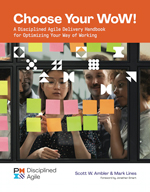
Our new book, Choose Your WoW! A Disciplined Agile Delivery Handbook for Optimizing Your Way of Working, is now available! This handbook is an indispensable guide for agile coaches and practitioners to identify what techniques – including practices, strategies, and lifecycles – are effective in certain situations and not as effective in others. This advice is based on proven experience from hundreds of organizations facing similar situations to yours. There are literally hundreds of books that have been written on agile and lean. So why one more? Most books focus on just a subset of what is required to delivery end-to-end solutions in an agile manner. Developing a coherent approach to the complete picture by piecing together these practices is difficult, especially when the advice in many of these books is conflicting and not well researched, often based on just a few successful applications in a specific context. Disciplined Agile (DA) is the only toolkit available that combines the most effective practices across lean and agile methods into one comprehensive context-driven approach that you can use to optimize your way of working (WoW). This book is organized into several sections:
For more information, please visit the Choose Your WoW! book page. |
|
On Monday I attended a talk by Mike Rosen about successful Digital Transformation. As always, Mike’s presentation was very insightful. One of many points that he made is that most organizations are struggling with the current talent shortage, something that in my experience has been a problem worldwide for several years and will continue to be so. There are many reasons for why there is a talent shortage:
Here are a few things that your organization can do to start addressing its talent shortage:
The primary reason why there is a shortage of talented people is because organizations are underinvesting in the learning paths of their staff. If you want talented people you’re going to have to help create them.
Related reading: |
|
We believe that the changes we’re suggesting are straightforward:
The original manifesto principles were crafted to reflect the environment in the ‘90s when it was an accomplishment to have a demonstrable increment of a solution even every month. In modern times the bar is significantly higher. As such, if you compare the wording of the updated principles as we describe them to the original, you will observe that they reflect a lean philosophy of a continuous, just-in-time, experimental, and emergent approach to everything we do. What we have written may be perceived as heresy to some agile religious puritans but we believe it is time to move on to reflect modern realities and capabilities. We’d love to hear your feedback. Good things to know
|
|
A common question that we get from customers who are new to Disciplined Agile (DA) is how do you aggregate, or "roll up", metrics from agile teams into a portfolio dashboard? A more interesting question is how do you do this when the teams are working in different ways? Remember, DA teams choose their way of working (WoW) because Context Counts and Choice is Good. Even more interesting is the question “How do you aggregate team metrics when you still have some traditional teams as well as some agile/lean teams?” In this blog we answer these questions one at a time, in order. Note: We’re going to talk in terms of a single portfolio in this article, but the strategies we describe can apply at the program (a large team of teams) too, and then the program-level metrics are further rolled up to higher levels.
How Do You Aggregate Agile Team Metrics Into a Portfolio Dashboard?Pretty much the same way you aggregate metrics from traditional teams. There tends to be several potential challenges to doing this, challenges which non-agile teams also face:
How Do You Aggregate Agile Team Metrics Into a Portfolio Dashboard When the Teams Choose Their WoW, and it’s Different For Each Team?When a team is allowed to choose it’s way of working (WoW), or “own their own process,” the team will often choose to measure itself in a manner that is appropriate to it’s WoW. This makes a lot of sense because to improve your WoW you will want to experiment with techniques, measure their effectiveness for your team within your current context, and then adopt the techniques that work best for you. So teams will need to have metrics in place that provide them with insight into how well they are working, and because each team is unique the set of metrics they collect will vary by team. For example, in Figure 1 below we see that the Data Warehouse (DW) team has decided to collect a different sent of metrics to measure stakeholder satisfaction than the Mobile Development team. The DW team needs to determine which reports are being run by their end users, and more importantly they need to identify new reports that provide valuable information to end users – this is why they have measures for Reports run (to measure usage) and NPS (to measure satisfaction). The Mobile team on the other hand needs to attract and retain users, so they measure things like session length and time in app to determine usage, and user retention and NPS to measure satisfaction. Figure 1. Applying consistent metrics categories across disparate teams (click on it for a larger version).
Furthermore, the nature of the problem that a team faces will also motivate them to choose metrics that are appropriate for them. In Figure 1 we see that each team has a different set of quality metrics: the DW team measures data quality, the mobile team measures code quality, and the package implementation team measures user acceptance test (UAT) results. Although production incidents and automated test coverage are measured by all three teams, the remaining metrics are unique. The point is that instead of following the consistent metrics practice across teams by insisting that each team collects the same collection of metrics, it is better to ask for consistent metric categories across teams. So instead of saying “thou shalt collect metrics X, Y, and Z” we instead say “Thou shalt collect metrics that explore Category A, Category B, and Category C.” So, as you can see in Figure 1, each team is asked to collect quality metrics, time to market metrics, and stakeholder satisfaction metrics but it is left up to them what metrics they will choose to collect. The important point is that they need to collect sufficient metrics in each category to provide insight into how well the team addresses it. This enables the teams to be flexible in their approach and collect metrics that are meaningful for them, while providing the governance people within our organization the information that they need to guide the teams effectively. So how do you aggregate the metrics when they’re not consistent across teams? Each team is responsible for taking the metrics that they collect in each category and calculating a score for that category. It is likely that a team will need to work with the governance body to develop this calculation. For example, in Figure 2 we see that the each team has a unique dashboard for their team metrics, yet at the portfolio level the metrics are rolled up into a stoplight status scorecard strategy for each category (Green = Good, Yellow = Questionable, Red = Problem). Calculating a stoplight value is one approach, you could get more sophisticated and calculate a numerical score if you like. This is something the governance body would need to decide upon and then work with teams to implement. Figure 2. Rolling up metrics categories (click on it for a larger version).
From the looks of the Portfolio dashboard in Figure 2 there is a heat map indicating the overall status of the team (using green, yellow, and red again) and the size of the effort (indicated by the size of the circle). Anyone looking at the portfolio dashboard should be able to click on one of the circles or team stoplights and be taken to the dashboard for that specific team. The status value for the heatmap would be calculated consistently for each team based on the category statuses for that team – this is a calculation that the governance body would need to develop and then implement. The size of the effort would likely come from a financial reporting system or perhaps your people management systems.
How Do You Aggregate Team Metrics When Some Teams Are Still Traditional?With a consistent categories approach it doesn’t really matter what paradigm the team is following. You simply allow them to collect whatever metrics are appropriate for their situation within each category and require them to develop the calculation to roll the metrics up accordingly. If they can’t come up with a reasonable calculation then the worst case would be for the Team Lead (or Project Manager in the case of a traditional team) to manually indicate/enter the status value for each category.
Parting ThoughtsFor the consistent categories strategy to work the governance people need to be able to look at the dashboard for a team, which will have a unique collection of widgets on it, and be able to understand what the dashboard indicates. This will require some knowledge and sophistication from our governance people, which isn’t unreasonable to ask for in our opinion. Effective leaders know that metrics only provide insight but that they shouldn’t manage by the numbers. Instead they should follow the lean concept of “gemba” and go see what is happening in the team, collaborating with them to help the team understand and overcome any challenges they may face.
Related Links
|
|
"I might repeat to myself, slowly and soothingly, a list of quotations from beautiful minds profound; if I can remember any of the damn things." - Dorothy Parker |