







Guessing is not a strategy: How to build decision velocity with AI and real-time data
June 10, 2026 | Live Webinar

Disciplined Agile 5.5 Released
Choose Your WoW! Second Edition Is Now Available
Requisite Agility applied in Project Management
Disciplined Agile and PMBoK Guide 7th Edition
#ChoiceIsGood, #ChooseYourWoW, #ConsumableSolution, #ContinuousImprovement, #CoreAgilePractices, #experiment, #Experimentation, #GuidedContinuousImprovement, #Kaizen, #LifeCycles, #ProcessImprovement, #TealOrganizations, Adoption, agile, agile adoption, Agile Alliance, Agile Business Analyst, Agile certification, agile data, agile governance, agile lifecycle, agile metrics, agile principles, agile transformation, Agile2018, Agile2019, Agile20Reflect, AgileData, Analogy, announcement, Architecture, architecture, architecture owner, Articles and publications, Asset Management, Atari, Backlog, Barclays, being agile, benefits, bi, blades, book, Branching strategies, Browser, Business Agility, business intelligence, business operations, capex, Case Study, Certification, certification, charity, Choose your WoW, CMMI, cmmi, Coaching, Collaboration, Communications Management, Compliance, Compliancy, Conference, Construction, Construction phase, Context, Continuous Improvement, coordination, COVID-19, Culture, culture, Cutter, DA, DAD, DAD Book, DAD discussions, DAD press, DAD roles, DAD supporters, DAD webcast, DADay2019, Data Management, database, dependencies, Deployment, Development Strategies, DevOps, disaster, Discipline, discipline, Disciplined Agile, disciplined agile delivery, disciplined agile delivery blog, Disciplined Agile Enterprise, disciplined devops, Documentation, Domain complexity, dw, DW/BI, Energy Healing, Enterprise Agile, Enterprise Architecture, Enterprise Awareness, enterprise awareness, Essence, estimation, Evolving DA, Executive, Experiment, facilitation, FailureBow, feedback-cycle, finance, Financial, FLEX, Flow, foundation layer, Funding, GCI, GDD, Geographic Distribution, gladwell, global development, Goal-Driven, goal-driven, goals, Governance, GQM, Guideline, Hybrid, Improvement, inception, Inception phase, India, information technology, infosec, Introduction, iterations, Kanban, large teams, layer, lean, Lean Startup, learning, Legal Project Management, LeSS, Lifecycle, lifecycle, Manifesto, mark lines, marketing, MBI, Metaphor, Metrics, metrics, mindset, Miscellaneous, MVP, News, News and events, Non-Functional Requirements, non-functional requirements, Non-solo development, offshoring, Operations, opex, Organization, Outsourcing, outsourcing, paired programming, pairing, paper, People, People Management, phases, Philosophies, Planning, PMBoK, PMI, PMI and DA, PMI Chapter, Portfolio Management, post-format-quote, Practices, practices, Principle, Process, process improvement, process tailoring, Product Management, product owner, Product Owners, productivity, Program Management, Project Management, project-initiation, Promise, Quality, quality, rational unified process, Refactoring, Reiki, Release Management, release management, Remote Training, Remote Work, repeatability, requirements, Requirements Management, research&development, responsibilities, retrospectives, Reuse, Reuse Engineering, ride for heart, rights, Risk Management, Risk Management, Risk management, Roles, RUP, SAFe, sales, Scaling, scaling, scaling agile, Scheduled Workshops, SCM, scorecard, Scrum, ScrumMaster, SDLC, Security, security, self-organization, SEMAT, serial, skill, solutions software consumable shippable, Stakeholder Management, strategy, Support, Surveys, Teal organizations, team development, Team Lead, team lead, Teams, Technical Debt, Teleconferencing, Terminology, terraforming, test strategy, testing, time tracking, Tool kit, Toolkit, tools, traditional, Transformation, Transition iteration, transition phase, Uncategorized, Upmentors, Using PMI Standards, value stream, velocity, vendor management, Virtual Training, Workflow, workflow, workspaces


|
Being a Product Manager is an interesting and exciting role. We hope that this blog has been valuable for you. |
|
The term minimum viable product (MVP) has achieved buzzword status in recent times and I’m now hearing people throwing around the term MVP almost on a daily basis. The issue is that it’s common for people to say MVP when they are actually talking about is a minimum business increment (MBI), a minimum marketable feature (MMF), or a minimum marketable release (MMR). Having said that, I prefer the terms MVP and MBI, two different concepts, and rarely use terms like MMF or MMR other than to point people to the first two terms. Having said that, I'll still cover all four concepts in detail here. There are several reasons why there is significant confusion in the marketplace:
To clear things up, we address the following topics:
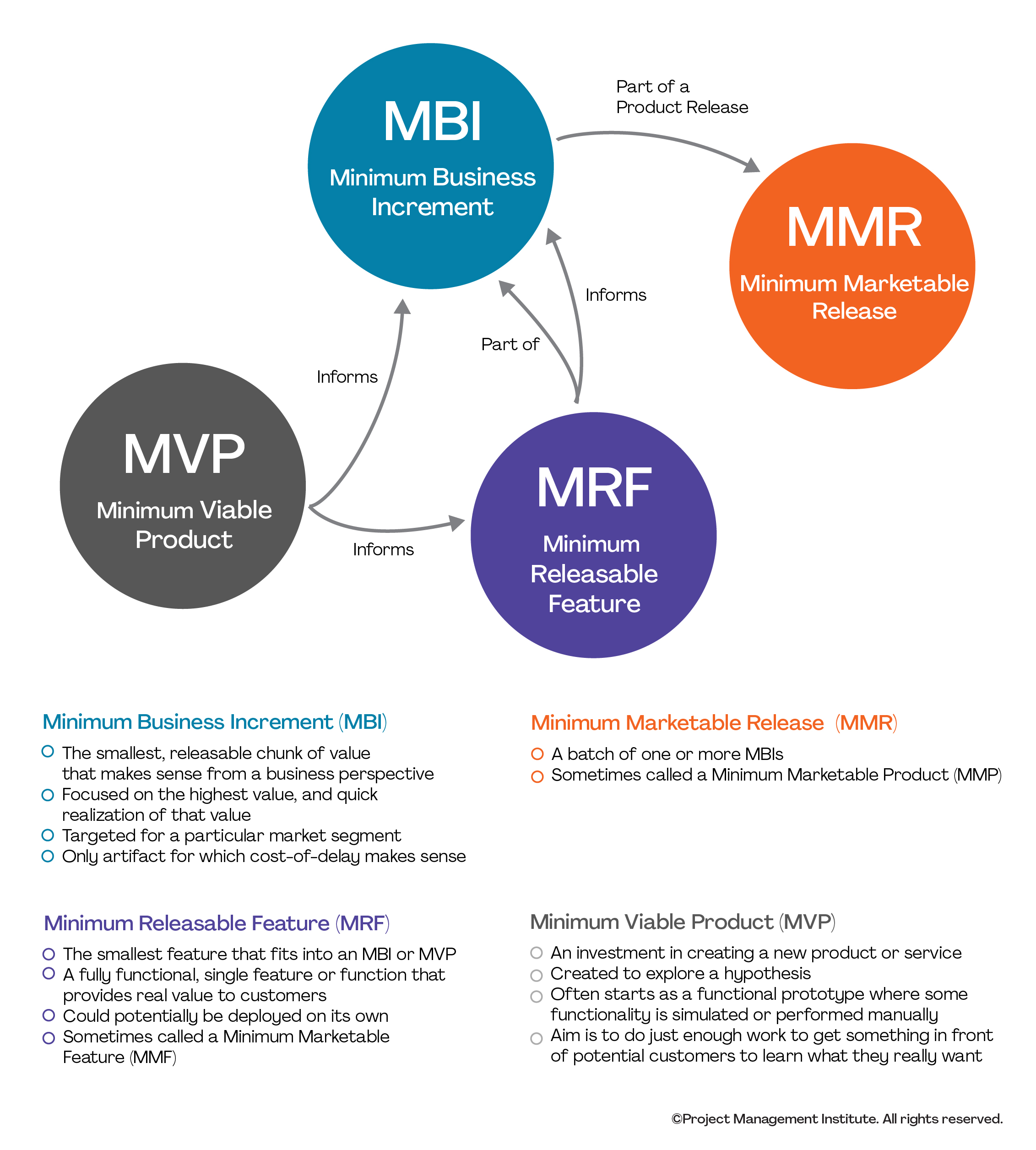
1. Defining the TerminologyFigure 1 below overviews how the following terms relate to one another:
Figure 1. The relationship between MVP, MBI, MMR, and MMF.
2. Answering Common QuestionsWe often get asked several common questions around this topic:
What are the Key Take-Away Points?The key take-away points of this article are:
Is it Minimum or Minimal?Given that I’m being picky about terminology, I realized that there isn’t agreement as to whether we should use the term MINIMUM viable product or MINIMAL viable product (and similarly for MBI, MMR, and MMF). Once again, the words are very close:
As you can see, very nuanced. For better or worse, the industry has settled on the term minimum so that's what we're sticking with.
Why Differentiate Between MBI and MMR?We wish we didn't have to. Ideally an MMR is a single MBI - your team wants to do just enough work to develop the minimum functionality that provides your customers with value and release it as quickly as you can. That's an MBI. Practically though you're sometimes forced to release more than a single MBI in a release. Perhaps you've decided to have a regular quarterly release cadence. Perhaps your customers prefer large releases (this still occurs in practice, although is becoming less common as your customers become more savvy with regards to incremental releases). These challenges can all be addressed in time, and they should be, but you may not be there yet.
Don't We Just Need The Concepts of MVP and MBI?That's correct. When you've streamlined your way of working (WoW) you should be at the point where an MBI is an MMF that you release to your customers, so it is also an MMR. The concepts of MMF and MMR are stepping stones towards what you are really aiming for, MBIs. But you might not be there yet, and you may be working with people who are more familiar with older terminology such as MMF and MMR - as a result we recognize in DA that these older terms exist but we avoid them where we can.
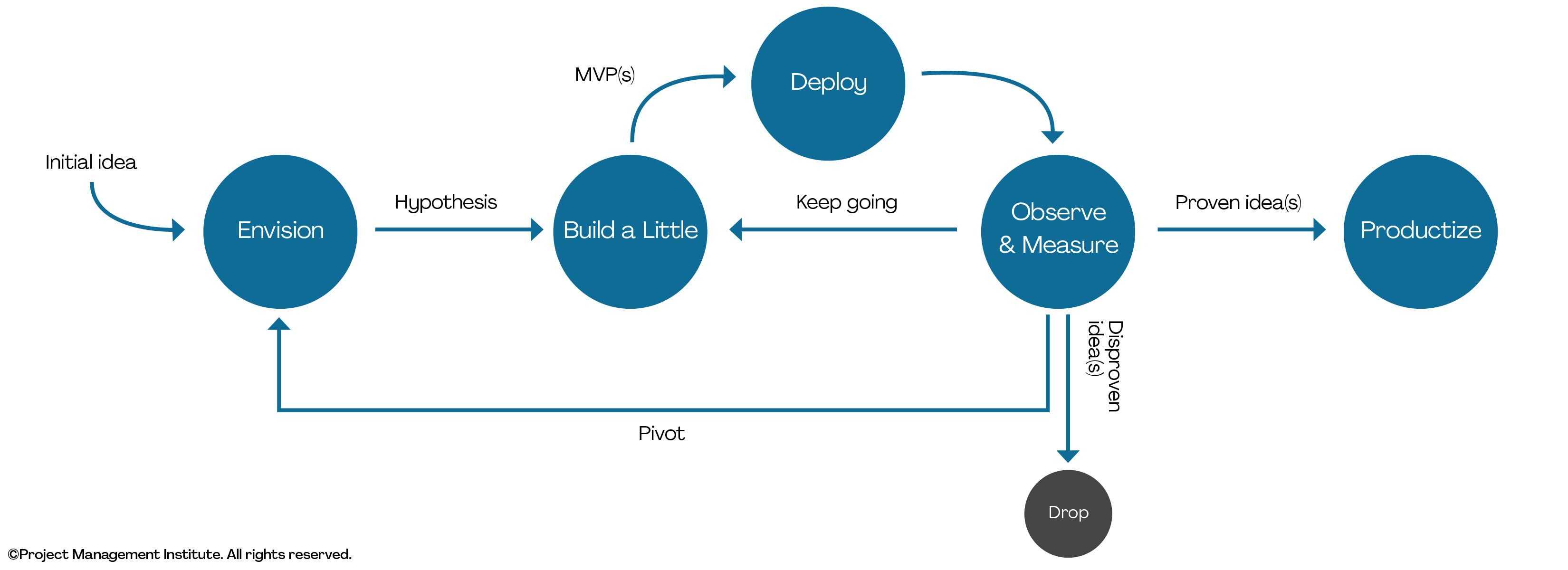
3. An ExampleNow let’s work through an example of the development of a fictional product using the concept of MVPs and MBIs. One day while shopping in the local mall my phone ran out of power. This proved to be a problem for me because I had a conference call that I had to be on, forcing me to cut my shopping trip short to go home and take the call there. This experience made me realize that there’s a potentially untapped market need as I would have been very willing to pay to charge my phone while at the mall. Note: I am fully aware that products such as Safecharge and Brightbox exist, but let’s pretend they don’t for the sake of this example. Just because I’m willing to pay for this doesn’t mean that others will. To determine whether this could be a profitable endeavour I decide to follow Disciplined Agile’s Exploratory Lifecycle (see Figure 2), which is based on Lean Startup’s hypothesis-driven approach. My plan is to iteratively run a series of experiments to explore this product idea. Figure 2. The Exploratory Lifecycle.
Over a several week period I work through a series of minimum viable products (MVPs):
This series of experiments led me to identify a collection of features that this product should offer:
Over the next two months we built a minimum business increment (MBI). The MBI was a large box which had 16 cubby holes for small devices such as phones. We the each box from folded sheet metal with clear, thick plastic doors so that people can see their devices. For security and payment processing we built a device that used a small touch screen (it was a tablet) as an input device attached to a card swipe for capturing both credit and debit card payments. Over several weeks we built five of them, placing three boxes in the mall where we had run our initial experiments and two boxes in another smaller mall on the other side of the city. Then we continued to evolve the product via a series of MVPs. We ran some experiments in a public library where we discovered that library patrons wanted to charge large devices such as tablets and laptops as well as smaller devices. So we developed a new MBI, a “Library Charging Station” that had eight small device cubbies and six large device cubbies. We also hired a designer to develop a sleeker looking box when one mall management chain told us that they loved the concept but wouldn’t allow our boxes into their more upscale locations until they were more attractive.
4. SummaryI'll say it again (a paraphrasing of Al Shalloway's advice):
Here's the key difference between the two: With an MVP you are in entrepreneurial mode and need to discover what your customers actually want. MBIs are for when you have an existing product and have a good idea for how to extend it. My hope is that this article has helped to clear up some of this confusion.
5. Related Resources |
|
I’m happy to announce that the Disciplined Agile Consortium (DAC) is now working with SEMAT. SEMAT, Software Engineering Method and Theory, is an international community of people, companies, and universities. Led by Ivar Jacobson, SEMAT is working together to create a common ground, or kernel, for software engineering. As you may know I am one of the original signatories who first indicated their support for the SEMAT effort and am currently a member of the SEMAT advisory board. So why are we working with SEMAT? We hope to gain several benefits:
Of course it is still early days and there is a lot to do. Please stay tuned here for further updates! Recommended Reading |
| An important aspect of Support that is easily forgotten is the need to build out your infrastructure to enable your support efforts. This may include:
Figure 1. High-level architecture for a Support environment (click on it for larger version). |
|
I recently ran into The Oath for an Agile Coach. There are clearly some great ideas in the oath and it would be hard to argue that you wouldn’t want to adopt the advice contained within it. So I won’t do that. However, I do feel that there are some serious challenges surrounding the oath but that with a bit of hard work we could do better. Some Great Ideas HereFrankly, what’s not to like? The oath promotes the idea that coaches should do no harm, that they’re guests, that they should respect learnings, that they value discretion, and many other wonderful philosophies. Several of them are arguably a bit naive, for example:
It’s clear to me that a lot of smart people have put a lot of effort into the oath, that they’ve thought it through, and are honestly trying to make things better. I also believe that this is a step in the right direction, although at the time of this writing there are some serious challenges surrounding it that can and should be addressed.
A Few Serious ChallengesFirst and foremost, we should give the authors of the oath the benefit of the doubt and assume that they aren’t doing the things I’m about to describe on purpose. Although what I have to say is harsh, I honestly believe that the authors have their hearts in the right place but have not thought through the implications of what they’ve started. So here goes. The oath is deceptive and as a result possibly unethical. The reason why I say this is that they claim to have based the coach’s oath on the The Hippocratic Oath (which I’m sure they’ve actually done). The problem is that they’ve merely skimmed the surface of the Hippocratic Oath, lifting ideas such as “First, do no harm” (which the oath doesn’t actually say, that’s the Hollywood interpretation of it) without also adopting the context in which the Hippocratic Oath is taken. This is important. New medical practitioners, after years of training, are asked to take the oath, or something similar, by medical schools. These schools are governed and the medical professionals themselves are governed. Control mechanisms are in place to ensure that the people who take the oath know what they’re doing and work in a trustworthy manner. Therein lies the rub – no such governance exists for agile coaching and I suspect the vast majority of agile coaches would chaff at the suggestion. To see why this is an issue consider the following example. I have no medical training or background, with the exception of taking a few first aid courses over the years. Come to think of it, by agile standards I have more than enough medical training to be considered a Certified Surgery Master (CSM), so it’s all good. I have just now recited the Hippocratic Oath and have pledged to abide by it. As a result I now feel that I am qualified to offer plastic surgery procedures as I’ve heard that this is a lucrative business to be in. If you would like a face lift, liposuction, or augmentation of a body part please contact me to arrange a procedure. You can trust me because I’ve recited the Hippocratic Oath and I’m a CSM. What? You’re not interested? I’ve pledged to do no harm, so you can trust me. I think that you inherently know it would be a bad thing for me to perform plastic surgery on you. I’m obviously not qualified. Therein lies the rub. I could easily advertise that I’ve pledged the oath, tell people about my CSM credentials, and make it sound like I’m qualified, particularly to people who don’t have much of a background in agile. In fact, recently in Toronto, a 19-year old woman did something very similar to this and as you’d expect it didn’t work out well for the recipients of her surgery endeavours. By claiming that the agile coach’s oath is based on the Hippocratic Oath the authors are taking advantage of something called “prestige association.” The Hippocratic Oath is prestigious – the people who pledge it have to work very hard to be asked to pledge it and are subsequently held to its high standards throughout their careers. By explicitly associating the agile coaching oath with the Hippocratic Oath the prestige of the latter is conferred to the former. This is deceptive at best and unethical at worst. I believe we can be better than this.
How We Can Do BetterIt isn’t appropriate to complain about the Agile Coach’s Oath without also providing some possible ways to fix it. Here are my initial thoughts:
I believe the people who developed The Oath for an Agile Coach have good intentions. They’ve gotten a great start on an interesting and potentially valuable idea. But, they need to follow through and make it something real if they really want this oath to be meaningful. I hope they choose to build a vibrant community that does exactly that. Time will tell.
Related Postings |
|
"Life is but a walking shadow, a poor player that struts and frets his hour upon the stage and then is heard of no more. It is a tale told by an idiot, full of sound and fury, signifying nothing." - William Shakespeare |