






Guessing is not a strategy: How to build decision velocity with AI and real-time data
June 10, 2026 | Live Webinar

Disciplined Agile 5.5 Released
Choose Your WoW! Second Edition Is Now Available
Requisite Agility applied in Project Management
Disciplined Agile and PMBoK Guide 7th Edition
#ChoiceIsGood, #ChooseYourWoW, #ConsumableSolution, #ContinuousImprovement, #CoreAgilePractices, #experiment, #Experimentation, #GuidedContinuousImprovement, #Kaizen, #LifeCycles, #ProcessImprovement, #TealOrganizations, Adoption, agile, agile adoption, Agile Alliance, Agile Business Analyst, Agile certification, agile data, agile governance, agile lifecycle, agile metrics, agile principles, agile transformation, Agile2018, Agile2019, Agile20Reflect, AgileData, Analogy, announcement, Architecture, architecture, architecture owner, Articles and publications, Asset Management, Atari, Backlog, Barclays, being agile, benefits, bi, blades, book, Branching strategies, Browser, Business Agility, business intelligence, business operations, capex, Case Study, Certification, certification, charity, Choose your WoW, CMMI, cmmi, Coaching, Collaboration, Communications Management, Compliance, Compliancy, Conference, Construction, Construction phase, Context, Continuous Improvement, coordination, COVID-19, Culture, culture, Cutter, DA, DAD, DAD Book, DAD discussions, DAD press, DAD roles, DAD supporters, DAD webcast, DADay2019, Data Management, database, dependencies, Deployment, Development Strategies, DevOps, disaster, Discipline, discipline, Disciplined Agile, disciplined agile delivery, disciplined agile delivery blog, Disciplined Agile Enterprise, disciplined devops, Documentation, Domain complexity, dw, DW/BI, Energy Healing, Enterprise Agile, Enterprise Architecture, Enterprise Awareness, enterprise awareness, Essence, estimation, Evolving DA, Executive, Experiment, facilitation, FailureBow, feedback-cycle, finance, Financial, FLEX, Flow, foundation layer, Funding, GCI, GDD, Geographic Distribution, gladwell, global development, Goal-Driven, goal-driven, goals, Governance, GQM, Guideline, Hybrid, Improvement, inception, Inception phase, India, information technology, infosec, Introduction, iterations, Kanban, large teams, layer, lean, Lean Startup, learning, Legal Project Management, LeSS, Lifecycle, lifecycle, Manifesto, mark lines, marketing, MBI, Metaphor, Metrics, metrics, mindset, Miscellaneous, MVP, News, News and events, Non-Functional Requirements, non-functional requirements, Non-solo development, offshoring, Operations, opex, Organization, Outsourcing, outsourcing, paired programming, pairing, paper, People, People Management, phases, Philosophies, Planning, PMBoK, PMI, PMI and DA, PMI Chapter, Portfolio Management, post-format-quote, Practices, practices, Principle, Process, process improvement, process tailoring, Product Management, product owner, Product Owners, productivity, Program Management, Project Management, project-initiation, Promise, Quality, quality, rational unified process, Refactoring, Reiki, Release Management, release management, Remote Training, Remote Work, repeatability, requirements, Requirements Management, research&development, responsibilities, retrospectives, Reuse, Reuse Engineering, ride for heart, rights, Risk Management, Risk Management, Risk management, Roles, RUP, SAFe, sales, Scaling, scaling, scaling agile, Scheduled Workshops, SCM, scorecard, Scrum, ScrumMaster, SDLC, Security, security, self-organization, SEMAT, serial, skill, solutions software consumable shippable, Stakeholder Management, strategy, Support, Surveys, Teal organizations, team development, Team Lead, team lead, Teams, Technical Debt, Teleconferencing, Terminology, terraforming, test strategy, testing, time tracking, Tool kit, Toolkit, tools, traditional, Transformation, Transition iteration, transition phase, Uncategorized, Upmentors, Using PMI Standards, value stream, velocity, vendor management, Virtual Training, Workflow, workflow, workspaces


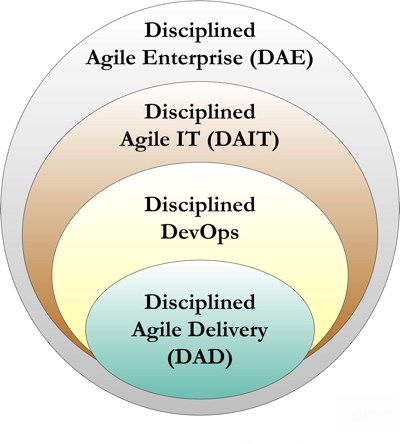
| The quick answer is of course “Yes”. ?? A couple of years ago we caused a bit of confusion when we expanded the scope of Disciplined Agile Delivery (DAD) to address the activities of an information technology (IT) department. When we did this we realized that the scope of the toolkit and the name no longer matched, so we decided to rebrand to be simply the “Disciplined Agile (DA)” toolkit. Having said that, sometimes it makes sense to say DAD and sometime DA depending on what you’re focusing on at the time. The Scope of Disciplined Agile (DA)As you can see in the following diagram, which depicts the scope of the DA toolkit, it’s clear why there has been some confusion because DA covers a lot of ground.
Let’s explore each aspect depicted in the diagram:
Some HistoryThe first “1.0 release” was the original Disciplined Agile Delivery book in June of 2012. As the title suggests the focus was on DAD, although it laid the groundwork for Disciplined DevOps in that it baked in the development side of DevOps right into DAD. In 2015 we began publishing our work in both Disciplined DevOps and Disciplined Agile IT (DAIT) and renamed the toolkit to Disciplined Agile (DA) to reflect this expanded scope. Since 2017 we have begun to flesh out Disciplined Agile Enterprise strategies and will soon begin the share them here on this site. |
|
For the want of a whiteboard the vision was lost, For the want of a new vision the release was lost, For the want of a new release the product was lost, For the want of a new product the customer was lost, For the want of a new customer the company was lost, And all for the want of a whiteboard. With a nod to Benjamin Franklin. |
| The quick answer is no, that’s an incredibly bad idea. We ran a study in February 2017, the 2017 Agile Governance survey, to explore the issues around governance of agile teams. This study found that the majority of agile teams were in fact being governed in some way, that some agile teams were being governed in an agile or lightweight manner and some agile teams in a traditional manner. See the blog Are Agile Teams Being Governed? for a summary of those results. The study also examined the effect of governance on agile teams, exploring the perceived effect of the organization’s governance strategy on team productivity, on the quality delivered, on IT investment, and on team morale. It also explored how heavy the governance strategy was perceived to be and how well it was focused on the delivery of business value. The following figure summarizes the results of these questions.
Here are our conclusions given these results:
When we work with organizations to help them to adopt agile ways of working, we often find that they are running into several common challenges when it comes to IT governance:
For agile to succeed in your organization the way that you approach IT must evolve to enable and support it, and this includes your governance strategy. Reach out to us if you would like some help in addressing this important issue. Related Reading
|
| For the major of teams the answer is yes. We ran a survey in February 2017, the 2017 Agile Governance survey, to explore the issues around governance of agile teams. As you can see in the following diagram, 78% of respondents indicated that yes, their agile teams were in fact being governed in some manner.
We also asked people about the approach to governing agile teams that their organization followed. As you can see in the following diagram, a bit more than a third of respondents indicated that the governance strategy was lightweight or agile in nature. Roughly the same indicated that their agile teams had a more traditional approach to governance applied to them, and one quarter said their governance approach was neither helping nor hindering their teams.
Governance tends to be a swear word for many agilists and they will tell you that governance is nothing than useless bureaucracy. Sadly in many organizations this seems to be the case. In the next blog in this series we will compare the effectiveness of agile and traditional strategies for governing agile teams. Related Reading |
|
On March 21 2017 we ran a webinar entitled Measuring Agile: A Discipline Agile Approach to Metrics. We unfortunately didn’t have enough time to answer all of the great questions that we received so we said that we’d write a blog with the answers. This is it. We’ve organized the blog into the following sections:
Convincing ManagementFirst and foremost, please read our blog entitled 7 “Easy” Steps to Convince Management to Support a Hard Change. This blog has a lot of great advice for getting support from senior management for the changes asked about below.
Q: What is the message to deliver to the board of directors of a company and/or sponsors of projects when it comes to metrics? The principles section of the webcast made this pretty clear I think. The principles we discussed are:
If I had to pick a key message, it’s that you need to be flexible and enable teams to take a context sensitive approach. Q: How do you address the resistance to ranged estimates? We see a lot of resistence to this with leaders! Sadly this is all too common. There is a desire for an “exact number” for the cost/schedule for an IT project, the belief being that such precision leads to lower financial risk. This never seems to work out, and in practice it tends to increase overall financial risk. Worse yet it motivates some very ethically questionable management practices such as padding the budget (lying about the cost to get the fixed estimate as close to the upper end of the range as possible), dropping scope late in the lifecycle (lying about what will be delivered and wasting money working on stuff you had no hope of delivering in the first place), or asking for more money when it’s clear you’re not going to deliver it (this is arguably extortion). In the article Estimating on Agile Projects I go into further detail about the need for ranged estimates. As we discuss in the 7 Easy Steps blog, you need to educate management on the trade-offs involved with their current approach and help the to see that it isn’t working out well for them in practice. Q: My management definitely wants to know if they are on time and on budget… how should I handle this problem? This is also another common problem in more traditional organizations, and is sadly a mindset that is often promoted by project management canon. The first thing to do is ask them why “on time and on budget” is important to them, and to continue to explore their goals via an evolutionary “5 why” strategy until you get to the heart of the matter. Usually the real issue is that they want to reduce schedule risk and financial risk but they only know to ask for on time and on budget respectively. Help them to recognize that they can do better than that. For example, a more effective question to ask instead of “Are we on budget?” would be “Are we spending the money wisely?”, the latter question requiring competent governance to truly answer. Similarly, a more effective question to ask that “Are we on schedule?” would be “Are we going to deliver when the functionality is actually needed?”, also a question requiring better governance than many organizations seem to have today. Q: Executives and senior management wants common metrics period… can you talk to this – how should a change agent (me) handle this? Sadly another very common problem. This proves to be selfishly motivated in most cases – they want a common set of metrics to make it easy for them to monitor teams (they have less thinking to do when all the dashboards look the same). As we discussed in the webinar, this isn’t realistic because every team is unique, they face a unique situation, and they have a unique set of priorities. Yes, there are commonalities between teams but also differences. For example, it makes sense for teams to measure quality. BUT, surely it’s obvious that a data warehousing team will measure quality different than a mobile app team, which in turn measures quality differently than a team sustaining a mainframe-based system. This is why I promoted the idea of asking teams to address common categories (such as Quality, Stakeholder Satisfaction, Finance, and so on) but to do so in a manner that makes sense for them.
Transformation MetricsQ: In a transformation is the ‘stakeholder vision’ milestone something that you see ‘could’ be used as a way to guage adoption of the toolkit across an Enterprise? Stakeholder vision is a milestone that marks the end of the Inception phase. I’m not sure how it could be used to gauge adoption. It could be used to gauge readiness to move forward with the transformation though. Q: Is there more thoughts you have on transformation metrics? Context counts. In general, take a context-sensitive approach where you measure what is important to you. I worked through a lightweight approach to Goal-Quality-Metric (GQM) during the webinar and the OKR approach is also good. There is no one single answer. Q: How do start-up agile projects best survive in a really non-agile organization? Sadly, they generally don’t. If you go poking around on the web you’ll find that there’s a lot of advice around this sort of issue, and a large portion of it advising you to jump to another organization.
Specific MetricsQ: Please throw some light on Accelaration metric. I’d like to implement that in my org. We have a detailed blog about acceleration. Q: Velocity, used to calculate acceleration, can only be calculated if velocy is based on the same point system… I don’t agree acceleration factors out the points, the points have different meaning potentially by project – can you talk to this some more? You’re wrong, Here’s a quick answer:
Q: Is value is only monetary value is $? No, it doesn’t have to be but often is. You should measure value in units that are important to your stakeholders. Perhaps value may be measured in market share by them, for example.
MiscellaneousQ: Excecutive leaders want to measure “team health” using metrics and compare teams – maybe reward or punish based on these metrics – please talk to this. This is generally recognized as bad practice because as soon as teams realized that they are being judged by management they’re motivated to game the metrics as best they can. In the case of automated metrics that are difficult to game, then perhaps its possible to compare against that (code quality metrics come to mind). But, management will get what they measure. For example, if they judge teams based on how many defects they fix, chances are pretty good that the team will start identifying relatively trivial defects and then “fix” them to make their metrics looks good. However, if they judge teams based on code quality trends (i.e. Is code quality improving?) they will likely get higher quality code in the long run. As I said in the webinar, the primary usage of metrics should be to provide insights to teams to help them to improve. Monitoring teams, part of your overall governance strategy, should be an important but secondary concern. Q: What if the teams don’t agree with the metrics established by management? My advice is for teams to identify the metrics that make sense for the situation that they face via a lightweight GQM approach (or something similar such as OKR). Management may want to guide teams, perhaps by insisting on certain categories of metrics, see the earlier discussion, or even by suggesting metrics being collected by other teams. If it’s a situation where management is trying to inflict a common metrics strategy across all teams, which is a relatively bad idea as I discussed earlier, then I think that the team should justify why they don’t agree with the metrics prescribed by management. I also hope that they would suggest a more appropriate strategy and that management would listen to them. Q: What are some of your favorite tools for metrics? I typically don’t like recommending tools because the answer to this question is context dependent. Tool choice will be driven by:
So, identify what you situation is then do a bit of research to identify the tools that are right for you. Q: Is it realistic at scale to have multiple dashboards? +900 teams. I’ll turn this one around. Is it reasonable to ask teams not to have dashboards simply because your organization is big? Is it reasonable to give up on monitoring teams because your organization is big? Is it reasonable to give up on automation because your organization is big? You see where I’m going with this.
|
|
"When angry, count to four; when very angry, swear." - Mark Twain |