





Guessing is not a strategy: How to build decision velocity with AI and real-time data
June 10, 2026 | Live Webinar

Disciplined Agile 5.5 Released
Choose Your WoW! Second Edition Is Now Available
Requisite Agility applied in Project Management
Disciplined Agile and PMBoK Guide 7th Edition
#ChoiceIsGood, #ChooseYourWoW, #ConsumableSolution, #ContinuousImprovement, #CoreAgilePractices, #experiment, #Experimentation, #GuidedContinuousImprovement, #Kaizen, #LifeCycles, #ProcessImprovement, #TealOrganizations, Adoption, agile, agile adoption, Agile Alliance, Agile Business Analyst, Agile certification, agile data, agile governance, agile lifecycle, agile metrics, agile principles, agile transformation, Agile2018, Agile2019, Agile20Reflect, AgileData, Analogy, announcement, Architecture, architecture, architecture owner, Articles and publications, Asset Management, Atari, Backlog, Barclays, being agile, benefits, bi, blades, book, Branching strategies, Browser, Business Agility, business intelligence, business operations, capex, Case Study, Certification, certification, charity, Choose your WoW, CMMI, cmmi, Coaching, Collaboration, Communications Management, Compliance, Compliancy, Conference, Construction, Construction phase, Context, Continuous Improvement, coordination, COVID-19, Culture, culture, Cutter, DA, DAD, DAD Book, DAD discussions, DAD press, DAD roles, DAD supporters, DAD webcast, DADay2019, Data Management, database, dependencies, Deployment, Development Strategies, DevOps, disaster, Discipline, discipline, Disciplined Agile, disciplined agile delivery, disciplined agile delivery blog, Disciplined Agile Enterprise, disciplined devops, Documentation, Domain complexity, dw, DW/BI, Energy Healing, Enterprise Agile, Enterprise Architecture, Enterprise Awareness, enterprise awareness, Essence, estimation, Evolving DA, Executive, Experiment, facilitation, FailureBow, feedback-cycle, finance, Financial, FLEX, Flow, foundation layer, Funding, GCI, GDD, Geographic Distribution, gladwell, global development, Goal-Driven, goal-driven, goals, Governance, GQM, Guideline, Hybrid, Improvement, inception, Inception phase, India, information technology, infosec, Introduction, iterations, Kanban, large teams, layer, lean, Lean Startup, learning, Legal Project Management, LeSS, Lifecycle, lifecycle, Manifesto, mark lines, marketing, MBI, Metaphor, Metrics, metrics, mindset, Miscellaneous, MVP, News, News and events, Non-Functional Requirements, non-functional requirements, Non-solo development, offshoring, Operations, opex, Organization, Outsourcing, outsourcing, paired programming, pairing, paper, People, People Management, phases, Philosophies, Planning, PMBoK, PMI, PMI and DA, PMI Chapter, Portfolio Management, post-format-quote, Practices, practices, Principle, Process, process improvement, process tailoring, Product Management, product owner, Product Owners, productivity, Program Management, Project Management, project-initiation, Promise, Quality, quality, rational unified process, Refactoring, Reiki, Release Management, release management, Remote Training, Remote Work, repeatability, requirements, Requirements Management, research&development, responsibilities, retrospectives, Reuse, Reuse Engineering, ride for heart, rights, Risk Management, Risk Management, Risk management, Roles, RUP, SAFe, sales, Scaling, scaling, scaling agile, Scheduled Workshops, SCM, scorecard, Scrum, ScrumMaster, SDLC, Security, security, self-organization, SEMAT, serial, skill, solutions software consumable shippable, Stakeholder Management, strategy, Support, Surveys, Teal organizations, team development, Team Lead, team lead, Teams, Technical Debt, Teleconferencing, Terminology, terraforming, test strategy, testing, time tracking, Tool kit, Toolkit, tools, traditional, Transformation, Transition iteration, transition phase, Uncategorized, Upmentors, Using PMI Standards, value stream, velocity, vendor management, Virtual Training, Workflow, workflow, workspaces


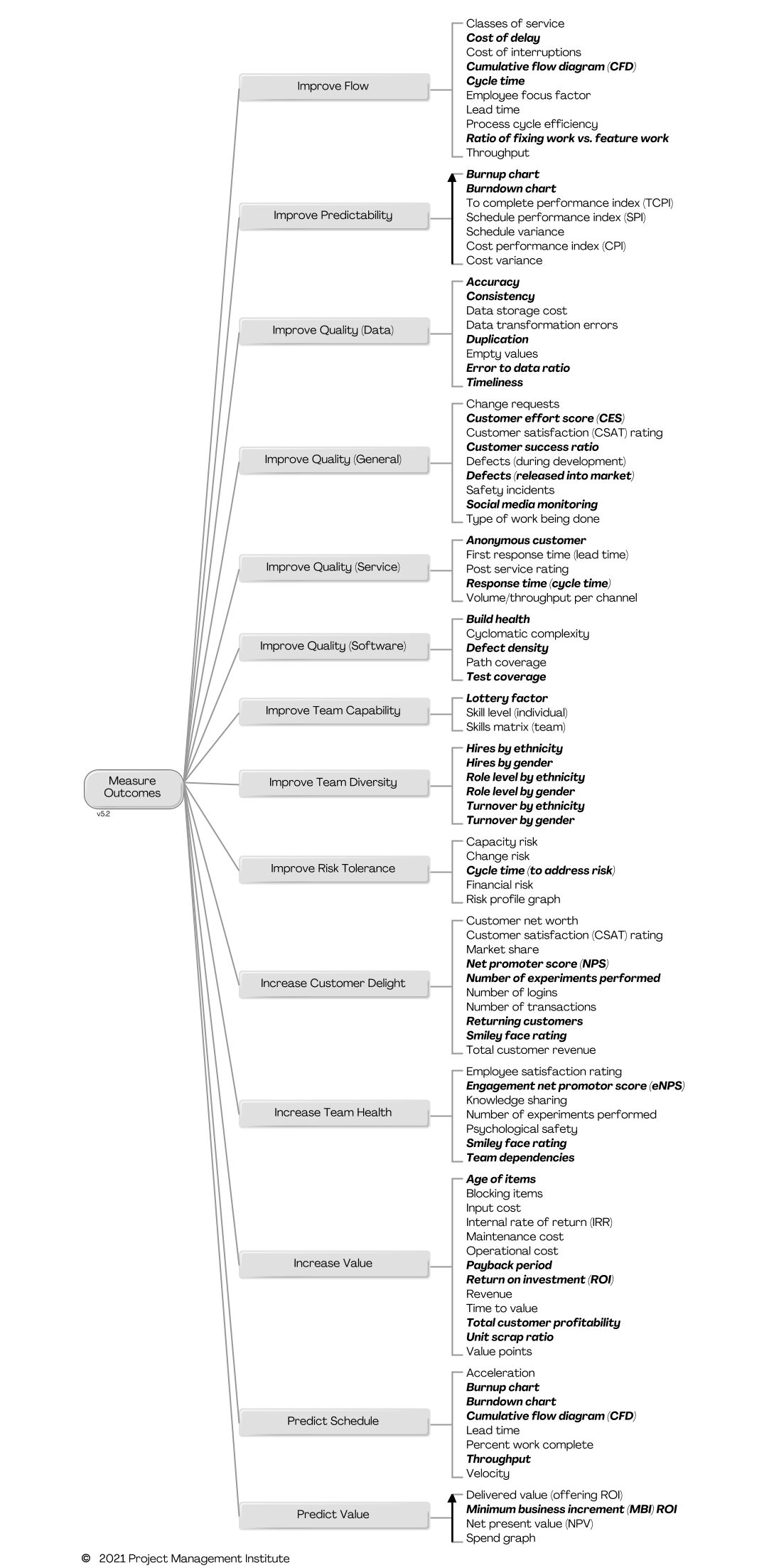
| We recently released the 5.2 version of the Disciplined Agile (DA) tool kit, and in that release we added three new process goals: Intake Work, Organize Metrics, and Measure Outcomes. The focus of this posting is the Measure Outcomes process goal, the goal diagram for which is posted in Figure 1.
Figure 1. The Measure Outcomes process goal diagram (click to enlarge).
The Measure Outcomes process goal describes potential improvement outcomes, or improvement goals, and suggests potential metrics to measure progress against those outcomes. Disciplined Agile doesn't prescribe what to measure, that would be naive because every team is unique with its own priorities and desired outcomes. All of the potential outcomes in Figure 1 are important. However, you will want to focus on a subset at any given time, and that subset is likely to evolve as your improvement focus evolves. Context counts.
Related Resources
|
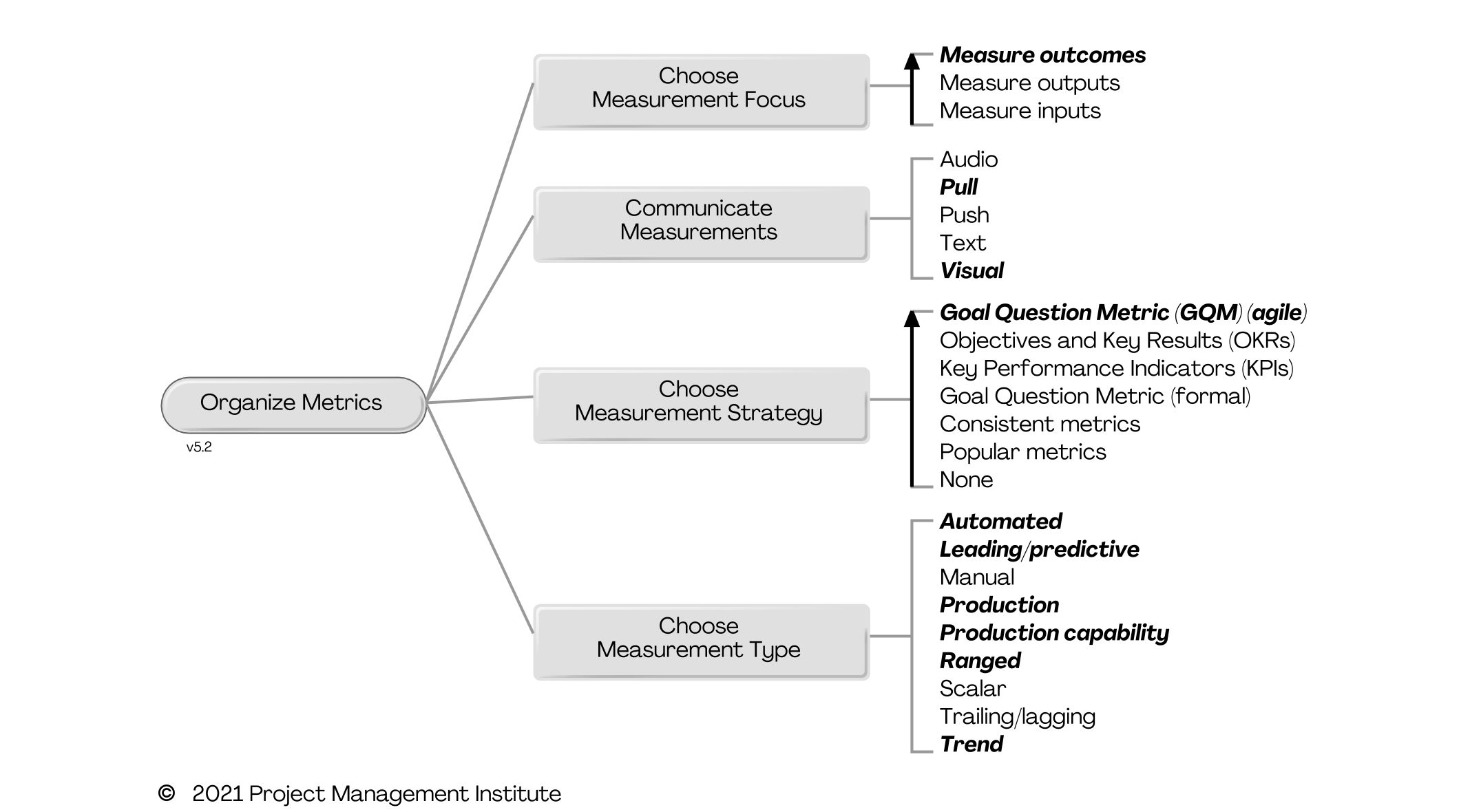
| We recently released the 5.2 version of the Disciplined Agile (DA) tool kit, and in that release we added three new process goals: Intake Work, Organize Metrics, and Measure Outcomes. The focus of this posting is the Organize Metrics process goal, depicted in Figure 1.
Figure 1. The Organize Metrics process goal diagram (click to enlarge).
As the name implies, this process goal describes strategies to organize the metrics approach within your team. This strategy will be driven both by your team's culture and skills as well as the needs of your stakeholders - your metrics will likely need to "roll up" to the program or portfolio level. Your metrics strategy will focus on several important questions:
Where this goal focuses on how to measure, the Measure Outcomes goal describes what to potentially measure.
Related Resources
|
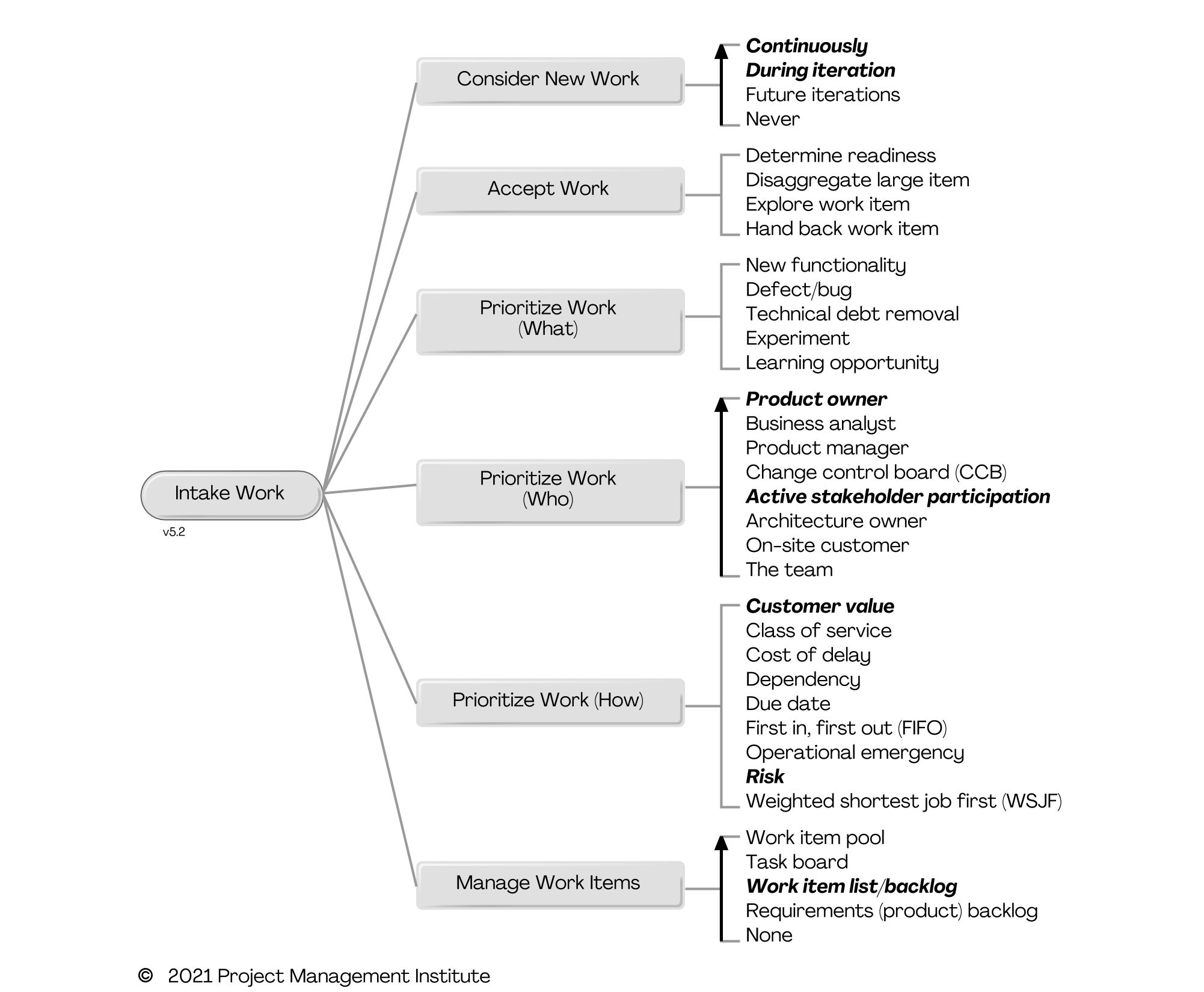
| We recently released the 5.2 version of the Disciplined Agile (DA) tool kit, and in that release we added three new process goals: Intake Work, Organize Metrics, and Measure Outcomes. The focus of this posting is the Intake Work process goal. Intake Work: AddedFigure 1 depicts the process goal diagram for Intake Work (see How to Read Process Goal Diagrams). This is how a team pulls in work from their "upstream" stakeholders. The incoming work is examined and if ready it is prioritized and put on the team's work backlog. We introduced this process goal because we wanted to have a cohesive source of process information capturing the issues around a common activity that is critical to your team's success. Figure 1. The Intake Work process goal diagram (click to enlarge)
To be effective at intaking work, we need to consider several important questions:
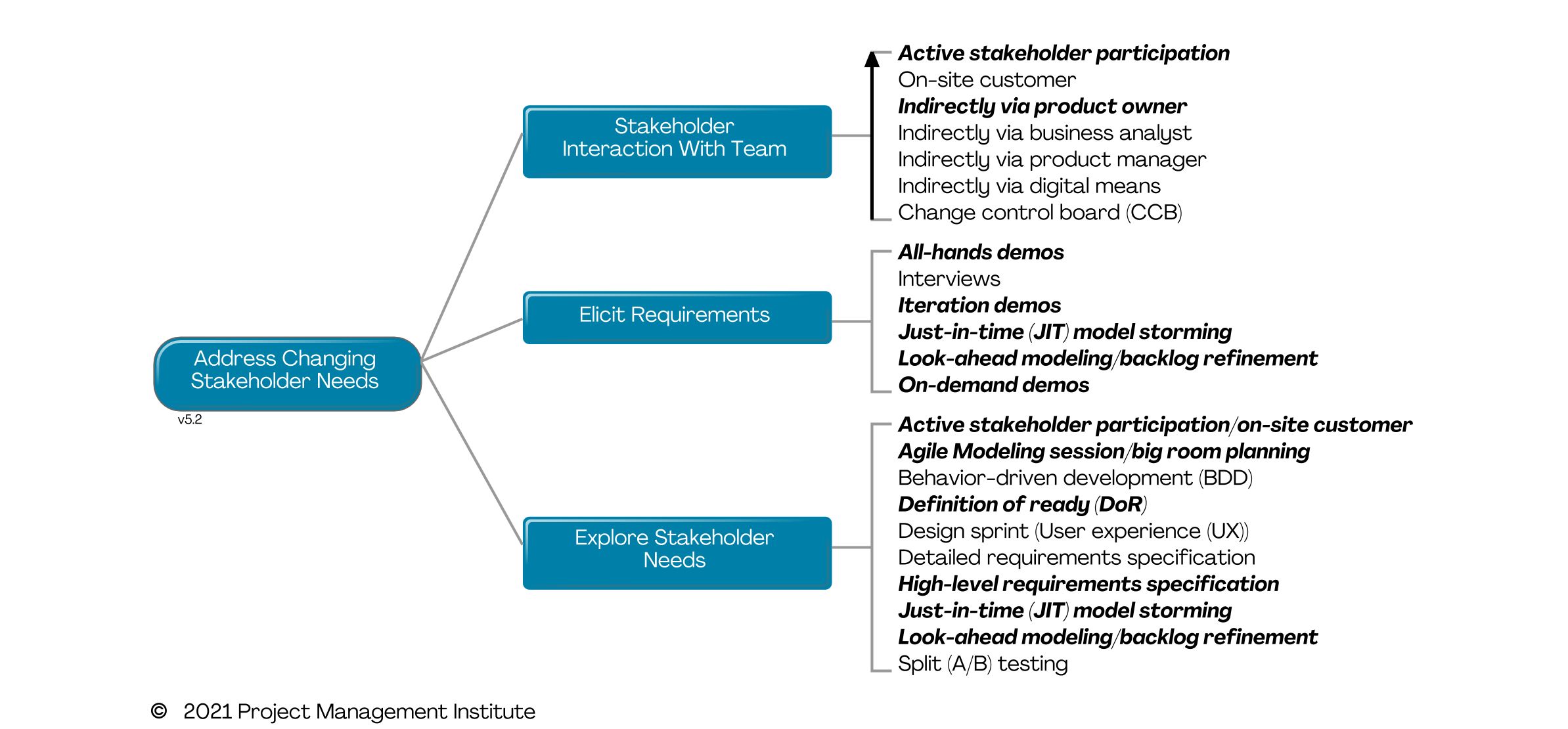
Address Changing Stakeholder Needs: RefactoredPart of the development of Intake Work was the refactoring of Address Changing Stakeholder Needs which previously captured several decision points that focused on intaking work and several on exploring stakeholder needs. Figure 2 depicts the updated goal diagram. Important changes include:
Figure 2. The Address Changing Stakeholder Needs goal diagram (click to enlarge)
Related Resources
|
|
One of the mantras of the agile community is that you need to "be agile," that you need to adopt an agile mindset. Agilists will often point to the Manifesto for Agile Software Development, commonly referred to as the Agile Manifesto, as a good starting point to understand this mindset, which it is. Other mantras within the agile community include respecting others and having a safe environment that embraces diversity. All wonderful ideas, but what do you do when they collide with one another?
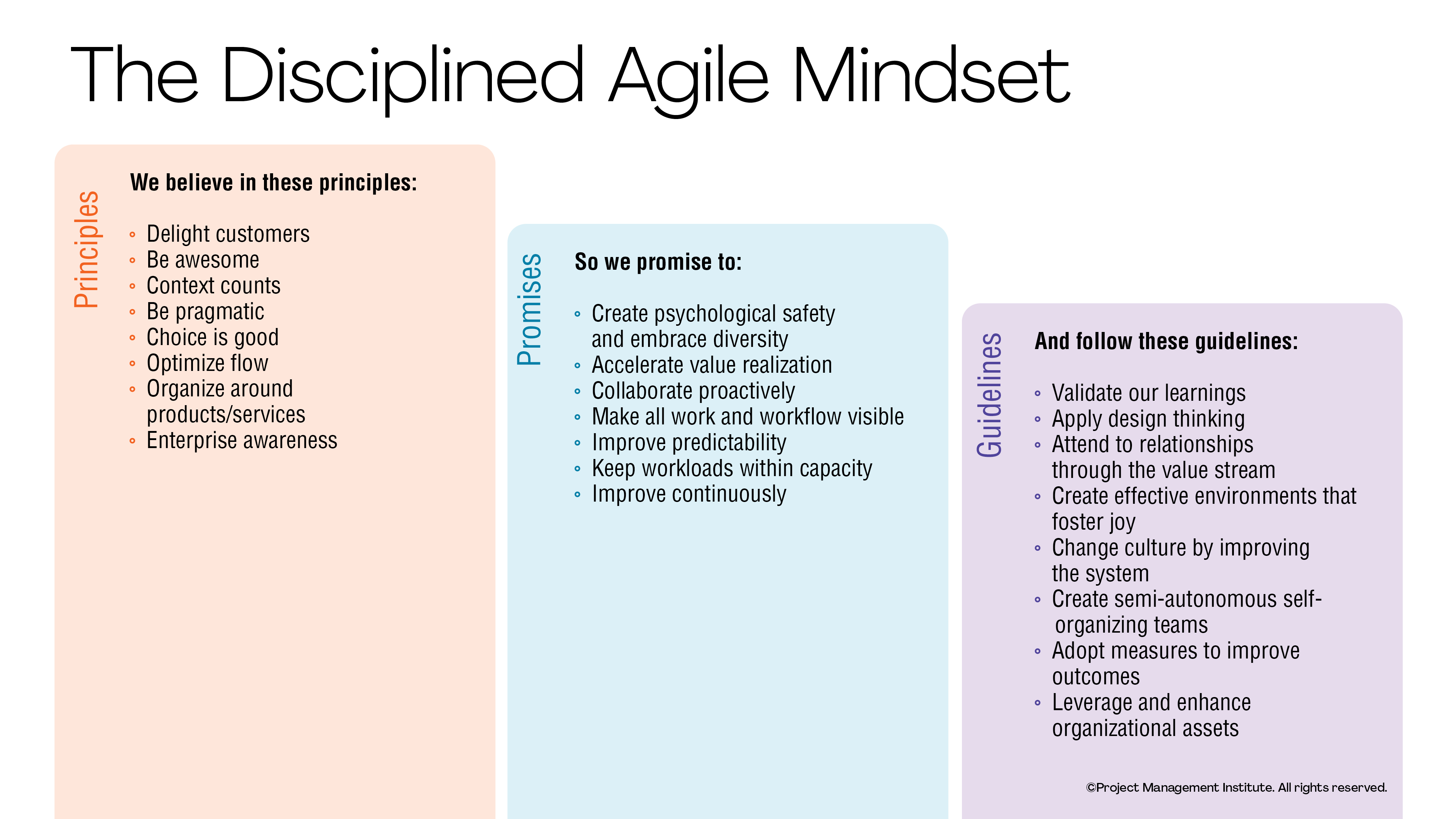
The Disciplined Agile MindsetFigure 1 depicts the Disciplined Agile (DA) mindset, which is captured in the form of principles, promises, and guidelines. Disciplined agilists believe in the DA principles, so we promise to adopt these behaviours and follow these guidelines when doing so. Where the Agile Manifesto addressed the environment faced by software developers 20 years ago, the DA mindset addresses the environment faced by organizations today. The DA mindset reflects our learnings over these past 20 years, adopting great ideas from a wide range of sources, in particular ideas around lean and flow, to describe concepts that enable enterprise agility.
Figure 1. The Disciplined Agile mindset.
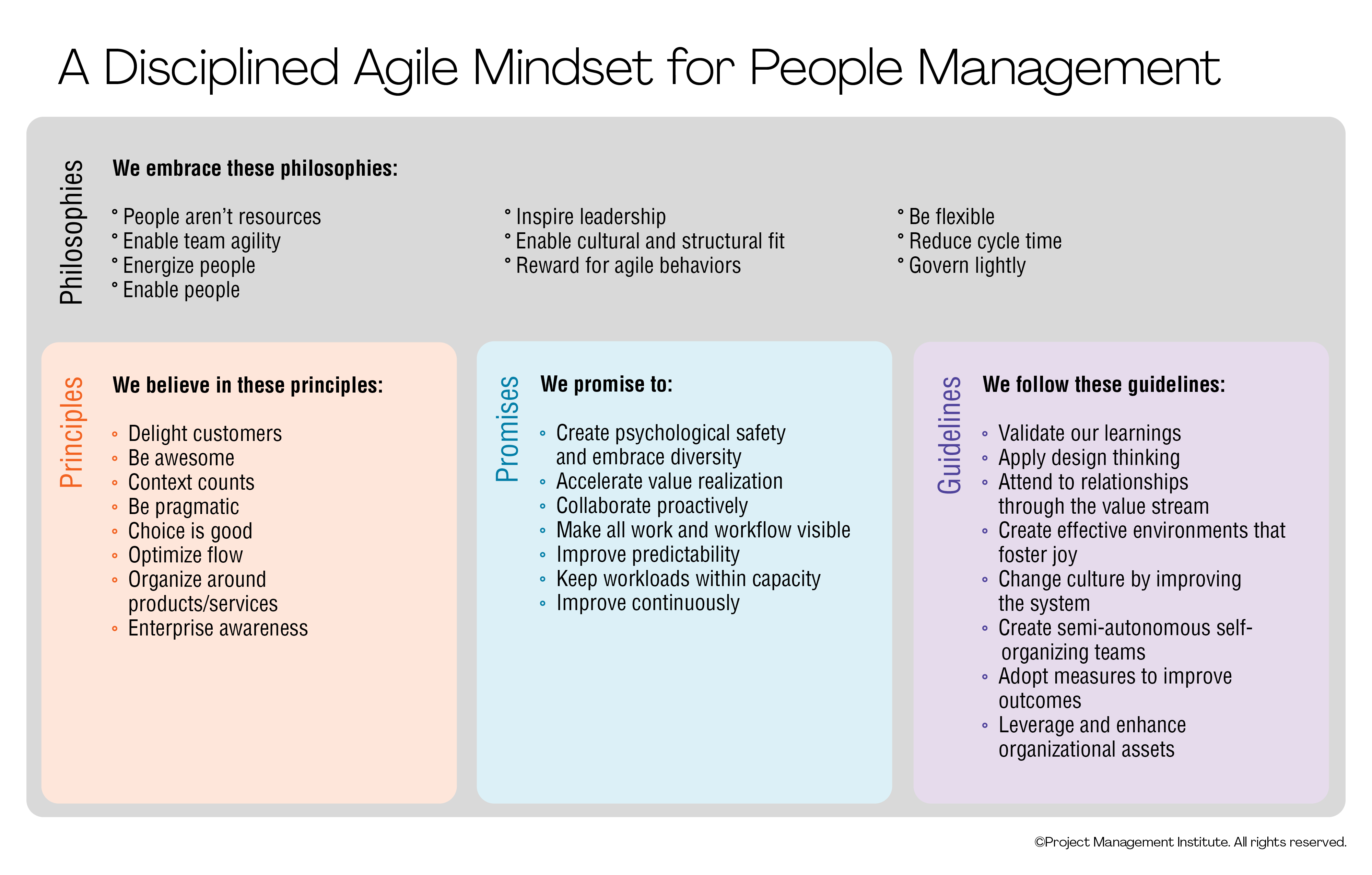
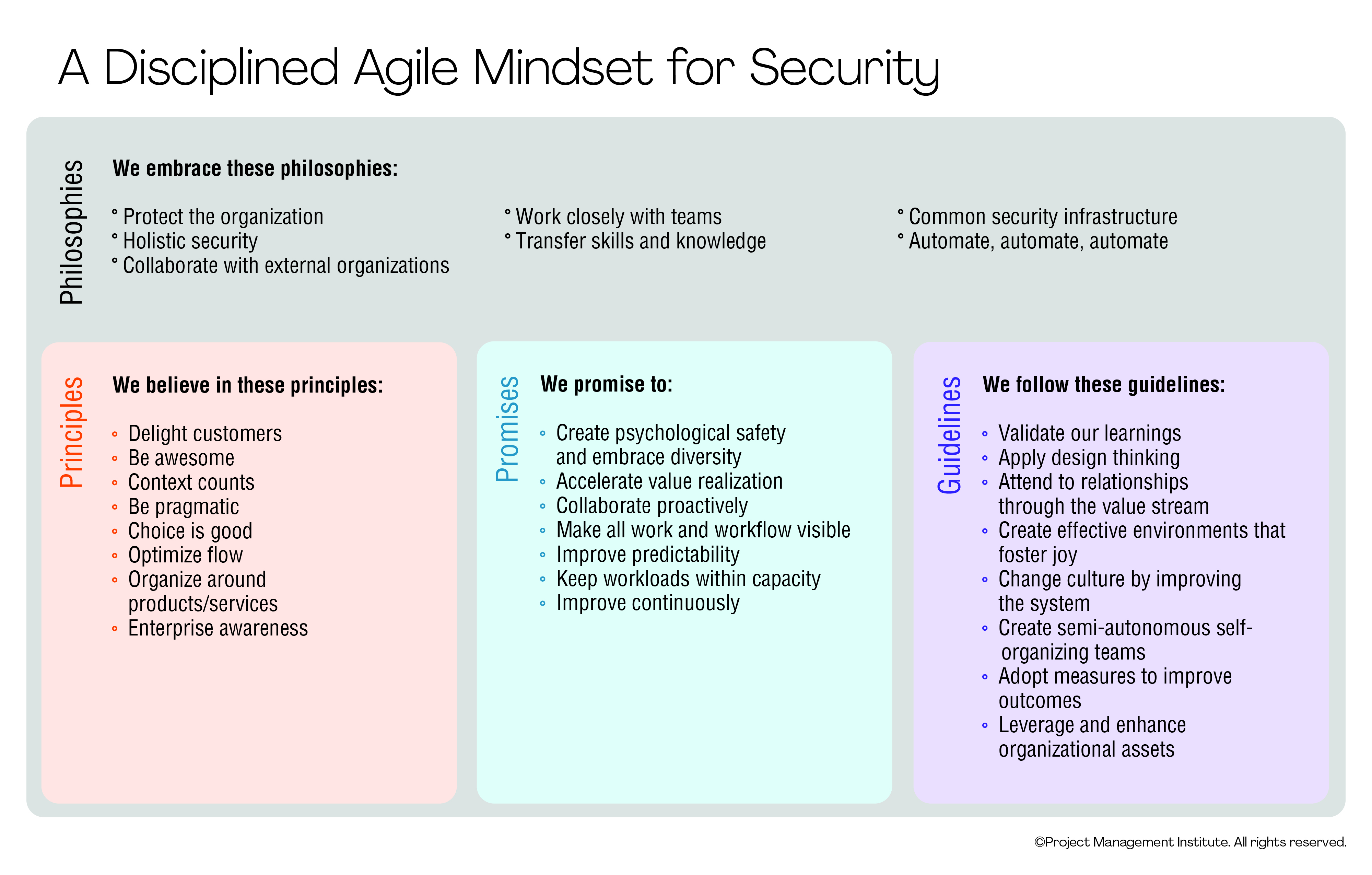
Embracing Different Mindsets in the DA Tool KitOne of the promises of the DA mindset is to create psychological safety and embrace diversity. Interestingly, when you do that you soon realize that people often have very different mindsets and that this is a very desirable thing. Yes,we want people to embrace an agile mindset so that we all share a similar point of view, but that's only one of many points of view. There are still noticeable differences between the way that you approach something and the ways that others do, even when everyone involved has an agile mindset. This happens because we are all unique people with unique experiences and backgrounds, and as a result you have other points of view than just the agile mindset. I'm sure that you've noticed that finance people have a different perspective than people from marketing, whose perspective differs from data management professionals, which is different yet again than research and development people, and so on. Each business function tends to attract, and then reinforce, people of a certain mindset. Some people find legal work incredibly interesting, whereas others find it spectacularly boring. To each their own. This is where it gets interesting. Remember that DA is a tool kit that supports improvement across all aspects of your organization, not just software development. One aspect of the architecture of the DA tool kit is that we've captured the different business functions within your organization as process blades, which in turn are described in terms of mindset, people, flow, and practices. Process blades include Finance, Strategy, Legal, Marketing, Security, IT Operations, Portfolio Management, and many more. Regarding mindset, for a given process blade, we extend the base DA mindset with philosophies that are applicable to that process blade. For example, Figure 2 depicts DA's People Management (Human Resources) mindset and Figure 3 DA's Security mindset.
Figure 2. Disciplined Agile's People Management Mindset.
Figure 3. Disciplined Agile's Security Mindset.
There are several important points to this strategy:
Just like one process does not fit all situations, one mindset doesn't either. The Disciplined Agile (DA) tool kit explicitly embraces mindset diversity. Do you? |
|
We used to say that software is eating the world, but the fact is today software is the world. Gone are the days where IT could be treated like a utility, one that more often than not was outsourced in the belief that you needed to focus on your core competencies and IT didn’t make it onto that list. These days being competent at IT is mere table stakes at best, you need to excel at IT if you hope to become an industry leader. Today business executives must focus on disruptors, new competitors entering their market space using technologies in new ways. Becoming an agile business – an adaptive, responsive, and learning organization – is the true goal. Business agility requires true agility across all of your organization, not just software development, not just DevOps, and not just IT. There isn’t a single industry now that either isn’t dominated by agile businesses or isn’t under threat of disruption by new agile competitors. The Disciplined Agile (DA) tool kit was created to apply agile in complex enterprise agile implementations. DA has been well received and implemented in organizations around the world. According to Gartner, Disciplined Agile is also the only available agile process explicitly allowing enterprises to customise agile for their unique enterprise challenges at both the organization and project levels. In their research report, Adopt Disciplined Agile Delivery for a Comprehensive and Scalable Agile IT Approach, Gartner reported:
In this article, we address several common questions executives have about Disciplined Agile (DA):
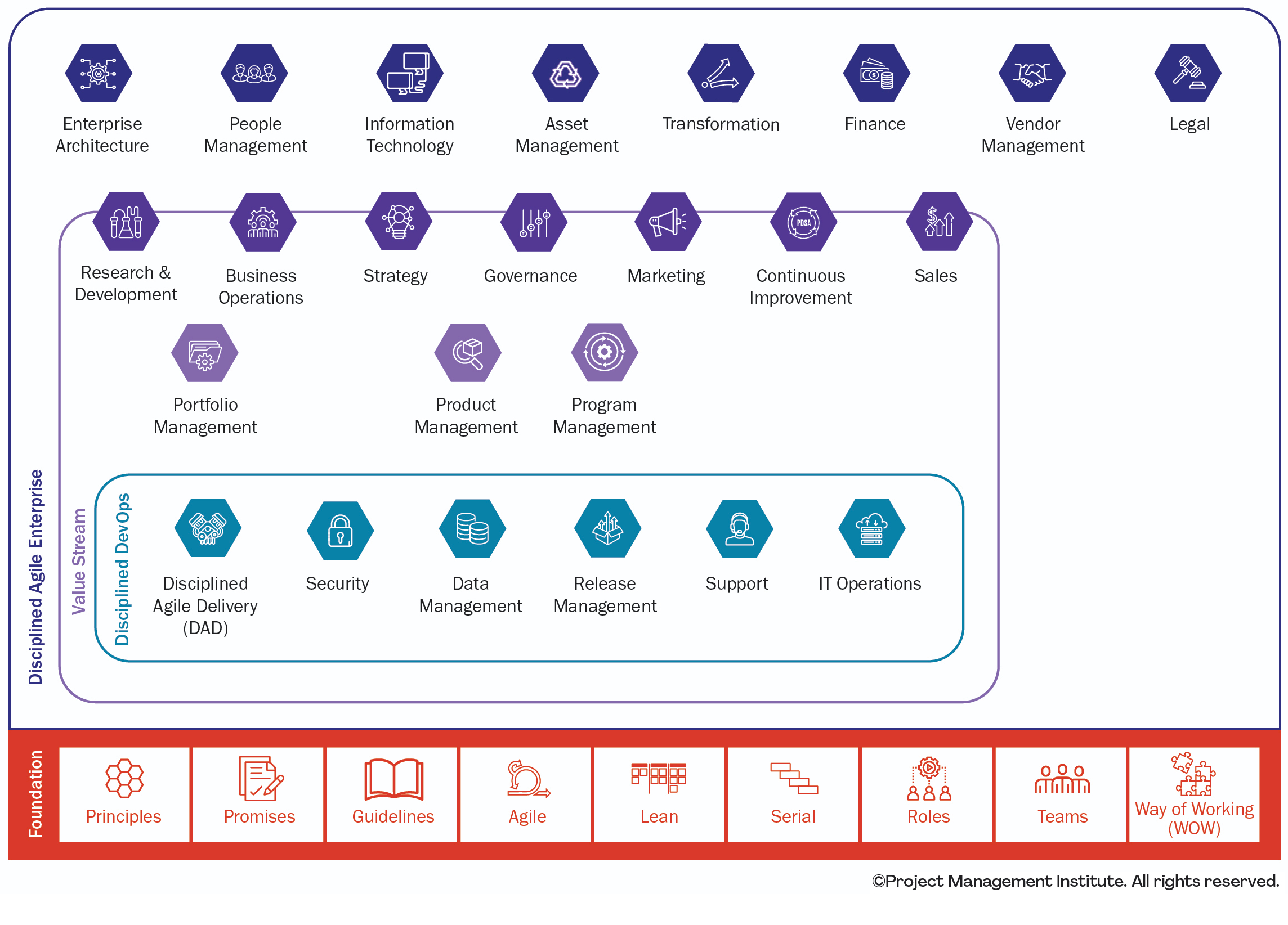
What is Disciplined Agile (DA)?The Disciplined Agile (DA) tool kit provides straightforward guidance to help organizations streamline their processes in a context-sensitive manner, providing a solid foundation for business agility. The figure below provides a high-level overview of the scope of DA (click on the diagram to zoom in).
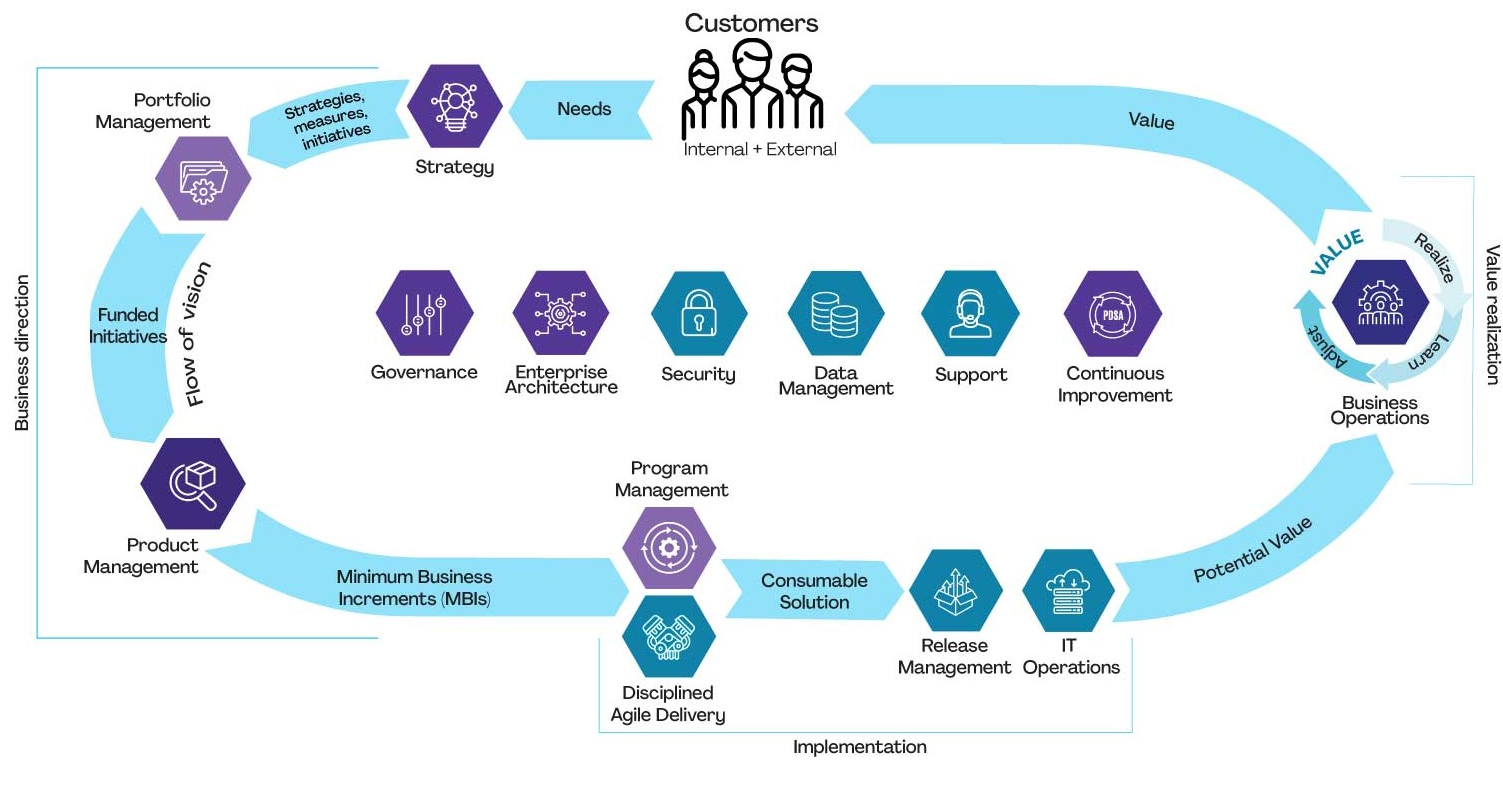
DA provides a foundation for business agility does this by showing how the various activities such as Finance, Portfolio Management, Solution Delivery (software development), IT Operations, Enterprise Architecture, Vendor Management and many others work together. DA also describes what these activities should address, provides a range of options for doing so, and describes the trade-offs associated with each option. DA also provides a straightforward strategy for implementing value streams, overviewed in the following diagram (click on it to zoom in).
You can read more about DA in Introduction to Disciplined Agile.
Why should I consider Disciplined Agile (DA)?There are several reasons why your organization should adopt the Disciplined Agile (DA) tool kit:
You can read more about why you should consider DA at Why Disciplined Agile?
Where is Disciplined Agile (DA) being used?DA is being used in numerous organizations, in a wide range of industries, around the world. You can see a list of a subset of the organizations using Disciplined Agile.
Are there any Disciplined Agile (DA) success stories?Yes. We have published several Disciplined Agile success stories with more on the way.
How can we get started with Disciplined Agile (DA)?The answer to this question depends on what you're trying to achieve:
Getting personally started with Disciplined AgileThere are several ways that you can learn more about DA, and we recommend following the one(s) that seem best for you:
Getting a team started with Disciplined AgileThere are also several options for getting a team going with Disciplined Agile, we recommend considering all three:
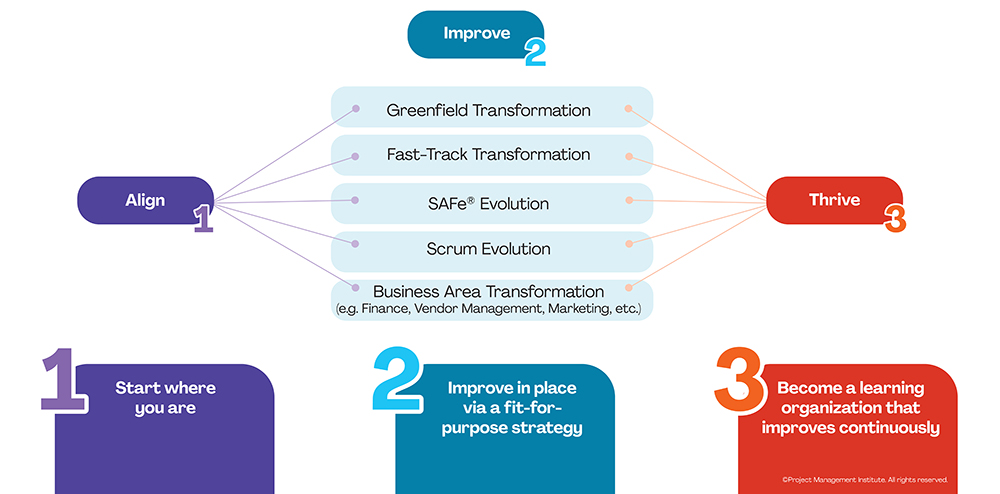
Getting your organization started with Disciplined AgileOur fundamental advice is to start where you are, do the best that you can given the situation that you face, and always strive to get better. To succeed, there are three key concepts to understand:
Although every organization's journey is unique, we have found that at a high-level they all follow a similar 3-step transformation path:
|
|
"I never thought much of the courage of a lion-tamer. Inside the cage he is at least safe from people." - George Bernard Shaw |