


.jpg)





Guessing is not a strategy: How to build decision velocity with AI and real-time data
June 10, 2026 | Live Webinar

Disciplined Agile 5.5 Released
Choose Your WoW! Second Edition Is Now Available
Requisite Agility applied in Project Management
Disciplined Agile and PMBoK Guide 7th Edition
#ChoiceIsGood, #ChooseYourWoW, #ConsumableSolution, #ContinuousImprovement, #CoreAgilePractices, #experiment, #Experimentation, #GuidedContinuousImprovement, #Kaizen, #LifeCycles, #ProcessImprovement, #TealOrganizations, Adoption, agile, agile adoption, Agile Alliance, Agile Business Analyst, Agile certification, agile data, agile governance, agile lifecycle, agile metrics, agile principles, agile transformation, Agile2018, Agile2019, Agile20Reflect, AgileData, Analogy, announcement, Architecture, architecture, architecture owner, Articles and publications, Asset Management, Atari, Backlog, Barclays, being agile, benefits, bi, blades, book, Branching strategies, Browser, Business Agility, business intelligence, business operations, capex, Case Study, Certification, certification, charity, Choose your WoW, CMMI, cmmi, Coaching, Collaboration, Communications Management, Compliance, Compliancy, Conference, Construction, Construction phase, Context, Continuous Improvement, coordination, COVID-19, Culture, culture, Cutter, DA, DAD, DAD Book, DAD discussions, DAD press, DAD roles, DAD supporters, DAD webcast, DADay2019, Data Management, database, dependencies, Deployment, Development Strategies, DevOps, disaster, Discipline, discipline, Disciplined Agile, disciplined agile delivery, disciplined agile delivery blog, Disciplined Agile Enterprise, disciplined devops, Documentation, Domain complexity, dw, DW/BI, Energy Healing, Enterprise Agile, Enterprise Architecture, Enterprise Awareness, enterprise awareness, Essence, estimation, Evolving DA, Executive, Experiment, facilitation, FailureBow, feedback-cycle, finance, Financial, FLEX, Flow, foundation layer, Funding, GCI, GDD, Geographic Distribution, gladwell, global development, Goal-Driven, goal-driven, goals, Governance, GQM, Guideline, Hybrid, Improvement, inception, Inception phase, India, information technology, infosec, Introduction, iterations, Kanban, large teams, layer, lean, Lean Startup, learning, Legal Project Management, LeSS, Lifecycle, lifecycle, Manifesto, mark lines, marketing, MBI, Metaphor, Metrics, metrics, mindset, Miscellaneous, MVP, News, News and events, Non-Functional Requirements, non-functional requirements, Non-solo development, offshoring, Operations, opex, Organization, Outsourcing, outsourcing, paired programming, pairing, paper, People, People Management, phases, Philosophies, Planning, PMBoK, PMI, PMI and DA, PMI Chapter, Portfolio Management, post-format-quote, Practices, practices, Principle, Process, process improvement, process tailoring, Product Management, product owner, Product Owners, productivity, Program Management, Project Management, project-initiation, Promise, Quality, quality, rational unified process, Refactoring, Reiki, Release Management, release management, Remote Training, Remote Work, repeatability, requirements, Requirements Management, research&development, responsibilities, retrospectives, Reuse, Reuse Engineering, ride for heart, rights, Risk Management, Risk Management, Risk management, Roles, RUP, SAFe, sales, Scaling, scaling, scaling agile, Scheduled Workshops, SCM, scorecard, Scrum, ScrumMaster, SDLC, Security, security, self-organization, SEMAT, serial, skill, solutions software consumable shippable, Stakeholder Management, strategy, Support, Surveys, Teal organizations, team development, Team Lead, team lead, Teams, Technical Debt, Teleconferencing, Terminology, terraforming, test strategy, testing, time tracking, Tool kit, Toolkit, tools, traditional, Transformation, Transition iteration, transition phase, Uncategorized, Upmentors, Using PMI Standards, value stream, velocity, vendor management, Virtual Training, Workflow, workflow, workspaces


|
We often hear the refrain that Disciplined Agile (DA) is too complicated, that it needs to be simpler. Believe me, we’re all for simplicity and we do everything that we can to make DA as simple as possible. However, to be fair, we often find that the people complaining about this are often coming at the situation from a different point of view than we are. With this blog we work through how why the complications encompassed by DA reflects the reality that we face in modern enterprises. To do this let’s explore why DA may appear to be complicated at first. This blog explores the following issues:
There is a Natural Complications in What We DoSoftware development by itself is complicated: we need to work closely with stakeholders to understand their needs, we need to architect and design solutions, we need to build or configure these solutions, we need to test them, we need to deploy them, we need to organize this effort somehow, and many other things. There’s clearly a bit of natural complexity in software development. Furthermore, the overall IT process surrounding software development adds even more complications to operate, manage, and govern our overall IT ecosystem. This is why we get paid what we get paid – if it was easy, organizations could find a multitude of lower-skilled, and lower-paid, people to do this work. Enterprise Solution Delivery is Inherently Complicated
The Disciplined Agile Delivery (DAD) portion of the DA toolkit addresses solution delivery in enterprise-class organizations. Sometimes people who have only worked in startups or small companies don’t appreciate the realities of enterprise-class development. A small company that has been in business for a few years is very different than a large organization that has several decades of legacy systems, legacy processes, and legacy thinking in place. Adopting agile and lean ways of working when you effectively have a clean slate to start from is a very different proposition than working in an organization where you need to respect and evolve the existing legacy ecosystem. But don’t other, simpler methods such as Scrum work in these settings? Yes, they potentially do, but they address a much smaller scope than does DAD. Scrum is less complicated because it only looks at a very small portion, likely not even 5%, of the software delivery process. The focus of Scrum is on a few collaboration patterns for organizing small software construction teams and for managing changing requirements. It purposefully does not address the full project delivery lifecycle from beginning to end. Nor does Scrum address technical practices for architecture, design, testing, programming, modeling, documentation, deployment, and many other aspects of solution delivery. DAD, on the other hand, purposely addresses all of these aspects of software delivery from beginning to end in a streamlined manner. And Scrum only describes a single way of working, what DAD calls the Agile/Basic lifecycle, whereas DAD includes six lifecycles (Agile, Lean, Continuous Delivery: Agile. Continuous Delivery: Lean, Program, and Exploratory/Lean Start Up) to choose from to address a great range of needs. So yes, as a toolkit DAD is much more complex than Scrum because DAD answers the multitude of questions that Scrum leaves up to you. Interestingly, from the point of view of enterprise agile transformation, DAD is a less complicated solution to adopt because it’s already done the “heavy lifting” for you on the process side of things. We wrote a blog a few years ago about how it’s easier to right-size your process by starting in the middle with something like DAD than it is to start at the “simple bottom” with Scrum. Enterprise IT is Inherently ComplicatedDisciplined Agile IT (DAIT) extends DAD (and Disciplined DevOps) to look at all of IT. The workflow of a Disciplined Agile IT department is depicted in the following diagram, and that diagram is merely a high-level overview. Many of the challenges that developers like to complain about – dysfunctional governance, ineffective enterprise architecture, slow data management, non-existent reuse, questionable HR processes, and many more – DA chooses to explicitly address. Because DA deals with the much wider range of enterprise IT issues than just software development it encompasses more complexity than many developers may be comfortable with, or even aware of.
DA addresses this bigger picture because our philosophy is to provide coherent, pragmatic advice to help organizations address the challenges that they face in improving their processes. In fact, the DA toolkit appears to be the only source of information that addresses enterprise agile IT in a coherent and comprehensive manner. Without a holistic vision such as this an organization will end up development a piece-meal strategy where the individual parts may be effective on their own but do not integrate well as a whole. Not looking at the entire IT picture at once is the primary cause of organizational dysfunctional in your department today, with the DA toolkit you can avoid this problem as you evolve into an agile/lean way of working. BTW, you can download a copy of the workflow diagram shown above from the Disciplined Agile posters page. Choice is Good, But Having Choices Adds ComplicationsDisciplined Agile looks at a range of situations, giving you choices. Other methods and frameworks, such as LeSS and SAFe, prescribe a single way of working. Certainly a small development team will work differently than a medium-sized development team which works differently than a large team. A team that is co-located will work differently than a team spread across a single building, than a team spread across several buildings in the same city, than a team spread across the world. A team working in a regulatory environment will work in a more sophisticated way than a team in a non-regulatory environment. A team where everyone works for your company will work differently than a team where some of the work is being outsourced. A team facing a simple domain problem will work differently than a team facing a complex problem. And so on. Although many people just want to be told what to do, they just want a single way of working given to them, that desire for prescription is a recipe for disaster in modern IT organizations. You have a range of teams facing a range of situations: One process size does not fit all.
Having choices is definitely complicated. This is similar to “needing a new outfit”, going to the store, only to be overwhelmed by the myriad of choices presented to you.
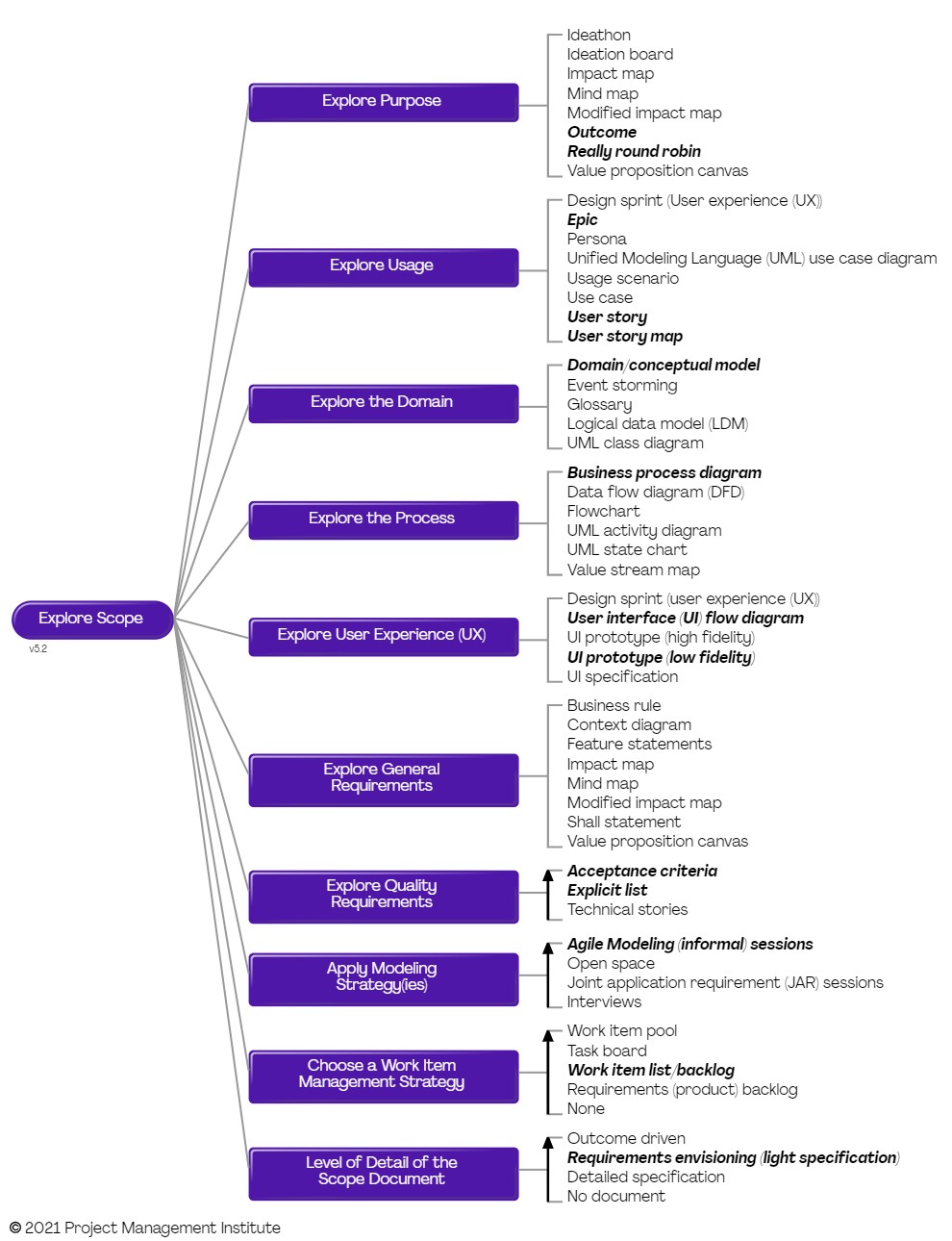
Let’s bring the conversation back to software process. In Disciplined Agile Delivery (DAD) we called out a collection of process goals that a team should fulfill in some way to be successful at agile solution delivery. These goals included exploring the initial scope, putting the team together, developing a consumable solution, coordinating activities, and deploying the solution into production to name a few. Each process goal is overviewed by a process goal diagram, the one for Explore Initial Scope follows below. Each goal is organized into a collection of process decision points, each decision point has options, and each option has advantages and disadvantages. Where one agile method might advise you to write a collection of epics and user stories to identify the initial scope, in DAD we say that you need to explore how people will use your solution (and writing epics and user stories are two of many options available to you), you may need to explore the user interface, you should consider to what extent (if any) the initial requirements should be documented, how you will go about eliciting requirements, and other important decisions. Ideally, if you want to be effective, then you want each team to own their own process and make the choices that are best for them given the situation that you face.
Back to the clothing analogy. Just like Scrum and SAFe prescribe one way of working, you could similarly take a prescriptive approach to shopping for new clothes. This is the equivalent of saying that you will be successful if you wear a red polo shirt, blue pants, blue socks, and black shoes. That may be great advice if you are working as a food server at your local restaurant chain but horrible advice if you need an outfit that is appropriate for a wedding, or for working in a formal office, or for going to the beach. When buying the right clothing you need first need to understand the context and then hopefully have several choices available to you. You want to be able to choose the right shirt for you, not the one prescribed to you. You want to choose a nice pair of pants or a skirt that complements that shirt, and so on. Yes, it’s much easier just to buy exactly the clothes that you’re told to, but it doesn’t give you as satisfying a result in most situations. In Disciplined Agile we extended this choice-driven approach to IT-level activities such as Portfolio Management, Enterprise Architecture, Reuse Engineering, Data Management, and others. The following diagram is the process goal diagram for Enterprise Architecture, depicting the process decision points that your EA team should consider addressing and a range of options for each choice.
People Underestimate the Inherent Complications of the Familiar
When most people are asked what the gentleman in the picture is wearing, they’ll say a blue dress shirt and slacks. However, he’s also wearing shoes, socks, a belt, and underwear (we hope). It is quite common for people to abstract away, to ignore, details that are familiar to them – the “shirt and slacks” answer abstracted away the details of the entire outfit. However, for someone to whom western clothing is new, this “simple outfit” appears quite complex to them until someone helps them to understand it. The exact same thing happens in the software world. When asked what we do it’s easy to casually say that we work with stakeholders to understand what they want, we write some software, and then we deploy it. Of course the reality of what actually goes on is a lot more complex than that. We invite you to spend a few minutes and jot down all of the activities that your team does to actually build and deploy software in practice. Pretty long list, isn’t it? And for every strategy on that list, you’ve selected one of many options available to you. DA Purposefully Includes Some Questionable Choices
It’s exactly the same when it comes to process – we have a range of choices and some of them are better for us than others. For example, consider the choices we have when it comes to the level of detail that we capture when exploring the initial scope. We could choose to: write a very detailed requirements specification; write a light specification (perhaps using index cards, whiteboard sketches, and a bit of overview documentation); write a simple bulleted list of goals; or not capture any requirements information at all. Many agile purists will say that writing a detailed requirement specification isn’t agile, and in the vast majority of situations it isn’t, although we have seen life-critical regulatory situations where it is appropriate. But, what if you’re in a situation where detailed requirements specifications aren’t appropriate yet someone is demanding that you create one? Agile purists will likely get into religious arguments with this person: the traditionalist will argue that their way is best and the purist will argue that there way is best, but in the end the person with the most political clout will win. With a DAD-based we recognize that there is a range of options available to you, including writing detailed specifications. But we take it one step further and are clear about the advantages and disadvantages of each approach and when the approach is appropriate. Now you can have more intelligent conversations and pragmatic about your process choices. When you get into situations such as this you can go beyond the “but that isn’t agile” refrain to have coherent reasons that as to why one strategy is better for another strategy given the situation that you face. Choice is good. Most People Focus on a Small Part of the Overall Process
Many people choose to focus on their part of the job, which is fair enough. But what about all of the other activities that your team performs from beginning to end? You may be a developer focused on software construction, but what about all of the initial inception work that occurred, such as gathering initial requirements, putting the team together, and getting funding for construction that occurred before you began your work? What about the activities that occur within other teams that interact with, often to support, your team? For example, there may be some enterprise architects responsible for evolving and supporting a technical roadmap for your organization, there may be an infrastructure team responsible for operating your technical environment, and there may be people responsible for people management/HR activities (such as seeing that you get paid). Disciplined Agile looks at the holistic picture, not just at your piece of the overall puzzle. Just because you’re not involved with data management, or portfolio management, or operations doesn’t mean that those activities, and the teams that perform them, aren’t important to the overall success of your organization. What Would You Take Away?Now that you understand the overall scope of DA, what would you remove? We’re asking this question from the point of view of:
If you think Disciplined Agile (DA) contains something that it doesn’t need, please add a comment at the end of this blog. What Would You Like to Add?Ha! Every single time we’ve had this conversation with someone, and they were willing to consider the issues above, they’ve told us that we needed to include one or more techniques that they’ve found effective in practice. EVERY. SINGLE. TIME. In short, the conversation goes from DA is too complex to DA is not complex enough. Argh! So, once again, please add a comment at the end of the blog for anything you think we’re missing. A Few Parting ThoughtsSoftware development, IT in general, and in fact your organization is a complicated game with many moving parts that are evolving all of the time. It’s natural for us, as human beings, to want simple answers. But sometimes the simplest answer can still be quite complicated. Simplistic answers may be more attractive, and in the short term or in very narrow situations they may in fact be a good solution for you, but more often than not they’ll make your situation even worse. In Disciplined Agile (DA) we actively strive to drive the complications out of the software process but at the same time we have the courage to look at the bigger picture and explicitly address the range of issues that modern enterprises face in practice. With DA we’re working together to make the process as simple and streamlined as possible.
|
| The majority of testing, and in simple situations all of it, is performed by an agile delivery team itself. This is because we strive to have cross-functional “whole teams” that have the capability and accountability to perform the activities of solution delivery from beginning to end. For organizations new to agile this means that you embed testers on agile teams and for organizations experienced in agile that you’ve managed to motivate agile team members to gain testing skills over time (often via close collaboration with other people who already have those skills). This blog is organized into the follow topics:
Parallel Independent TestingThe whole team approach to development where agile teams test to the best of the ability is a great start, but it isn’t sufficient in some scaling situations. In these situations, described below, you need to consider instituting a parallel independent test team that performs some of the more difficult or expensive forms of testing. As you can see in Figure 1, the basic idea is that on a regular basis the development team makes their working build available to the independent test team. This may happen several times an iteration – we’ve seen teams do so at the end of each iteration, on a nightly basis, as part of their continuous deployment (CD) strategy. How often this occurs needs to be negotiated between the two teams. Figure 1. Independent testing with an agile team.
The goal of this independent testing effort is not to redo the confirmatory testing that is already being done by the development team, but instead to identify the defects that may have fallen through the cracks. The implication is that this independent test team does not need a detailed requirements speculation, although they may need updated release notes including a list of changes since the last time the development team sent them a build. Instead of testing against the specification, the independent testing effort typically focuses on:
Why Independent Testing?There are several reasons why you should consider independent testing:
Figure 2: Average cost of change curve.
Questionable Reasons to Adopt Independent TestingWe’ve run into a few rather poor excuses to justify independent testing over the years:
But That Isn’t Agile!Bullshit! Please excuse my language. Disciplined agile is pragmatic, going beyond the limited approach promoted by many agile purists. These purists will claim that you don’t need parallel independent testing, and in simple situations this is clearly true. The good news is that it’s incredibly easy to determine whether or not your independent testing effort is providing value: simply compare the likely impact of the defects/change stories being reported with the cost of doing the independent testing. In short, whole team testing works well for agile in the small, but for more complex systems and in some tactical scaling situations you need to be more sophisticated. |
|
Lean thinking is important for scaling agile in several ways:
|
|
In Implementing Lean Software Development, Mary and Tom Poppendieck show how the seven principles of lean manufacturing can be applied to optimize the whole IT value stream. These principles are:
|
|
A common question that customers ask us is how do you measure productivity on agile teams. If you can easily measure productivity you can easily identify what is working for you in given situations, or what is not working for you, and adjust accordingly. One way to do so is to look at acceleration, which is the change in velocity. A common metric captured by agile teams is their velocity. Velocity is an agile measure of how much work a team can do during a given iteration. Velocity is typically measured using an arbitrary point system that is unique to a given team or program. For example, my team might estimate that a given work item is two points worth of effort whereas your team might think that it’s seven points of effort, the important thing is that it’s consistent. So if there is another work item requiring similar effort, my team should estimate that it’s two points and your team seven points. With a consistent point system in place, each team can accurately estimate the amount of work that they can do in the current iteration by assuming that they can achieve the same amount of work as last iteration (an XP concept called “yesterday’s weather”). So, if my team delivered 27 points of functionality last iteration we would reasonably assume that all things being equal we can do the same this iteration. It generally isn’t possible to use velocity as a measure of productivity. You can’t compare the velocity of the two teams because they’re measuring in different units. For example, we have two teams, A and B, each of 5 people and each working on a web site and each having two-week long iterations. Team A reports a velocity of 17 points for their current iteration and team B a velocity of 51 points. They’re both comprised of 5 people, therefore team B must be three times (51/17) as productive as team A. No! Team A is reporting in their point system and B in their point system, so you can’t compare them directly. The traditional strategy, one that is also suggested in the Scaled Agile Framework (SAFe), would be to ask the teams to use the same unit of points. This might be a viable strategy with a small number of teams although with five or more teams it would likely require more effort than it was worth. Regardless of the number of teams that you have it would minimally require some coordination to normalize the units and perhaps even some training and development and support of velocity calculation guidelines. Sounds like unnecessary bureaucracy that I would prefer to avoid. Worse yet, so-called “consistent” measurements such as FPs are anything but consistent because there’s always some sort of fudge factor involved in the calculation process that will vary by individual estimator. An easier solution exists. Instead of comparing velocities you instead calculate the acceleration of each team. Acceleration is the change in velocity over time. The exact formula for acceleration is: (NewVelocity – InitialVelocity)/InitialVelocity For example, consider the reported velocities of each team shown in the table below. Team A’s velocity is increasing over time whereas team B’s velocity is trending downwards. All things being equal, you can assume that team A’s productivity is increasing whereas B’s is decreasing. At the end of iteration 10, if we wanted to calculate the acceleration since the previous iteration (#9), it would be (23-22)/22= 4.5% for Team A and (40-41)/41 = -2.4% for Team B. So Team A improved their productivity 4.5% during iteration 10 and Team decreased their productivity 2.4% that iteration. A better way to calculate acceleration is to look at the difference in velocity between multiple iterations as this will help to smooth out the numbers over time because as you see in the table the velocity will fluctuate naturally over time (something scientists might refer to as noise). Let’s calculate acceleration over 5 iterations instead of just one, in this case comparing the differences in velocity from iteration 6 to iteration 10. For Team A the acceleration would be (23-20)/20 = 15% and for Team B (40-45)/45 = -11.1% during the 5 iteration period, or 3% and -3.7% respectively on average per iteration.
Normalizing Acceleration for Team SizeThe calculations that we performed above assumed that everything on the two teams remained the same. That assumption is likely a bit naïve. It could very well be that people joined or left either of those teams, something that would clearly impact the team’s velocity and therefore it’s acceleration. Let’s work through an example. We’ve expanded the first table to include the size of the team each iteration. We’ve also added a column showing the average velocity per person per iteration for each team, calculated by dividing the velocity by the team size for that iteration. Taking the effect of team size into account, the average acceleration between the last five iterations for Team A is (1.9-1.8)/1.8/5 = 1.1% and for Team B is (5-5)/5/5 = 0.
Similarly, perhaps there was a holiday during one iteration. When there are ten working days per iteration and you lose one or more of them due to holidays it can have a substantial impact on velocity as well. As a result you may want to take into account the number of working days each iteration in your calculation. You would effectively calculate average acceleration per person per day in this case. Frankly I’m not too worried about that issue as it would affect everyone within your organization in pretty much the same way, and it’s easy to understand why there was a “blip” in the data for that iteration.
What Does Acceleration Tell You?For how you use acceleration in practice, there are three scenarios to consider:
Of course it’s not wise to govern simply by the numbers, so instead of assuming what is going on we would rather go and talk with the people on the two teams. Doing so you might find out that team A has adopted quality-oriented practices such as continuous integration and static code analysis which team B has not, indicating that you might want to help team A share their learnings with other teams.
Monetizing AccelerationThis is fairly straightforward to do. For example, assume your acceleration is 0.7%, that there are five people on the team, your annual burdened cost per person is $150,000 (your senior management staff should be able to tell you what this number is), and that you have two week iterations. So, per iteration the average burdened cost per person must be $150,000/26 = $5,770. Productivity improvement per iteration for this team must be $5,770 * 5 * .007 = $202. If the acceleration stayed constant at 0.7% the overall productivity improvement for the year would be (1.007)^26 (assuming the team works all 52 weeks of the year) which would be 1.198 or 19.8%. This would be a savings of $148,500 (pretty much the equivalent of one new person). Another approach is calculate the acceleration for the year by comparing the velocity from the beginning of the year to the end of the year (note that you want to avoid comparing iterations near any major holidays). So, if the team velocity the first week of February 2015 was 20 points, the same team’s velocity the first week of February 2016 was 23 points, that’s an acceleration of (23-20)/20 = 15% over a one year period, for a savings of $112,500.
Advantages of the Acceleration MetricThere are several advantages to using acceleration as an indicator of productivity over traditional techniques such as FP counting:
Potential Disadvantages of AccelerationOf course, nothing is perfect, and there are a few potential disadvantages:
We hope that you’ve found this blog post valuable. |
|
"Don't go around saying the world owes you a living. The world owes you nothing. It was here first." - Mark Twain |