
Viewing Posts by Scott Ambler


Accelerate Value Delivery
Categories:
agile,
Goal-Driven,
Construction phase,
testing,
DevOps,
Scrum,
goals,
scaling,
Documentation,
Construction
Categories: agile, Goal-Driven, Construction phase, testing, DevOps, Scrum, goals, scaling, Documentation, Construction


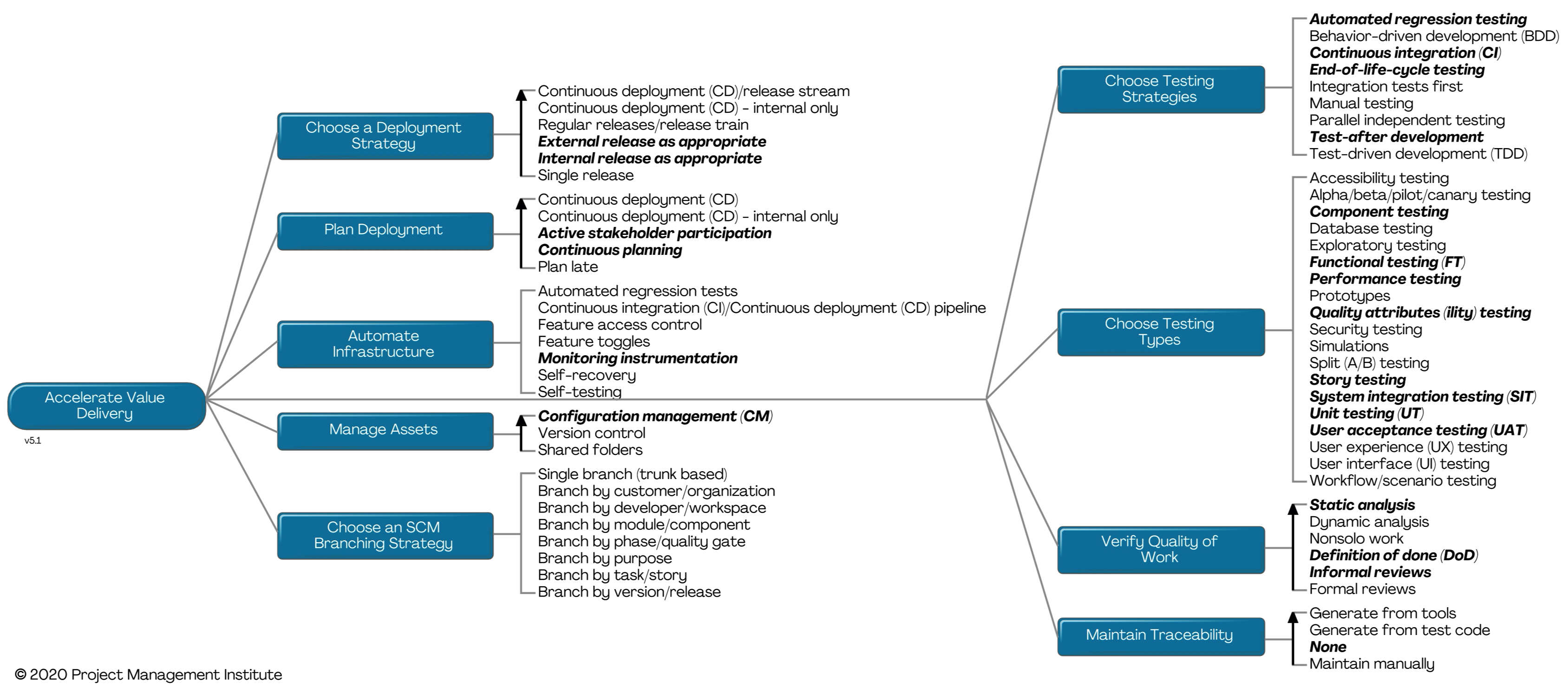
| One of the process goals that a disciplined agile team will want to address during construction is Accelerate Value Delivery. Ideally, in each construction iteration a team will move closer to having a version of their solution that provides sufficient functionality to its stakeholders. This implies that the solution is a minimally viable product (MVP) that adds greater business value than its cost to develop and deploy. Realistically it isn’t a perfect world and sometimes a team will run into a bit of trouble resulting in an iteration where they may not have moved closer to something deployable but hopefully they’ve at least learned from their experiences. This is an important process goal for several reasons. First, it encompasses the packaging aspects of solution development (other important development aspects are addressed by its sister goal Produce a Potentially Consumable Solution). This includes artifact/asset management options such as version control and configuration management as well as your team’s deployment strategy. Second, it provides deployment planning options, from not planning at all (yikes!) to planning late in the lifecycle to the more DevOps-friendly strategies of continuous planning and active stakeholder participation. Third, this goal covers critical validation and verification (V&V) strategies, many of which push testing and quality assurance “left in the lifecycle” so that they’re performed earlier and thereby reducing the average cost of fixing any defects. The process goal diagram for Accelerate Value Delivery is shown below. The rounded rectangle indicates the goal, the squared rectangles indicate issues or process factors that you may need to consider, and the lists in the right hand column represent potential strategies or practices that you may choose to adopt to address those issues. The lists with an arrow to the left are ordered, indicating that in general the options at the top of the list are more preferable from an agile point of view than the options towards the bottom. The highlighted options (bolded and italicized) indicate default starting points for teams looking for a good place to start but who don’t want to invest a lot of time in process tailoring right now. Each of these practices/strategies has advantages and disadvantages, and none are perfect in all situations, which is why it is important to understand the options you have available to you.
Let’s consider each process factor:
We want to share two important observations about this goal. First, this goal, along with Explore Scope, Coordinate Activities, and Identify Architecture Strategy seem to take the brunt of your process tailoring efforts when working at scale. It really does seem to be one of those Pareto situations where 20% addresses 80% of the work, more on this in a future blog posting. As you saw in the discussion of the process issues, the process tailoring decisions that you make regarding this goal will vary greatly based on the various scaling factors. Second, as with all process goal diagrams, the one above doesn’t provide an exhaustive list of options although it does provide a pretty good start. We’re firm believers that a team should tailor their strategy, including their team structure, their work environment, and their process, to reflect the situation that they find themselves in. When it comes to process tailoring, process goal diagrams not only help teams to identify the issues they need to consider they also summarize potential options available to them. Agile teams with a minimal bit of process guidance such as this are in a much better situation to tailor their approach that teams that are trying to figure it out on their own. The DA too lkit provides this guidance. |
Identifying Your Initial Architecture Strategy
| When a disciplined agile project or product team starts, one of the process goals which they will likely need to address is Identify Architecture Strategy. This is sometimes referred to as initial architecture envisioning or simply initial architecture modeling. This is an important process goal for several reasons. First, the team should think through, at least at a high level, their architecture so as to identify a viable strategy for moving forward into construction. A little bit of up-front thinking can increase your effectiveness as a team by getting you going in a good direction early in the life cycle. Second, the team should strive to identify the existing organizational assets, such as web services, frameworks, or legacy data sources, that they can potentially leverage while producing the new solution desired by their stakeholders. By doing this you increase the chance of reuse, thereby avoiding adding technical debt into your organizational ecosystem, and more importantly you reduce the time and cost of delivering a new solution as the result of reuse. You will do this by working with your organization’s enterprise architects, if you have any. This is an aspect of Disciplined Agile’s mindset of working in an enterprise aware manner. This is an important goal for several reasons:
The process goal diagram for Identify Architecture Strategy is shown below. The rounded rectangle indicates the goal, the squared rectangles indicate issues or process factors that you may need to consider, and the lists in the right hand column represent potential strategies or practices that you may choose to adopt to address those issues. The lists with an arrow to the left are ordered, indicating that in general the options at the top of the list are more preferable from an agile point of view than the options towards the bottom. The highlighted options (bolded and italicized) indicate default starting points for teams looking for a good place to start but who don’t want to invest a lot of time in process tailoring right now. Each of these practices/strategies has advantages and disadvantages, and none are perfect in all situations, which is why it is important to understand the options you have available to you.
Let’s consider each process factor:
We want to share two important observations about this goal. First, this goal, along with Explore Scope, Coordinate Activities, and Accelerate Value Delivery seem to take the brunt of your process tailoring efforts when working at scale. It really does seem to be one of those Pareto situations where 20% addresses 80% of the work, more on this in a future blog posting. As you saw in the discussion of the process issues, the process tailoring decisions that you make regarding this goal will vary greatly based on the various scaling factors. Second, as with all process goal diagrams, the one above doesn’t provide an exhaustive list of options although it does provide a pretty good start. We’re firm believers that a team should choose their own way of working (WoW), including their team structure, their work environment, and their process, to reflect the situation that they find themselves in. When it comes to process tailoring, process goal diagrams not only help teams to identify the issues they need to consider they also summarize potential options available to them. Agile teams with a minimal bit of process guidance such as this are in a much better situation to tailor their approach than teams that are trying to figure it out on their own. The DA tool kit provides this guidance, particularly via Guided Continuous Improvement (GCI). |

Myths and Misunderstandings about Agile Teams
|
Recently on a LinkedIn discussion forum people were sharing their opinions about agile teams. Throughout that conversation I heard several statements which just didn’t ring true with me. In some cases I suspect that the problem was they were thinking they were agile when they clearly weren’t and in other cases I suspect people were sharing ill-founded rumours about how agile works. I heard that everyone on an agile team must be highly skilled, that everyone on an agile team is a “jack of all trades”, and that people on agile teams are working so fast that they have no time to learn. Let’s examine each myth/misunderstanding one at a time. Myth #1: Everyone on an agile team must be highly skilled Myth #2: Everyone on an agile team is a “jack of all trades”
Granted, this is different than how some people staff traditional projects where they have specialists and then incur an incredible amount of overhead to get the job done. When you are new to agile you very likely have many people who are specialists on staff, perhaps they are focused on being a business analyst, on being a tester, on being a programmer, an architect, and so on. That’s OK, as they say you go to war with the army that you have. Over time you will want to actively support, and motivate people, to learn new skills from other people on the team (see next point). It’s also important to recognize that although someone may currently be focused on a certain traditional role today, that in the past they held other roles and as a result may have a broader range of skills, albeit rusty in some cases, than they may give themselves credit for. Regardless of your situation people can easily gain new skills if they choose to.
Myth #3: People on agile teams are working so fast that they have no time to learn Agile promotes iterative, collaborative, and experimental strategies. This promotes learning within the team, it doesn’t reduce it. Agile, and lean strategies in particular, expect the team to learn as you go. They’ll learn more about the domain, about the technologies they’re working with, about how to work effectively, and about each other. When people work together collaboratively, not alone at their own desks, they start to pick up skills from one another naturally. This is particularly true when the team adopts non-solo strategies such as pairing (I alluded to the value of pairing programmers and testers earlier). Of course coaching and mentoring are important to support learning as well as training.
|
If the Requirements Aren't Changing Your Team is Likely in Trouble
| I often run into people who are concerned about changing requirements, or evolving requirements if you like that term better, on software development projects (or product teams as the case may be). This is typically a reflection of their training and background in traditional software development strategies where changing requirements are usually perceived as a problem. In agile we consider changing requirements to be a good thing and we even embrace the idea that this will happen. In fact, one philosophy of Disciplined Agile Delivery (DAD) is that changing requirements are a sign of a healthy relationship with your stakeholders. Changing requirements indicate that:
So how do you support changing requirements in practice? The Disciplined Agile (DA) toolkit includes the “Address Changing Stakeholder Needs” goal which guides you through understanding and selecting the right strategy for prioritizing requirements changes as they occur throughout the lifecycle. These strategies include, but aren’t limited to Scrum’s Product Backlog Strategy, a more disciplined Work Item List strategy, or a lean Options Pool strategy. In regulatory situations you may even want to consider a formal change management strategy. DAD’s process goal-driven approach enables disciplined agile teams to tailor their strategy to meet the situation that they find themselves in, avoiding the challenges seen with methods such as Scrum that prescribe a single strategy (in this case Product Backlogs) that don’t work in all situations. And of course, to minimize the pain of changing requirements you will need to adopt disciplined development practices such as:
|
Choose the Best Communication Technique Available
| Recently on the DAD LinkedIn discussion forum we’ve had an interesting conversation going on that strayed into the effectiveness of various communication techniques. This conversation got me to thinking a bit about an article that I first wrote over a decade ago, Communication on Agile Software Projects, based on material in my Agile Modeling book. This article extends some of Alistair Cockburn’s thinking on the topic, summarized in Figure 1, which in turn extends a body of work called Media Richness Theory. The basic observation is that the richer the communication channel – such as email, videoconferencing, or face-to-face conversation – the more effective it is in practice. Figure 1. Comparing the effectiveness of communication techniques.
In the DAD book Mark and I said that the implication of Figure 1 was that given the situation you find yourself in that you should choose to use the most effective communication strategy available to you. We thought that this was all that needed to be said, but since then we’ve come to realize that a better diagram is needed. We developed Figure 2 which we believe communicates this strategy a bit more clearly. Figure 2. Choosing the best communication technique for your situation.
Figure 2 indicates that that the viability of communication options available to you varies depending on the situation that you find yourself in. For example, people on a co-located team can communication in pretty much any manner they choose. Ideally they would choose face-to-face communication around a whiteboard or paper but there’s nothing stopping someone from writing a detailed document and then emailing it to someone sitting beside them. When a team is geographically distributed they have fewer communication strategies available to them, unless of course they invest in travel so that they can be face-to-face. Figure 2 also indicates strategies for capturing, or persisting, a conversation. For example, a few people could have a conversation around a whiteboard, sketching the design of a screen perhaps. When they’re done they might decide to take a digital snapshot of it so that they can retain the diagram to work on it later (many organizations still don’t provide permanent whiteboard space to their development teams). They may even choose to have someone write up notes, perhaps on a wiki or in a word processor, and embed the snapshot(s) into those notes. To summarize, when it comes to how people communicate with one another they have choices. Disciplined agilists prefer to choose the most appropriate communication strategy for the situation that they find themselves in. |




