Disciplined Agile
by Tatsiana Balshakova,
Mark Lines, Mike Griffiths, James Trott, Bjorn Gustafsson, Curtis Hibbs, Scott Ambler

This blog contains details about various aspects of PMI's Disciplined Agile (DA) tool kit, including new and upcoming topics.
View Posts By:
Tatsiana Balshakova
Mark Lines
Mike Griffiths
James Trott
Bjorn Gustafsson
Curtis Hibbs
Scott Ambler
Past Contributors:
Joshua Barnes
Michael Richardson
Daniel Gagnon
Valentin Tudor Mocanu
Kashmir Birk
Glen Little
Klaus Boedker
Recent Posts
DA 5.6 is released
Disciplined Agile 5.5 Released
Choose Your WoW! Second Edition Is Now Available
Requisite Agility applied in Project Management
Disciplined Agile and PMBoK Guide 7th Edition
Categories
#ChoiceIsGood,
#ChooseYourWoW,
#ConsumableSolution,
#ContinuousImprovement,
#CoreAgilePractices,
#experiment,
#Experimentation,
#GuidedContinuousImprovement,
#Kaizen,
#LifeCycles,
#ProcessImprovement,
#TealOrganizations,
Adoption,
agile,
agile adoption,
Agile Alliance,
Agile Business Analyst,
Agile certification,
agile data,
agile governance,
agile lifecycle,
agile metrics,
agile principles,
agile transformation,
Agile2018,
Agile2019,
Agile20Reflect,
AgileData,
Analogy,
announcement,
Architecture,
architecture,
architecture owner,
Articles and publications,
Asset Management,
Atari,
Backlog,
Barclays,
being agile,
benefits,
bi,
blades,
book,
Branching strategies,
Browser,
Business Agility,
business intelligence,
business operations,
capex,
Case Study,
Certification,
certification,
charity,
Choose your WoW,
CMMI,
cmmi,
Coaching,
Collaboration,
Communications Management,
Compliance,
Compliancy,
Conference,
Construction,
Construction phase,
Context,
Continuous Improvement,
coordination,
COVID-19,
Culture,
culture,
Cutter,
DA,
DAD,
DAD Book,
DAD discussions,
DAD press,
DAD roles,
DAD supporters,
DAD webcast,
DADay2019,
Data Management,
database,
dependencies,
Deployment,
Development Strategies,
DevOps,
disaster,
Discipline,
discipline,
Disciplined Agile,
disciplined agile delivery,
disciplined agile delivery blog,
Disciplined Agile Enterprise,
disciplined devops,
Documentation,
Domain complexity,
dw,
DW/BI,
Energy Healing,
Enterprise Agile,
Enterprise Architecture,
Enterprise Awareness,
enterprise awareness,
Essence,
estimation,
Evolving DA,
Executive,
Experiment,
facilitation,
FailureBow,
feedback-cycle,
finance,
Financial,
FLEX,
Flow,
foundation layer,
Funding,
GCI,
GDD,
Geographic Distribution,
gladwell,
global development,
Goal-Driven,
goal-driven,
goals,
Governance,
GQM,
Guideline,
Hybrid,
Improvement,
inception,
Inception phase,
India,
information technology,
infosec,
Introduction,
iterations,
Kanban,
large teams,
layer,
lean,
Lean Startup,
learning,
Legal Project Management,
LeSS,
Lifecycle,
lifecycle,
Manifesto,
mark lines,
marketing,
MBI,
Metaphor,
Metrics,
metrics,
mindset,
Miscellaneous,
MVP,
News,
News and events,
Non-Functional Requirements,
non-functional requirements,
Non-solo development,
offshoring,
Operations,
opex,
Organization,
Outsourcing,
outsourcing,
paired programming,
pairing,
paper,
People,
People Management,
phases,
Philosophies,
Planning,
PMBoK,
PMI,
PMI and DA,
PMI Chapter,
Portfolio Management,
post-format-quote,
Practices,
practices,
Principle,
Process,
process improvement,
process tailoring,
Product Management,
product owner,
Product Owners,
productivity,
Program Management,
Project Management,
project-initiation,
Promise,
Quality,
quality,
rational unified process,
Refactoring,
Reiki,
Release Management,
release management,
Remote Training,
Remote Work,
repeatability,
requirements,
Requirements Management,
research&development,
responsibilities,
retrospectives,
Reuse,
Reuse Engineering,
ride for heart,
rights,
Risk Management,
Risk Management,
Risk management,
Roles,
RUP,
SAFe,
sales,
Scaling,
scaling,
scaling agile,
Scheduled Workshops,
SCM,
scorecard,
Scrum,
ScrumMaster,
SDLC,
Security,
security,
self-organization,
SEMAT,
serial,
skill,
solutions software consumable shippable,
Stakeholder Management,
strategy,
Support,
Surveys,
Teal organizations,
team development,
Team Lead,
team lead,
Teams,
Technical Debt,
Teleconferencing,
Terminology,
terraforming,
test strategy,
testing,
time tracking,
Tool kit,
Toolkit,
tools,
traditional,
Transformation,
Transition iteration,
transition phase,
Uncategorized,
Upmentors,
Using PMI Standards,
value stream,
velocity,
vendor management,
Virtual Training,
Workflow,
workflow,
workspaces
Date
Viewing Posts by Scott Ambler
| Because Disciplined Agile Delivery (DAD) addresses the full delivery lifecycle it explicitly addresses the effort required to transition your solution into production, or in the case of product teams into the marketplace. This transition effort may be referred to as release, deployment, or even the “end game”. For teams relatively new to agile this transition effort is a phase, or if you don’t like the term phase then an iteration which very likely has a different time frame than construction iterations. However, as teams gain more experience with agile and lean techniques the “transition phase” can be evolved into a “transition activity” with a little bit of discipline. That is the focus of this blog posting.
The DA tool kit is goal-driven, not prescriptive, and as a result it describes the transition effort in terms of goals:
- Ensure that the solution is ready to deploy. To achieve this goal you will need to address several issues, such as planning the transition effort, verifying that the solution meets the stakeholder needs for the current release, and validating that the solution is of sufficient quality. As with other DAD goals, there are several ways each of these issues can be addressed, each with advantages and disadvantages. There is no single strategy that’s right for all situations.
- Ensure that stakeholders are ready to receive the solution. Similarly, there are several issues you need to consider when addressing this goal, including how you communicate that the release is coming, how to train and educate stakeholders in the new solution, and how to prepare the operations and support environment for the new release (one of the many aspects of a disciplined DevOps strategy built right into DAD).
- Deploy the solution. Issues to consider when achieving this goal is identifying what should be released, how you can back out the release if you run into trouble, and how to determine that the release was successful. The last issue, determining success, isn’t as obvious as you would think. Does success mean that the solution is up and running in production? Or does success mean that you have satisfied, or better yet, delighted stakeholders?
It is straightforward to empirically observe that the complexity of your transition effort can vary depending on the context of your situation. For example, a simple standalone application such as a website can be easily deployed regularly because it effectively involves copying some files to a server (farm). Organizations in this sort of situation may choose to deploy their software many times a day. However, as we showed in the DAD book, for non-trivial enterprise deployments the transition effort can be significant. In fact, the November 2010 Agile State of the Art survey found that the average agile team spent six weeks in their transition efforts, with some respondents indicating spending one day or less and some indicating twelve weeks or more. There are several reasons why this happens:
- Transition isn’t agile yet. Many organizations are adopting agile techniques for construction but not for other aspects of the delivery lifecycle. This is often referred to as “Water-Scrum-Fall”. As a result these organizations are inflicting traditional, labor intensive transition practices on their agile teams.
- We’re dealing with more than just software. It’s often a bit more difficult than simply copying some files onto a production server. Mainstream agile methods describe the goal of creating “shippable software” at the end of every iteration. That’s a wonderful, overly simplistic philosophy that doesn’t hit the mark in practice. In DAD we prefer to use the phrase “consumable solution” indicating that shippable does not necessarily mean usable software. Furthermore, in many situations more needs to be delivered than just software – there may also be hardware upgrades, the business processes surrounding the use of the system may evolve, and even the organization structure of the people using the system may evolve. In short, disciplined agilists adopt a solutions over software mindset.
- Transition occurs infrequently. Some agile project teams adopt a long release cycle, often six months or more, and as a result don’t have sufficient opportunities or motivation to get good at deployment. Sometimes this is due to the nature of the solution they’re working on but more often than not it’s because of the cost of transition – the greater the effort to transition into production the greater the cost to do so, therefore you need to spend more time building the solution to add sufficient value to justify the cost of transition.
- Lack of vision. Many IT organizations don’t believe it’s possible that releasing solutions into production can be evolve from a multi-week phase to a multi-hour, or even multi-minute, activity. Or they realize it’s possible for others to do so but not them (I find it amazing how many people believe they’re in a special situation or blame others, often senior management, for not being able to adopt fundamental strategies that would improve their approach).
Because of the potential complexities of releasing a solution in most mid-to-large sized organizations the deployment of solutions is carefully controlled. This is particularly true when the solutions share architectures and have project interdependencies, one of the reasons why DAD promotes the need for enterprise awareness within agile teams. For many reasons release cycles to your stakeholders are less frequent that you would like because of existing complexities within the environment. However, the ability to frequently deploy value to your stakeholders is a competitive advantage; therefore you should reduce the release cycle as much as possible. To do so requires a great degree of discipline in areas such as:
- Quality practices. First and foremost, testing and any related fixing should be done as much as possible during construction iterations. Transition is not a “stabilization phase” nor is it a “test phase”, it’s a deployment effort. Granted, you should still run your regression test suite(s) one last time as part of your overall deployment effort, with the potential that if tests fail you will need to do some fixing, but this should be a minimal effort. The implication is that quality practices – including testing, refactoring, reviews, code analysis, and so on – be performed continually throughout construction.
- Pre-production integration and deployment testing. These are two of the most challenging types of testing, and sadly they’re often given short-shrift in the agile literature. The goal of pre-production integration testing, sometimes called production testing, is to test the solution in the best approximation of the production environment as possible. This can be particularly challenging in larger organizations where hundreds of systems are already running in production and dozens are being worked on at any given time. To make this testing economical during construction many organizations find that they need to go beyond the “whole team testing” approach with a parallel independent testing team that focuses on complex forms of testing that development teams can struggle with. Similarly deployment testing can also be a challenge because its goal is to determine whether you can successfully deploy into production.
- Regular coordination between project teams and with operations and support staff. Throughout construction you will want to ensure that the development, operations, and support teams are all aligned. One aspect of DAD’s enterprise awareness is to include DevOps strategies, such as treating operations and support staff as key stakeholders that you need to work closely with throughout the lifecycle, in the process itself. The better the coordination the smoother, and therefore quicker, transition will go.
- Adoption of continuous deployment practices. The fundamental idea behind continuous deployment is that the more often you choose to deploy the better at it you will get. This happens because you have more opportunities to hone your deployment skills and also because you’re motivated to find ways to simplify or automate deployment activities.
I’ve seen teams evolve transition phases of several weeks down to several hours through adoption of the disciplined strategies mentioned above. A disciplined agile team may start with relatively long Inception, Construction, and Transition phases and over time shrink all three down. Over time the Inception phase mostly disappears, particularly if you maintain team consistency between releases, and as I’ve argued in this posting the Transition phase shrinks to a very small activity. When deployment becomes inexpensive it enables you to have shorter construction phases and thus more regular releases – teams go from annual releases to bi-annual, then to quarterly releases, then monthly, weekly, and yes, sometimes even daily. Your team will need to choose a release cadence that makes sense for you.
These days it is fairly easy to observe multi-billion dollar companies, particularly e-commerce companies but even staid organizations such as financial institutions, deploy on a monthly, weekly, and even daily basis. If other organizations choose to work this way then why can’t you?
|
Posted
by
Scott Ambler
on: September 21, 2012 12:15 PM
|
Permalink |
Comments (0)
| The Disciplined Agile Delivery (DAD) process framework includes an explicit Inception phase – sometimes called a project initiation phase, startup phase, or iteration/sprint zero – which is conducted before actually starting to build a solution. The goals of this phase include: clarifying the business problem that needs to be solved; identifying a viable technical solution; planning your approach; setting up your work environment and team; and gaining stakeholder concurrence that it makes sense to proceed with investing in the implementation of the chosen strategy. These goals are listed in the following diagram.

In the Disciplined Agile Delivery book we devoted a lot space to describing how to effectively initiate a DAD project. Unfortunately in our experience we have seen many organizations that are still new to agile treat this phase as an opportunity to do massive amounts of upfront documentation in the form of project plans, charters, and requirements specifications. Some people have referred to the practice of doing too much temporary documentation up front on an agile project as Water-Scrum-Fall. We cannot stress enough that this is NOT the intent of the Inception phase. While we provide many alternatives for documenting your vision in Inception, from very heavy to very light, you should take a minimalist approach to this phase and strive to reach the stakeholder consensus milestone as quickly as possible.
According to the 2013 Agile Project Initiation survey the average agile team invests about 4 weeks performing project initiation activities, including initial requirements envisioning, initial architecture envisioning, forming the team, initial release planning, and so on. Of course this is just an average, some respondents reported investing less than a week to do so and some reporting investing more than two months – the amount of time required varies depending on the complexity of the effort, your stakeholders’ understanding of their requirements, your team’s understanding of the solution architecture, whether this is a new solution or merely a new release of an existing solution, and many others.
If you are spending more than a few weeks on this phase, you may be regressing to a Water-Scrum-Fall approach. It takes discipline to be aware of this trap and to streamline your approach as much as possible. You can do this in several ways:
- Recognize that the goal is to get going in the right direction. For any project or product of reasonable complexity you want to spend a bit of time up front ensuring that you understand the problem and have what you believe to be a viable strategy to addressing that problem. This doesn’t imply that you need a comprehensive requirements specification, a detailed project plan, nor a comprehensive architecture model but it does mean you need to do a bit of initial thinking and organizing. In a small handful of cases, typically at scale, you may find that your team does require detailed models and plans but this is a very uncommon exception (regardless of what traditional THEORY may claim).
- Educate people that details can safely come later. If you have the ability to plan or model something in detail today, won’t you also have that same ability a few months from now when you actually need those details? Of course you do. In lean software development they recommend deferring decisions – including planning decisions, detailed design decisions, and even requirements – until the most appropriate moment. The observation is that by waiting you can make a better decision because you have better information at hand. This strategy of course assumes that you’re able to overcome basic logistical problems such as having the appropriate people available at the time to help explore an issue, provide requisite information, and make the decision. It’s far less risky, and far less expensive, in most cases to address basic logistical issues than it is to apply the process band-aid of writing detailed documentation at the beginning of a project.
- Promote a sense of urgency. This is the most important thing that you can do. Just as there is risk associated with not sufficiently thinking about your strategy for approaching a new project or product there are also risks associated with doing too much up front work. My experience is that far too many IT professionals are complacent regarding the risks associated with the project initiation activities of the Inception phase. The longer you put off building a consumable solution the greater the risk that you’re building the wrong thing.
- Keep your modeling efforts as light as possible. You very likely need to do some initial requirements envisioning and architecture envisioning early in the project lifecycle to help you think through what you’re doing. But in most cases this modeling should be high level and light, not detailed and heavy. In every project I’ve ever been involved with the team has been asked to identify what they’re going to deliver (at least giving a rough sense of the scope) and how they’re going to do it (at least providing a rough idea of the technical strategy) to secure funding for construction. In short, they need to do a bit of up front thinking. You will often find that you need to reign-in some of your staff who are experienced with traditional approaches to modeling and specification. These people have a lot of value to add to your project, modeling is an important skill needed on disciplined agile teams, but they may need help keeping their approach light-weight and incremental. The details can come later. See the process goals Identify Scope and Identify Technical Strategy for more thoughts on this subject.
- Keep your planning efforts as light as possible. Similarly you need to invest some time in high-level release planning to answer basic questions such as how long do you believe (roughly) it will take to get a release of your solution deployed and how much (roughly) this will cost. Planning details can come throughout the Construction phase when it’s more appropriate to invest in such decisions.
I think that it’s very clear that the secret to keeping Inception short is to have the discipline to know that you need to invest some time thinking your approach through but that you want to avoid getting bogged down in too many details. You need the discipline to do some planning but not too much. You need the discipline to do some modeling but not too much. You need the discipline to get going in the right direction knowing that the details will come out in time.
|
Posted
by
Scott Ambler
on: September 07, 2012 03:15 PM
|
Permalink |
Comments (0)
| Whether you like it or not, as you adopt agile you will constrained by the organizational ecosystem, and you need to act accordingly. It takes discipline to work with enterprise professionals such as enterprise architects, data administrators, portfolio managers, or IT governance people who may not be completely agile yet, and have the patience to help them. It takes discipline to work with your operations and support staff in a DevOps manner throughout the lifecycle, particularly when they may not be motivated to do so.
Despite the fact that governing bodies such as project management offices (PMOs), architecture and database authorities, and operations may indeed be a source of impediments to your DAD adoption, these authorities serve important functions in any large enterprise. Therefore a disciplined approach to proactively working with them and being a positive change agent to make collaboration with them more effective is required.
Although it takes discipline to work in an enterprise aware manner, the payoff can be dramatic. Enterprise architects can help guide your team early in the lifecycle to adopt a viable architecture strategy. Portfolio managers can help to govern your team to ensure that you truly are spending the stakeholder’s investment wisely. Enterprise administators, including data management professionals and operations professionals, can help you to leverage existing legacy assets. These are just a few examples of the potential ways that enterprise professionals can help a DAD team work more effectively.
|
Posted
by
Scott Ambler
on: August 08, 2012 03:47 PM
|
Permalink |
Comments (0)
| I was recently asked a question around the scope of the DAD lifecycle and thought that I would share my answer publicly.
The focus of DAD is the delivery portion of the solution lifecycle, from initiation to delivery into production (or the marketplace in the case of a commercial product). Any given solution will go through the delivery portion of the lifecycle many times during it’s existence as releases are put into production.
BUT, this isn’t the entire solution lifecycle as you in the following figure. For example:
- There are some portfolio management activities before a project starts such as project identification and selection that are outside the scope of DAD. We show this as input into the DAD lifecycle to help provide context.
- There are also post-delivery activities, particularly operations and support, that are part of the overall solution lifecycle but outside of the delivery portion of the lifecycle. In DAD we explicitly show feedback coming back from the production portion of the solution lifecycle because this is a common occurrence.
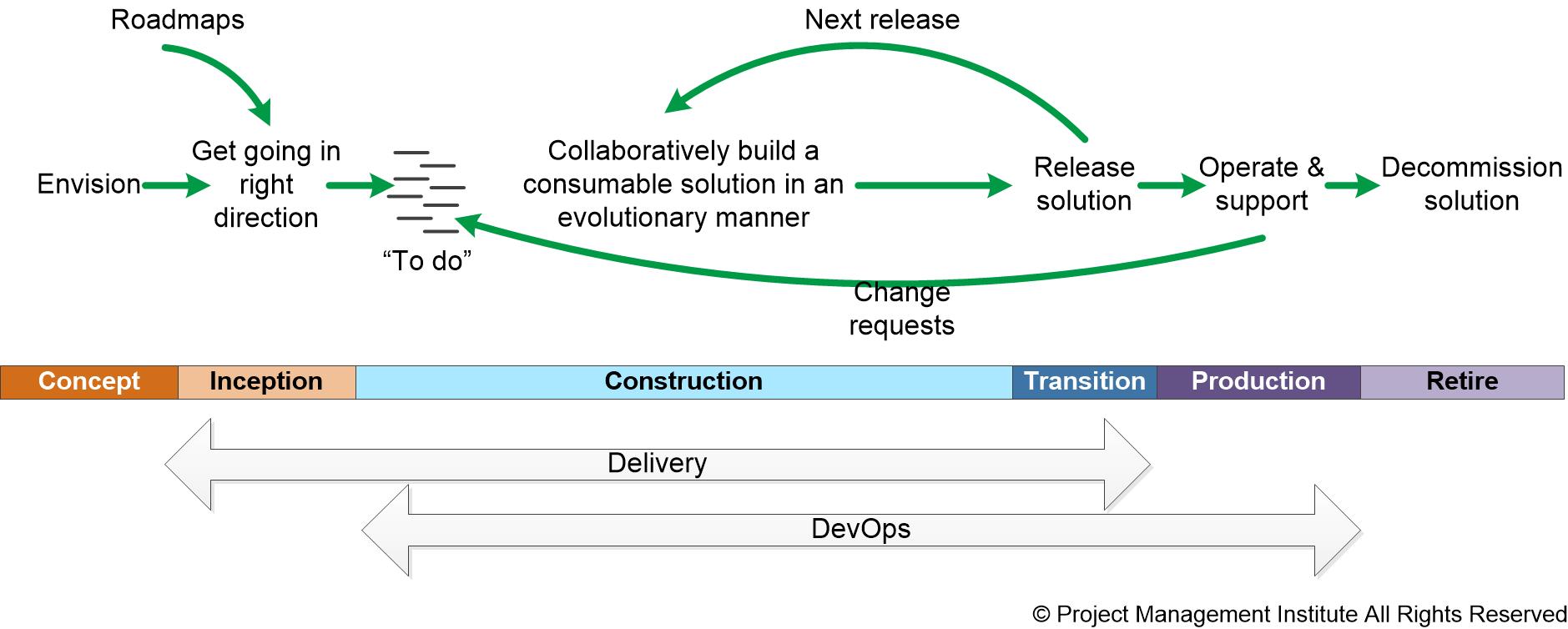
Note that these comments apply to both the basic (Scrum-like) version of the lifecycle as well as the advanced/lean version. Because DAD explicitly recognizes that your process improvement activities will include changes that affect the lifecycle, we don’t enforce a single DAD lifecycle.
|
Posted
by
Scott Ambler
on: June 14, 2012 11:37 AM
|
Permalink |
Comments (0)
| DAD teams focus on producing repeatable results, such as delivering high-quality software which meets stakeholder needs in a timely and cost effective manner. DAD teams do not strive to follow repeatable processes. The observation is that because each DAD team finds themselves in a unique situation, to be most efficient they need to follow a unique process tailored to reflect that situation. That “unique process” may be comprised of a relatively standard lifecycle and common practices such as architecture envisioning, database regression testing, non-solo development, and many others (granted, those practices may be tailored to reflect the situation too). The point is that each team in your organization may follow a different process, albeit processes which share similar components defined by a common process framework, while achieving the results required of them.
This may of course be heresy in some organizations. The danger with “repeatable processes” is that they grow in size over the years to address all possible situations, and as a result address none of them very well. Imagine a project team that is large and has regulatory compliance concerns. This team will tailor its practices accordingly. Now imagine a small team that doesn’t have to address regulatory concerns. An organization focused on repeatable processes might have that team follow the same process that the previous team followed, even though some of the practices had been tailored to meet scaling factors that don’t apply. In other words, the repeatable process included some aspects that were overkill for the second team, thereby impacting their ability to deliver in a timely manner or in a cost efficient manner. In the vast majority of organizations, when given the choice, stakeholders prefer to spend the money wisely and have the solution delivered in a timely manner, not to have the team follow a consistently “repeatable process.”
|
Posted
by
Scott Ambler
on: May 17, 2012 05:37 AM
|
Permalink |
Comments (0)
|
"Forgive your enemies, but never forget their names."
- John F. Kennedy
|




