





Guessing is not a strategy: How to build decision velocity with AI and real-time data
June 10, 2026 | Live Webinar

Disciplined Agile 5.5 Released
Choose Your WoW! Second Edition Is Now Available
Requisite Agility applied in Project Management
Disciplined Agile and PMBoK Guide 7th Edition
#ChoiceIsGood, #ChooseYourWoW, #ConsumableSolution, #ContinuousImprovement, #CoreAgilePractices, #experiment, #Experimentation, #GuidedContinuousImprovement, #Kaizen, #LifeCycles, #ProcessImprovement, #TealOrganizations, Adoption, agile, agile adoption, Agile Alliance, Agile Business Analyst, Agile certification, agile data, agile governance, agile lifecycle, agile metrics, agile principles, agile transformation, Agile2018, Agile2019, Agile20Reflect, AgileData, Analogy, announcement, Architecture, architecture, architecture owner, Articles and publications, Asset Management, Atari, Backlog, Barclays, being agile, benefits, bi, blades, book, Branching strategies, Browser, Business Agility, business intelligence, business operations, capex, Case Study, Certification, certification, charity, Choose your WoW, CMMI, cmmi, Coaching, Collaboration, Communications Management, Compliance, Compliancy, Conference, Construction, Construction phase, Context, Continuous Improvement, coordination, COVID-19, Culture, culture, Cutter, DA, DAD, DAD Book, DAD discussions, DAD press, DAD roles, DAD supporters, DAD webcast, DADay2019, Data Management, database, dependencies, Deployment, Development Strategies, DevOps, disaster, Discipline, discipline, Disciplined Agile, disciplined agile delivery, disciplined agile delivery blog, Disciplined Agile Enterprise, disciplined devops, Documentation, Domain complexity, dw, DW/BI, Energy Healing, Enterprise Agile, Enterprise Architecture, Enterprise Awareness, enterprise awareness, Essence, estimation, Evolving DA, Executive, Experiment, facilitation, FailureBow, feedback-cycle, finance, Financial, FLEX, Flow, foundation layer, Funding, GCI, GDD, Geographic Distribution, gladwell, global development, Goal-Driven, goal-driven, goals, Governance, GQM, Guideline, Hybrid, Improvement, inception, Inception phase, India, information technology, infosec, Introduction, iterations, Kanban, large teams, layer, lean, Lean Startup, learning, Legal Project Management, LeSS, Lifecycle, lifecycle, Manifesto, mark lines, marketing, MBI, Metaphor, Metrics, metrics, mindset, Miscellaneous, MVP, News, News and events, Non-Functional Requirements, non-functional requirements, Non-solo development, offshoring, Operations, opex, Organization, Outsourcing, outsourcing, paired programming, pairing, paper, People, People Management, phases, Philosophies, Planning, PMBoK, PMI, PMI and DA, PMI Chapter, Portfolio Management, post-format-quote, Practices, practices, Principle, Process, process improvement, process tailoring, Product Management, product owner, Product Owners, productivity, Program Management, Project Management, project-initiation, Promise, Quality, quality, rational unified process, Refactoring, Reiki, Release Management, release management, Remote Training, Remote Work, repeatability, requirements, Requirements Management, research&development, responsibilities, retrospectives, Reuse, Reuse Engineering, ride for heart, rights, Risk Management, Risk Management, Risk management, Roles, RUP, SAFe, sales, Scaling, scaling, scaling agile, Scheduled Workshops, SCM, scorecard, Scrum, ScrumMaster, SDLC, Security, security, self-organization, SEMAT, serial, skill, solutions software consumable shippable, Stakeholder Management, strategy, Support, Surveys, Teal organizations, team development, Team Lead, team lead, Teams, Technical Debt, Teleconferencing, Terminology, terraforming, test strategy, testing, time tracking, Tool kit, Toolkit, tools, traditional, Transformation, Transition iteration, transition phase, Uncategorized, Upmentors, Using PMI Standards, value stream, velocity, vendor management, Virtual Training, Workflow, workflow, workspaces


| The Disciplined Agile Delivery (DAD) process framework includes an explicit Inception phase – sometimes called a project initiation phase, startup phase, or iteration/sprint zero – which is conducted before actually starting to build a solution. The goals of this phase include: clarifying the business problem that needs to be solved; identifying a viable technical solution; planning your approach; setting up your work environment and team; and gaining stakeholder concurrence that it makes sense to proceed with investing in the implementation of the chosen strategy. These goals are listed in the following diagram.
In the Disciplined Agile Delivery book we devoted a lot space to describing how to effectively initiate a DAD project. Unfortunately in our experience we have seen many organizations that are still new to agile treat this phase as an opportunity to do massive amounts of upfront documentation in the form of project plans, charters, and requirements specifications. Some people have referred to the practice of doing too much temporary documentation up front on an agile project as Water-Scrum-Fall. We cannot stress enough that this is NOT the intent of the Inception phase. While we provide many alternatives for documenting your vision in Inception, from very heavy to very light, you should take a minimalist approach to this phase and strive to reach the stakeholder consensus milestone as quickly as possible. According to the 2013 Agile Project Initiation survey the average agile team invests about 4 weeks performing project initiation activities, including initial requirements envisioning, initial architecture envisioning, forming the team, initial release planning, and so on. Of course this is just an average, some respondents reported investing less than a week to do so and some reporting investing more than two months – the amount of time required varies depending on the complexity of the effort, your stakeholders’ understanding of their requirements, your team’s understanding of the solution architecture, whether this is a new solution or merely a new release of an existing solution, and many others. If you are spending more than a few weeks on this phase, you may be regressing to a Water-Scrum-Fall approach. It takes discipline to be aware of this trap and to streamline your approach as much as possible. You can do this in several ways:
I think that it’s very clear that the secret to keeping Inception short is to have the discipline to know that you need to invest some time thinking your approach through but that you want to avoid getting bogged down in too many details. You need the discipline to do some planning but not too much. You need the discipline to do some modeling but not too much. You need the discipline to get going in the right direction knowing that the details will come out in time. |
| Whether you like it or not, as you adopt agile you will constrained by the organizational ecosystem, and you need to act accordingly. It takes discipline to work with enterprise professionals such as enterprise architects, data administrators, portfolio managers, or IT governance people who may not be completely agile yet, and have the patience to help them. It takes discipline to work with your operations and support staff in a DevOps manner throughout the lifecycle, particularly when they may not be motivated to do so. Despite the fact that governing bodies such as project management offices (PMOs), architecture and database authorities, and operations may indeed be a source of impediments to your DAD adoption, these authorities serve important functions in any large enterprise. Therefore a disciplined approach to proactively working with them and being a positive change agent to make collaboration with them more effective is required. Although it takes discipline to work in an enterprise aware manner, the payoff can be dramatic. Enterprise architects can help guide your team early in the lifecycle to adopt a viable architecture strategy. Portfolio managers can help to govern your team to ensure that you truly are spending the stakeholder’s investment wisely. Enterprise administators, including data management professionals and operations professionals, can help you to leverage existing legacy assets. These are just a few examples of the potential ways that enterprise professionals can help a DAD team work more effectively. |
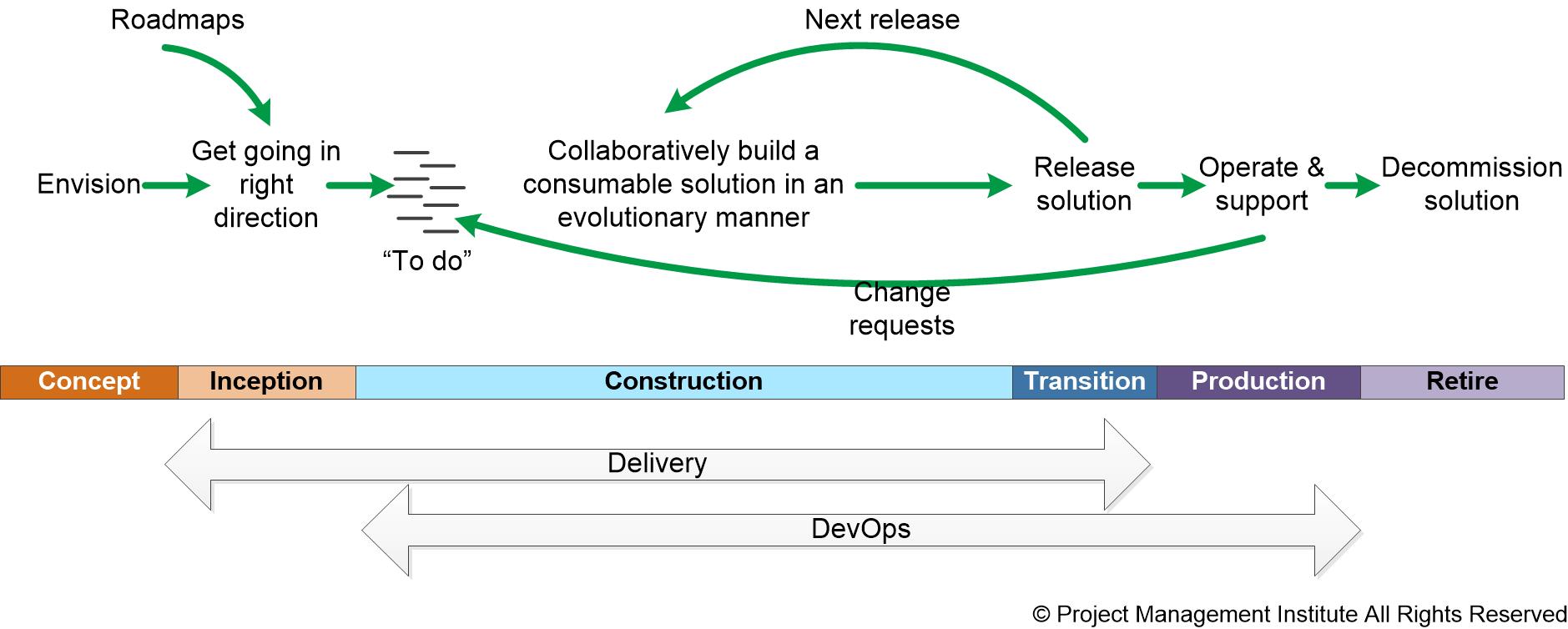
| I was recently asked a question around the scope of the DAD lifecycle and thought that I would share my answer publicly. The focus of DAD is the delivery portion of the solution lifecycle, from initiation to delivery into production (or the marketplace in the case of a commercial product). Any given solution will go through the delivery portion of the lifecycle many times during it’s existence as releases are put into production. BUT, this isn’t the entire solution lifecycle as you in the following figure. For example:
Note that these comments apply to both the basic (Scrum-like) version of the lifecycle as well as the advanced/lean version. Because DAD explicitly recognizes that your process improvement activities will include changes that affect the lifecycle, we don’t enforce a single DAD lifecycle. |
| DAD teams focus on producing repeatable results, such as delivering high-quality software which meets stakeholder needs in a timely and cost effective manner. DAD teams do not strive to follow repeatable processes. The observation is that because each DAD team finds themselves in a unique situation, to be most efficient they need to follow a unique process tailored to reflect that situation. That “unique process” may be comprised of a relatively standard lifecycle and common practices such as architecture envisioning, database regression testing, non-solo development, and many others (granted, those practices may be tailored to reflect the situation too). The point is that each team in your organization may follow a different process, albeit processes which share similar components defined by a common process framework, while achieving the results required of them. This may of course be heresy in some organizations. The danger with “repeatable processes” is that they grow in size over the years to address all possible situations, and as a result address none of them very well. Imagine a project team that is large and has regulatory compliance concerns. This team will tailor its practices accordingly. Now imagine a small team that doesn’t have to address regulatory concerns. An organization focused on repeatable processes might have that team follow the same process that the previous team followed, even though some of the practices had been tailored to meet scaling factors that don’t apply. In other words, the repeatable process included some aspects that were overkill for the second team, thereby impacting their ability to deliver in a timely manner or in a cost efficient manner. In the vast majority of organizations, when given the choice, stakeholders prefer to spend the money wisely and have the solution delivered in a timely manner, not to have the team follow a consistently “repeatable process.” |
| Despite some agilists reluctance to admit that projects go through phases the DAD process framework explicitly recognizes that they do. Building serious solutions requires a lot more than just doing the cool construction stuff. It takes discipline to ignore this rhetoric and frame your project within the scope of a full delivery lifecycle. The Agile (Scrum-based) and Lean (Kanban-based) DAD lifecycles explicitly depict:
Without a doubt construction is an important aspect of the overall Disciplined Agile Delivery process, but it’s not the only aspect. Yes, for many people this is the fun part of delivery, it certainly is for me. But the reality is that as development professionals we need to explicitly consider more than just construction if we’re to be effective. It takes discipline to adopt a broader lifecycle that goes beyond the fun stuff that we would prefer to focus on. |
|
"Only those who have been in the frying pan are really qualified to talk about the heat." - Winston Churchill |