






Guessing is not a strategy: How to build decision velocity with AI and real-time data
June 10, 2026 | Live Webinar

Disciplined Agile 5.5 Released
Choose Your WoW! Second Edition Is Now Available
Requisite Agility applied in Project Management
Disciplined Agile and PMBoK Guide 7th Edition
#ChoiceIsGood, #ChooseYourWoW, #ConsumableSolution, #ContinuousImprovement, #CoreAgilePractices, #experiment, #Experimentation, #GuidedContinuousImprovement, #Kaizen, #LifeCycles, #ProcessImprovement, #TealOrganizations, Adoption, agile, agile adoption, Agile Alliance, Agile Business Analyst, Agile certification, agile data, agile governance, agile lifecycle, agile metrics, agile principles, agile transformation, Agile2018, Agile2019, Agile20Reflect, AgileData, Analogy, announcement, Architecture, architecture, architecture owner, Articles and publications, Asset Management, Atari, Backlog, Barclays, being agile, benefits, bi, blades, book, Branching strategies, Browser, Business Agility, business intelligence, business operations, capex, Case Study, Certification, certification, charity, Choose your WoW, CMMI, cmmi, Coaching, Collaboration, Communications Management, Compliance, Compliancy, Conference, Construction, Construction phase, Context, Continuous Improvement, coordination, COVID-19, Culture, culture, Cutter, DA, DAD, DAD Book, DAD discussions, DAD press, DAD roles, DAD supporters, DAD webcast, DADay2019, Data Management, database, dependencies, Deployment, Development Strategies, DevOps, disaster, Discipline, discipline, Disciplined Agile, disciplined agile delivery, disciplined agile delivery blog, Disciplined Agile Enterprise, disciplined devops, Documentation, Domain complexity, dw, DW/BI, Energy Healing, Enterprise Agile, Enterprise Architecture, Enterprise Awareness, enterprise awareness, Essence, estimation, Evolving DA, Executive, Experiment, facilitation, FailureBow, feedback-cycle, finance, Financial, FLEX, Flow, foundation layer, Funding, GCI, GDD, Geographic Distribution, gladwell, global development, Goal-Driven, goal-driven, goals, Governance, GQM, Guideline, Hybrid, Improvement, inception, Inception phase, India, information technology, infosec, Introduction, iterations, Kanban, large teams, layer, lean, Lean Startup, learning, Legal Project Management, LeSS, Lifecycle, lifecycle, Manifesto, mark lines, marketing, MBI, Metaphor, Metrics, metrics, mindset, Miscellaneous, MVP, News, News and events, Non-Functional Requirements, non-functional requirements, Non-solo development, offshoring, Operations, opex, Organization, Outsourcing, outsourcing, paired programming, pairing, paper, People, People Management, phases, Philosophies, Planning, PMBoK, PMI, PMI and DA, PMI Chapter, Portfolio Management, post-format-quote, Practices, practices, Principle, Process, process improvement, process tailoring, Product Management, product owner, Product Owners, productivity, Program Management, Project Management, project-initiation, Promise, Quality, quality, rational unified process, Refactoring, Reiki, Release Management, release management, Remote Training, Remote Work, repeatability, requirements, Requirements Management, research&development, responsibilities, retrospectives, Reuse, Reuse Engineering, ride for heart, rights, Risk Management, Risk Management, Risk management, Roles, RUP, SAFe, sales, Scaling, scaling, scaling agile, Scheduled Workshops, SCM, scorecard, Scrum, ScrumMaster, SDLC, Security, security, self-organization, SEMAT, serial, skill, solutions software consumable shippable, Stakeholder Management, strategy, Support, Surveys, Teal organizations, team development, Team Lead, team lead, Teams, Technical Debt, Teleconferencing, Terminology, terraforming, test strategy, testing, time tracking, Tool kit, Toolkit, tools, traditional, Transformation, Transition iteration, transition phase, Uncategorized, Upmentors, Using PMI Standards, value stream, velocity, vendor management, Virtual Training, Workflow, workflow, workspaces


|
We recently recorded a short discussion between Sunil Prashara, CEO of PMI; Dave Garrett, VP of Corporate Development and Innovation at PMI; and Mark Lines, co-creator of Disciplined Agile and now VP of Disciplined Agile at PMI. In the audio recording, which you can find at Quick Podcast on PMI’s Disciplined Agile Acquisition, they share their thoughts about four interesting questions:
There’s a lot more goodness to come! |

At the Agile 2019 conference in DC I facilitated a workshop with about 70 people where we explored the topic of how do you coach an agile data warehousing (DW)/business intelligence (BI) team. To do this we worked through four issues:
The basic strategy was to introduce the issues to the class one at a time, then at their tables they would discuss the issue and write up to five ideas on sticky notes, then we’d share the ideas. Pictures of the flipcharts for each issue follow below. After the groups shared their ideas I then shared my thoughts with the class. Issue #1: What Challenges Do You Face Coaching DW/BI Teams?As you can see the class identified a lot of the classic issues that agile coaches face in general, such as trust issues, the teams being management-driven instead of self organizing, lack of agile skills within the team, cross-team dependencies, and being overwhelmed with work. Certainly there were DW/BI flavours of common problems, such as how to do vertical slices of DW/BI functionality and which lifecycle (agile, lean, CD, …) to follow. But there were also DW/BI specific issues, such as lack of access to data sources, knowing the actual data, and DW/BI architecture and design strategies. These DW/BI specific issues are where agile coaches tend to get hung up. 
In my discussion of the challenges that we face when coaching agile DW/BI teams I shared my thoughts on the cultural impedance mismatch that exists between the agile and data communities. This mismatch makes it a bit more difficult to engage with data teams as opposed to application development teams. I also shared results of studies (2009, 2013,2016, 2018) around data quality challenges and practices – it is certainly common for teams to have to deal with technical debt, but data technical debt is both different in nature than code quality debt and the traditional data culture has led them down a very questionable (read dysfunctional) path regarding quality practices. Issue #2: What Skills/Knowledge Does an Agile DW/BI Coach Require?The second issue that we explored was what skills/knowledge does an agile DW/BI coach need. Once again the groups identified both classic agile coaching ideas as well as DW/BI specific ideas. Clearly you need coaching skills in order to coach a DW/BI team. But you also need to be knowledgeable about critical skills such as data modeling, data analysis, database testing, database refactoring, and others. You might not be an expert at these things, but you need to know of them and be able to guide the team in their adoption. You’ll also need to be able to speak intelligently about why some of the traditional strategies that they likely hold near and dear to their hearts (remember the cultural impedance mismatch) need to be abandoned for better, more effective strategies. 
In my discussion I overviewed the “agile database techniques stack,” a collection of agile strategies and practices for database development. The stack is:
As you can see, this list of techniques is fairly common from an agile point of view, albeit the corresponding data(base) versions of those techniques. The point is that the techniques exist that enable data professionals to work in an agile, and far more effective, manner. As a coach you will need to be aware of these strategies and be able to help your DW/BI team adopt them. And of course there are agile data management strategies that you need to be aware of as well. Issue #3: What Strategies Should You Use To Engage Successfully With An Agile DW/BI Team?The groups identified a collection of great strategies for engaging with DW/BI teams. Once again there were a lot of standard coaching strategies, a DW/BI team is still a group of people after all, but there was also a focus on strategies to address the DW/BI challenges identified earlier. 
The discussion that followed the sharing of the stickies a very interesting point was brought up. I had earlier stated that my experience with coaching DW/BI teams was that it was different than coaching other types of teams, mostly because of the cultural impedance mismatch. A handful of agile DW/BI coaches in the audience disagreed with that, pointing out that the critical issue was gaining the trust and respect of the team at the start. This is true of any team, and certainly true of DW/BI teams. To do this you need to understand and appreciate the issues that they deal with and be able to show that you know how to guide them through addressing their issues. You might not be an expert in the techniques of the agile database technique stack, or other important agile data techniques, but you do know of them and can help the team learn them. So yes, engaging with an agile DW/BI team is no different on the surface, but it does require the coach to have different skills and knowledge than what your typical agile coach has. Issues #4: What Are The Qualities You Should Look For In An Agile DW/BI Coach?For this exercise I pretty much asked the groups to put together a list of qualities for a job ad for an Agile DW/BI coach. This is what they came up with. 
Our LearningsHere are our main learnings regarding coaching an agile DW/BI team:
|
|
As you have likely heard, the Project Management Institute (PMI) has purchased Disciplined Agile (DA). Since the announcement we’ve received a very large number of congratulatory messages (thank you for that!) and quite a few queries around where we’re going with all of this. We’ve decided to start this FAQ to address the common queries that we’re getting. This FAQ will evolve over the next few weeks as we receive queries as well as when our answers themselves evolve. We address the following questions in this FAQ:
Why did you do this?We want to bring Disciplined Agile (DA) to the next level and we need a partner to do this. For years we have pointed to PMI as a respectable organization that has done a very good job at educating and certifying their membership in their body of knowledge (BoK) in a disciplined way. We like to think that Disciplined Agile has done something similar albeit on a smaller scale. As a small Canadian company, DA has grown quickly and organically, but not as fast as its potential. With the PMI acquisition, we have immediate reach into thousands of companies around the world that will appreciate DA’s agnostic, pragmatic, and context-based approach to enterprise agility. Regardless of traditional or agile approaches, project or product, PMI now has guidance to help organizations and teams be more successful. You might find that the Quick Podcast on PMI’s Disciplined Agile Acquisition to be an interesting thing to listen to. Are Scott and Mark sticking around?Yes! We’re looking forward to working with PMI for many years to come to evolve and make Disciplined Agile (DA) even more successful in the marketplace. The short story is that the two of us are continuing in our existing roles, albeit with significant help to do so now. Mark will be the Vice President of Disciplined Agile and I will be Vice President and Chief Scientist of Disciplined Agile. Since we now work for a not-for-profit organization, we will however be cutting back on the consulting services that we provided in the past. We will still be in the field as we continue to learn from agile organizations about what ways of work are effective in different contexts, but our key focus will be on enhancing the DA content, and supporting and growing our membership and partners. How do you see the Certified Partner program changing?It will continue to expand. We see a huge demand for DA Certified agilists and Partners. In fact, even prior to this acquisition we are getting an increased level of inquiries into how to find local partners and certified DA practitioners and coaches to help roll out DA. Given that we will be cutting back on these services we are already handing customer leads to existing partners. If you are a services company we recommend that you look into the partner program. We will also certify more DA instructors and are introducing a train-the-trainer program. The requirement will be that you are a CDAC with significant teaching experience. How does this affect my current certification(s)?It doesn’t. All existing certifications will be fully supported going forward. We will be enhancing the program in the future, all for the better. As you know, both DA and PMI have always believed that certifications should be earned and they should be meaningful. That isn’t going to change. Should I still be moving forward on a new certification?Yes. Please see above. The DA certifications build upon one another, so if you’re in the process of moving to CDAP from CDA, or CDAI/CDAC from CDAP, then please continue working on doing so. Where are you going with the DA toolkit?We’re going to get back to you on this. What we can tell you now is that we will accelerate a few changes that were already on the roadmap, improve the consumability of the toolkit, and flesh out the toolkit even further. Having the resources of the PMI behind us will be very good for DA itself. We are certainly going to continue with our pragmatic and agnostic approach to helping you to choose your way of working (WoW). From the very beginning the DA toolkit put practices and strategies from a wide range of sources, including agile, lean, and traditional sources. Contrary to what the purists may want you to believe, there are great ideas for improving your WoW coming out of all of the various “camps,” not just the agile camp. The aim of the DA toolkit is to help you to better understand your options. Will DADay2019 be affected?DADay2019 will not be affected at all. The only potential change is the content that we will share to kick off the event. Our plan was always to give you an update around where we are and where we’re heading. With PMI behind us now our timelines are accelerating. Will the Next PMP Exam Update Cover Disciplined Agile?No. The next update for the PMP exam is scheduled for December 2019. The questions have been baselined already. Is there a conspiracy?No, but that’s exactly what you’d expect us to say, isn’t it? Bwa ha ha ha ha! Seriously though, we have seen a few postings online about how this is all some sort of nefarious plot. Don’t get us wrong, we love conspiracy theories (particularly Scott) and we’d love to hear what you’ve got. BUT we’re going to ask you to up your game because as you know all good conspiracy theories involve one or more of Area 51, The Illuminati, Sasquatch, a secret dark government agency, the 1%, or Vladimir Putin. So we’re looking forward to any theories you may want to share – which is probably all part of our overall strategy to distract you from what we’re really plotting. – Scott Ambler and Mark Lines |
 We are excited to announce that the Project Management Institute (PMI) has acquired Disciplined Agile. The official announcement is posted here. In the coming weeks we will have more information for you, so please stay tuned! |
|
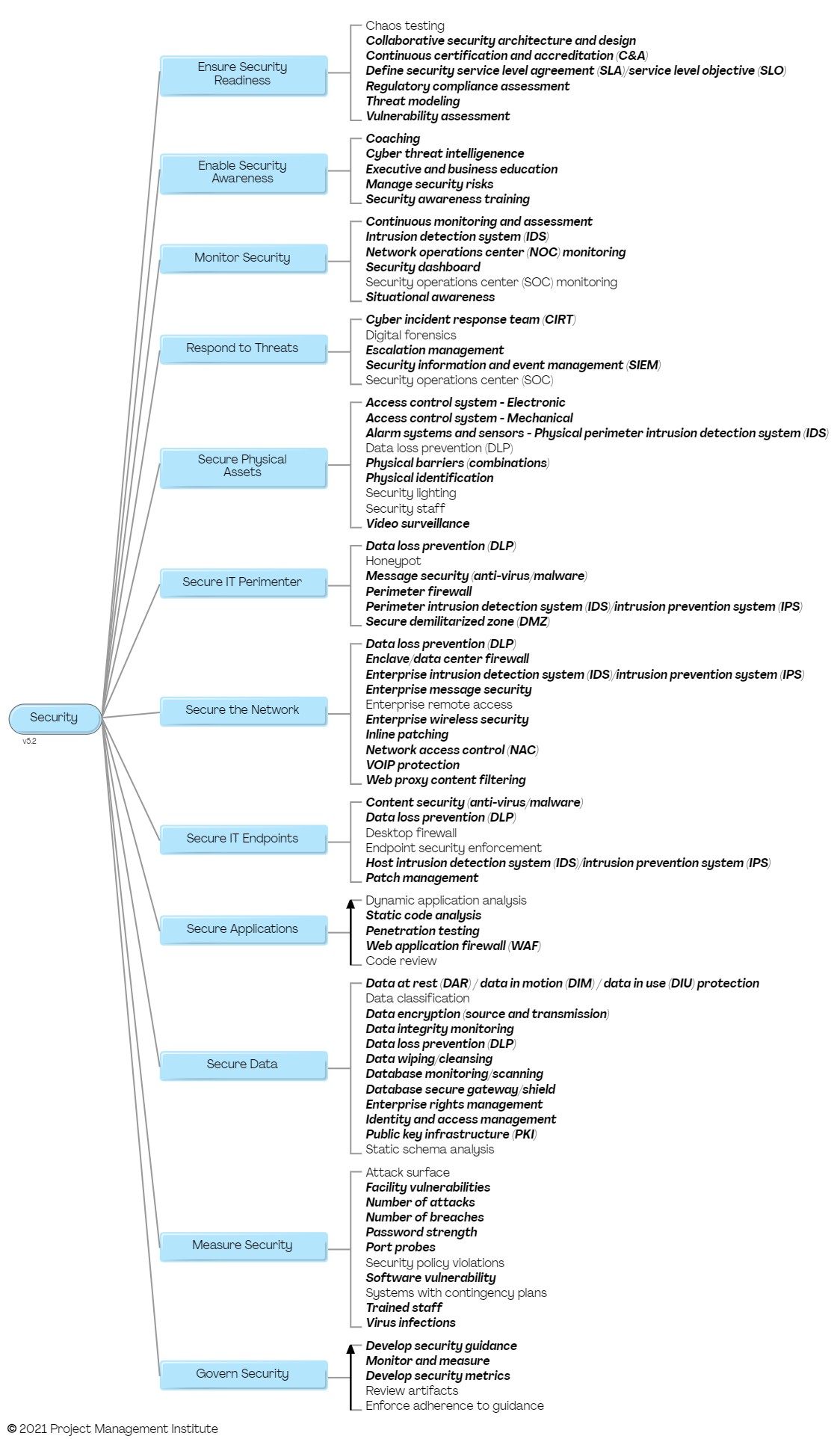
Security is one of the process blades of Disciplined DevOps. The focus of the Security process blade is to describe how to protect your organization from both information/virtual and physical threats. This includes procedures for security governance, identity and access management, vulnerability management, security policy management, incident response, and vulnerability management. As you would expect these policies will affect your organization’s strategies around change management, disaster recovery and business continuity, solution delivery, and vendor management. For security to be effective it has to be a fundamental aspect of your organizational culture. The following process goal diagram overviews the potential activities associated with disciplined agile security. These activities are performed by, or at least supported by, your security (often called an information security or infosec) team. Figure 1. The Security process goal diagram (click to enlarge).
The process factors that you need to consider for implementing effective security are:
Further Reading
|
|
I hate music, especially when it's played. - Jimmy Durante |