






Guessing is not a strategy: How to build decision velocity with AI and real-time data
June 10, 2026 | Live Webinar

Disciplined Agile 5.5 Released
Choose Your WoW! Second Edition Is Now Available
Requisite Agility applied in Project Management
Disciplined Agile and PMBoK Guide 7th Edition
#ChoiceIsGood, #ChooseYourWoW, #ConsumableSolution, #ContinuousImprovement, #CoreAgilePractices, #experiment, #Experimentation, #GuidedContinuousImprovement, #Kaizen, #LifeCycles, #ProcessImprovement, #TealOrganizations, Adoption, agile, agile adoption, Agile Alliance, Agile Business Analyst, Agile certification, agile data, agile governance, agile lifecycle, agile metrics, agile principles, agile transformation, Agile2018, Agile2019, Agile20Reflect, AgileData, Analogy, announcement, Architecture, architecture, architecture owner, Articles and publications, Asset Management, Atari, Backlog, Barclays, being agile, benefits, bi, blades, book, Branching strategies, Browser, Business Agility, business intelligence, business operations, capex, Case Study, Certification, certification, charity, Choose your WoW, CMMI, cmmi, Coaching, Collaboration, Communications Management, Compliance, Compliancy, Conference, Construction, Construction phase, Context, Continuous Improvement, coordination, COVID-19, Culture, culture, Cutter, DA, DAD, DAD Book, DAD discussions, DAD press, DAD roles, DAD supporters, DAD webcast, DADay2019, Data Management, database, dependencies, Deployment, Development Strategies, DevOps, disaster, Discipline, discipline, Disciplined Agile, disciplined agile delivery, disciplined agile delivery blog, Disciplined Agile Enterprise, disciplined devops, Documentation, Domain complexity, dw, DW/BI, Energy Healing, Enterprise Agile, Enterprise Architecture, Enterprise Awareness, enterprise awareness, Essence, estimation, Evolving DA, Executive, Experiment, facilitation, FailureBow, feedback-cycle, finance, Financial, FLEX, Flow, foundation layer, Funding, GCI, GDD, Geographic Distribution, gladwell, global development, Goal-Driven, goal-driven, goals, Governance, GQM, Guideline, Hybrid, Improvement, inception, Inception phase, India, information technology, infosec, Introduction, iterations, Kanban, large teams, layer, lean, Lean Startup, learning, Legal Project Management, LeSS, Lifecycle, lifecycle, Manifesto, mark lines, marketing, MBI, Metaphor, Metrics, metrics, mindset, Miscellaneous, MVP, News, News and events, Non-Functional Requirements, non-functional requirements, Non-solo development, offshoring, Operations, opex, Organization, Outsourcing, outsourcing, paired programming, pairing, paper, People, People Management, phases, Philosophies, Planning, PMBoK, PMI, PMI and DA, PMI Chapter, Portfolio Management, post-format-quote, Practices, practices, Principle, Process, process improvement, process tailoring, Product Management, product owner, Product Owners, productivity, Program Management, Project Management, project-initiation, Promise, Quality, quality, rational unified process, Refactoring, Reiki, Release Management, release management, Remote Training, Remote Work, repeatability, requirements, Requirements Management, research&development, responsibilities, retrospectives, Reuse, Reuse Engineering, ride for heart, rights, Risk Management, Risk Management, Risk management, Roles, RUP, SAFe, sales, Scaling, scaling, scaling agile, Scheduled Workshops, SCM, scorecard, Scrum, ScrumMaster, SDLC, Security, security, self-organization, SEMAT, serial, skill, solutions software consumable shippable, Stakeholder Management, strategy, Support, Surveys, Teal organizations, team development, Team Lead, team lead, Teams, Technical Debt, Teleconferencing, Terminology, terraforming, test strategy, testing, time tracking, Tool kit, Toolkit, tools, traditional, Transformation, Transition iteration, transition phase, Uncategorized, Upmentors, Using PMI Standards, value stream, velocity, vendor management, Virtual Training, Workflow, workflow, workspaces


 We are excited to announce that the Project Management Institute (PMI) has acquired Disciplined Agile. The official announcement is posted here. In the coming weeks we will have more information for you, so please stay tuned! |
|
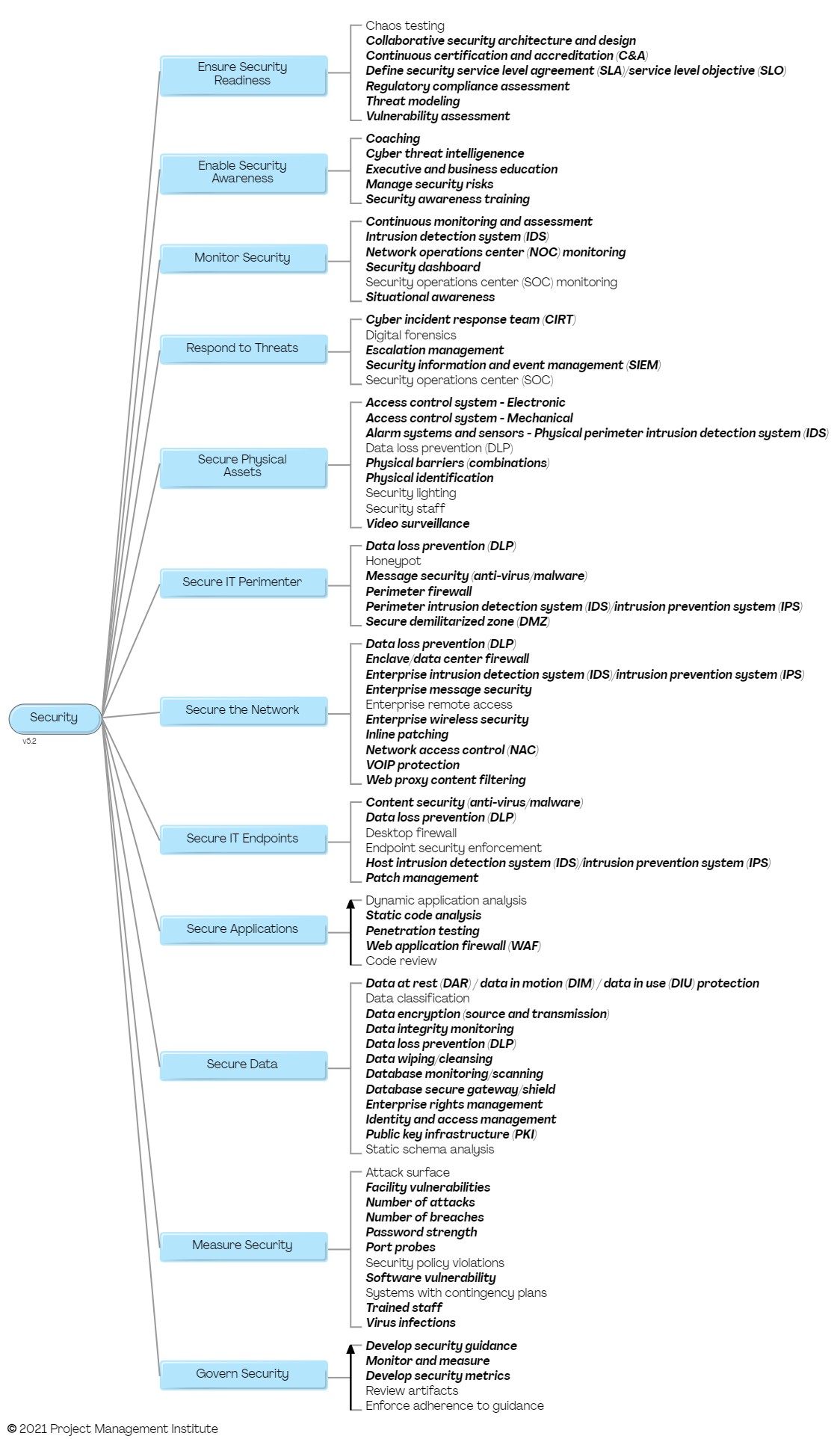
Security is one of the process blades of Disciplined DevOps. The focus of the Security process blade is to describe how to protect your organization from both information/virtual and physical threats. This includes procedures for security governance, identity and access management, vulnerability management, security policy management, incident response, and vulnerability management. As you would expect these policies will affect your organization’s strategies around change management, disaster recovery and business continuity, solution delivery, and vendor management. For security to be effective it has to be a fundamental aspect of your organizational culture. The following process goal diagram overviews the potential activities associated with disciplined agile security. These activities are performed by, or at least supported by, your security (often called an information security or infosec) team. Figure 1. The Security process goal diagram (click to enlarge).
The process factors that you need to consider for implementing effective security are:
Further Reading
|
 Mark Lines and I edited a special issue of the Cutter Business Journal in 2018 entitled A Disciplined Agile Approach to Business Agility which can be downloaded free of charge. It contains several articles. Itamae, the Agile Organization, and You by John HoganHogan shares some insights on delighting customers. He argues for a customer-focused organizational structure, with Agile teams supported by Agile leadership. Hogan describes the importance of goal setting to focus on delighting customers, supported by incremental planning and delivery to do so. He works through the implications for:
The Agile Enterprise and the Division of Labor by Gene CallahanGene Callahan has some great advice for building awesome people. Beginning with the idea of the division of labor, Callahan walks us through the history of how traditional organizations find themselves as a collection of specialists who struggle to be responsive to the changing marketplace. He then examines the need for people who are generalizing specialists (people who can collaborate effectively and learn from one another). The Necessities for Successful Enterprise Agile Transformation by Matthew Ganis and Michael AckerbauerThis article describes how to build awesome teams. You want to be Agile (of course!) and adopt Agile practices. Awesome teams have the skills and resources to fulfill their mission and include the right mix of personalities. The authors argue that the organization is really a “team of teams” that needs a shared purpose and way of working to make the abstract concrete. According to them, awesome teams build on a common foundation based on the concept of Breakthrough Thinking/diversity of thought. Business Agility: A Roadmap for the Digital Enterprise by Jaco ViljoenIn his discussion of the five levels of a digital business ecosystem (DBE), Jaco Viljoen explores the idea that“choice is good because context counts.” The five levels, each with its own set of capabilities that build one on top of another, are: waterfall/traditional, hybrid Agile (a combination of waterfall and Agile), regular delivery, continuous delivery, and continuous exploration. The five DBEs provide insight into which process-building blocks to apply. Viljoen also discusses using a frame- work to achieve business agility at scale. Case Study: Linking Business Workflows and Agile User Stories in an SOA Environment by Gill Kent and Robin HarwoodGill and Robin provide a case study about linking Business Process Model and Notation (BPMN) workflows and user stories. They focus on the importance of initial modeling during what they call the Discovery phase of a digital trans-formation project. In their example, they followed a pragmatic, Agile approach to modeling the business and their host systems to gain important insight into the enterprise transformation scope and a vision of the required system change for their endeavor. This enabled them to establish a business/stakeholder vision that captured a clear scope for the following phases. With an initial technical strategy/architecture identified, the team was able to name a backlog of architecturally relevant stories, mitigating the risk of late identification of system integration requirements and the potential for significant rework. In short, a pragmatic investment in initial modeling and planning paid off in huge divi-dends for their Agile team. The Wizard of OSS: Follow the Open Space and Sociocracy Road to Enterprise Agile Transformation by Jutta Eckstein and John BuckThe principle of enterprise awareness appears in several of the articles, and Jutta Eckstein and John Buck walk us through an enterprise-aware approach that helps optimize the process flow of value streams. The authors show how to apply “Open Space” and “Sociocracy” to support enterprise Agile transformation. Open Space is a technique where everyone is invited to put forward ideas that they’re passionate about; if there is enough interest in the idea people will get behind it and make it happen. Sociocracy is a form of democracy for use in organizations, building feedback mechanisms into the organizational structure itself that ensure every voice is heard. Both strategies promote enterprise awareness, increasing collaboration between people in what would normally be disparate parts of the organization and helping optimize flow as the situation evolves. Core Thinking Patterns for Lean/Agile Organizations by Srinivas GarapatiThis article explores important philosophies and the mindset behind Agile and Lean. He starts with the thinking patterns required to be successful and then considers the nature of an Agile organization and finishes with strategies for organizational design. |
 The Institution of Engineering and Technology has recently published a paper entitled An Academic Approach to Transform Organizations One Engineer at a Time by Eduardo Juarez Pineda, Rocio Aldeco-Perez, and Jose Manuel Velazquez. The DA toolkit features in this paper so I thought you’d be interested. Paper Abstract: Every year software development industry requires a higher number of trained software engineers who are not only skilled programmers but also talented software projects managers. To deliver high quality software projects, engineers require of the application of sound engineering competencies along with discipline. Obtaining those practices usually require years of experience. Companies are not prepared to invest this time on engineers resulting in a high percentage of deficient projects. In this paper we present a bachelor level competency-based approach that develops and evaluates such competencies during a challenge-based learning experience. In this way, the rate of successful projects where software engineers are involved will be higher, as they have obtained the appropriate competencies to deliver such projects. |
|
I recently read the book 8-Bit Apocalypse: The Untold Story of Atari’s Missile Command by Alex Rubens. One of my hobbies is to collect, and of course work with, Atari 8-bit computers (such as the Atari 800) and peripherals. I heard about this book on an Atari discussion forum so thought that I’d read it. The story behind Missile Command itself is definitely interesting. For agilists the book covers some history about Atari’s culture and way of working (WoW) that provides some interesting background about Silicon Valley in the late 70s. This short blog explores both of these topics. The Missile Command StoryDave Theurer was the lead developer on Missile Command, working with Rich Adam (who went on to develop Gravitar) to do so. Although the game is long in the tooth now, it was incredibly innovative at the time using bright colours and a track ball. At the time Pong was leading edge, although new games were emerging that used colour and the joysticks and buttons that were soon to become ubiquitous in arcade machines. 
An interesting aspect of the Missile Command story was that it was developed at the height of the cold war, with the threat of nuclear armageddon hanging over everyone’s heads. Dave wanted to send a message that there was no winner in a nuclear war. This message was implicit throughout the game in that there was no way to win, all you could do was stave off the inevitable. Instead of ending with “Game Over” as other games did at the time, it ended with “The End.” These subtleties were often missed by players who were more interested in being entertained than being educated, but some people did receive the message. A game that did more than merely keep you entertained for a few minutes was also an important aspect of Missile Command’s innovativeness. How Agile Was Atari?In the late 70s and early 80s Atari was the company to work at in Silicon Valley. For every open job position they received hundreds of resumes, not unlike some of the leading firms today. Atari had a work hard, play hard culture that we still see today at many Silicon Valley firms. Atari employees did not work at a sustainable pace, and in fact the book goes into detail about the health problems Dave Theurer suffered from as a result of the stress and overwork. So in that respect Atari was far from being an agile company. Many employees dealt with the Atari culture through the use of drugs. In fact some of the mythology surrounding Atari is that the employees managed to stave off an acquisition by IBM by openly smoking Cheech & Chong quantities of marijuana the day the IBM executives toured the Atari facilities. On the positive side of things the development teams were allowed to work autonomously, getting support from other groups for testing, marketing, and deployment as needed. Remember that they were building physical arcade game machines, and were on the leading edge at the time and were creating a multi-billion dollar industry. Development of the machine required a holistic design approach because the team was developing the game software, the hardware it ran on, and even the design of the artwork for the arcade cabinet. Atari development teams were very aware of the overall design, realizing that the look and sound of the machine were key to attracting people to play, whereas the actual gameplay itself was key to keeping people coming back. Given the level of competition in arcades, it was a lot harder to earn the quarters of the players than you would think. Development proceeded incrementally. The team would build something, test it internally with their own people, and once they thought it was ready they would take it to one or more local arcades to test their game in the field. To do so they would basically take a test machine to an arcade, plug it in, and watch what happened. Atari had people in the arcades observing players with the games under test, and often talking with them about a game after they played it. Very often the developers of a game would go out in the field to be actively involved in this testing. This gave them critical insight into whether people liked a game and what aspects they (didn’t) like about it. They would then act on this feedback and update their game. The book describes how Missile Command went through a series of such iterations until they finally homed in on the final version. Very similar to the Exploratory lifecycle and experimenting through a series of minimum viable products (MVPs). Atari developers inherently knew that for a game to succeed that it had to delight its customers – if not the player would move on with their fistful of quarters and play another game. For Atari as a company to succeed they had to continuously release new games that delighted customers because Atari wasn’t the only company competing in this market space. You can’t possible blog about Atari without mentioning that Steve Jobs was one of Atari’s early employees. And yes, he was a total jerk then too. Another important part of Atari mythology is how Atari paid Steve Jobs to develop a circuit board for the game Breakout which he then outsourced most of the work to Steve Wozniak, without telling Woz about the hefty delivery bonus associated with the work (which Jobs kept). Parting ThoughtsYes, I’ve been looking for a reason to blog about Atari for awhile. 8-Bit Apocalypse is in fact a good read and there is some very interesting history surrounding Atari. I hope you enjoyed this blog. Recommended Reading About Atari
|
|
"If a man does only what is required of him, he is a slave. If a man does more than is required of him, he is a free man." - Chinese Proverb |