


Research shows that appreciation – as measured by the VIA character strength[1] of appreciation of beauty and excellence – is not used a great deal at work.[2] It is often associated with appreciating nature, art, or skillful performances. And it is that last definition that is useful in teams in the workplace.
Subtly different than gratitude[3] which is about being thankful, appreciation is the strength that allows us to see and name the skills, values, and contributions of people around us. It is a strength that makes calling out the contribution of a colleague more comfortable. And yet we don’t use it much at work.
The strange thing is that it is not an uncommon top strength – some research suggests that 4 out of 10 of us rank it as a top strength! Maybe we just don’t think to use it in the workplace. The same is often true of love – but that is another story!
Checking in on your sense of appreciation
When was the last time you took a stakeholder aside and thanked them for their contribution? Maybe you are good at thanking people – after all research shows that Gratitude is a top strength for about 25% of us[4].
When was the last time you told them why you are thanking them? Explaining what it is specifically that they bring to the table? Telling them in enough detail that they can repeat the behavior in the future and make it a permanent fixture in their project contributions. If it was recent that is great. But all too often, we go through the day on autopilot, taking in stride the contribution from colleagues. We are all too quick to notice when someone is not giving us what we want or need on a project, but when people do what we think they are supposed to, we tend to take it for granted. We may give a quick “thanks” to someone who has delivered on something
It starts with you
We do the same thing with ourselves. I often speak with groups and train people about character strengths. They are one of the triumvirate of strengths that when working well together put us in what Dr Neal Mayerson of the VIA Institute on Character calls, “the Power Zone”[5]. The other two prongs are Talents and Skills. When we take our talents, build them with training and practice into skills and then add in our character strengths – those internal motivators that give us a sense of connection to what we are doing. This triangle of personal attributes – not unlike the talent triangle of leadership, strategic and technical skills in project management – creates our own capacity to excel.
The other topic we explore I talk about is strengths- blindness. Research shows that 66% of us are strengths blind we don’t actually know what we bring to the table[6]. Often, the attributes that others find most remarkable – and most beneficial – about us we don’t even recognize as special, unusual or note-worthy. One of my coaching clients described her strengths of self-regulation (unusual as a high strength), prudence – the planning strength – and teamwork as boring! And yet her team described her as present, even- tempered and easy to work with. Are they talking about the same strengths? Yes, they are!
Two steps to full appreciation:
Step 1 is to appreciate the contribution YOU make. You can take the free VIA strengths assessment here: http://PMcom.pro.viasurvey.org
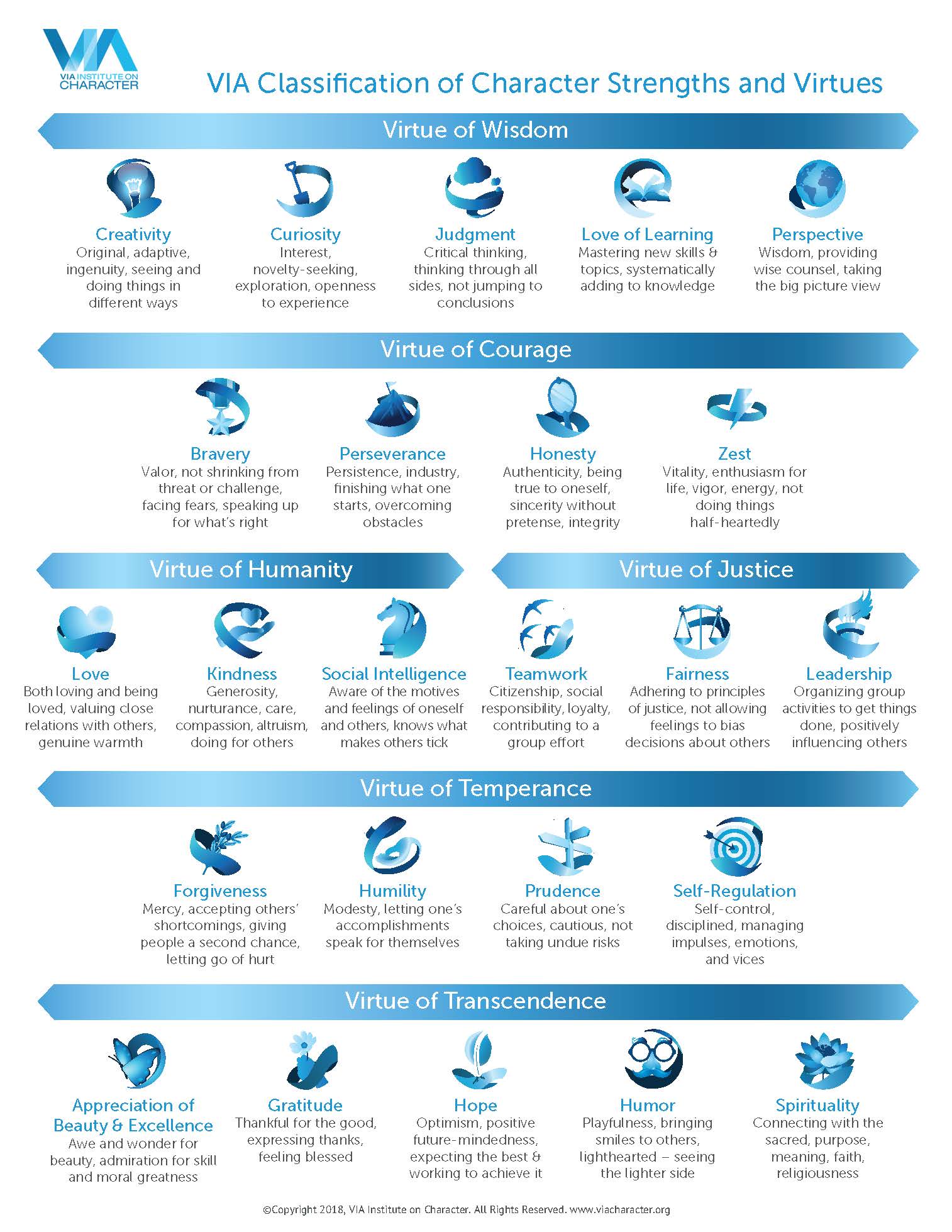
Or you can take a look at the strengths sheetbelow and just circle the top 5 that strike a chord with you.
Now watch out for them each day. For example, my top strengths are Appreciation, Bravery, Curiosity, Fairness & Gratitude.
In a typical day, they show up like this:
Appreciation – I take a walk in the morning and take in the nature around me and appreciate the silliness of my dog. I look out for people going the extra mile and express my appreciation whenever I can (I also express my dismay when people don’t seem be doing what they are meant to be doing!)
Bravery – I try to push myself to do something outside my comfort zone on a regular basis. I write a post about a new topic or make a call to a new person.
Curiosity – I allow myself to read about new topics, explore new ideas, and get perspective from new people. I also have to manage my curiosity so that I don’t go down rabbit holes!
What are your top strengths?
Make a note for the next 7 days of how each of your strengths show up now that you know about them.
Which ones are a surprise?
Which ones do you sometimes overdo?
Which ones take a back seat at work? Where do they show up strong and present?
Next time in Building a Culture of Appreciation, we will explore expressing appreciation of others!
Strengths list with descriptions – reproduced with kind permission:
[1] Peterson, C., & Seligman, M. E. (2004). Character strengths and virtues: A handbook and classification. Oxford: Oxford University Press. 537-551
[2] Money, K., Hillenbrand, C., & Camara, N. D. (2008). Putting positive psychology to work in rganizations. Journal of General Management, 34 (2), 21-26.
[3] Character Strengths & Virtues 553-568
[4] TECHNICAL REPORT The VIA Assessment Suite for Adults ... (n.d.). Retrieved from https://www.viacharacter.org/www/Portals/0/2017 VIA Assessment Suite Technical Report.pdf
[5] http://www.viacharacter.org/blog/characterizing-workplace-using-character-strengths-create-sustained-success/
[6] Linley, A. (2008), Average to A+: Realising strengths in yourself and others. Coventry, UK: CAPP Press


 Community Champion




