The best ideas show up after the 'dip'
From the Transformation & Leadership - Insider Tips Blog
by Jeffrey Martinez,
Nic Jain, Aung Sint

Today's world is influenced by change. Project managers and their organizations need to embrace and sometimes drive changes to keep up with the pace in highly competitive environments. In this blog, experienced professionals share their experiences, tips and tools to manage and exploit changes and take advantage of them. The blog is complimentary to the webinar series of the Change Management Community Team and is managed by the same individuals.
View Posts By:
Jeffrey Martinez
Nic Jain
Aung Sint
Past Contributors:
Luisa Cristini
Rob Bogue
Angela Montgomery
Carole Osterweil
Ruth Pearce
Amrapali Amrapali
John ORourke
Kavitha Gunasekaran
Ronald Sharpe
Ross Wirth
Steve Salisbury
Ryan Gottfredson
Walter Vandervelde
Tony Saldanha
Joseph Pusz
Vitaly Geyman
Recent Posts
How to do a webinar in our Change Management Community - Updated 2023!
Call for Volunteer - Transformation & Leadership
Why Projects Fail Due to Lack of Sponsorship
PM - A cheerleader, a manager or the captain of the team?
Stakeholder management in research: How to keep people engaged and interested in your project
Categories
3-generational workforce,
Agile,
Agility,
Authenticity,
Carole Osterweil,
change,
Change Management,
Change Resistance,
Character Strengths,
character strengths,
CIO,
communications management,
creative organization,
creativity,
creatvity,
Crisis management,
Culture,
curiosity,
Decision Making,
Design Thinking,
Digital Transformation,
Disruptive change,
Embracing change,
emotional intelligence,
Employee engagement,
Exponential,
first birthday,
Fourth Industrial Revolution,
Future-readiness,
Humanizing workplace interactions,
ideas,
Innovation,
innovation management,
innovative organization,
inovation,
Joe Pusz,
Leadership,
Leadership in 21st century,
Leading change,
Listening,
Luisa Cristini,
Management,
managing crisis,
Mental Maturity,
mentalhealth,
Mindsets,
modern project management,
Neuroscience,
New normal,
perspective,
PM,
PMI,
PMO,
pmo,
PMO Joe,
Project Delivery,
Project Management,
project management,
research and development,
Resilience,
risk management,
science management,
self-esteem,
Self-evolution,
social intelligence,
Sponsorship,
Stakeholder Management,
stakeholder management,
Stakeholder Management; Engagement; Appreciation,
Strengths-Based Project Management,
Sustainability,
systems thinking,
Teams,
Technologies,
The Great Reset,
Thought Leadership,
Transformant,
Transformative Leadership,
Transformative leadership,
Uncertainty,
Upskilling,
VUCA,
Walter Vandervelde,
Wise passivity,
Workspace dynamics
Date
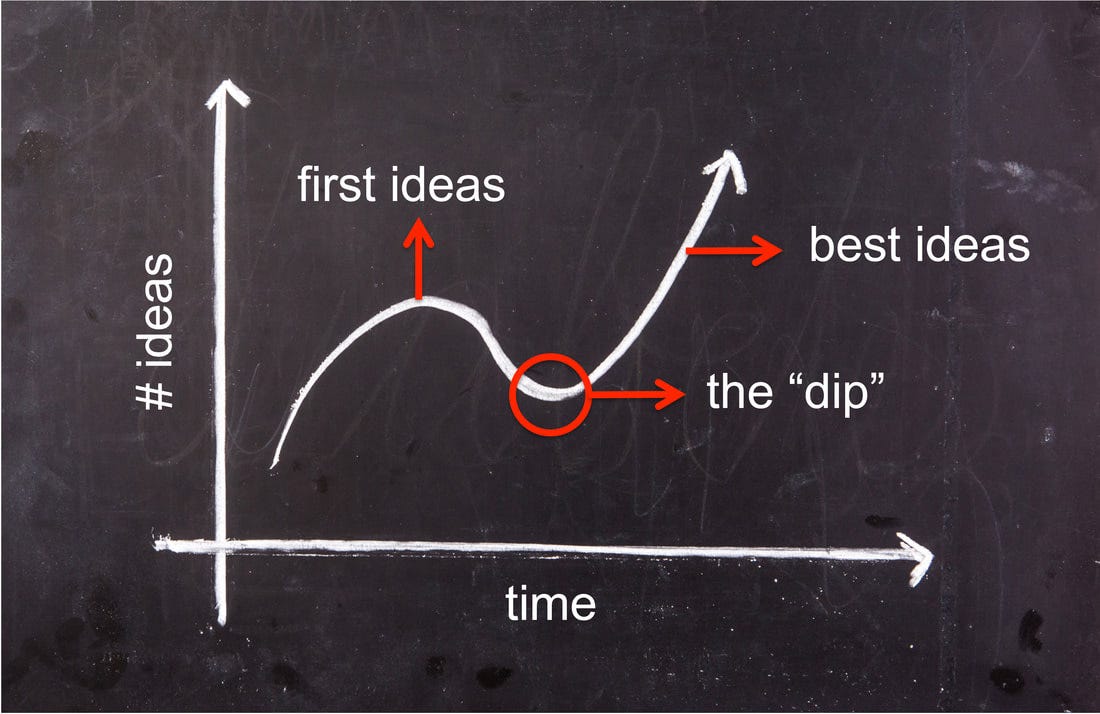
If you think brilliant ideas just simply drop out of the sky, you are wrong. A recent scientific study of Brian Lucas and Loran Nordgren shows that the best ideas actually occur only after the ‘dip’. So creativity is far and foremost a matter of persistence.
During my career as a designer many years ago, I often experienced this. Long hours, evenings and sometimes even nights in which you are toiling for that ‘reasonably well’ concept for the customer, to bring that ‘ok it is a nice idea and it does have something’ to a higher level. Because it was supposed to be brilliant, great, original. And I knew it would come, I only didn’t know when this Eureka-moment would pop up. So you keep working, choose a new path, try to find inspiration in even the smallest things. And when you entirely have lost faith and have reached your ‘dip’, you take a break. But even during these short moments, the engine keeps running at full speed. And then it pops up, totally unexpected. And I knew, after all these years, it always would. It was that knowledge that, again and again, gave me the power to go on.
And now — finally — this knowledge has been scientifically proven. Through a series of experiments Lucas and Nordgren demonstrated that people systematically underestimate the number of ideas they can generate to solve a problem. They started by asking a couple of students to come up with as much recipes as possible for a Thanksgiving Dinner. After this test, the students had to estimate how much more ideas they could come up with if they would continue for another ten minutes. On average, the students thought they could come up with ten more recipes, but the reality showed it was often more than fifteen.
A similar test was done with other groups of people: stand-up comedians were asked to come up with punch lines for a joke, adults had to invent slogans for a product and another group of people needed to generate ideas to raise money for a charity project. In each and every one of these tests, the participants underestimated how many ideas they could come up with after their first ‘dip’.
After every study, the researchers asked another group of people to judge the quality of the ideas. The result was even more surprising… The best ideas were the ones that were generated after the ‘dip’. So this means that persistence does not only generate significantly more ideas, but the quality of these additional ideas is even higher than the first batch of ideas.
And still, we give up so easily. Not that surprising, because creative challenges are often perceived as very difficult. A lot of people consider themselves not to be very creative and are, because of that, convinced that after the dip the stream of ideas has entirely dried out. Hard labour and final failure on a non-creative task — for example a technical problem — often means that you need to quit. There often is only one solution, and if that solution doesn’t work, there’s simply no alternative. But with creative issues, more solutions are possible. Which is difficult to understand for most people who have a linear thought process.
‘Quantity breeds Quality’, Alex Osborn — the founder of modern-day brainstorming — already stated in the early sixties. And he was fully right! Finaly some small tips to give your unborn and potentially brilliant ideas the chances they deserve:
- Ignore your first instinct to quit early. Know that the best ideas will only pop up after the dip, especially in the first phases of the process. Just try to generate some additional ideas or come up with some alternatives, or build on the things you already have. You will see that the stream of ideas will quickly start to flow again.
- Remember that creative idea generation is per definition not easy. Everybody will reach that point in time where it seems impossible to find new ideas. That is part of every creative process. Just remember that persistence will be richly rewarded.
Posted
by
Walter Vandervelde
on: September 16, 2019 01:27 AM |
Permalink
Comments (6)
Please login or join to subscribe to this item

LORI WILSON
RETIRED - Technical Project Manager| RETIRED - LifePoint Health
Clarkston, Wa, United States
So interesting and I've experienced this - thank you for sharing some evidence to back it up!

Lily Murariu
Speaker, Author, Researcher| Public Service Canada
Cantley, Quebec, Canada
Thank you for this topic. We need to talk more about how good ideas can be promoted and how they can be borne, and what type of environment can nurture the hard and soul of individuals in order to bring new ideas to the surface.More self awareness is needed equal at the individual and organizational level.

Vincent Guerard
Coach - Trainer - Speaker - Advisor| Freelance
Mont-Royal, Quebec, Canada
Thanks for sharing, first ideas are often not that great. Identifying the limit or problem in them stimulate the search for a better one. Now scientifically demonstrated.

Collins Aluga
Quantity Surveyor| MCK Contract Services Ltd
Nairobi, Nairobi, Kenya

Tim Wachtel
Senior Project Manager| BRIGHT HEALTH GROUP
Austin, Tx, United States
I've seen the 'dip' factor discussed in some science journals. Sometimes our mind needs to go into a lull in order for logic to be displaced by brilliant insight.
Please Login/Register to leave a comment.
|
When someone is lying, is it true that their pants are actually on fire?
- Jerry Seinfeld
|




