




From about 2000 until 2013, Microsoft’s market capitalization hung around 200 billion and its stock price hovered around $26 per share. While a market capitalization of 200 billion is nothing to bat an eye at, Microsoft’s stagnation meant that they were losing ground to their competitors. Near the turn of 2014, it is safe to say that Microsoft was not primed for future success.
Since 2014, Microsoft has been on a tear and their market capitalization recently eclipsing $1 trillion, passing Apple, and becoming the most valuable company in the United States. Further, its stock price is now five times greater than it was during their stagnant period: $132.45.
Does Microsoft seem much more primed for future success now? Certainly!
What has been the difference?
Well, one obvious thing: a new CEO. During the early part of 2014, Satya Nadella took the helm at Microsoft. Since he has taken over Microsoft, he has focused on ensuring Microsoft has the characteristics that enable future success. This focus has clearly paid huge dividends, literally and figuratively.
What Organizational Characteristics Enable Future Success?
Step back and consider the industry in which your organization operates. Out of the organizations within your industry, some are going be highly successful 5, 10, 20 years from now, while others are going to be obsolete.
This leads us to two questions:
- What characteristics do those organizations that are going to be obsolete 5, 10, 20 years from now possess today that will hinder their future success?
- What characteristics do those organizations that are going to be highly successful 5, 10, 20 years from now possess today that will help them ensure future success?
The Characteristics that Hinder Future Success
Among potentially many, the characteristics that hinder future success involve being short-sighted and change-resistant. The organizations that are short-sighted are so focused on figuring out how to be successful right now that they are unable to consider the needs of and opportunities associated with the future. The organizations that are change-resistant:
- Focus more on looking good than making an impact
- Emphasize tradition and stifle new and innovative ideas
- Are risk-averse
- Do not value their people
The Characteristics that Enable Future Success
One characteristic that you will not find among the characteristics that enable future success is current success! Just ask organizations like Circuit City, Blockbuster, and Toys ‘R’ Us. Being successful today does not mean that you will be successful in the future.
In fact, 52% of the Fortune 500 companies from 2000 no longer exist.
The characteristics that enable future success involve being future-centered and agile. Being future-centered does not mean your organization isn’t concerned with the ‘right now,’ rather it means that your organization recognizes that your current level of success is based upon how future-centered you were leading up to the ‘now.’ Further, it means that your organization recognizes that what might be working now, is not likely to be what will work in the future.
Being agile means being willing and able to quickly adapt to the changing market conditions. It is speed, nimbleness, and athleticism. Characteristics that fuel agility include:
- Being focused on continually improving the organization’s impact on and value to those it is serving
- Emphasizing innovation and psychological safety
- Being willing to take strategic risk
- Valuing its people
How did Microsoft become Primed for Future Success?
When Satya Nadella stepped in as CEO of Microsoft, he quickly recognized that Microsoft possessed more of the characteristics that hindered future success than those that enabled future success. This became evident in one of the first meetings he had with his leadership team. In the meeting, a facilitator asked for a volunteer amongst the team, promising whoever volunteered to have an extraordinary personal experience. Nobody was willing to stand up. This led Nadella to wonder: “Why wouldn’t everyone jump up. Wasn’t this a high performing group? Didn’t everyone just say they wanted to do something extraordinary? … The answers were hard to pull out, even though they were just beneath the surface: Fear of being ridiculed, of failing, of not looking like the smartest person in the room, and arrogance. ‘I am too important for these games.’”
In his book, Hit Refresh, Nadella described Microsoft’s culture as: “Rigid. Each employee had to prove to everyone that he or she knew it all, and was the smartest person in the room. Accountability, delivering on time, and hitting the numbers trumped everything. Meetings were formal. Everything had to be planned in perfect detail before the meeting…Hierarchy and pecking order had taken control and spontaneity and creativity had suffered as a result.”
Recognizing these limiting characteristics, Nadella made it his mission to change the culture at Microsoft. In fact, in his book, he continually states that the ‘C’ in CEO stands for curator of the organization’s culture, and is the CEO’s most important role.
So, what did Nadella focus on to ensure Microsoft developed the characteristics that enable future success?
Mindsets.
Priming Your Organization for Future Success
The solution for priming your organization for future success is the same as it was for Microsoft’s.
As we makes shifts in our mindsets, we develop the characteristics that enable future success.
Specifically, there are four shifts in mindsets that we need to make.
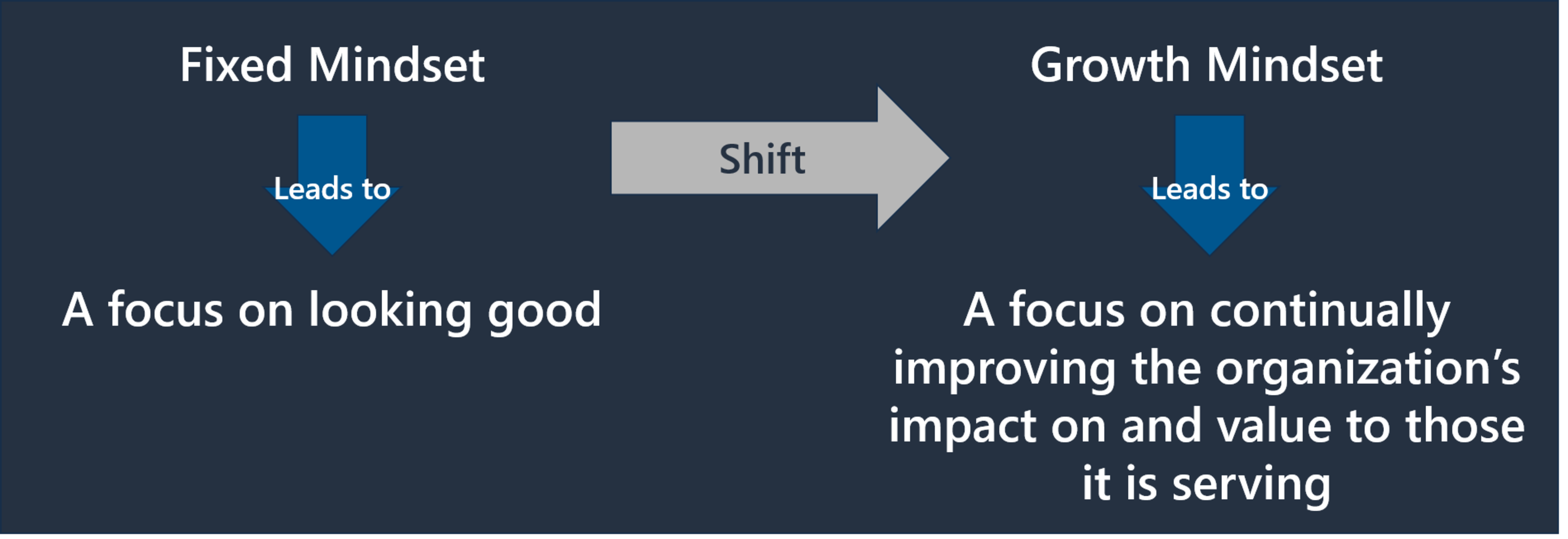
- Fixed Mindset to a Growth Mindset
As an organization shifts from a fixed mindset to a growth mindset, it, and the employees within it, will focus less on looking good and more on continually improving the organization’s impact on and value to those it is serving.
Nadella quickly realized that the negative culture at Microsoft was because of a fixed mindset. One way that he helped Microsoft make the shift was by putting the following on all employee ID cards: “Know it all to Learn it all.”
- Closed Mindset to an Open Mindset
As an organization shifts from a closed mindset to an open mindset, it, and the employees within it, adhere less to tradition and become more willing to embrace innovation and new ideas. Also, this shift necessitates a change from communication and information going from the top down to communication and information coming from the bottom up. Such a change allows for the fostering of psychological safety, which is the #1 factor that drives top-performing teams.
Nadella knew that if Microsoft was going to be the spontaneous and creative company that it once was and that it needed to be, there needed to be greater open-mindedness and psychological safety. Thus, Nadella sought to break down structures and policies that prevented empowerment.

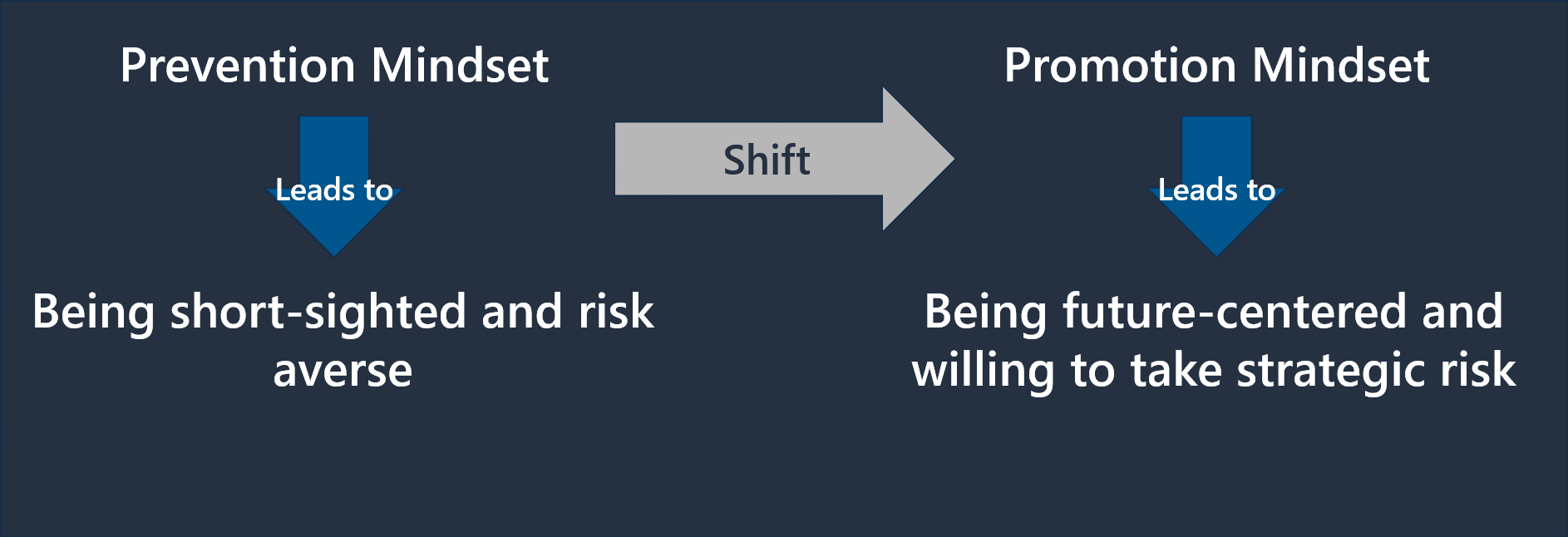
- Prevention Mindset to a Promotion Mindset
A shift from a prevention mindset to a promotion mindset requires that the organization develop a clearer purpose and destination they are shooting toward. This primes the organization for future success in two ways:
- It forces the organization to become less short-sighted and more future-centered
- It helps the organization to become less risk-averse and more willing to take the strategic risks that will ensure progress toward the organization’s destination and accomplishment of its purpose.
One of Nadella’s first priorities was to develop and evangelize a new, clear mission statement: “Empower every person and every organization on the planet to achieve more.” What a great mission statement! It gets leaders and employees to be forward-thinking, causing them to naturally ask the question: “How do we/I do that?”
- Inward Mindset to an Outward Mindset
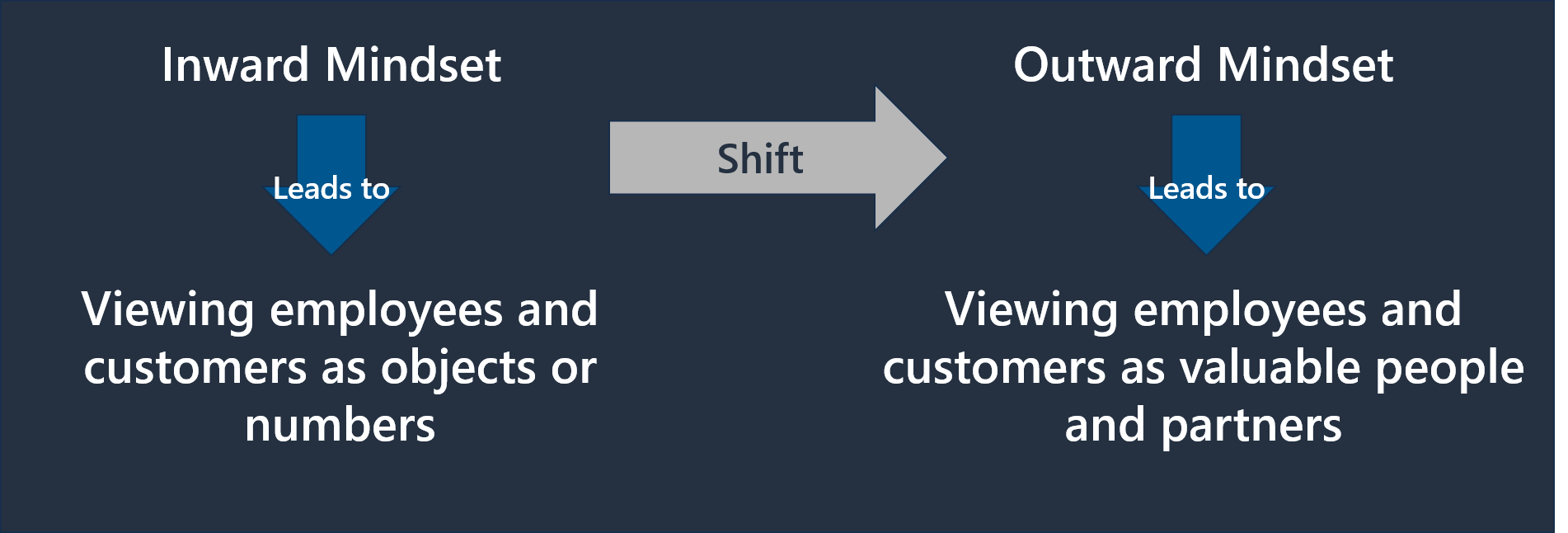
As an organization shifts from an inward mindset to an outward mindset, it, and the employees within it, view employees and customers less as objects or numbers and more as people of value.
To help make this shift, Nadella has emphasized inclusivity, stating “Inclusion happens when…you are showing up, you are being an ally, a mentor, you are really creating, through your everyday actions, a more inclusive environment…that’s the journey we’re on…[its] very, very exciting.” He has even developed a mobile empathy museum.
Is Your Organization Primed for Future Success?
Knowing the foundational role mindsets play in organizational agility and future-readiness, now the question becomes: Does your organization possesses the mindsets and characteristics required for future success?




