


Categories: Agile, Change Management, CIO, Culture, Design Thinking, Digital Transformation, Exponential, Fourth Industrial Revolution, Leadership, Management, modern project management, PM, PMI, Project Management, Technologies
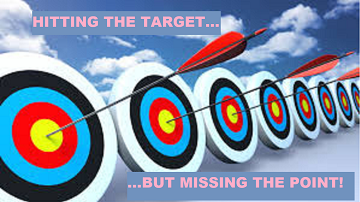
Next Level Transformation Management: How to avoid hitting the target but missing the point
If there’s one execution-related principle that has been drilled into us by management theory, it’s that ‘you get what you measure’. We’re exhorted to just get going when it comes to metrics – i.e. ‘Measurement is like laundry. It piles up the longer you wait to do it’. That’s all fine, but every seasoned project manager knows that there are limits to which business sponsors can fully and precisely envision what success looks like ahead of time. Don’t get me wrong, they may have a general idea of which direction success lies. But often, it’s difficult to see what’s possible unless you iterate. Which is why Steve Jobs said, ' People don't know what they want until you show it to them. That's why I never rely on market research’.
The issue of unclear end-state articulation becomes more difficult as you move up from managing projects to managing portfolios to managing digital transformations. When it comes to imagining an end-state of large-scale digital transformation of an enterprises business model itself, you then get into the realm of fuzzy meanings per United States Justice Potter Stewart who famously said of the definition of obscenity that ‘I could never succeed in intelligibly [defining it], but I know it when I see it’.
The “north pole” of metrics in digital transformation
That leaves most transformation leaders thinking ‘Great! If managing a complex digital transformation portfolio wasn’t hard enough, I now need to work with the handicap of the goal posts being moved as we execute…’. Well, it’s not that bad. There is clearly confusion on what the term ‘digital transformation’ implies, but there are some “north pole” business outcomes that will never change. Navigating by those “north pole” metrics are likely to keep the program safe on track. For enterprises, the eventual “Wall Street” grade business metrics of sustained “Total Shareholder Return”, which puts together all financial metrics of cost, revenue, cash, controls, and sustained performance factors like brand equity and organizational strength are usually a great guiding star. Once we factor that in, the question becomes how to define usable and relevant metrics that can be cascaded down the organization. And, often this is where the issue lies.
The dilemma of measuring success in digital transformation
The root of the ambiguity in definitions is driven by the confusion on what digital transformation is. Most executives tend to relate it to technology i.e. using technology for more effective or efficient operations. That’s only the first stage of digital transformation. True digital transformation is the rewiring of entire business models, work processes and people skills, so that enterprises which are successful in the third industrial revolution are made ready to be successful in the fourth. Or said another way, it is to rewire people, processes and business models to understand the needs of the customer and meet it exponentially better, as in say, the successful transition from printed classified ads to Craigslist. To better appreciate how digital transformation leaders can seize this historic opportunity, we need to understand the context of the fourth industrial revolution, the stages of digital transformation, and how a full-fledged digital transformation is all about meeting customer needs exponentially better.
 What is digital transformation?
The context of industrial revolutions is foundational. The World Economic Forum has declared that we’re in the midst of the Fourth Industrial Revolution where digital technology is transforming and fusing together the physical, biological, chemical, and information worlds. It’s affecting every area valued by society—from convenience (e.g., online shopping) and improved health (e.g., biotech) to personal security (e.g., digital homes), food security (e.g., agrotech), and so on. Only one thing is guaranteed: it will bring about dramatic change, just as the previous three industrial revolutions did. The first three were caused by different technologies i.e. steam, electricity and the internet respectively, whereas the fourth is caused by digital. However, all four have one thing in common. Individuals and societies will be affected significantly, and companies will either transform or die. And the process of transforming from being a viable entity in the third to the fourth industrial revolution is digital transformation.
The stages of digital transformation
 Although full-fledged digital transformation is about fully rewiring the business models, processes and organization capability, there’s no getting away from the fact that still mass confusion on the definition. Most executives mix it up with the run-of-the-mill digital technology project. The best way to frame the definition is to put it in the context of the five-stage digital transformation model.
Stage 1 is the Foundation. This is where enterprises are actively automating internal processes, such as marketing, selling, manufacturing, or finance. This is more automation (also called digitalization) than transformation, but it provides the digitalized foundation necessary for future transformation.
The next stage is called Siloed, where you might see individual functions or businesses start to use disruptive technologies to create new business models. So, for instance, this is what using digital channels for selling is. Additionally, this is what the transition to using digital media, and more precise targeting of customers using data is.
Stage 3 is Partially Synchronized transformation. The enterprise leader, owner, or CEO has recognized the disruptive power of digital technologies and defined a digital future state. At Stage 3, the organization has started rowing in the same direction.
Stage 4, or Fully Synchronized, marks the point where an enterprise-wide digital platform or new business model has fully taken root. However, it is a one-time transformation. It is still just one technology (or business model) change away from being disrupted.
Stage 5, or Living DNA, is the step where the transformation becomes perpetual. You maintain ongoing industry trend leadership because you are disciplined in constantly innovating and setting industry trends. You’re not just a market leader; you’re a disciplined innovator.
The context of the five-stage model helps define the gap between the eventual “north pole” success of sustainable digital transformation and what incremental stages of transformation is being targeted by your current program. Articulate that correctly, and you mitigate the risk of hitting the target but missing the point.




