


Categories: Agile, CIO, Culture, Design Thinking, Digital Transformation, Exponential, Fourth Industrial Revolution, Leadership, Management, PM, PMI, Project Management, Technologies
Is it Time to Re-brand and Re-charter the IT Function?
Very few functions have evolved as much in the past 3-4 decades as the IT function. It’s been in the vanguard of driving efficiency and transforming legacy operations, and has been rewarded in being moved out of the backrooms of the company and into the boardrooms.
However, with great power comes great responsibilities. We need to ask if we in the IT function are doing enough to transform our own legacy behaviors. I would contend that not all organizations are. Which is why it might be time to re-brand and re-charter the IT function. I call this new re-branded organization the “digital resources function”.
Why Re-charter the IT Function?
With digital transformation becoming the #1 priority for most company boards, expectations from the IT functions have increased. At its heart is the change from “managing” technology to “leading” the digital transformation of the enterprise. The change isn’t just administrative though, there are technologies, platforms and people skills that will need to be redone. I have identified six vectors of change –
- More flexible technology platforms: Amazon and other digitally native companies have the capability to make hundreds of noticeable changes to their systems to test out new business models daily. They use a new generation of digital capabilities to blend scale with speed, to support constantly evolving digital business models.
In contrast, the current technologies in most enterprises were originally built for enterprise efficiency and scale. They are large, complex, took a long time to implement, and take even longer to modify. Think large enterprise resource planning (e.g. SAP) implementations. These monolithic systems worked extremely well in the past because the goal at the time was scale. The new digital revolution has changed that goal.
- More agility in execution: Ask any large enterprise business unit leader their opinion on IT projects in general and you will likely find their response liberally sprinkled with “millions of dollars” and “years to implement”. Meanwhile, a digitally native start-up could rent a server with an order-processing software and have a business up and running in minutes. Large enterprise IT organizations have a big challenge on agile execution.
- Skills on newer technology: The top 5 high-paying skills of 2018 according to CIO magazine[i] are Information Security, DevOps, Data Science, Business Application Development and Machine Learning. The only thing you need to know as a leader is that perhaps only one of these five (i.e. Business Application Development) would have been on that list five years ago. How many of your IT professionals have been in the enterprise for more than five years? How many have kept up with the latest skills?
- New capabilities to lead digital transformation: The IT professional of the future will need as many non-technical skills including creativity, communications, influencing and teamwork, as technical. Further, I use the term “technical” in its broadest sense to include items such as process mapping, business model design and LEAN execution, in addition to IT technology. This is to be expected as the role of the IT function evolves from “doing” technology to “leading” digital transformation. The new digital resources function requires a skill-set that is of a transformational leader, who also happens to be a guru on technology. The traditional approach has been to rely on consultancies that seem to have such a mix. There may be a legitimate role especially during transition, for consultancies. However, this is problematic long-term, keeping in mind the goal of leading perpetual digital transformation for the organization.
- Governing the digital ecosystem: The freelance workforce in the US is growing three times faster than the overall workforce and is projected to be the majority by 2027.[ii] Within the freelance workforce, the growth in IT is faster than most other functions. Secondly, as systems across one enterprise to another get more inter-connected, the predominant skill-set in demand will become more governing and less managing.
- Updated vendor ecosystem: It’s very likely that the mix of IT vendors and partners who were associated with the old IT function may not be the best fit for the Digital Resources Function. Part of this is easy to understand – the vendors who were optimal for stability and cost-efficiency goals might not be fit for digital transformation. However, that’s only half the issue. The other half is that the same digital disruptive forces are acting upon the IT industry as well. Traditional IT service partners are being squeezed as their people-centric businesses get disrupted. Being locked into multi-million, multi-year contracts with the older-generation IT providers, even for “commodity IT” services may not be in your best interests. Current contracts may be optimized for cost efficiency over agility and innovation. The dirty little secret of IT outsourcing is that the IT providers take a given scope of work, freeze it, and promise to deliver it for 15-50% less cost partly by ruthlessly optimizing efficiencies and partly because there’s not much innovation on the old scope of work.
Why Re-brand the IT Function?
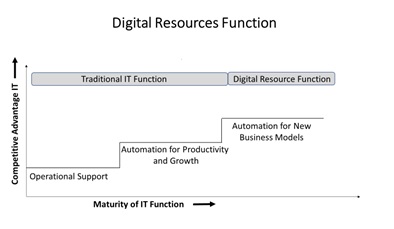 As we’ve learned from the experience with constantly upgrading our smartphones, technology gets old fast. That’s true of IT functions in the enterprise as well. IT technologies, IT scope of operations and IT skills all have incredibly short life cycles. That’s been historically true and is not a surprise. What’s new is that the piston-engine version of IT has reached an inflection point. It needs a consciously different engine. We’re no longer talking evolution; we’re talking about a dramatically different redesign. The new IT function is not just about new technology platforms, a new charter of work, or newer skills; it is about leading all the other functions and business units in the company to new technology-enabled business models. The digital enterprise needs digital to be done by every function, but powered by IT. Which is why I believe that the new IT function needs a totally new charter and a new name – The Digital Resources Function.
[i] Scorsone, G. (2018). 5 hot and high-paying tech skills for 2018. [online] CIO. Available at: https://www.cio.com/article/3269251/it-skills-training/5-hot-and-high-paying-tech-skills-for-2018.html [Accessed 19 Dec. 2018].
[ii] Caminiti, S. (2018). 4 gig economy trends that are radically transforming the US job market. [online] CNBC. Available at: https://www.cnbc.com/2018/10/29/4-gig-economy-trends-that-are-radically-transforming-the-us-job-market.html [Accessed 19 Dec. 2018].

 Community Champion



