Comparing Agile and Lean Backlog Strategies
From the Disciplined Agile Blog
by Tatsiana Balshakova,
Mark Lines, Mike Griffiths, Scott Ambler, Bjorn Gustafsson, Curtis Hibbs, James Trott

This blog contains details about various aspects of PMI's Disciplined Agile (DA) tool kit, including new and upcoming topics.
View Posts By:
Tatsiana Balshakova
Mark Lines
Mike Griffiths
Scott Ambler
Bjorn Gustafsson
Curtis Hibbs
James Trott
Past Contributors:
Joshua Barnes
Michael Richardson
Daniel Gagnon
Valentin Tudor Mocanu
Kashmir Birk
Glen Little
Klaus Boedker
Recent Posts
DA 5.6 is released
Disciplined Agile 5.5 Released
Choose Your WoW! Second Edition Is Now Available
Requisite Agility applied in Project Management
Disciplined Agile and PMBoK Guide 7th Edition
Categories
#ChoiceIsGood,
#ChooseYourWoW,
#ConsumableSolution,
#ContinuousImprovement,
#CoreAgilePractices,
#experiment,
#Experimentation,
#GuidedContinuousImprovement,
#Kaizen,
#LifeCycles,
#ProcessImprovement,
#TealOrganizations,
Adoption,
agile,
agile adoption,
Agile Alliance,
Agile Business Analyst,
Agile certification,
agile data,
agile governance,
agile lifecycle,
agile metrics,
agile principles,
agile transformation,
Agile2018,
Agile2019,
Agile20Reflect,
AgileData,
Analogy,
announcement,
Architecture,
architecture,
architecture owner,
Articles and publications,
Asset Management,
Atari,
Backlog,
Barclays,
being agile,
benefits,
bi,
blades,
book,
Branching strategies,
Browser,
Business Agility,
business intelligence,
business operations,
capex,
Case Study,
Certification,
certification,
charity,
Choose your WoW,
CMMI,
cmmi,
Coaching,
Collaboration,
Communications Management,
Compliance,
Compliancy,
Conference,
Construction,
Construction phase,
Context,
Continuous Improvement,
coordination,
COVID-19,
Culture,
culture,
Cutter,
DA,
DAD,
DAD Book,
DAD discussions,
DAD press,
DAD roles,
DAD supporters,
DAD webcast,
DADay2019,
Data Management,
database,
dependencies,
Deployment,
Development Strategies,
DevOps,
disaster,
Discipline,
discipline,
Disciplined Agile,
disciplined agile delivery,
disciplined agile delivery blog,
Disciplined Agile Enterprise,
disciplined devops,
Documentation,
Domain complexity,
dw,
DW/BI,
Energy Healing,
Enterprise Agile,
Enterprise Architecture,
Enterprise Awareness,
enterprise awareness,
Essence,
estimation,
Evolving DA,
Executive,
Experiment,
facilitation,
FailureBow,
feedback-cycle,
finance,
Financial,
FLEX,
Flow,
foundation layer,
Funding,
GCI,
GDD,
Geographic Distribution,
gladwell,
global development,
Goal-Driven,
goal-driven,
goals,
Governance,
GQM,
Guideline,
Hybrid,
Improvement,
inception,
Inception phase,
India,
information technology,
infosec,
Introduction,
iterations,
Kanban,
large teams,
layer,
lean,
Lean Startup,
learning,
Legal Project Management,
LeSS,
Lifecycle,
lifecycle,
Manifesto,
mark lines,
marketing,
MBI,
Metaphor,
Metrics,
metrics,
mindset,
Miscellaneous,
MVP,
News,
News and events,
Non-Functional Requirements,
non-functional requirements,
Non-solo development,
offshoring,
Operations,
opex,
Organization,
Outsourcing,
outsourcing,
paired programming,
pairing,
paper,
People,
People Management,
phases,
Philosophies,
Planning,
PMBoK,
PMI,
PMI and DA,
PMI Chapter,
Portfolio Management,
post-format-quote,
Practices,
practices,
Principle,
Process,
process improvement,
process tailoring,
Product Management,
product owner,
Product Owners,
productivity,
Program Management,
Project Management,
project-initiation,
Promise,
Quality,
quality,
rational unified process,
Refactoring,
Reiki,
Release Management,
release management,
Remote Training,
Remote Work,
repeatability,
requirements,
Requirements Management,
research&development,
responsibilities,
retrospectives,
Reuse,
Reuse Engineering,
ride for heart,
rights,
Risk Management,
Risk Management,
Risk management,
Roles,
RUP,
SAFe,
sales,
Scaling,
scaling,
scaling agile,
Scheduled Workshops,
SCM,
scorecard,
Scrum,
ScrumMaster,
SDLC,
Security,
security,
self-organization,
SEMAT,
serial,
skill,
solutions software consumable shippable,
Stakeholder Management,
strategy,
Support,
Surveys,
Teal organizations,
team development,
Team Lead,
team lead,
Teams,
Technical Debt,
Teleconferencing,
Terminology,
terraforming,
test strategy,
testing,
time tracking,
Tool kit,
Toolkit,
tools,
traditional,
Transformation,
Transition iteration,
transition phase,
Uncategorized,
Upmentors,
Using PMI Standards,
value stream,
velocity,
vendor management,
Virtual Training,
Workflow,
workflow,
workspaces
Date
One of the changes that we made in the DA 5.3 release on September 30th was to update our advice around managing backlogs. We had been using older terminology from when we first developed Disciplined Agile Delivery (DAD) and we had an out-of-date description of what was being advised in the Scrum community (they've adopted a more disciplined strategy in recent years). So we've acted and updated this aspect of the tool kit.
Recent Refactorings
There are three refactorings that are pertinent to our discussion:
- Introduction of the Intake Work process goal. In the DA 5.2 release of July 9th, 2021 we created a new process goal, Intake Work by refactoring it out of the existing Address Changing Stakeholder Needs process goal. The Intake Work process goal is depicted in Figure 1. The reasons for this refactoring was that Address Changing Stakeholder Needs wasn't cohesive in that it had two purposes, the first to explore the changing needs and the second to intake the work into the team.
- Introduction of the Manage Backlog decision point. For the 5.3 release we refactored further, and split the Manage Work Items decision point into two, creating the new Manage Backlog decision point. The reason for this refactoring was that the original decision point wasn't cohesive, it had two purposes, the first to capture strategies to manage backlogs and the second to manage/visualize work items.
- Update to Explore Scope. We updated Explore Scope's Choose a Backlog Management Strategy decision point to reflect the changes we made to Intake Work.
Figure 1. The Intake Work process goal.

Managing Backlogs
As you can see in Figure 1 there are four fundamental strategies for managing your backlog of work. These strategies are ordered, you know this because there is an arrow beside the list, indicating that the strategies towards the top of the list are generally more effective than the strategies towards the bottom. In order from most effective to least effective, these strategies are:
- Lean backlog. Lean backlogs are typically organized into four groupings: Potential work that the team may commit to; Committed work that the team will perform, which is typically sequenced into several classes of service; Work in process (WIP) that the team is currently performing; and completed work that is ready to move on to the next stage in your overall process. Lean backlogs are overviewed in Figure 2.
- Agile backlog. Work items are managed as an ordered list/stack. Higher-priority work items appear at the top of the list, are granular and captured in greater detail, and are sequenced. Lower-priority work appear towards the bottom of the list, lack detail, and are effectively in unsequenced priority buckets. In previous versions of DA we referred to this strategy as a Work Item List and it has always been our default recommendation for agile team. This strategy was an extension to Scrum's (at the time) product backlog which was a prioritized list of requirements, but over the years Scrum's approach has evolved into this more disciplined strategy. Agile backlogs are overviewed in Figure 3.
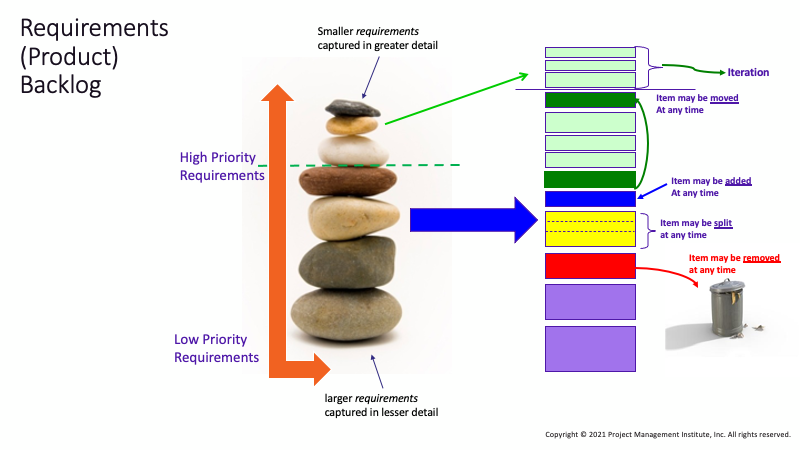
- Requirements (product) backlog. A unique, ranked stack of requirements that needs to be addressed. Requirements at the top of the list should be captured in greater detail than lower-priority requirements at the bottom of the list. In earlier versions of Scrum this was a prioritized list of functional/usage requirements, often captured as user stories. Some teams would include defects and some form of quality requirements (often captured as technical stories) on the backlog, as they were considered valid requirement types as well. Requirements backlogs are overviewed in Figure 4.
- Unsequenced backlog. All of the work is effectively the same priority, although sometimes there may be the concept of two priorities - what is in the current release and what needs to be in future releases.
Figure 2. Lean backlog overview.
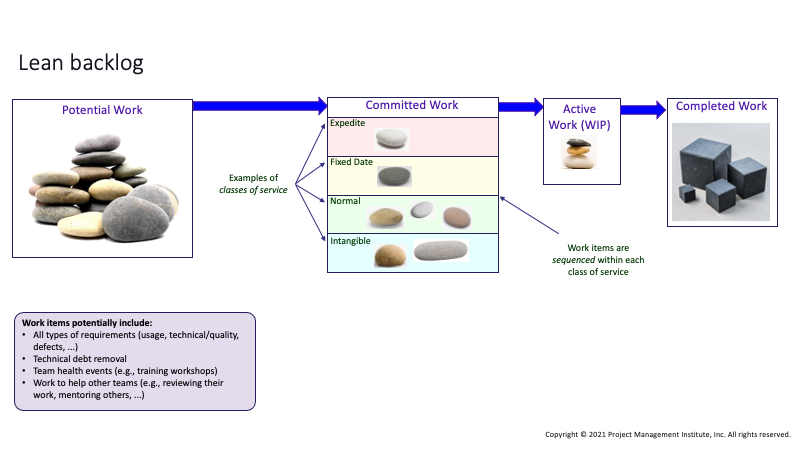
Figure 3. Agile backlog overview.
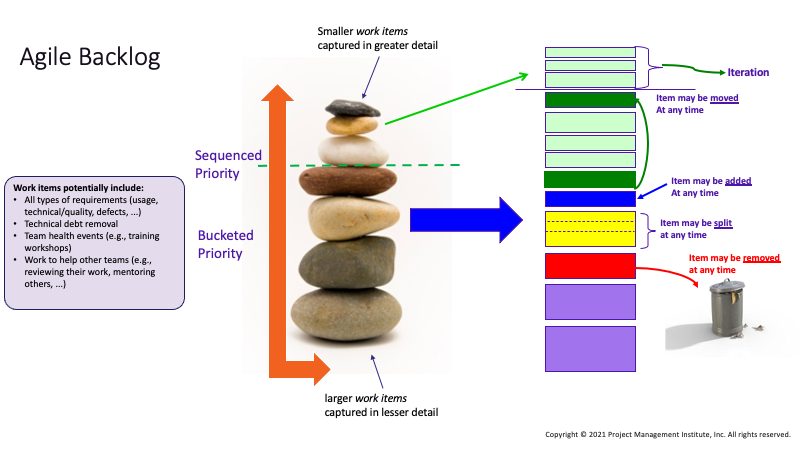
Figure 4. Requirements (product) backlog overview.
Comparing Backlog Strategies
The following table compares the four backlog strategies. For more information, please refer PMI's Disciplined Agile (DA) Browser.
Table 1. Comparing Backlog Strategies
| Backlog Strategy |
Advantages |
Disadvantages |
| Lean |
- Best where priorities are changing continually.
- Easily supports several work sequencing schemes in parallel.
|
- Harder to see the work as a single stack of sequenced work items if there are multiple classes of service.
- Requires discipline to pull new work fairly from the various classes of service. It's common to see one or more classes, such as paying down technical debt, starved in favor of implementing new functionality.
|
| Agile |
- Best suited where the team follows one of the agile life cycles.
- Clearly indicates the order in which work will be performed, enabling effective prioritization discussions with stakeholders.
- Supports the forecasting of cost and schedule estimates via techniques such as burndown or burnup charts.
|
- Requires ongoing maintenance and refinement, adding overhead to your process.
|
| Requirements (product) |
- Clearly indicates the order in which work will be performed, enabling effective prioritization discussions with stakeholders.
- Supports the forecasting of cost and schedule estimates via techniques such as burndown or burnup charts.
|
- Forecasts tend to be overly optimistic due to non-requirement work not being accurately taken into account.
- Requires ongoing maintenance and refinement, adding overhead to your process.
|
| Unsequenced |
- Enables the team to perform the work the the order they deem to be the most effective.
|
- You don't know what's next to be worked on, making it more difficult to do look-ahead planning/refinement.
- Team members tend to work on what they want to, or what they find easy.
- By not working in priority order, when the team runs out of time or funding, they risk missing critical functionality because it needed to be cut.
|
Acknowledgements
I'd like to thank Curtis Hibbs and Klaus Boedker for their great work on Figures 2-4, which I reused from our upcoming Disciplined Agile Product Owner workshop.
Posted
by
Scott Ambler
on: October 04, 2021 12:03 PM |
Permalink
Comments (16)
Please login or join to subscribe to this item

Rami Kaibni
 Community Champion
Senior Projects Manager | Field & Marten Associates
New Westminster, British Columbia, Canada
Very interesting information Scott, thank you for sharing.
Rami Kaibni
Community Champion
Senior Projects Manager | Field & Marten Associates
New Westminster, British Columbia, Canada
I never knew all those kinds of different backlogs existed nor did I think there is difference between Agile Backlog and Requirements Backlog, they are very similar in principal but your point of view on each is interesting. However, in real life, it’s not as black and white :-)

Scott Ambler
Consulting Methodologist| Ambysoft Inc.
Toronto, Ontario, Canada
@Rami, you're correct. The approach to managing your work backlog is a key decision that needs to be made by a team, but it's one that's rarely understood well because prescriptive methods tend to only present people with one strategy.
Rami Kaibni
Community Champion
Senior Projects Manager | Field & Marten Associates
New Westminster, British Columbia, Canada
The Agile backlog has also another advantage: offers a better opportunity to clarify dependencies. It is the same idea presented in the DAVSC workshop for value planning meetings. This modeling/planning is common for various types of looking ahead (envisioning, look ahead before iteration, iteration start look ahead ...) and we can try to reduce dependencies every time. It is one of the best opportunities to reduce the waste that could be caused by badly managed dependencies.
Also, the backlog offer a buffer that could avoid the waste of waiting if someone that collaborates in the intake process is missing.

Junaid Sagheer
Staff, Technical Program Manager| Walmart Global Tech
Bentonville, AR, United States
Thank you for writing the blog.

Carl M. Gilbert
CEO & CMO| Solutions GP CMG inc.
La Prairie, Quebec, Canada
Very interesting article! Thanks Scott.
Like the update and the refactoring.
On Figure 2, where it states "Work items are sequenced", is it "Work items are sequenced within each class of service"?
Scott Ambler
Consulting Methodologist| Ambysoft Inc.
Toronto, Ontario, Canada
@Daniel, yes! Very good catch. I will get that updated. Thank you!

Rachel Leidenfrost
Executive Vice President, People & Projects| FeedMore WNY
Buffalo, Ny, United States
Fantastic article. Thank you!
@Scott, great agility, updated in less than an hour!

Kate Folwell
Consultant| Liberty Mutual Insurance
Ma, United States
Thanks, @Scott. Great addition to value stream refinement.

Hajer El Aissi
Project / Program Manager| PMI KSA
Jeddah, Slimania, Saudi Arabia
Great Information... Thank you all
Good visualisation; explorative one

Karsten Zenk
Project Engineer| ***
Wolfenbuettel, Niedersachsen, Germany
Thank you. The article leads to a better understanding :-)
Please Login/Register to leave a comment.
|
"A behaviorist is someone who pulls habits out of rats."
- Anonymous
|






