



Guessing is not a strategy: How to build decision velocity with AI and real-time data
June 10, 2026 | Live Webinar

Autonomous vehicles: when 90% done means nowhere near ready
The accidental path to Project Management
What history reveals about AI and the Project Manager profession
When results aren’t enough: Rethinking Leadership
The Sagrada Família: A living Project Management case study
74-343, Agile, Agile, Artificial Intelligence, basadur, Budget Management, Career Development, Certification, Change Management, Change; Change management; Team management, Chapter, Communications Management, Complexity, conceptualizer, Cost Management, data management, Decision Making, Estimating, Ethics, generator, Giga Projects, Goal Setting, Governance, Human touch, implementer, Leadership, Lessons Learned, machine learning, MS Project 2013, Negotation, New Practitioners, optimizer, Organizational behavior, Organizational Culture, personal growth, pharmaceutical; lifecyle management; agile; waterfall, PMI, Problem solving, Product Owner, Project Communication, Project Management, PSM I, PSPO, Resource Management, Risk Management, Scheduling, Scope Management, Scrum, self-development, Stakeholder management, Strategy, Teams, test, training, Volunteering


1. The Promise: reimagining mobilityFor decades, the idea of autonomous vehicles has captured the imagination of engineers, policymakers, and society at large. At its core, the vision is compelling: a world where mobility is seamless, efficient, and largely invisible. In such a future, commuting time is reclaimed. Cars become extensions of our living or working spaces rather than tools requiring constant attention. Ownership models shift dramatically: vehicles no longer sit idle 95% of the time but operate continuously, transporting passengers, then repositioning themselves autonomously. Urban landscapes evolve: fewer parking spaces, less congestion, and a more efficient use of public space. The promise extends beyond convenience. Autonomous systems hold the potential to drastically reduce human error (the leading cause of road accidents!) thereby improving safety outcomes at scale. It is, in every sense, a transformative vision. And for a time, it felt imminent. 2. The Reality: understanding levels of autonomyTo understand where we stand, it is essential to ground the discussion in the standardized classification of driving automation, ranging from Level 0 (no automation) to Level 5 (full autonomy).
In reality, most commercially available systems, including those from Tesla, operate at Level 2, despite frequent public perception suggesting otherwise. Meanwhile, companies like Waymo have achieved Level 4 capabilities in tightly controlled environments. However, the leap to Level 5 remains elusive. Notably, for over a decade, industry leaders have suggested that full autonomy was “just around the corner.” Yet, year after year, that milestone has remained out of reach. 3. The 90–10 Problem: when progress stalls at the finish lineThis gap between expectation and reality can be understood through the lens of the “90–10 problem,” a well-known engineering principle often cited in discussions of complex systems. The principle is deceptively simple: The first 90% of a project often takes 10% of the time, while the final 10% consumes the remaining 90%. In the context of autonomous vehicles, the industry has largely solved the “easy” part: structured environments, predictable conditions, controlled variables. This is the world of highways, clear weather, and well-marked roads. The remaining 10% is where complexity explodes:
From a project management perspective, this is where traditional planning often breaks down. Linear assumptions fail. Marginal gains become exponentially expensive. And the definition of “done” becomes increasingly ambiguous. 4. The Downfall: when optimism meets realityBetween roughly 2015 and 2020, the autonomous vehicle space experienced a surge of optimism. Capital flowed freely, timelines were aggressive, and the narrative was clear: full autonomy was imminent. Reality, however, had other plans. From 2021 onwards, a noticeable shift occurred. Several major players scaled back or exited the race altogether:
5. The Deeper Insight: when knowledge outpaces technologyAt a conceptual level, the autonomous vehicle journey highlights a broader strategic misalignment, one that can be framed through a simple but powerful lens: the relationship between knowledge and technological readiness. This dynamic is often captured in frameworks that map what we know versus what we can reliably build, similar in spirit to technology maturity models such as Technology Readiness Levels (TRLs), where theoretical understanding can significantly outpace real-world deployment capability. In this case, the industry possessed:
Closing ReflectionThe story of autonomous vehicles is not one of failure but of premature certainty. It is a case study in how ambitious projects evolve:
And in project management, as in engineering, that last 10% is where the real work begins. |
| Project management has quietly become one of the most widespread professions in the modern economy. According to the PMI, there are more than 1.4 million active PMP-certified professionals worldwide, and tens of millions of people work in project-related roles across industries. Demand continues to grow, with estimates suggesting that around 89 million people will be needed in project management roles by 2027. And yet, despite the size and maturity of the profession, many project managers share a similar story: they did not plan to become one. They simply ended up there. A project needed coordination, someone stepped up, and the role slowly evolved into a career. Looking back, I sometimes ask myself: why did I accept that first role that resembled project management? Applying the Five Whys technique (traditionally used to find root causes) can be surprisingly revealing. 1. Why did I accept the role? Because I wanted to be close to where decisions are made. 2. Why did I want that? Because I wanted to see the impact of my work. 3. Why did I want to see that impact? Because it gives a sense of accomplishment. Interestingly, I did not need five whys to reach the root cause. After three, the answer already felt clear. In a way, this resembles the idea behind ikigai, represening the intersection between what you are good at, what you enjoy, and what creates value for others. For me, project management sits precisely there: close to the “engine room” of an organization, where decisions translate into action and outcomes. Looking at it from this perspective also raises another question: what comes next? One of the challenges of our profession is that job titles rarely tell the whole story. Two roles called project manager can have very different scopes and responsibilities depending on the organization. The same ambiguity applies when project managers start evolving in their careers. For many, the natural progression is upward within the discipline itself: becoming a program manager, portfolio manager, or leading a PMO. These roles expand the same core capabilities (coordination, prioritization and strategic alignment) while increasing the level of influence on how initiatives are selected and executed. Others take a slightly different path but remain close to that same “engine room” where decisions take shape. Roles such as transformation manager, change manager, or even chief of staff often rely on the same skills that project managers develop over time: connecting strategy with execution, aligning stakeholders, and ensuring that ideas translate into outcomes. Seen this way, project management is not only a profession in itself but also a platform. It places you at the intersection of strategy, operations and people, an excellent vantage point from which several career paths can emerge. And that leads to another reflection. How has your own path evolved since you first stepped into project management? Have you stayed within the discipline, or has it opened the door to other roles close to the decision-making core of your organization? |
| Every major technological revolution has triggered the same anxiety. Steam engines would destroy artisanal work. Tractors would eliminate farm labor. Computers would make offices obsolete. Each time, the warning sounded familiar: “This time is different.” Today, artificial intelligence has taken that role. For months, if not years, the impact of AI on the Project Manager profession has been debated. Will AI replace Project Managers? Will project management as a discipline disappear? Or will it be fundamentally transformed? I want to elevate this debate by stepping away from prediction and alarmism and instead looking backward. History, as economist Xavier Sala‑i‑Martín argues in De la sabana a Mart (literally From the Savannah to Mars), is not a forecast but a powerful teacher. In his book (unfortunately still untranslated into English), Sala‑i‑Martín traces how Homo sapiens evolved from its emergence roughly 200,000 years ago in the Serengeti savannah to a species capable of landing spacecraft on Mars. In spirit, it sits close to the work of authors like Yuval Noah Harari: a long‑arc view of human progress, and adaptation. One of its most relevant messages for today’s AI debate is simple but profound: while technology repeatedly destroys specific jobs and tasks, it has never eliminated human work as a whole. What changes is where humans add value. Below, I map five historical lessons from technological revolutions to concrete project management competencies; not to argue that Project Managers are “safe,” but to explain why the role is likely to become more human, not less. 1. We are bad at imagining future jobs and future project workOne of Sala-i-Martín’s central arguments is that humans systematically fail to imagine the jobs that will be created by innovation. In 1895, no expert could have predicted digital marketers, YouTubers, or UX designers. MIT economist David Autor estimates that roughly 60% of today’s occupations did not exist in 1940. The problem is not that experts were careless. Future work often emerges indirectly, as a second or third order effect of technology. What this means for Project Managers Much of today’s AI anxiety focuses on current PM tasks: scheduling, reporting, risk tracking, documentation... Yes, many of these will be automated or heavily augmented. But history suggests the more important question is: what new coordination problems will AI create? Early signals are already visible:
PM competencies amplified: systems thinking, strategic framing, ambiguity navigation. 2. Automation replaces tasks, not professionsWhen calculators entered offices, many believed accounting roles would vanish. When computers arrived, clerical work was expected to disappear. Neither happened. Instead, productivity rose and roles evolved. Technology consistently eliminates tasks, not entire professions. What this means for Project Managers AI will outperform us at:
PM competencies amplified: judgment, prioritization, decision‑making under uncertainty. 3. Technological transitions are painful and increase the need for PMsSala-i-Martín is explicit: the fact that innovation ultimately creates work does not mean transitions are easy. Workers displaced by mechanization did not automatically reskill. Societies had to invest in education, coordination, and institutional change. What this means for Project Managers AI adoption is not a technical rollout. It is a transformation. And transformations fail most often because of:
PM competencies amplified: change leadership, stakeholder management, organizational navigation. 4. Innovation creates new needs and new project portfoliosThe automobile didn’t just replace horses. It created tourism, hotels, road infrastructure, logistics networks and entirely new urban designs. Innovation doesn’t merely solve problems, it also creates new needs that later become essential. What this means for Project Managers AI is already creating new categories of work:
PM competencies amplified: portfolio management, value realization, cross‑functional integration. 5. “This time Is different” has always been wrong, including nowFrom tractors to computers to AI, the recurring claim has been: this time, humans will not adapt. History shows the opposite. Not because progress is guaranteed, but because societies reorganize around new constraints. What this means for Project Managers As automation increases, complexity does not disappear, it rather intensifies. And complexity elevates the value of deeply human capabilities:
PM competencies amplified: human leadership in complex systems. Conclusion: from controllers of work to designers of progressHistory does not tell us that Project Managers are immune to technological change. It tells us something more useful. Roles that sit at the intersection of technology, people, and decision making do not disappear. They evolve. AI will not end project management. But it will act as a filter. It will steadily automate coordination and execution mechanics, and leave behind the parts of the role that require judgment, ethical reasoning and leadership across uncertainty. For Project Managers, the real question is not whether AI will change our profession. It already is. The real question is whether we choose to remain controllers of tasks or step fully into our role as designers of progress, stewards of change, and leaders of complex human systems. For those willing to adapt, that shift is not a threat. It is an invitation. |
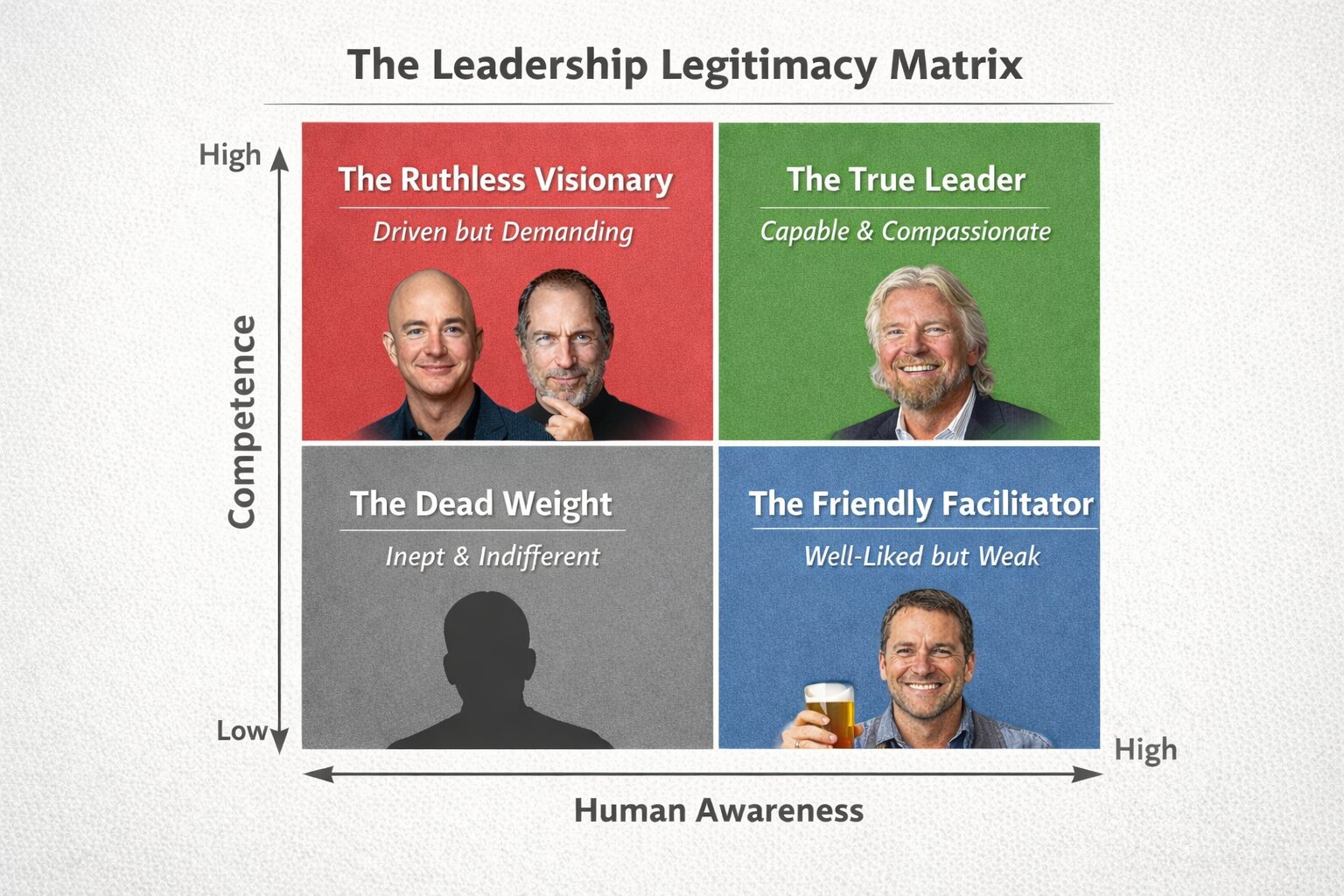
| We often label bad experiences at work as toxic leadership. It’s a convenient shortcut to explain disengagement or quiet resentment. But the more I reflect on it, the more the term itself starts to feel misleading. Because if leadership is toxic, if if it consistently erodes trust and destroys long‑term value, should we still call it leadership? To explore this question, I find it useful to strip leadership down to two fundamental dimensions. A simple leadership matrixImagine leadership mapped across two axes:
Cross these two dimensions, and four leadership archetypes emerge. |
In project management we obsess about three constraints: scope, schedule and budget. Rarely does a single project illustrate the tension between them more dramatically than Barcelona’s Sagrada Família.1) A Schedule Without a Deadline (…for a Very Long Time)Construction of the Sagrada Família began in 1882 under architect Francisco de Paula del Villar; Antoni Gaudí took over in 1883 and transformed it into his life’s work. When Gaudí died in 1926, less than a quarter of the basilica was complete. For decades there was no realistic finish date. Interruptions - most notably the Spanish Civil War - and the loss of Gaudí’s plans only compounded uncertainty. In the early 21st century, project planners set 2026 (the 100th anniversary of Gaudí’s death) as a symbolic completion date for the main structures, especially the tallest central tower. However, decorative elements, interior work and ancillary features (like the controversial grand entrance stairway) are now expected to extend into the mid-2030s.  This makes the Sagrada Família one of the longest-running construction projects in history, approaching 150 years and counting, yet still deeply relevant and alive. A useful comparison is the Sydney Opera House, which began construction in 1959 with an expected delivery of 1963 and ultimately opened in 1973, 10 years behind schedule and dramatically over budget, yet today is celebrated not as a failure but as a monumental success. 2) Scope: From Cross to Cathedral to Cultural IconThe project’s scope has not been static. Early plans envisaged a monumental Christian cross configuration that would have required demolishing entire city blocks in Barcelona’s Eixample district, a plan that would be socially and politically untenable today. Over time, the focus shifted to building the basilica itself, and the symbolic cross of the Christian faith is now expressed primarily through the central tower dedicated to Jesus Christ, not as an urban-scale structure. This evolution reflects a unique interpretation of scope, less as “scope creep” and more as scope negotiation across generations, adjusting to cultural values, urban constraints and stakeholder expectations. 3) Budget: Finance Through Visitors, Not GovernmentsUnlike most large-scale heritage or civic projects, the Sagrada Família is not financed by state or church funds. From the beginning, it has relied on private donations, and in the modern era its primary funding source is ticket sales, which bring in millions of euros annually. Tourism revenue now directly supports ongoing construction, turning the budget constraint into a living mechanism rather than a fixed baseline. In 2024 the basilica attracted around 4.9 million visitors, making it one of Europe’s most visited monuments... despite being unfinished! 4) A Project That Breaks the Rules — and Still SucceedsBy traditional PMI standards, the Sagrada Família would seem to fail: - Schedule: No fixed deadline for most of its existence, regularly revised and extended. - Scope: Evolved radically from its original concept. - Budget: Dependent on market-driven revenue, not fixed capital allocations. And yet the project has become a global icon, a UNESCO World Heritage Site, and a thriving cultural and religious destination that draws millions of visitors each year. Projects such as the Sydney Opera House remind us that late and over budget does not inherently mean failure. What matters more is impact, enduring value, adaptability, and stakeholder engagement over time. The Sagrada Família challenges many of the assumptions we make about what defines project success. - Can a project still be considered successful if scope, schedule, and budget are never fully stabilized? - At what point does long-term value outweigh delivery efficiency? - Are there projects today (e.g. digital, infrastructure, or product-based) that should be managed more like living systems than finite initiatives? And perhaps the most uncomfortable question of all: how many potentially great projects do we cancel too early because they don’t fit our traditional success criteria? |
|
"Life is like music; it must be composed by ear, feeling, and instinct, not by rule." - Samuel Butler |