
Value generation and project management: two sides of the same coin


| The objective of this article is to provide a high-level analysis of the relationship between project management and the contribution of value in the achievement of strategic objectives. Concepts such as agile transformation or project economy have become part of the business lexicon in a rapidly changing environment. The covid-19 vaccine development and commercialization project is a representative example of a new paradigm in the creation and management of value. From the Great Pyramids to the project economy Moving to more recent times, it was not until the 20th century that the popularity and professionalization of project management increased and different associations began to emerge to proselytize various project management frameworks, tools and techniques. A transition process is currently underway towards the so-called project economy, in which people acquire the skills and abilities necessary to turn ideas into reality. Value is created through successful project completion, product delivery, and alignment with the organization's strategic goals. In the project economy, project managers abandon operational tasks and begin to bear higher levels of responsibility in converting ideas into value. The project manager of the 21st century Broadly speaking, there are two factors to consider when evaluating the suitability of a predictive or adaptive model to achieve the objectives of a project: the need for creativity and the speed of commercialization.
A manufacturing line validation project or one for the development of new drugs requires different levels of creativity and speed to market. The former fits well into more traditional or predictive management while the latter requires an approach that facilitates greater adaptability. There is no one model superior to the other, the two models or their mixture are perfectly viable and must be molded according to the specific needs that each situation and moment demands. Something similar to what happens with the so-called scrumban, an unregulated mixture of scrum and Kanban that creates misgivings in some purists but can be highly effective. There is no doubt, the world today is changing at a great speed. The acronym VUCA has been added to the dictionary of professionals in all fields. The paradigm shift affects aspects such as corporate culture, promoting collaboration and entrepreneurship, or structural ones, moving from a hierarchical or silos arrangement to others with a higher level of self-management. Projects and their managers are not impervious to these changes, continuously adapting without losing sight of the main objective: to promote change and add value. A 2019 Gartner study ensures that 80% of the tasks carried out by a project manager will have been eliminated by 2030 as a result of the rise of artificial intelligence. Report writing, monitoring or data collection will add to the list of machine payroll activities. Even the selection of projects that make up the portfolio can be delegated to computers. However, the project manager is still in the top 20 of the most in-demand roles across all industries. To stay in this privileged position, the project management professional must expand their field of action and incorporate a series of elements such as agile, lean, design thinking or product management, among others, thus becoming an implementing agent of business strategy. Vaccines in record time
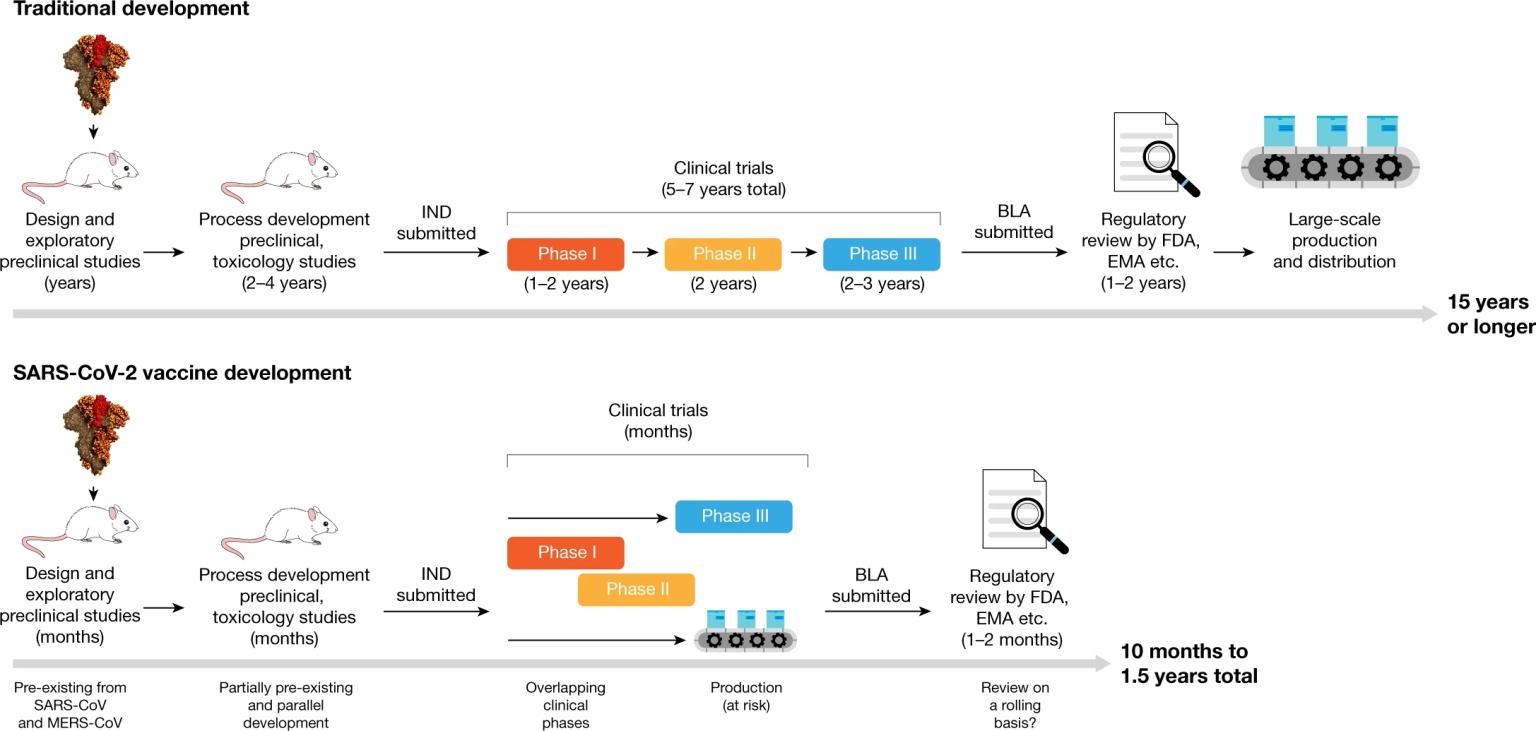
Although the stages are the same for both cases, there is a factor of 10 to 18 between the duration of the projects, thus making it possible to obtain value early. The accelerated development of vaccines against covid-19 is due to a multitude of circumstances: a very short research phase due to the prior knowledge of vaccines for SARS-CoV and MERS-CoV, the parallel execution of phases I and II of the clinical study (fast-tracking, in traditional project management jargon) and large-scale vaccine production before obtaining a marketing permit from regulatory authorities (another traditional project schedule management technique called lead). From a management point of view, the development of the new vaccines has used a hybrid model that adds traditional elements such as lead or fast-tracking to a highly agile environment. In addition, it is an example of generating value throughout the life cycle of the project. For example, mRNA technology was developed before the pandemic, thus generating value that was later realized in the creation of the vaccine. Gone are the times in which it was common to spend long periods without harvesting any fruit to end up delivering the value generated shortly before closing the project. The hybrid model used to commercialize coronavirus vaccines in record time has created a precedent for future developments in the biotechnology field. Driving change To quote the famous saying, the best way to deal with change is to help create it. Are you in? |


Politics going agile (or not)!
| As the worldwide vaccination against covid-19 is slowly progressing, I had to reflect on a statement given by the Dutch Minister of Health, Hugo de Jong, back in early January 2021. Due to poor risk management and non-optimal decision-making, the Netherlands kicked off the vaccination campaign a few weeks later than his European neighbors. Mr. de Jong claimed that the country could have started vaccinating people earlier but was not agile enough to take decisions back in November 2020. Agile enough. I am quite positive that he used this term in the sense of someone being able to move quickly and easily rather than referring to the manifesto written 20 years ago. It got me thinking. Can politics be run in an agile manner? Politics differ largely from country to country and are influenced by a large amount of environmental and cultural factors. However, and for the sake of simplification, one can carry out a preliminary assessment by measuring the degree of adherence to the three laws of agile developed by Steve Denning (author of the reference book Age of Agile). Does it comply with the Law of the Customer? In other words, is adding value to their customers (citizens) the top priority of politicians? At the end of the day, politicians are responsible for proposing, supporting and creating laws or policies to govern the land and, by extension, its people. The degree of success they achieve may be measured against the actual value delivered to the citizens and the efficiency of resources used to achieve the set goals. Assuming that political programs are developed to serve the citizens in the best possible manner, then the adherence to the law of the customer may be directly linked to the fulfillment of these programs. Does it comply with the Law of the Small Teams? This is about descaling complex problems into small pieces, working in small cycles and getting direct feedback from the citizen. A political cycle is defined by the time between two elections, typically four years. Therefore, the most direct feedback can only be given every four years by casting a vote. This is anything but frequent feedback and leaves the customer with a feeling of despair. The pandemic has been an example of how the involvement of too many stakeholders played against a quick and unified response. After the initial discoordination, the Dutch government launched an initiative to create the Outbreak Management Team, a small group of knowledgeable SMEs who report directly to the Ministry of Health. Overall, and despite some baby steps in the good direction, the adherence to this law fares low. Does it comply with the Law of the Network? Organizations that fulfill this law function as a fluid network, with communication flowing up, down and sideways. Ideas can come from anywhere. On the contrary, political systems are rather hierarchical with inflexible communication channels and responsibilities, similarly to what occurs in some large corporations. Even though politics are making efforts to increase their accessibility (Twitter has been a game-changer in this aspect), it is still a long way until they become truthfully fluid. In short: politics are currently not run in a fully agile manner. On the positive side, there is plenty of room and opportunities for further development in this field; on the less positive side, some of the usual dogmas are going to be hard to change. |
Predict or Adapt. Why should we choose?
| One of the most popular thread in a project management forum is about predictive and adaptive project management methodologies, and whether only of the two will prevail. Black or white. Sweet or salty. Hot or cold. Like in most things in life, the sweet spot is somewhere in the middle. In this blog, I’d like to scratch the surface of this “dilemma” in the pharmaceutical industry. There are two factors to consider to assess the suitability of a predictive or an adaptive model in order to achieve the project goals: the need for creativity and the speed to market. If these two score low, a predictive model will likely be the best fit. Think of projects like the commissioning and qualification of a new manufacturing line or the implementation of a laboratory information management system. However, projects that require high doses of creativity or are time-to-market constrained fit better in an adaptive model. Think of projects related to the development of new drugs or investigation of new indications for existing products. At the end of the day, most projects are managed following a mix of these models, leaning more towards adaptive or predictive depending on the particularities of the project. The development of a vaccine against covid-19, the disease caused by SARS-CoV-2, is an example of this. On one hand, it was (still is) a project subjected to an enormous pressure. Speed to market scores very high. On the other hand, the steps to conceive, develop, register and mass produce a vaccine do not require creativity and are subjected to a stringent regulation from several regulatory bodies across the globe. The prestigious scientific journal Nature published a very informative infographic that depicts the roadmap for the development and commercialization of SARS-CoV-2 vaccine versus a traditional vaccine (Nature 586, 516–527, 2020). In short, both differ by a factor of 10! Compared to the traditional development, the schedule of SARS-CoV-2 vaccine makes use of two techniques that typically fall under the predictive model: fast tracking – by running clinical phases in parallel instead of sequentially – and crashing – throughout the whole project but more obvious in the assessment phase by the regulatory authorities (from 1 to 2 years to 1 to 2 months!). To summarize: “the best” model or a model that fits all does not exist. In a fast changing world it is crucial to avoid dogmatism and embrace the challenges that present themselves with an open mind. |
Passing PSM I
| Yesterday I cleared the PSM I (Professional Scrum Master I) exam, with a score of 96.3%; thus, I failed 3 out of the 80 questions. Passing the exam requires a minimum of 85%, or getting right at least 68 out of 80 questions. The list below randomly captures recommendations and observations about achieving PSM I.
Good luck to all future PSM I holders. Never stop learning. The important thing is not to stop questioning. Curiosity has its own reason for existing (Albert Einstein) |


