
Simplicity is the ultimate sophistication


| Leonardo de Vinci said these words some 500 years ago. The words of a visionary. Fast forward to 1960, the KISS principle – Keep It Simple, Silly (or Stupid, depending on the source) – states that most systems work best if they are kept simple. In other terms, unnecessary complexity must be avoided. This postulate resonates well with other famed quotes of Albert Einstein "If you can't explain it simply, you don't understand it well enough" or French writer Antoine de Saint-Éxupery “It seems that perfection is reached not when there is nothing left to add, but when there is nothing left to take away”. We aim for simplicity in an increasingly Volatile, Uncertain, Complex and Ambiguous world (VUCA, an acronym coined in 1987). As a society and as individuals, we face a constant challenge: to be able to simplify in a complex environment.
In the recent history one can find examples of how simplicity has led to successful stories. I recall that my first cell phone, back in the mid-90s, came with a thick booklet of instructions. Operating the phone – not yet smart – required some serious reading and testing. As technology advanced, phones became smarter and simpler. As a matter of fact, A
Project management is a discipline affected by the shift towards simplicity. An example of this can be seen in the evolution of the number of pages in one of the most used resources, the PMBoK (Project Management Body of Knowledge, from the Project Management Institute). From the 1st ed., released in 1996, until the 6th ed., released in 2017, the number of pages has steadily increased until reaching an staggering 978 pages for the 6th ed. The 7th and last edition to date, released in 2021, has knocked this figure down to 370. The decrease of the number of pages is a consequence of a shift towards simplicity and a focus in performance over processes; the 49 (!) processes in PMBoK 6th ed. have turned into 8 performance domains and 12 project management principles. It is a step in the good direction and opens up the door to further simplicity in the coming years.
Along these lines, I would like to recommend the Project Management Handbook by Antonio Nieto-Rodriguez (Harvard Business Review), who is able to address project management from an outsider’s perspective in a pragmatic and hand-on manner. As he writes, a simple framework and a common language are key elements to the success of almost any endeavor.
Last but not least. Simplicity derives from a standard with which we are all equipped: common sense, although Voltaire said in 1764 that common sense is not so common. Surely we have experienced conversations at work that have spiraled towards complexity. Before we know it, parallel arguments and theories are thrown in about topics that add little in solving the real issue; on the contrary, they add up complexity. In these cases, applying a dose of unbiased fact-based common sense is often the first step in the right direction. It is not my intention to claim that the application of simplicity is a silver bullet for all issues. But amid a bombardment of dozens of methodologies and practices, it is important to make sure that we do not neglect something as valuable as common sense. |
 pple’s cofounder Steve Jobs developed a phone with a revolutionary user interface that made an instructions booklet unnecessary. The user was able to operate the phone and test its functionalities in a simple manner. The customer valued the iPhone’s simplicity. It is not surprising that the message displayed on the wall of Apple’s marketing department reads “
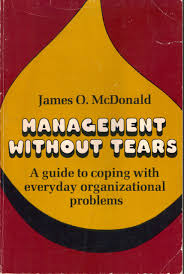
Management without tears
| I have recently completed the lecture of a book entitled "Management without tears. A guide to coping with everyday organizational problems". It was written by James O. McDonald almost 40 years ago, in 1981 to be precise. The book sets forth some managerial problems likely to be encountered during the career of a manager. For each problem, the author provides a solution based on his expertise. Although it is intended for managers - line managers, production managers, operations manager and functions alike - as a project manager I could relate to a few of the problems listed in the book. It is worth noting that most of the issues we face in our everyday work are nothing new, they have been there for a long time and will probably still be there when we retire.
Get things off your chest The author refers to the manager's secretary and her frequent tardiness. The manager decides to not bring this up to her to avoid losing his "nice guy" reputation. As you can imagine, this approach did not work out and she kept arriving late to the office. The manager decided to confront her. She said that she was not aware that her tardiness was such an issue, and from that moment on she was on time. In projects the same approach works; when something gets off tracks, avoid sending a memorandum sitting behind the computer. Politely confront the team - or whichever stakeholder - and get it off your chest. Being a pleaser can easily end up backfiring. Know your job It is frequent that an engineer, a software developer or a researcher gets dragged into project management. Becoming a project manager presents then a challenge. The technical knowledge in these domains become less relevant; instead, planning, personnel, budgets, purchasing, negotiation and a wide array of administrative tasks make up the new life. Getting this mental fix is essential for a successful new career. Be yourself This topic is particularly interesting. It is quite common to find opinionated colleagues regarding how a project manager should behave. Some would say "Stand tough, or they'll walk all over you" whilst others would advise on the opposite direction. Leadership tone has to be decided by the practitioner, and the practitioner alone. It is up to the practitioner whether to be tough, soft or somewhere in between. In words of the author "effective management requires integrity, conviction, knowledge, courage, awareness, timing. These qualities determine how you react in any situation". |
 My blog followers know that I always like to break things down in three, or pick up the top 3, or make lists of 3 items. Number three puts a spell on me - I guess since the time I learned at school that the compositions had to contain an introduction, a "knot", and an ending. So this time around will not be any different. I have picked the top 3 issues, and summarized the author's view on a proposed solution.

