


We often label bad experiences at work as toxic leadership. It’s a convenient shortcut to explain disengagement or quiet resentment. But the more I reflect on it, the more the term itself starts to feel misleading.
Because if leadership is toxic, if if it consistently erodes trust and destroys long‑term value, should we still call it leadership?
To explore this question, I find it useful to strip leadership down to two fundamental dimensions.
A simple leadership matrix
Imagine leadership mapped across two axes:
- Competence ➜ the ability to consistently turn intent into outcomes through sound judgment, clear decision-making and effective execution.
- Human awareness ➜ An umbrella term that includes empathy, emotional intelligence, self‑awareness and the ability to understand how one’s actions affect others.
Cross these two dimensions, and four leadership archetypes emerge.
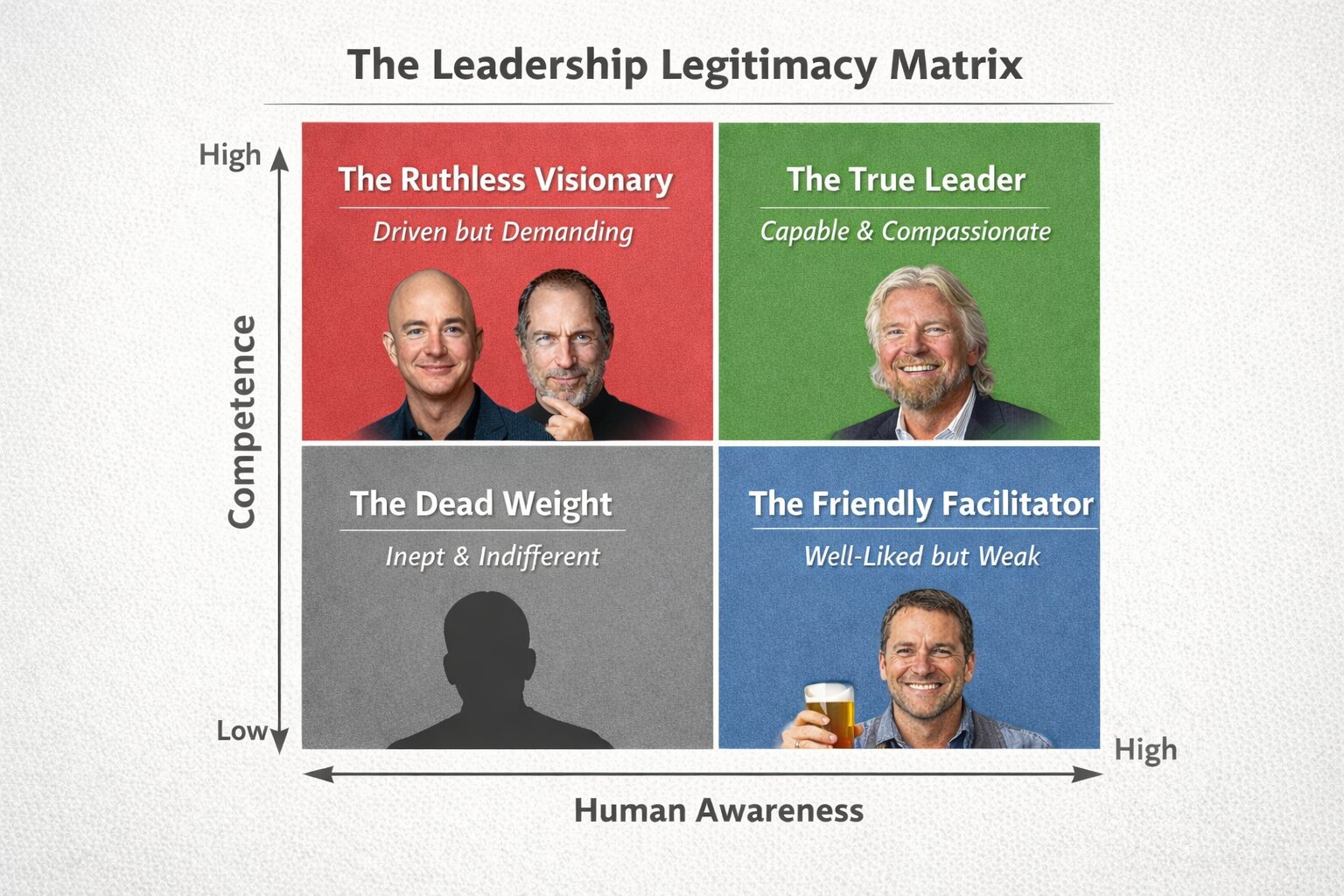
1. HIGH COMPETENCE, HIGH HUMAN AWARENESS — THE TRUE LEADER
This is the quadrant most leadership books describe, and also the one people encounter least often.
These leaders are strong decision‑makers who understand the work deeply but they are grounded enough to know they don’t have all the answers. They hire people better than themselves, avoid micromanagement, and create clarity without crushing autonomy. They understand that suistainable success is a collective effort. Results matter, but so do the people producing them.
A commonly cited example is Richard Branson. He has repeatedly emphasized trust and putting people first, not as soft values, but as strategic ones. His leadership style reflects a belief that if you take care of people, performance follows.
This is leadership that compounds over time.
2. High competence, low human awareness — The Extractor
This quadrant is often confused with strong leadership.
These individuals are frequently visionaries: resilient, ambitious, intolerant of excuses, and unafraid of failure. When told something isn’t possible, they respond with “then figure it out.” They push boundaries and redefine industries.
But they do so by extracting relentlessly from the people around them.
In The Everything Store (Brad Stone’s book on Amazon), employees describe environments marked by extreme hours, constant pressure, public criticism and little recognition. Performance is demanded at all costs. People are interchangeable. Burnout is collateral damage.
Jeff Bezos is often cited in this category, as is Steve Jobs during certain periods of his career. Both delivered extraordinary results. Both also left behind well‑documented trails of exhausted, expendable talent.
These leaders don’t lack intelligence or drive. They lack restraint.
3. Low competence, high human awareness — The Beer Buddy
These leaders are easy to like.
They are approachable and genuinely attentive to how people feel. One-on-ones are friendly. Conversations often drift toward weekend plans, personal stories and shared frustrations.
The problem is not intent, it’s direction.
This archetype often shows up as managers who arrive at one-on-ones unprepared, asking questions like “What do you want to do?” without offering structure or a clear development perspective. People feel safe, but stagnant. Without competence, empathy alone becomes passive. Teams don't grow. Standards blur. Potential remains untapped.
Comfort replaces progress.
4. Low competence, low human awareness — The Detractor
This is the most damaging quadrant, and, unfortunately, not a rare one.
These leaders lack the skills to do the job and the awareness to recognize the impact they’re having. They create confusion, drain energy, and slow everything they touch.
Instead of extracting value, they subtract it.
Decisions are inconsistent. Feedback is absent or arbitrary. Accountability flows downward but never upward. Over time, capable people disengage or leave, not loudly, but deliberately.
What remains is inertia.
Why this distinction matters
Most people in organizations don’t choose their leaders, but they live with the consequences.
Understanding these patterns helps explain why some environments feel energizing while others feel depleting, even when the work itself is similar. It clarifies why results alone are a poor proxy for leadership quality, and why good intentions without capability still cause harm.
When we label all of this as leadership, we lose precision. And without precision, we normalize behaviors that should be questioned.
So… is toxic leadership really leadership?
Maybe the real issue isn’t toxic leadership at all.
Maybe it’s that we’ve expanded the definition of leadership so much that we’ve stopped interrogating it. We tolerate behaviors we would never accept from a peer, simply because they come wrapped in authority or justified by results. Competence without human awareness creates output, but not progress. Human awareness without competence creates comfort, but not growth.
Leadership only exists when both are present.
Everything else deserves a different name.
And once you see these patterns, the harder question becomes: which quadrant have you been operating in, and which one are you enabling?
Posted on: February 02, 2026 10:54 AM |
Permalink

 Community Champion




