Simplicity is the ultimate sophistication


| Leonardo de Vinci said these words some 500 years ago. The words of a visionary. Fast forward to 1960, the KISS principle – Keep It Simple, Silly (or Stupid, depending on the source) – states that most systems work best if they are kept simple. In other terms, unnecessary complexity must be avoided. This postulate resonates well with other famed quotes of Albert Einstein "If you can't explain it simply, you don't understand it well enough" or French writer Antoine de Saint-Éxupery “It seems that perfection is reached not when there is nothing left to add, but when there is nothing left to take away”. We aim for simplicity in an increasingly Volatile, Uncertain, Complex and Ambiguous world (VUCA, an acronym coined in 1987). As a society and as individuals, we face a constant challenge: to be able to simplify in a complex environment.
In the recent history one can find examples of how simplicity has led to successful stories. I recall that my first cell phone, back in the mid-90s, came with a thick booklet of instructions. Operating the phone – not yet smart – required some serious reading and testing. As technology advanced, phones became smarter and simpler. As a matter of fact, A
Project management is a discipline affected by the shift towards simplicity. An example of this can be seen in the evolution of the number of pages in one of the most used resources, the PMBoK (Project Management Body of Knowledge, from the Project Management Institute). From the 1st ed., released in 1996, until the 6th ed., released in 2017, the number of pages has steadily increased until reaching an staggering 978 pages for the 6th ed. The 7th and last edition to date, released in 2021, has knocked this figure down to 370. The decrease of the number of pages is a consequence of a shift towards simplicity and a focus in performance over processes; the 49 (!) processes in PMBoK 6th ed. have turned into 8 performance domains and 12 project management principles. It is a step in the good direction and opens up the door to further simplicity in the coming years.
Along these lines, I would like to recommend the Project Management Handbook by Antonio Nieto-Rodriguez (Harvard Business Review), who is able to address project management from an outsider’s perspective in a pragmatic and hand-on manner. As he writes, a simple framework and a common language are key elements to the success of almost any endeavor.
Last but not least. Simplicity derives from a standard with which we are all equipped: common sense, although Voltaire said in 1764 that common sense is not so common. Surely we have experienced conversations at work that have spiraled towards complexity. Before we know it, parallel arguments and theories are thrown in about topics that add little in solving the real issue; on the contrary, they add up complexity. In these cases, applying a dose of unbiased fact-based common sense is often the first step in the right direction. It is not my intention to claim that the application of simplicity is a silver bullet for all issues. But amid a bombardment of dozens of methodologies and practices, it is important to make sure that we do not neglect something as valuable as common sense. |
 pple’s cofounder Steve Jobs developed a phone with a revolutionary user interface that made an instructions booklet unnecessary. The user was able to operate the phone and test its functionalities in a simple manner. The customer valued the iPhone’s simplicity. It is not surprising that the message displayed on the wall of Apple’s marketing department reads “
Value generation and project management: two sides of the same coin
| The objective of this article is to provide a high-level analysis of the relationship between project management and the contribution of value in the achievement of strategic objectives. Concepts such as agile transformation or project economy have become part of the business lexicon in a rapidly changing environment. The covid-19 vaccine development and commercialization project is a representative example of a new paradigm in the creation and management of value. From the Great Pyramids to the project economy Moving to more recent times, it was not until the 20th century that the popularity and professionalization of project management increased and different associations began to emerge to proselytize various project management frameworks, tools and techniques. A transition process is currently underway towards the so-called project economy, in which people acquire the skills and abilities necessary to turn ideas into reality. Value is created through successful project completion, product delivery, and alignment with the organization's strategic goals. In the project economy, project managers abandon operational tasks and begin to bear higher levels of responsibility in converting ideas into value. The project manager of the 21st century Broadly speaking, there are two factors to consider when evaluating the suitability of a predictive or adaptive model to achieve the objectives of a project: the need for creativity and the speed of commercialization.
A manufacturing line validation project or one for the development of new drugs requires different levels of creativity and speed to market. The former fits well into more traditional or predictive management while the latter requires an approach that facilitates greater adaptability. There is no one model superior to the other, the two models or their mixture are perfectly viable and must be molded according to the specific needs that each situation and moment demands. Something similar to what happens with the so-called scrumban, an unregulated mixture of scrum and Kanban that creates misgivings in some purists but can be highly effective. There is no doubt, the world today is changing at a great speed. The acronym VUCA has been added to the dictionary of professionals in all fields. The paradigm shift affects aspects such as corporate culture, promoting collaboration and entrepreneurship, or structural ones, moving from a hierarchical or silos arrangement to others with a higher level of self-management. Projects and their managers are not impervious to these changes, continuously adapting without losing sight of the main objective: to promote change and add value. A 2019 Gartner study ensures that 80% of the tasks carried out by a project manager will have been eliminated by 2030 as a result of the rise of artificial intelligence. Report writing, monitoring or data collection will add to the list of machine payroll activities. Even the selection of projects that make up the portfolio can be delegated to computers. However, the project manager is still in the top 20 of the most in-demand roles across all industries. To stay in this privileged position, the project management professional must expand their field of action and incorporate a series of elements such as agile, lean, design thinking or product management, among others, thus becoming an implementing agent of business strategy. Vaccines in record time
Although the stages are the same for both cases, there is a factor of 10 to 18 between the duration of the projects, thus making it possible to obtain value early. The accelerated development of vaccines against covid-19 is due to a multitude of circumstances: a very short research phase due to the prior knowledge of vaccines for SARS-CoV and MERS-CoV, the parallel execution of phases I and II of the clinical study (fast-tracking, in traditional project management jargon) and large-scale vaccine production before obtaining a marketing permit from regulatory authorities (another traditional project schedule management technique called lead). From a management point of view, the development of the new vaccines has used a hybrid model that adds traditional elements such as lead or fast-tracking to a highly agile environment. In addition, it is an example of generating value throughout the life cycle of the project. For example, mRNA technology was developed before the pandemic, thus generating value that was later realized in the creation of the vaccine. Gone are the times in which it was common to spend long periods without harvesting any fruit to end up delivering the value generated shortly before closing the project. The hybrid model used to commercialize coronavirus vaccines in record time has created a precedent for future developments in the biotechnology field. Driving change To quote the famous saying, the best way to deal with change is to help create it. Are you in? |


Our iceberg is melting - revisited
Categories:
Change; Change management; Team management
Categories: Change; Change management; Team management
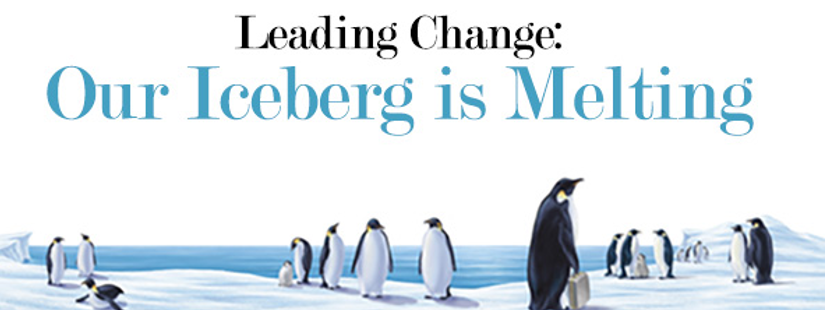
| Our iceberg is melting is not a new release – in fact its first edition dates back from 2005. Nevertheless, the content of this wonderful fable about change management is still valid today. Organizations are constantly evolving in order to adapt to a changing environment. The authors of the book, John Kotter and Holger Rathgeber, describe the change that a penguin colony must undertake in order to adjust to a changing reality and save their lives.
The reader shall not get fooled by the numerous illustrations that populate the pages of this book. This is not a children’s book. And this is precisely what makes it so valuable. In a world with abundance of academic materials about change management, using penguins instead of complex flowcharts increases the reader engagement – and makes the key concepts stick. The reader will surely recognize the characters of the book. For instance, Fred, an observant penguin who identifies and reports the worrying issue to Alice. She is the go getter penguin that puts the valuable information in the agenda of colony’s counsel. Or Louis, the head penguin, wise and respected by all except the naysayers (sure we can all think of naysayers in our organizations!). And Buddy, a not so wise but charismatic penguin whose main role is to provide assurance and confidence in times of distrust. Finally, don’t forget the Professor, who will make use of scientific evidence to back up the need for change throughout the arduous journey. The change team is ready, and they will be covering all required stages; creating and communicating a vision of the new reality, circumventing all obstacles, getting the colony onboard by empowering it and recognizing the efforts carried out by all colony members. These are, in a nutshell, the stages that the reader is navigated through since the need for change is detected until it is successfully implemented (apologies for the spoiler, but when has a fable end up badly?). I read this book during the lockdown caused by coronavirus, which made its lecture very special. At the end of the day, this pandemic will lead the whole world to live in a different way, what has been coined as “new normality”. What a better example of change management than this? One can mull over the reasons that have caused a poor management of the pandemic, specially during the initial stage. A scientific article published in 2007 (Clin. Microbiol Rev 20(4)) took the role of Fred and warned about it: “The presence of a large reservoir of SARS-CoV-like viruses in horseshoe bats, together with the culture of eating exotic mammals in southern China, is a time bomb. The possibility of the reemergence of SARS and other novel viruses from animals or laboratories and therefore the need for preparedness should not be ignored.” Was there an Alice to put this item in the agenda of all world leaders? Were there too many Louis’ leading the efforts to fight the battle against the virus? Did the community trust its leaders? The lecture of this book brings an opportunity to reflect about these aspects and change management in general. |