Random Thoughts
by Eduard Hernandez

Uniting the passion for writing and project management
Recent Posts
Copilot, not Autopilot: Three weeks of learning to trust (and argue with) my AI assistant
Autonomous vehicles: when 90% done means nowhere near ready
The accidental path to Project Management
What history reveals about AI and the Project Manager profession
When results aren’t enough: Rethinking Leadership
Categories
74-343,
Agile,
Agile,
Artificial Intelligence,
basadur,
Budget Management,
Career Development,
Certification,
Change Management,
Change; Change management; Team management,
Chapter,
Communications Management,
Complexity,
conceptualizer,
Cost Management,
data management,
Decision Making,
Estimating,
Ethics,
generator,
Giga Projects,
Goal Setting,
Governance,
Human touch,
implementer,
Leadership,
Lessons Learned,
machine learning,
MS Project 2013,
Negotation,
New Practitioners,
optimizer,
Organizational behavior,
Organizational Culture,
personal growth,
pharmaceutical; lifecyle management; agile; waterfall,
PMI,
Problem solving,
Product Owner,
Project Communication,
Project Management,
PSM I,
PSPO,
Resource Management,
Risk Management,
Scheduling,
Scope Management,
Scrum,
self-development,
Stakeholder management,
Strategy,
Teams,
test,
training,
Volunteering
Date
We often label bad experiences at work as toxic leadership. It’s a convenient shortcut to explain disengagement or quiet resentment. But the more I reflect on it, the more the term itself starts to feel misleading.
Because if leadership is toxic, if if it consistently erodes trust and destroys long‑term value, should we still call it leadership?
To explore this question, I find it useful to strip leadership down to two fundamental dimensions.
A simple leadership matrix
Imagine leadership mapped across two axes:
- Competence ➜ the ability to consistently turn intent into outcomes through sound judgment, clear decision-making and effective execution.
- Human awareness ➜ An umbrella term that includes empathy, emotional intelligence, self‑awareness and the ability to understand how one’s actions affect others.
Human awareness and emotional intelligence are closely related, but not identical. Emotional intelligence is the capability to perceive and manage emotions: your own and others’. Human awareness is how that capability shows up in daily behavior: listening, recognizing limits, understanding context and treating people as thinking adults rather than interchangeable units.
Cross these two dimensions, and four leadership archetypes emerge.
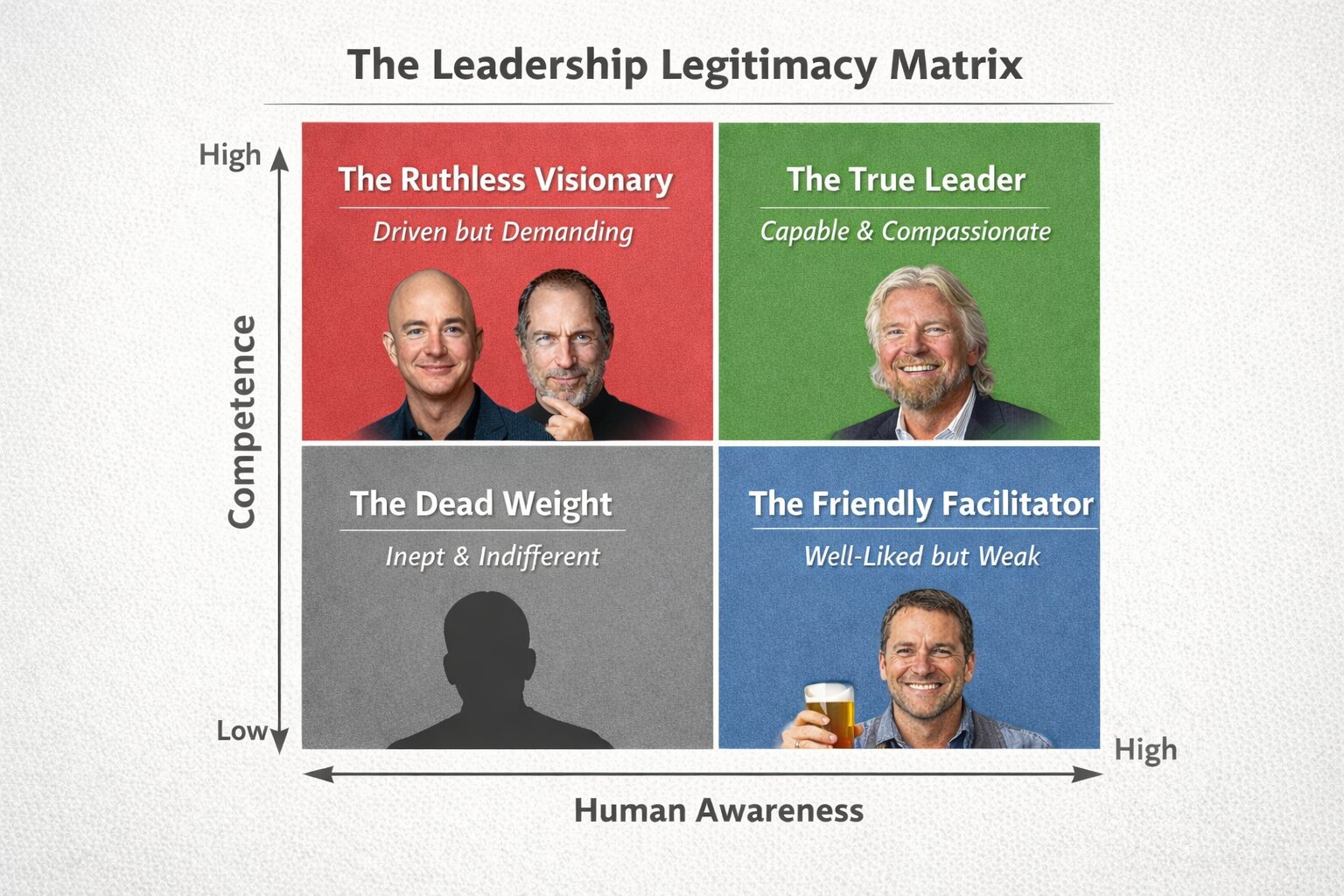
1. HIGH COMPETENCE, HIGH HUMAN AWARENESS — THE TRUE LEADER
This is the quadrant most leadership books describe, and also the one people encounter least often.
These leaders are strong decision‑makers who understand the work deeply but they are grounded enough to know they don’t have all the answers. They hire people better than themselves, avoid micromanagement, and create clarity without crushing autonomy. They understand that suistainable success is a collective effort. Results matter, but so do the people producing them.
A commonly cited example is Richard Branson. He has repeatedly emphasized trust and putting people first, not as soft values, but as strategic ones. His leadership style reflects a belief that if you take care of people, performance follows.
This is leadership that compounds over time.
2. High competence, low human awareness — The Extractor
This quadrant is often confused with strong leadership.
These individuals are frequently visionaries: resilient, ambitious, intolerant of excuses, and unafraid of failure. When told something isn’t possible, they respond with “then figure it out.” They push boundaries and redefine industries.
But they do so by extracting relentlessly from the people around them.
In The Everything Store (Brad Stone’s book on Amazon), employees describe environments marked by extreme hours, constant pressure, public criticism and little recognition. Performance is demanded at all costs. People are interchangeable. Burnout is collateral damage.
Jeff Bezos is often cited in this category, as is Steve Jobs during certain periods of his career. Both delivered extraordinary results. Both also left behind well‑documented trails of exhausted, expendable talent.
These leaders don’t lack intelligence or drive. They lack restraint.
3. Low competence, high human awareness — The Beer Buddy
These leaders are easy to like.
They are approachable and genuinely attentive to how people feel. One-on-ones are friendly. Conversations often drift toward weekend plans, personal stories and shared frustrations.
The problem is not intent, it’s direction.
This archetype often shows up as managers who arrive at one-on-ones unprepared, asking questions like “What do you want to do?” without offering structure or a clear development perspective. People feel safe, but stagnant. Without competence, empathy alone becomes passive. Teams don't grow. Standards blur. Potential remains untapped.
Comfort replaces progress.
4. Low competence, low human awareness — The Detractor
This is the most damaging quadrant, and, unfortunately, not a rare one.
These leaders lack the skills to do the job and the awareness to recognize the impact they’re having. They create confusion, drain energy, and slow everything they touch.
Instead of extracting value, they subtract it.
Decisions are inconsistent. Feedback is absent or arbitrary. Accountability flows downward but never upward. Over time, capable people disengage or leave, not loudly, but deliberately.
What remains is inertia.
Why this distinction matters
Most people in organizations don’t choose their leaders, but they live with the consequences.
Understanding these patterns helps explain why some environments feel energizing while others feel depleting, even when the work itself is similar. It clarifies why results alone are a poor proxy for leadership quality, and why good intentions without capability still cause harm.
When we label all of this as leadership, we lose precision. And without precision, we normalize behaviors that should be questioned.
So… is toxic leadership really leadership?
Maybe the real issue isn’t toxic leadership at all.
Maybe it’s that we’ve expanded the definition of leadership so much that we’ve stopped interrogating it. We tolerate behaviors we would never accept from a peer, simply because they come wrapped in authority or justified by results. Competence without human awareness creates output, but not progress. Human awareness without competence creates comfort, but not growth.
Leadership only exists when both are present.
Everything else deserves a different name.
And once you see these patterns, the harder question becomes: which quadrant have you been operating in, and which one are you enabling? |
Posted on: February 02, 2026 10:54 AM
|
Permalink |
Comments (6)
| Ah, the thrill of decision-making in project management! The excitement, the brainstorming sessions, the camaraderie—and occasionally, the spectacular failures. As I recently delved into Jared Diamond’s Collapse, I was struck by his masterful analysis of how groups stumble into failure. In Chapter 14, Diamond outlines four categories of decision-making pitfalls that resonate deeply with our modern project challenges.
 Let’s take a tour through these categories, illustrated by historical examples from his book and mirrored by some contemporary project misadventures. Let’s take a tour through these categories, illustrated by historical examples from his book and mirrored by some contemporary project misadventures.
1. Failing to anticipate a problem
In Collapse, Diamond discusses how the Norse in Greenland failed to anticipate the Little Ice Age. They stuck to their European farming methods despite the changing climate, which ultimately led to their downfall. Fast forward to our era, and think of the blockbuster flop that was Google Glass. The product team, dazzled by the tech’s potential, didn’t anticipate consumer privacy concerns and the social stigma of being a “Glasshole.” Just like the Norse, they stuck to their vision, blind to the gathering storm.
2. Failing to perceive a problem
Diamond points out the classic case of the Easter Island civilization, which didn’t perceive the long-term consequences of deforestation. They chopped down every tree, oblivious to the environmental collapse it would trigger. A modern echo of this is the infamous Boeing 737 Max debacle. Despite internal warnings and obvious design flaws, Boeing failed to perceive—or at least acknowledge—the gravity of the problem until it was too late, resulting in tragic crashes and a costly grounding of the fleet.
3. Failing to try to solve the problem
The classic Maya civilization, another of Diamond's examples, saw environmental degradation and political strife but failed to address these issues effectively. Contemporary parallel? Think of Blockbuster. They saw the rise of digital streaming but chose to ignore it, clinging to their brick-and-mortar model until Netflix and other streaming services had eaten their lunch. It wasn’t that they didn’t perceive the problem; they simply didn’t try to adapt in time.
4. Failing to solve the problem successfully
Lastly, Diamond discusses the example of the Soviet irrigation projects in Central Asia that led to the Aral Sea disaster. They recognized the problem and tried to address water scarcity, but their solutions were catastrophic, turning the sea into a toxic desert. A modern-day counterpart would be the development of the F-35 fighter jet. Despite massive investment and numerous attempts to address its issues, the project has been plagued by cost overruns and technical failures, making it one of the most controversial military projects today.
In conclusion, decision-making is as much about avoiding pitfalls as it is about seizing opportunities. By reflecting on historical and contemporary examples of failed group decisions, we can learn to navigate the complexities of our own projects with a bit more savvy—and perhaps a dash of humility. So, the next time you’re in a meeting and someone says, “What could possibly go wrong?” just remember: quite a lot, actually.
|
Posted on: July 15, 2024 04:03 PM
|
Permalink |
Comments (6)
| Ever faced situations where ideas varied in execution quality? There are good ideas poorly executed, bad ideas well executed, and then there are bad ideas executed even worse. Let me share an example of the latter. In July, the eighth edition team of the "Arctic Challenge" expedition set out from Costa del Sol to Greenland. Their goal? To document climate change effects and undertake the "Iceberg Operation" — transporting a 15,000-kilogram (approx. 33,000-pound) glacier chunk to Spain, exhibiting it in central Malaga, where it would gradually melt.
 Noble intention to raise climate awareness, right? Well, it stirred controversy, especially drawing criticism from Ecologistas en Acción, labeling it counterproductive and mere PR by authorities. Noble intention to raise climate awareness, right? Well, it stirred controversy, especially drawing criticism from Ecologistas en Acción, labeling it counterproductive and mere PR by authorities.
The Project
Led by Málaga explorer Manuel Calvo Villena, the expedition ran from July 17th to August 3rd. The plan? Ship the massive ice chunk in a refrigerated vessel at -22°C from Greenland to southern Spain. All seemed well until the shipping company reported a mishandled load, leading the ice block to impact the container doors, breaking into four pieces. Despite this setback, they decided to continue. After days at sea (more than initially planned), the captain confirmed the iceberg wouldn't arrive, sharing a picture where the largest piece resembled a watermelon. Everyone was astonished. The project went belly up... or maybe not?
Success or failure
Ever heard the Spanish saying that it's better people talk about you, even if negatively? The gist: attention, even if negative, may hold more value than being completely forgotten. The failure gained worldwide notoriety, featured in over 180 international media outlets. One could argue that the goal of raising awareness about global warming succeeded, albeit through an unexpected path. Speaking about the project's failure meant talking about the underlying issue of climate change.
The Sydney Opera House project is another example — initially a failure later considered a success. The difference? Sydney Opera House was a good idea poorly executed, evident in its massive cost overrun and delays. In contrast, bringing a massive Arctic ice chunk was flawed from the start. There wasn't enough time or common sense applied to analyze the energy cost of hauling such a load at sub-zero temperatures across such distances — about 1500 metric tons of CO2 contributing to the very climate change the project aimed to address. It's a classic case that should've gone back to the drawing board before diving into such foolishness. In a way, it's reminiscent of world leaders jetting off in private planes to climate summits with entourages of gas-guzzling cars.
Conclusion
Next time you're offered a lead or participation in a project, take the time to reflect on the idea's validity and purpose behind it. What some call the "higher purpose" or the "why".
Thanks for reading!
|
Posted on: November 17, 2023 08:56 AM
|
Permalink |
Comments (7)
| I recently came across an attention-grabbing paper titled “Dance hit song prediction”. In this research, the authors developed a predictive model to evaluate the likelihood of a new tune making it to the chart’s Top 10. For that purpose, a vast database containing dance hit songs from 1985 to 2013 was built; attributes such as tempo, duration, loudness, energy and danceability were measured. Amazingly enough, the model showed a success predictability of more than 70%!
 Could a homologous predictive model for project success be successfully developed (pun intended)? In a world that spends $48 trillion every year on projects, a success ratio of only 35% is not acceptable (data published by the Standish group). Invigorating the success rate is not a trivial task. Before a model can be developed - not in the scope of this humble article - it is indispensable to identify the key parameters that play a role in project success. Could a homologous predictive model for project success be successfully developed (pun intended)? In a world that spends $48 trillion every year on projects, a success ratio of only 35% is not acceptable (data published by the Standish group). Invigorating the success rate is not a trivial task. Before a model can be developed - not in the scope of this humble article - it is indispensable to identify the key parameters that play a role in project success.
The list below captures my Top 10:
- Familiarity of the performing organization with similar projects. Certainly, one can expect a decreasing success rate with increasing project complexity and/or uncertainty.
- Strength of business case and association of the project with a higher purpose. Broadly put, projects are initiated to exploit opportunities or to solve issues. The project's ultimate purpose must be summarized in a concise statement agreed upon by all stakeholders.
- Alignment of the project within the performing organization strategy. Although projects are conceived and executed in a dynamic world (the infamous VUCA acronym), this should not be used as an excuse for accepting chaos. Some projects will need to be cancelled and others are swerved to the fast lane. Whichever case, the decisions must be consistently aligned with the organization's overall strategy.
- Commitment from the project sponsor and the rest of the project team. The role of the sponsor is critical and goes beyond funding the project. In fact, the sponsor must challenge, support and steer the project. Sponsoring a countless number of projects at a time is inefficient and can lead to delays and frustration.
- Selection and usage of appropriate and meaningful project performance indicators. Think of Einstein when defining KPIs; he wrote, "If you judge a fish by its ability to climb a tree, it will live its whole life believing that it is stupid".
- Organizational set-up (for example, siloed vs. non-siloed). Companies are gradually shifting towards non-siloed fluid structures with more room for interaction and shorter communication lines. This pragmatic way of working allows frequent feedback from project stakeholders and can significantly contribute to its success.
- Resource availability & competencies. The management of projects is all about people: people are key! For the sake of success, it is essential to understand that a higher variance - people involved in several projects at a time - will take a toll on project success.
- Truthfulness and accuracy of project schedule and budget. Even agile projects have plans, albeit susceptible to frequent change or pivoting.
- Availability of a project management plan or its subsidiaries, depending on project size and inner project characteristics (communication plan, risk management plan, etc.). Like Benjamin Franklin wrote, "Fail to plan and you are planning to fail".
- Clarity in project deliverables. The image below describes this well:

Do all ten items above have similar weights or is Pareto playing a role? Are there other factors missing? Have your saying in the comments section below.
|
Posted on: April 04, 2022 05:11 AM
|
Permalink |
Comments (6)
| When I was a little kid I used to read “Don Miki”, a thin booklet containing graphic comics of Mickey Mouse, Donald Duck and other characters like Goofy, Gyro Gearloose or the orange colored dog Pluto. It came out every two weeks and my grandmother visited the kiosk regularly to buy the latest issue, so I could enjoy reading it during my visits. Looking back, I realized that my passion for reading started perhaps with Walt Disney’s comics.
Fast forward to today, I found myself flipping through the pages of an ancient Don Miki together with my daughter; although she is still too young to grasp the content and moral of the stories, she surely enjoys glazing at the colorful pages. As I read the booklet, I put on the project manager lenses to realize that the fictitious characters with beaks and feathers could well be blueprints of their flesh and bone counterparts!
 I start with Donald Duck, an ill-tempered character with an upbeat attitude to life. He is a total procrastinator who chooses to take long naps over doing something useful. When he runs out of cash, which is almost every day, he doesn’t hesitate to ask his wealthy uncle Scrooge. Budget management surely would not be amongst his top three skills. He doesn’t get or do anything right and blames everyone else but himself for his disgrace. Despite these numerous flaws, Donald has a heart of gold. He would never leave his three nephews Huey, Dewey and Louie behind although sometimes he has a peculiar way of showing affection. With all due respect, I’d not choose this gracious duck to be in any of my teams. I start with Donald Duck, an ill-tempered character with an upbeat attitude to life. He is a total procrastinator who chooses to take long naps over doing something useful. When he runs out of cash, which is almost every day, he doesn’t hesitate to ask his wealthy uncle Scrooge. Budget management surely would not be amongst his top three skills. He doesn’t get or do anything right and blames everyone else but himself for his disgrace. Despite these numerous flaws, Donald has a heart of gold. He would never leave his three nephews Huey, Dewey and Louie behind although sometimes he has a peculiar way of showing affection. With all due respect, I’d not choose this gracious duck to be in any of my teams.
 But I would not vacillate to hire his beloved nephews Huey, Dewey and Louie - if they would have the minimum working age, naturally! They are crafty, inventive, responsible and always willing to give a helping hand in finding creative solutions to all sorts of problems. Their willingness to learn and experiment makes up for their shortcomings in areas that they are not too acquainted with. With such a wide array of skills, who could resist welcoming them onboard? But I would not vacillate to hire his beloved nephews Huey, Dewey and Louie - if they would have the minimum working age, naturally! They are crafty, inventive, responsible and always willing to give a helping hand in finding creative solutions to all sorts of problems. Their willingness to learn and experiment makes up for their shortcomings in areas that they are not too acquainted with. With such a wide array of skills, who could resist welcoming them onboard?
 Another one that I would enlist without hesitation is Gyro Gearloose, the genius inventor with an outrageous productivity rate, although sometimes his inventions do not work out the way he planned to. Can you picture Gyro in a scrum meeting? He would flourish in this setting, coming up with new features and ideas, and probably driving the rest of the development team crazy. Gyro is a superb mix of a generator and a conceptualizer who thrives on solving problems and exploring new opportunities. Assign him a predictable project and he’ll soon become demotivated and bored; enroll him in a highly adventurous initiative and he’ll quickly become the team cornerstone. Another one that I would enlist without hesitation is Gyro Gearloose, the genius inventor with an outrageous productivity rate, although sometimes his inventions do not work out the way he planned to. Can you picture Gyro in a scrum meeting? He would flourish in this setting, coming up with new features and ideas, and probably driving the rest of the development team crazy. Gyro is a superb mix of a generator and a conceptualizer who thrives on solving problems and exploring new opportunities. Assign him a predictable project and he’ll soon become demotivated and bored; enroll him in a highly adventurous initiative and he’ll quickly become the team cornerstone.

Last but not least, Mickey Mouse. He is a sweet, easy-going and carefree character, always eager to share his positivity with others and keep their spirits high during low times. Moreover, he is a composed professional even when inconveniences get in the way. On top of that, he is a true altruist who risks his own life for the safety of others without expecting any reward in return. I don’t know if you’d agree, but I believe that Mickey Mouse would make a striking project manager!
|
Posted on: February 24, 2022 10:25 AM
|
Permalink |
Comments (12)
|
If a woman has to choose between catching a fly ball and saving an infant's life, she will choose to save the infant's life without even considering if there is a man on base.
- Dave Barry
|




