Theory X Software Project Managers
Categories:
Project Leadership
Categories: Project Leadership


|
Let's review the Theory X / Theory Y models of McGregor, knowing full well they are just models. There is no purely Theory X or Theory Y manager. Theory XAssumes project team members:
Assumes project team members need:
Results in:
Theory YAssumes project team members:
Assumes project team members need:
Results in:
Knowledge Work, Specifically Software Project ManagementMy verdict is that software project managers exist out there in numbers who are heavily geared towards the Theory X side of things. And that the more they are, the more their teams succeed in spite of them rather than because of them. And even when they do succeed, it's far below the potential of the team. Now, what's your verdict? |
 I'm going to make a very specific case today.
Certifications Don’t Mean Squat...Unless They Do
Categories:
Career Development
Categories: Career Development
|
Saw this post recently in Project Management Central: Hello All, I'm a professional from telecommunication industry. Currently I'm employed with a telecom giant. My current profile makes me work for technical support group, however, I'm willing to move my career ahead in project management. But since I have no previous project management experience I cannot go for PMP certification. However, I can pursue Prince2 ( foundation + practioner) as it doesn't require any pre-requisites to be met. And I hope that Prince2 will aid me to change my job profile to project coordinator/ assistant. I'm also pursuing MBA in project management from Disance education. Please advise me if Prince2 is worth doing for me! I get questions like this one a lot. People trying to decide between an APM, IPMA, PMI, or PRINCE2 certification. Believe it or not my answer to this question is always the same. It depends. :-P Seriously dude. Let me explain. Target OrganizationsOrganizations are as different as anything else in our world. They all have different cultures, needs, and backgrounds. Some of them may absolutely HATE the PRINCE2 certification. Perhaps the founder had a bad experience, maybe the culture has no respect for these industry certifications. Whatever. Some may have drank the kool-aide of a particular certification and have based all of their processes around that particular framework and/or methodology. You Need To Find OutDo some research and find 3-5 organizations you want to go work for. For most of you that will be local you where you are currently living, for others who don’t mind moving you can expand your search. There are many things you can look for as sign posts of a culture you’ll enjoy and be able to grow with. But it starts with your own goals. If you want to be in a free-wheeling environment that is unstructured where you can make many changes and have a lot of influence even as someone new to the company, try a start-up. If you want to land in an environment filled with mentors and established career paths in project management, try a larger established company who has these things in place. Network Like A ManiacNetworking is a process, not an event. You should always be engaged in networking, not just when you are looking for a job. That’s actually the worst thing you could do, only network when you are hungry for a job. You are going to turn off a lot of people that way. Networking is an ongoing process of building relationships and trust over time with people who you like and who like you. You share common interests. In the case of targeting organizations, you may share the interest of a particular company. Perhaps they work for that organization already. The strategies and tactics involved with good networking are too exhaustive to cover in a blog post. If you want to go deeper into the rabbit hole with me, you can. I can tell you the primary approach however. Be Helpful, Add Value For Other PeopleMe! Me! Me! This is the wrong approach. When you reach out to people only to ask them if they know of a job, you are going to turn them off. It doesn’t work unless you’ve built a relationship and trust over time. Instead, do your best to help them. Ask them insightful questions about the work they do. Don’t just ask what you can do to help them, get to know them well enough that you can come up with an idea of how to help them and make it so all they have to do is say yes. Oh yeah, and you can ask them if their company gives a rip about certifications somewhere in there. |

Product Life Cycle Thinking in Project Management
Categories:
Lean
Categories: Lean
|
Initial Scope
This is probably the place we do best at identifying and trying to quantify the full life cycle costs of the product. There is at least a small section of the projects out there with a strong initiation phase that consider life beyond the final project milestone.
Change Control
When your project deals with a change request, what are the factors taken into account? Is it just a matter of how many hours or dollars it will take to implement the change? Documentation
When you decide to add another document into the mix or just on the initial number of documents required for your project, do you figure in the total impact for maintaining those documents across the entire product life cycle? Code
If you aren’t doing automated software builds and automated unit testing of code, have you figured in the lifetime costs during development and in operations of that decision? Processes
With all of the many processes that occur on your project, what’s the difference between their optimal state and the current state? Does saving an hour a day collectively across the project team because of a process improvement make a difference?
Training
Are you short-sighted in thinking that training your project staff or spending time learning how to get continually better is something you can’t afford? |
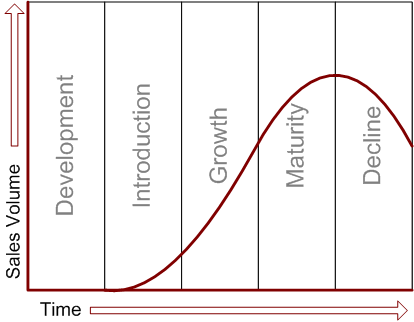 Do you manage your projects with the perspective of the full life cycle of the product(s) you are creating?
You've Got Muda On Your Shoes
Categories:
Lean
Categories: Lean
|
Waste. Shoveling Muda
For a long time now corporate offices have been intent on efficiency, on productivity. We have been shoveling value littered with muda, in some cases mostly muda. Self-Induced Muda
Now what if I tell you the muda involved in the above scenario is mostly self-induced? We’re actually creating the muda ourselves in many different ways. Eliminating Muda
What if there was a way to go about delivering what the customers wanted, without the mud? Or at least without bringing along our own mud to the project?
By the way, an answer like “upper management gets value because hey, they asked for it” is not good enough. Doing something just because somebody wants it isn’t good enough. Why do they want it? Are you sure they want it? |
 We have been focused on getting better at shoveling. More efficient shoveling is the only way to get more done, right?
The Distributed Agile Team: Greatest Challenge
|
Projects At Work just released a new report called “Distributed Agile Teams”.
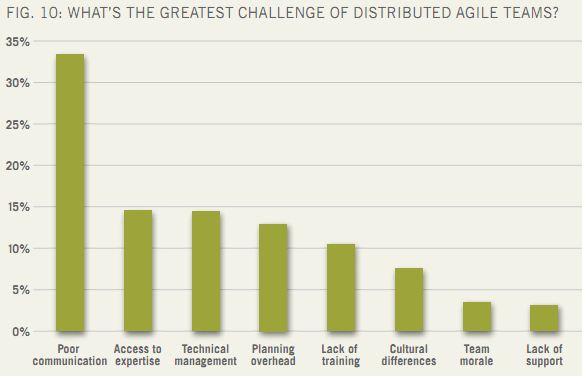
21. What is the greatest challenge of working with a distributed agile team?
“Poor Communication” was the biggest challenge by far. Go figure! Cross-Cultural Teams
I have experienced first-hand the frustration of assuming communication has been smooth with someone who does not have the same language as you for their first language, only to find out it wasn’t. Make It Objective
It’s important to make sure you are using some kind of documentation that makes it clear what is being delivered. Good software requirements work, user stories, use cases, behavior-driven development, etc. Make It Visual
The best way to communicate a concept clearly is through visuals, in my opinion. Independent Validation
Having someone else on the team independently validate the work of other team members after development is finished is critical. Tools For Distributed Teams
I think there is a lot of reliance on the wrong kind of tools out there for distributed teams. Task assignments shouldn’t be done through a software tool. In fact with something like kanban or some implementations of agile, it’s not even necessary. Self-organizing teams pull their own work out of the backlog. How do you think communication can be improved among distributed Agile teams? |