Project Management

Transformation & Leadership - Insider Tips

by , ,
Today's world is influenced by change. Project managers and their organizations need to embrace and sometimes drive changes to keep up with the pace in highly competitive environments. In this blog, experienced professionals share their experiences, tips and tools to manage and exploit changes and take advantage of them. The blog is complimentary to the webinar series of the Change Management Community Team and is managed by the same individuals.

About this Blog

RSS

View Posts By:

Jeffrey Martinez
Nic Jain
Aung Sint

Past Contributors:

Luisa Cristini
Rob Bogue
Angela Montgomery
Carole Osterweil
Ruth Pearce
Amrapali Amrapali
John ORourke
Kavitha Gunasekaran
Ronald Sharpe
Ross Wirth
Steve Salisbury
Ryan Gottfredson
Walter Vandervelde
Tony Saldanha
Joseph Pusz
Vitaly Geyman

Recent Posts

How to do a webinar in our Change Management Community - Updated 2023!

Call for Volunteer - Transformation & Leadership

Why Projects Fail Due to Lack of Sponsorship

PM - A cheerleader, a manager or the captain of the team?

Stakeholder management in research: How to keep people engaged and interested in your project

Categories

3-generational workforce, Agile, Agility, Authenticity, Carole Osterweil, change, Change Management, Change Resistance, Character Strengths, character strengths, CIO, communications management, creative organization, creativity, creatvity, Crisis management, Culture, curiosity, Decision Making, Design Thinking, Digital Transformation, Disruptive change, Embracing change, emotional intelligence, Employee engagement, Exponential, first birthday, Fourth Industrial Revolution, Future-readiness, Humanizing workplace interactions, ideas, Innovation, innovation management, innovative organization, inovation, Joe Pusz, Leadership, Leadership in 21st century, Leading change, Listening, Luisa Cristini, Management, managing crisis, Mental Maturity, mentalhealth, Mindsets, modern project management, Neuroscience, New normal, perspective, PM, PMI, PMO, pmo, PMO Joe, Project Delivery, Project Management, project management, research and development, Resilience, risk management, science management, self-esteem, Self-evolution, social intelligence, Sponsorship, Stakeholder Management, stakeholder management, Stakeholder Management; Engagement; Appreciation, Strengths-Based Project Management, Sustainability, systems thinking, Teams, Technologies, The Great Reset, Thought Leadership, Transformant, Transformative Leadership, Transformative leadership, Uncertainty, Upskilling, VUCA, Walter Vandervelde, Wise passivity, Workspace dynamics

Date

Making sense of how YOUR character strengths can help

linkedin twitter facebook Request to reuse this  

Photo by Santi Vedrí on Unsplash

Jo works in education in the U.K. Her signature character strengths are Fairness, Humor, Judgment, Social Intelligence and Prudence. Her lesser strengths – on a typical day – are Gratitude, Hope, Spirituality, Appreciation and Self-Regulation.

As schools close their doors during this crisis, and families face the challenge of being at home, reduced income and still giving their children an education, she and her colleagues are working tirelessly to create a consistent learning environment.

When asked how things are going, she said, “I have never worked as hard in my life!” Between work commitments, juggling a family of six people stuck in the house, managing updates, checking in on family and friends, it is a whirlwind of calls, texts, emails … So, I asked her how strengths help:

  1. TEAMWORK & GRATITUDE: “The family has realized that we are in this together. It is not perfect, and we have our moments of frustration, but for the most part everyone is focused on doing their part to make all of this work. I am so grateful that we are being mutually supportive – at home and at work – and that everyone has a “can do” attitude.”
  2. SELF-REGULATION: “We are keeping to a regular schedule, getting up at the normal time, dressing for school and work as usual – YES that means wearing school uniform. There is so much chaos and confusion and it is easy to be swept along in “what ifs” and catastrophic thinking. I keep asking the question, “What is one thing we can do now?” This helps me and my family stay focused on what is possible, and what is happening in this moment and not to dwell too much on what might – or might not - be coming next.”
  3. LEADERSHIP and PERSPECTIVE: “the decisions I am making at home and at work have an impact on many people. My concern is not just for family and friends. I am concerned about the students from my schools, their families and their friends. I am privileged to be able to do more than most to make this process less bewildering and more manageable than it would otherwise be.”
  4. PRUDENCE & CURIOSITY: “We have a plan that guides us day-to-day and we make any adjustments as needed. Noone has all the answers in this situation, so we learn as we go and look to each other for ideas and suggestions. There are lots of questions such as “how else might we do this?” and “What do we need in this moment?” and “What is one step we can take that will make things a little better right now?” So far, we have set up an obstacle course in the living room to make sure we all get exercise – we time each other. We are holding a competition to see who can make dinner out of the most unlikely ingredients. We even played hide and seek – something we have not done since the kids were small!
  5. PRUDENCE II: I have also realized how important it is that I plan time for me to read, crochet and exercise (even when I don’t feel like it!) Without taking care of myself, I cannot help anyone else.
  6. SOCIAL INTELLIGENCEFAIRNESSHONESTY and KINDNESS: “I speak to each of my team every day for a few minutes, and I make sure that each of our children has alone time with us so they can express their concerns and fears. It gets tiring sometimes and at the same time focusing on others is helping me to feel more hopeful and helpful! Honesty and consistency are the key to getting through this. There is no point in pretending that it is all sunshine and roses and by the same token it does not help to sit and wring our hands. One surprise has been that people who are often anxious about small things are suddenly handling a real crisis brilliantly!”
  7. HOPE and LOVE: “As I watch my team and my family come together to make it through this challenging time I am filled with HOPE, and LOVE. The creativity of the people around me makes me appreciate them so much, the perseverance of everyone is inspiring, the way people are pulling together for the greater good is uplifting, and I am energized by being able to help others who matter to me.”
  8. HUMOR: “When all else fails, humor and play are big ones for us. As Viktor Frankl said, “I never would have made it if I could not have laughed. It lifted me momentarily out of this horrible situation, just enough to make it livable.”

Of the first three strengths Jo named, two were lesser strengths for her. We may believe that our lesser strengths are inaccessible or absent. Tips for coping:

  1. All strengths count – even lesser strengths.
  2. Mindful strengths use brings out our best.
  3. Using our signature strengths to bolster our lesser strengths helps us to maintain energy.

Photo by Frank Busch on Unsplash

Posted by Ruth Pearce on: August 11, 2020 07:00 AM | Permalink | Comments (3)

The future is digital, but not in the way we think

linkedin twitter facebook Request to reuse this  

The future is digital, but not in the way we think

The question I get asked most often in conferences around capability building is, “What skills should I focus on, to be successful in a digital future”. I’ve always suspected that’s a loaded question. After all, if you ask a Global IT executive that question, you’re not expecting a response of “circus trapeze artist”, but most likely some variation of “computer science”. However, as an aside, are you really sure you want to ask any type of expert a question about the future? You see, when experts are wrong, they can be horribly off the mark.

When experts go horribly wrong

Consider these opinions from very reputable people about the future.

“Television won’t be able to hold on to any market it captures after the first six months. People will soon get tired of staring at a plywood box every night.” — Darryl Zanuck, executive at 20th Century Fox, 1946

“The horse is here to stay but the automobile is only a novelty – a fad.” — President of the Michigan Savings Bank advising Henry Ford’s lawyer, Horace Rackham, not to invest in the Ford Motor Company, 1903

“The Americans have need of the telephone, but we do not. We have plenty of messenger boys.” — Sir William Preece, Chief Engineer, British Post Office, 1876

"I think there is a world market for maybe five computers." Thomas Watson, president of IBM, 1943

"There is no reason anyone would want a computer in their home." Ken Olsen, founder of Digital Equipment Corporation, 1977

Oops!

You might charitably call these “a swing and a miss”. More bluntly, you might wonder what these guys were smoking when they said this. After all, these were all experts in their field.

So, should we be asking any type of expert about the future?

The future is digital.

Seriously, everyone knows that the future is digital. But, what the best visionaries and change leaders know is that this statement cannot be taken literally. The risk with being literal is that you go down rabbit holes of technology in an attempt to find digital versions of products (digital ice cream?), services (digital dry cleaning?) or work processes (digital financial analysis?). To be fair, some of these are important ingredients for the digital world and they are future-oriented. However, they are all means to a digital end.

What most successful change leaders do, is to understand the context of the world around them, and then deliberately go about creating the future by marrying their own capabilities with future trends.

Where’s the future headed?

So, what key context should we examine regarding the digital future? Here’s a few examples I’d like to share to make a point about a digital future.  This is what technology will bring to future life as we know it.

-              Driverless cars, which were just a dream a few years ago, have gotten to the stage where children being born today may never need to apply for a driver’s license.

-              Between 40-50% of jobs in the manufacturing, transportation and retail sectors could be done by hardware or software robots in the next 15 years.

-              Even robots in manufacturing will be disrupted in the next 10 years, as 3D printing takes over. If you can print your PC or smartphone at home, you eliminate robots in the factory.

-              Certain news agencies already generate 90% of their short, pro-forma real-time news updates on sports and financial markets using software robots. Artificial Intelligence (AI), with some human journalist help will generate 90% of all news in 15 years.

-              Voice recognition is already 3 times faster and more accurate than typing. In the future, Natural Language Processing bots will understand and execute most of the day-to-day tasks at home and at work.

-              Deep Learning can already read your lips with more than 90% accuracy, while the average lip reader usually delivers 50% accuracy.

-              In 20 to 30 years, the cost of producing energy at home will be a fraction of the cost of buying it off the grid.

-              More importantly, it’s the consequences of cheap electricity that are more exciting. Cheap electricity means cheap drinking water, as energy allows you to process all kinds of water including sea water.

-              In the next 5 years, there will be apps that can tell by your facial expression if you’re lying. Imagine what that could do to the judicial system!


Wait! Don’t all these examples simply illustrate the criticality of building technical capabilities? No. Not necessarily. Let me share one final statistic to explain why.

-              Over the next decade, modern manufacturing in the US will create 3.5 million new jobs. But, up to 2 million high-tech manufacturing jobs may go unfilled for lack of higher-skilled factory workers.

You read that right. In this case the gap will not be in IT programmer availability but in factory workers who know just enough digital technology to operate high-tech machines.

Follow your passion, but in a high-tech way

The future world will need lawyers, and bankers, and CEOs, and businesspeople, and teachers, and nurses, and sanitation workers, and cooks, and accountants, and priests, and factory and farm workers, and yes, politicians. Recent studies on the workforce of the future have demonstrated that beyond a technical digital skills shortage, the bigger skills gap will be related to right brained work. The future of the ice cream business isn’t necessarily a dystopian one where bits and bytes replace a snow cone, but in reimagining how we might better meet the need of ice cream consumers using digital technology. Design thinking, imagination, visual and intuitive product and service design, change management, bringing your organization along – these are all on the critical path to a digital future.

Obviously, this doesn’t take away from the need for a minimum level of digital literacy. We will all need a certain minimum amount of high-tech WITHIN OUR RESPECTIVE FIELD. That technical knowledge doesn’t have to be a one-size-fits-all skill like AI programming. It must be relevant to your field. So, if your field of passion is say, teaching, then keep building capabilities in that area. But ensure that you study enough digital teaching skills so that you can be the most relevant leader within the teaching field.


Posted by Tony Saldanha on: August 04, 2020 12:05 PM | Permalink | Comments (7)

Playing to your strengths as a leader.

linkedin twitter facebook Request to reuse this  

” To lead people, walk beside them…” Lao Tzu

Photo by Annie Spratt on Unsplash

One of the questions I am frequently asked is, “what is the best character strengths profile for a…?” (fill in the blank)

And most often groups fill in the blank with “leader”.

“What is the best character strengths profile for a leader?”

This question is often prompted by the discovery that the character strength of Leadership (encouraging a group to get things done and organizing group activities) is not one of their top strengths, and they start to think leadership is not for them!

My answer is always the same… “It is your strengths profile used well”.

What does that mean though?

Understanding your Character Strengths Profile

  1. Signature strengths – these are the strengths that you generally find toward the top of you character strengths profile. We have around 5-7 signature strengths. They are our go-to strengths = the ones that show up for us wherever we are, whatever we are doing and pretty much whoever we are with. We characterize them with the three Es – they are essential, effortless, and energizing. The upside of that is that they are dependable. We can call on them at any time. At the same time, if you have ever heard someone dismiss another’s ideas without really listening, or asking so many questions the other person becomes uncomfortable, or cracking a nervous joke when solemnity is called for, then you have already experienced what can happen with our signature strengths – we can lean on them too much, we can overdo them. Getting the balance right is the true mark of a leader because it is contextual. That is, whether they feel overused to another person DOES depend on the context, who we are with, what we are doing, what the purpose of our interaction is.

Strengths optimization and adjustment is the key – and great leaders are able to leverage their top strengths with sensitivity knowing when to ramp them up, when to dial them back and when to sprinkle in a teaspoon of a lower strength with mindfulness and deliberation.

  1. Middle strengths – these are the supporting actors in your cast of characters. Not as prominent or as dominant as your signature strengths, they are nevertheless available to you as a complement to your main players – the signature strengths. Sometimes they are boosting those top strengths, other times they are tempering them. Although these strengths may not feel as invigorating, being able to call on them when we need them is a characteristic of good leaders. And if we are struggling to call on our own middle strength, think about a collaboration – look around and spot the character strengths around you. Maybe a colleague seems to be able to read other people really well and anticipate their reactions to different messages (social intelligence) – sit down with them and explore options for delivering a message or constructing a group/team meeting. Or maybe you are noticing that the team seems a little down and burned out. Look for the people are future oriented and believe and see the steps to ensure that the vision of the future will be accomplished (Hope), or maybe there is that person who just seems to be full of enthusiasm and it you’ve noticed that they seem to be able to spread the joy without apparently trying (Zest). Work with those people to build energy in the team.
  2. Lesser strengths – many people confuse the last four or five strengths in their character strengths profile with weaknesses. First of all, the assessment does not measure weaknesses. The foundation of character strengths theory is that the 24 character strengths are universal, and that we all have the capacity for all 24 – even if engaging them is a stretch. As an example, Self-regulation (self-control) and Prudence (the planning with grounded caution strength) are two of the strengths most often ranked toward the bottom of the character strengths profile. (An exception appears to be Prudence in project managers! You can read more about that here: https://www.projectmanagement.com/blog-post/47971/5-ways-to-be-a-strong---and-socially-intelligent---project-manager)


Character Strengths Use Fatigue


Photo by Cristian Newman on Unsplash

And what about strengths fatigue? What does that look and feel like?

What happens when we have to use strengths that are lower in the ranking for us? Well, unsurprisingly, it is tiring. In the last few months many people have been suffering Prudence and Self-Regulation fatigue. The pandemic has meant that some things we take for granted if we are fortunate – shopping at the store – are now taking a lot more planning. Planning requires Prudence. Wearing a mask around others for their safety – even though it may feel uncomfortable – uses self-regulation (at least until we create a habit). That is why it is important to be consistent with things like wearing a mask. If we do it for ALL social situations, it starts to use less self-regulation. We use self-regulation more when we are constantly making decisions about “is this a situation where a mask is appropriate?” and “is this a situation where a mask is unnecessary?”

I have noticed this in friends. One or two of them are blessed with self-regulation as a top strength – yes, they are unicorns! – and they did not find it hard at the start to have masks in their car, by the front door etc. (at least not once they had found masks!). One or two others have Kindness as a top strength and these people used that kindness – manifested as a concern for the health and well-being of others – to groove in a habit of go to the door, put on a mask, pick up the car keys, put on a mask and so on. Although their self-regulation was not high, they were able to use other strengths to build a desirable habit.

And what about Bravery fatigue? Bravery is a strength that is about feeling apprehension, anxiety and fear and doing something anyway. There are three types of bravery[i]. There is physical bravery – the type that involves running into a physically threatening situation. This could be stepping in when there appears to be a physical threat to someone, saving someone from an accident or fire. What comes to mind for you?

There is psychological bravery – feeling apprehension and fear and taking a difficult step – this might be accepting stage fright and speaking at a conference or giving the most important workplace presentation. What have you experienced?

There is moral bravery which is speaking up for what is morally right even when confronted with push back. We are seeing a lot of that at the moment in the US as we confront our history and our present. It can be something like pointing out that a project no longer makes sense, or that the short-term benefit of a project is at the expense of a long-term detriment, or to call out unfair work practices. How does moral bravery impact you?

In our day-to-day, during Covid-19 we have all to keep leaning on bravery, it is exhausting and there are so many ways in which we are having to engage bravery at the moment. Another interesting tidbit of information is that bravery is very rare as a signature strength (see above). In fact, it tends to rank quite low in most profiles – 18 or 19 is pretty common.[ii]

As we embark on the next months and years of challenge and change, how will you embrace it?

Leading from Who and How You Are - Being and Doing

As a leader, what are the options? Consider these five questions. Journal about them. Discuss with others and get their perspective. Two heads are better than one (and many diverse heads are better than two!)

  1. Know your own strengths well – explore them, understand how they work for you and even against you or others.
  2. Start seeing strengths in others – what is at their core? What motivates them?
  3. How do your strengths and theirs complement each other?
  4. How do your strengths and theirs contribute to conflict?
  5. How can you as a leader – of yourself or others – engage the enormous strengths of your community?

When you begin to answer these five questions, you start to increase your value as a leader because:

“You can be the lead in your own life.” –  Kerry Washington


[i] Niemiec, Ryan M., and Robert E. McGrath. The Power of Character Strengths: Appreciate and Ignite Your Positive Personality. VIA Institute on Character, 2019.

[ii] Robert E. McGrath (2014): Character strengths in 75 nations: An update, The Journal of Positive Psychology: Dedicating to furthering research and promoting good practice.

Posted by Ruth Pearce on: July 20, 2020 06:00 AM | Permalink | Comments (2)

How to Inspire Employees to Drive Change

linkedin twitter facebook Request to reuse this  

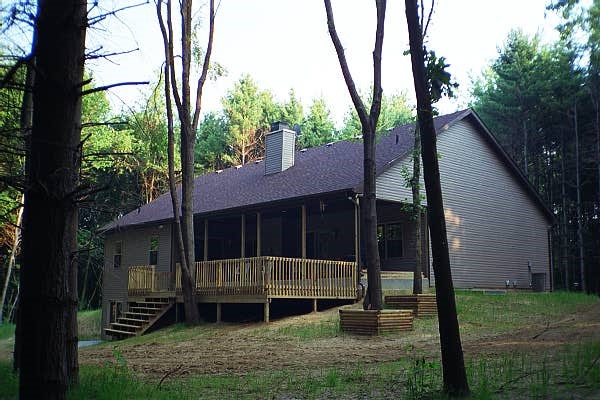
Some time ago, I had the opportunity to build a house. My builder told me that the typical house takes 160 days to complete – from groundbreaking to moving day.  He then warned me that because the house was 700 feet off the main road, construction would take longer. Just how much longer, he would not commit.

I determined to reduce construction time. My plan was to stay engaged with the general contractor and treat the subcontractors like royalty. During construction, I went out to the house nearly every day. Often it was after work to evaluate progress and report findings to the general contractor. Normally the reports were positive. Occasionally there were small issues for him to address. One time there were electrical outlets in the wrong place; he fixed it. Once I found a wall six feet from where it was planned. The general contractor made it right and thanked me for identifying the issue so quickly.

At times, I would go to the site early in the morning before work, or during my lunch break. During these times, I took coffee, water, donuts, cookies, or pizza for the subcontractors. Later, I learned that these gestures created a sense of purpose and appreciation among the subcontractors. They wanted to help people build their dreams. They wanted to do good work and they wanted to feel like they were a part of something bigger than 8 – 10 hours of labor a day. I also discovered later that this worked to my advantage as many extras were added – at no cost.

There are two major lessons here. First, the sponsor of the project must be actively engaged in monitoring and guiding progress. Can you imagine the costs and delays if I hadn’t found the misplaced wall as early as I did?  The second lesson is to engage and inspire your employees during change. I used donuts and coffee to share my passion for building the house in the woods, and in turn, the subcontractors felt like they were part of something bigger.

You might say, “Well, Steve, this is a nice story, but so what? You expended a lot of time and energy to supervise the construction, a job you delegated to the general contractor. But what were the real benefits?” We moved into the house in 140 days, the house met specifications, and the project came in under budget. How many of your projects achieve these kinds of results?

Call to Action: When you consider your next change initiative, be sure your sponsor plans time in her calendar to stay engaged with the project. Be sure she does more than attend the regular status meetings to stay informed. Instead, she can make a difference. She can talk to the employees doing the work or ask the project manager informally about progress. She can schedule lunches or other events during the project and not just to celebrate the end of the project.


Posted by Steve Salisbury on: July 13, 2020 08:00 AM | Permalink | Comments (2)

Agility Quotient

linkedin twitter facebook Request to reuse this  

There have been very few instances in humanity's existence where the global need for agility is higher than what it has been in the past six months. This is at both a personal and organizational level.

In fact, for this article, let’s consider agility at a personal level.

Could we say that “agility” is a quality or characteristic? If so, it seems to be something we should measure and value similar to other personal qualities and characteristics.

For example, consider intelligence quotient (IQ) and emotional intelligence (EQ). Both of these are measured amounts of how much intelligence or emotional intelligence a person has, respectively.

I believe that one’s agility is a quality and characteristic of great value. Thus, we should understand, value, and know-how to assess one’s agility quotient (AQ), or one’s ability to swiftly adapt to the changing needs of customers, employees, and the marketplace.

Why is AQ Needed?

The rate of change is faster than ever. Disruption of organizations and industries is increasingly occurring.

In fact, there are three rapidly increasing phenomena that all organizations are facing:

  1. Increasing competition
  2. Decreasing or compressed product life cycles
  3. Rapidly changing customer interests and needs

Together, this means that if organizations want to stay viable in the long run, they need the ability to adapt and pivot. And, in order for that to happen, organizations need individual employees that have the ability to quickly adapt and pivot: a high agility quotient.

Low versus High Agility Quotient

What sets apart someone with a high agility quotient from someone with a low agility quotient?

At a basic level, someone with low AQ is someone who values certainty, consistency, and comfort. Often, the reason why individuals might possess such values is because they are focused on what is best and comfortable for them: a sense of safety and security.

Someone with high AQ is someone who values learning, alternative perspectives, and personal disruption. Often, the reason why individuals might possess these values is because they are more concerned about (1) providing what is best for the customer, and (2) doing what is best for the long-term success for the organization, over and above a concern of what is best for themselves.

Microsoft Example

I think a great example of an organization that has helped employees make a significant positive shift in their AQ is Microsoft.

When Satya Nadella took over as CEO, he found that Microsoft employees needed to be the smartest people in the room, which meant a lot of jockeying for power and position and an inability to be wrong and see different perspectives. They were more focused on ensuring stability for themselves than adapting to ensure value for their customers.

As Satya Nadella set out to work on cultural change within Microsoft to become more agile, he promoted the idea that instead of being “know-it-alls,” they needed to become “learn-it-alls.”

And, to promote this shift, he encouraged employees to meet more and more with their customers at their customer’s locations. They were to identify what needs they had and ways in which their products were falling short of what they needed.

A natural byproduct of this is that Microsoft employees were coming back from meeting with their employees having learned something new, seeing a new perspective, and a willingness to disrupt themselves and what they were doing in order to better meet the needs and demands of their customers.

The result of this has been a four-fold increase in market capitalization and stock price since Satya Nadella took over in 2004. It has been an incredible transformation!

Improving Agility Quotient in Your Organization

How do you take employees from having a low agility quotient to having a high agility quotient? At a foundational level, we have got to recognize that the difference between such individuals isn’t a difference in skill or ability, it is a difference in how they see and perceive their world around them. It is a difference in their mindsets.

Mindsets: The Key to Agility

There is a lot of information “out there” on mindsets. But, most of this information fails to identify specific mindsets necessary for agility.

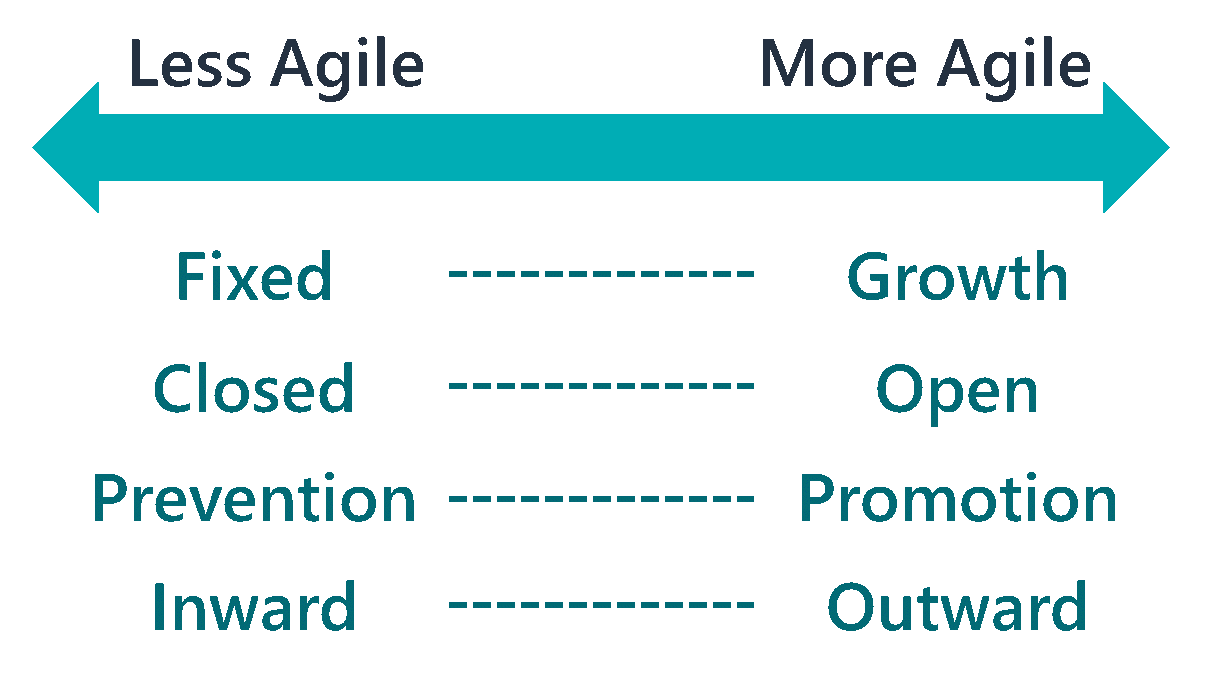
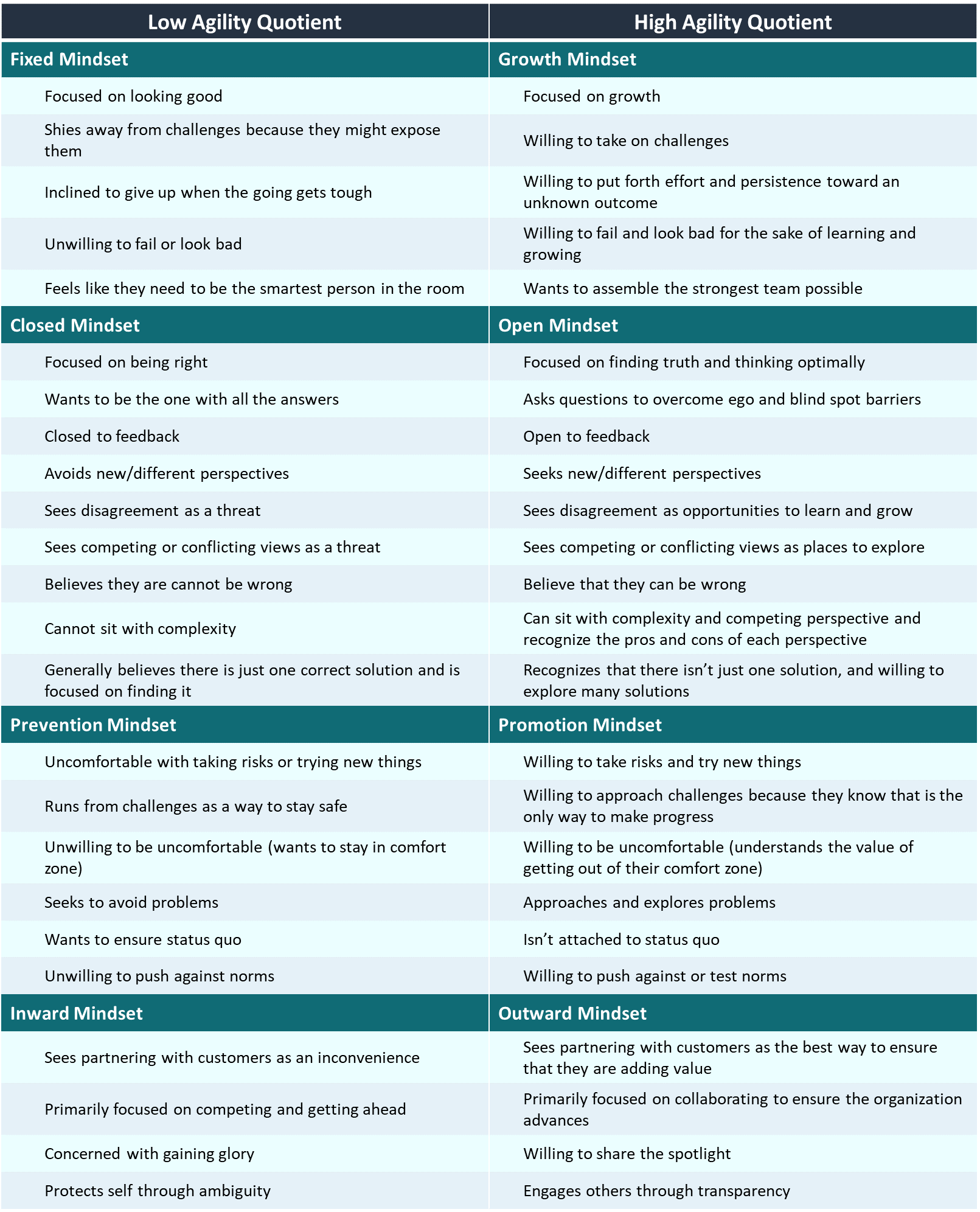
After scouring decades of research in a wide variety of disciplines. I have found that there are four sets of mindsets that have received 30+ years of research attention demonstrating that they influence how individuals think, learn, and behave (i.e., how agile they are). Each of these sets range on a continuum from less agile to more agile.

The table below demonstrates what research has found related to how these different mindsets affect how agile individuals are.

What is Your Agility Quotient?

Does this give you a sense of your personal AQ level? Are there areas where you could improve in your AQ?

What about your organization? Does your organization’s workforce have the collective mindsets that fuel agility?

In my research, I have found that only 5% of people are in the top quartile for all four sets of mindsets. Also, I have assessed the mindsets of over 60 organizations and groups, and I have only found a handful that have two or more collective mindsets on the “high agility” side of the continuum.

Improving Your and Your Workforce’s AQ

If you want to become more agile, or if you want to improve your workforce’s agility, you are going to have to, at a fundamental level, shift how you and they see their world. In other words, you are going to have to focus on mindsets.

Posted by Ryan Gottfredson on: July 07, 2020 02:00 PM | Permalink | Comments (2)
ADVERTISEMENTS

"Seriousness is the only refuge of the shallow."

- Oscar Wilde

ADVERTISEMENT

Sponsors