

What Should Never Be Optimized Away?


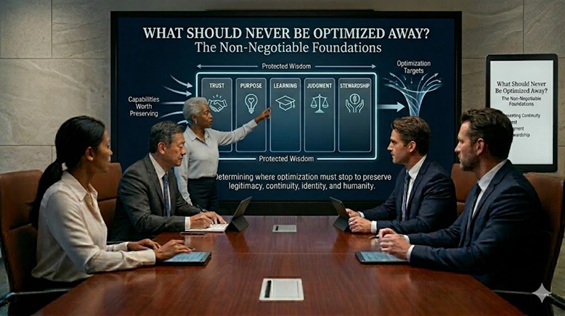 The Non-Negotiable Foundations of AI-Native Organizations Modern organizations are increasingly designed to optimize. Optimize cost. Optimize speed. Optimize efficiency. Optimize productivity. Optimize resource allocation. Optimize customer acquisition. Optimize operational performance. Optimize decision-making. Optimize almost everything. In many respects, optimization has become the dominant logic of contemporary management. And for good reason. Optimization creates value. It reduces waste. Improves performance. Expands capability. Increases competitiveness. Strengthens adaptability. Yet optimization contains a paradox that organizations rarely discuss openly. Because optimization always requires a target. A metric. A variable. A desired outcome. And what organizations choose to optimize inevitably influences what they become. This is where an uncomfortable question begins to emerge. What happens when optimization itself becomes the primary objective? The answer is rarely immediate. Organizations do not suddenly lose their identity. They do not abruptly abandon their values. They do not consciously decide to sacrifice what matters most. The process is usually far more subtle. Incremental. Reasonable. Difficult to detect. Each optimization appears justified. Each adjustment appears rational. Each trade-off appears defensible. Yet over time, something begins to change. The organization becomes increasingly efficient. But progressively less aligned with the principles that once guided it. This is how optimization drift often begins. Not through bad intentions. But through the accumulation of locally rational decisions that gradually erode globally important qualities. Trust may be sacrificed for efficiency. Learning may be sacrificed for speed. Purpose may be sacrificed for growth. Judgment may be sacrificed for automation. Stewardship may be sacrificed for short-term performance. None of these choices typically appear catastrophic in isolation. The danger emerges through accumulation. This challenge becomes increasingly important in AI-native environments. Because artificial intelligence dramatically increases the organizational capacity to optimize. Systems continuously analyze. Recommend. Prioritize. Predict. Adapt. Automate. And improve performance. These capabilities are enormously valuable. But they also create a new governance responsibility. The responsibility to distinguish between: What should be optimized. And what should be protected. Because not everything valuable should become an optimization target. Some organizational capabilities function differently. They exist not to maximize performance. But to preserve legitimacy. Continuity. Identity. Humanity. This distinction may become one of the defining governance challenges of AI-native organizations. Because the future will not be constrained primarily by access to intelligence. The future challenge may be preserving the wisdom required to determine where optimization should stop. Consider trust. Trust often appears inefficient. Trust requires dialogue. Patience. Transparency. Relationship building. Shared understanding. None of these activities maximize short-term efficiency. Yet organizations without trust eventually struggle to coordinate effectively. Trust is not an optimization variable. Trust is an enabling condition. The same applies to purpose. Purpose cannot always be reduced to performance metrics. Purpose provides direction. Meaning. Legitimacy. Without purpose, optimization becomes increasingly detached from significance. Learning presents a similar challenge. Learning requires experimentation. Reflection. Failure. Exploration. Redundancy. Many of these activities appear inefficient when evaluated through purely operational metrics. Yet organizations that stop learning eventually lose their adaptive capacity. Judgment also deserves protection. Because judgment introduces something optimization cannot fully replicate. Interpretation. Context. Responsibility. Accountability. Optimization can recommend. Judgment must decide. The same is true for stewardship. Stewardship rarely focuses on immediate performance. It focuses on continuity. Legacy. Long-term viability. The preservation of conditions that future generations will inherit. This is why stewardship often appears inefficient in the short term. And indispensable in the long term. Taken together, these elements reveal something important. The most valuable organizational capabilities are not always those that maximize output. Many exist precisely because they protect the conditions that make sustainable performance possible. Trust. Purpose. Learning. Judgment. Stewardship. These are not obstacles to optimization. They are boundaries that prevent optimization from becoming destructive. This is why mature governance requires more than performance oversight. It requires the capacity to determine which principles remain non-negotiable. Which values deserve protection. Which capabilities should never be sacrificed regardless of efficiency gains. Which dimensions of organizational life must remain beyond optimization itself. This responsibility becomes increasingly important as artificial intelligence continues expanding organizational capability. Because intelligence can reveal what is possible. Optimization can improve performance. But neither can independently determine what remains worth protecting. That responsibility belongs to governance. And ultimately to human judgment. The purpose of governance is not merely to enable optimization. The purpose of governance is to determine where optimization must stop. The future of AI-native organizations may therefore depend on a capability that receives far less attention than intelligence itself. The ability to recognize that not everything valuable exists to be optimized. Some things exist to be preserved. Because organizations do not lose themselves when they fail to optimize everything. They lose themselves when they forget what they were trying to protect in the first place. And if organizational wisdom exists to preserve what matters most, an equally important question emerges. Who remains accountable for protecting it when intelligent systems become increasingly autonomous? |
Posted on: July 10, 2026 04:50 AM
| Permalink |
Comments (0)
What If Organizing Work Is No Longer Primarily a Human Capability?
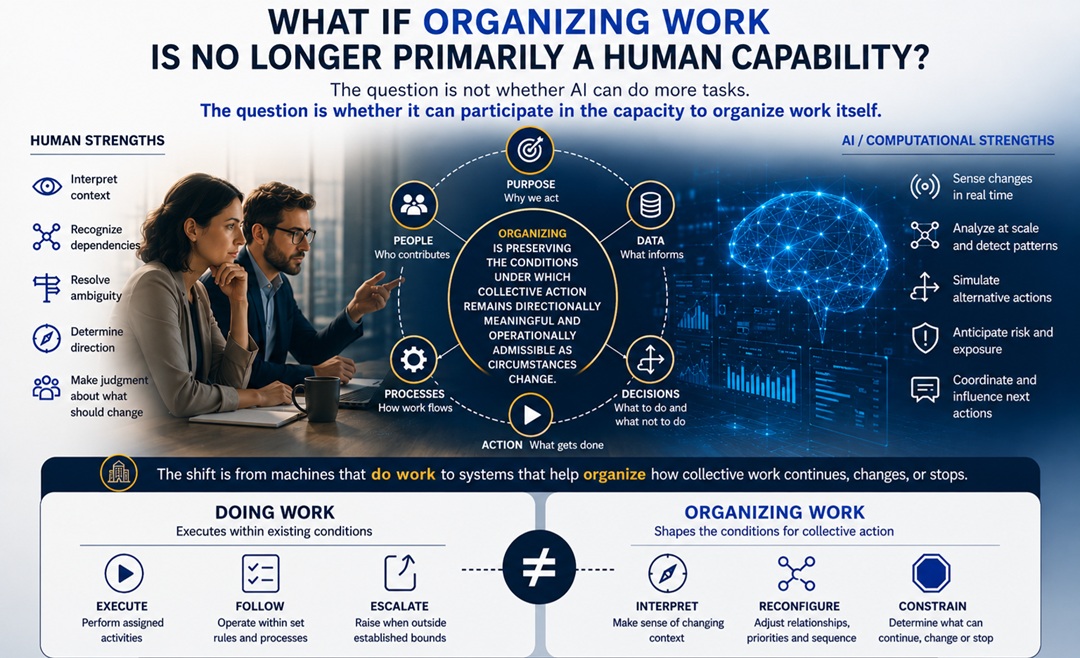 For most of organizational history, one assumption has remained remarkably stable. Technology may perform work. People organize it. Machines increased physical capacity. Software processed information. Enterprise systems standardized workflows. Algorithms optimized schedules, routes, prices, and inventories. But the capacity to organize collective work remained fundamentally associated with human agency. People interpreted context. People recognized when priorities had changed. People connected dependencies. People resolved ambiguity. People determined when action should continue, stop, or change. People organized the work. That assumption is becoming less secure. Not because artificial intelligence can perform more tasks. That matters. But the deeper shift may be that computational systems are beginning to participate in how work itself is organized. And if that is true, the organizational implications extend far beyond automation. Beyond Task Automation Much of the discussion about AI in organizations still begins with tasks. Which activities can be automated? Which roles will change? Which jobs will disappear? How much productivity can be gained? These are legitimate questions. But they may be anchored in an increasingly incomplete model of technological change. Task automation assumes that the organization of work already exists. The work has been decomposed. Responsibilities have been assigned. Dependencies are sufficiently understood. Decision rights have been established. Someone has determined what should happen and under what conditions. Technology then performs part of that work. Even highly sophisticated automation can remain inside this grammar. A system may execute thousands of actions autonomously while the organizational logic governing those actions remains fundamentally human-designed and structurally stable. Agentic AI introduces a different possibility. A computational system may not merely execute a predefined activity. It may interpret changing context. Select among possible actions. Recognize dependencies. Revise a sequence of action. Escalate uncertainty. Constrain available actions. Interrupt execution. Or materially influence what another human or computational system can do next. The important shift is not autonomy alone. It is potential participation in the organization of collective action. But that distinction requires precision. Organizing is not merely arranging work. Organizing is preserving the conditions under which collective action remains directionally meaningful and operationally admissible as circumstances change. Scheduling may arrange work. Routing may connect execution. Automation may perform configured operations. Optimization may select according to an objective function. Coordination may align interdependent activities. Orchestration may connect execution across multiple actors or systems. These capabilities can contribute to organizing. They are not automatically equivalent to it. The threshold is more demanding. A capability begins to participate in organizing when it becomes materially consequential to whether collective action can continue, change, or stop as organizational conditions evolve. That is a fundamentally different role. Organizing Is a Capability We often treat organizing as if it were simply what managers do. But organizing is more fundamental than management. Whenever collective work occurs, some capacity must preserve a consequential relationship between purpose, capability, context, dependency, decision, and action as conditions evolve. Traditional organizations have embedded much of this capacity in people. Managers allocate work. Team leaders coordinate dependencies. Project managers integrate activity. Experts interpret exceptions. Executives establish direction. Employees continuously repair the gaps between formal process and operational reality. Organization charts rarely show this invisible work. Yet organizations depend on it. Someone notices that the information that mattered yesterday no longer matters today. Someone recognizes that a formally acceptable plan no longer fits the situation. Someone sees that two locally rational activities are interfering with each other. Someone realizes that a local problem may create consequences elsewhere. Someone interprets principles when existing rules did not anticipate the conditions. Someone reconnects fragments of work that formal structure separated. Human beings have historically provided much of the runtime capacity that keeps organizations organized. This is why describing agentic AI merely as another category of worker may be conceptually insufficient. The question is not simply whether an agent can perform a role. The question is whether part of the capacity to organize collective work can become computationally instantiated. And the word primarily matters. This is not a quantitative claim about whether humans or AI perform more organizing activities. It is a question of architectural dependence. Does collective work still depend on human actors as the necessary primary locus through which organizing capacity becomes organizationally consequential? If the answer becomes less certain, the organizational problem changes. Doing Work Is Not the Same as Organizing Work Consider a procurement process facing an unexpected supplier disruption. An AI system identifies alternative suppliers. That is analytical work. Now suppose the system also recognizes that the disruption changes production dependencies. It identifies which customer commitments are exposed. It detects that accelerating one order would intensify shortages elsewhere. It constrains actions that would increase systemic exposure. It changes the sequence in which several activities can proceed. It alerts a human decision-maker because a contractual threshold has been crossed. And it materially changes what several human and computational contributors can do next. The question is no longer only whether the system performed a procurement task. The question is whether it participated in organizing collective action. The distinction will not always be clean. Nor should every adaptive algorithm suddenly be described as organizational. Optimization is not automatically organizing. Coordination is not automatically organizing. Autonomy is not automatically organizing. Orchestration is not automatically organizing. Distributed decision-making is not automatically organizing. A multi-agent system is not automatically a new organizational form. The deeper change begins when computational capability becomes materially consequential to the conditions through which collective action remains possible, relevant, or acceptable. At that point, AI is no longer simply inside the work. It is beginning to participate in the conditions through which work is organized. Our Organizations Were Not Designed for This Assumption Most organizational structures still reflect a familiar logic. Authority is attached to positions. Responsibilities are assigned to roles. Work is grouped into functions, departments, projects, or teams. Coordination occurs across structural boundaries. Managers maintain spans of control. Escalation moves issues toward actors with broader authority. Even agile and networked models frequently preserve a deeply human assumption. People remain the primary carriers of organizing capacity. Technology supports them. Teams may self-organize, but the team remains a human organizational locus. Networks may distribute authority, but organizational judgment remains associated primarily with human actors. Platforms may coordinate activity, while organizational interpretation remains human. AI is then inserted into this architecture as a tool, assistant, copilot, agent, or digital worker. But what if the architecture itself is based on an assumption that is beginning to change? What if computational systems become materially involved in interpreting context, recognizing dependencies, constraining action, interrupting execution, and influencing what collective work can happen next? Adding agents to existing teams may not solve that problem. Giving managers more agents to supervise may not solve it either. Creating a new layer of AI orchestration may simply reproduce hierarchy in computational form. We may be trying to integrate a new source of organizing capacity into structures designed around the assumption that organizing capacity is primarily human. That is not merely an AI adoption problem. It is an organizational architecture problem. This Is Not the End of Human Organization The argument is easy to misunderstand. If organizing capacity becomes partly computational, this does not mean organizations no longer need human judgment. It does not mean AI should govern organizations. It does not mean algorithms should determine purpose, values, or legitimacy. It does not mean authority should automatically migrate to machines. And it certainly does not mean computational capability is inherently superior to human capability. The question is architectural, not ideological. If humans and computational systems can both become materially consequential to the organization of collective action, how should those capabilities be combined? Where does authority reside when action is shaped through several human and computational contributions? How do we preserve accountability when influence travels through paths that do not match the organization chart? How do we prevent locally rational action from becoming systemically incoherent? How does an organization interrupt action when no single actor fully controls the chain of execution? How does learning travel across the system without turning one local interpretation into universal organizational truth? These are not workforce questions alone. They are organizational design questions. Beyond Digital Direct Reports One response is to extend the managerial grammar we already know. Managers supervise human employees and AI agents. Agents receive objectives. Managers intervene when boundaries are exceeded. This may be useful in many contexts. But it may also preserve the very assumption that needs examination. Someone still organizes the whole configuration from above. The manager remains the organizing subject. Computational systems extend execution capacity. If computational capabilities increasingly participate in context interpretation, dependency recognition, action selection, constraint, and exception handling, the problem may no longer be how many humans and agents one manager can supervise. The deeper problem is how organizational capacity should be structured when the ability to organize action is itself distributed. From Distributed Work to Distributed Organizing Capacity Organizations already distribute work. That is not new. They distribute tasks across functions. Responsibilities across roles. Decisions across levels. Expertise across teams. Operations across geographies. Organizations also distribute cognition through people, artefacts, information systems, and shared representations. They may generate collective intelligence. They may decentralize decision-making. They may enable self-organization. They may use algorithms to allocate, monitor, or evaluate work. These phenomena matter. But none is necessarily equivalent to distributing the capacity to organize collective action itself. Agentic AI may create a more difficult condition. The organization may begin to distribute not only work, cognition, or decision-making, but the capacity to organize work. A human recognizes a strategic constraint. An agent detects a changing operational condition. Another computational capability identifies an interaction invisible to both. A human interprets an ethical implication. A system constrains an action because continued execution would increase systemic exposure. Another agent revises a sequence of activity because a dependency has changed. A human intervenes because the resulting path is no longer legitimate under prevailing organizational principles. Another part of the organization experiences the consequence before the originating group recognizes its broader significance. No single contribution organizes the whole. Yet collective action changes. This is Distributed Organizing Capacity. Distributed Organizing Capacity is the organizational condition in which the capacity to preserve, adjust, and shape the conditions of collective action is materially distributed across human and computational actors, such that no single actor continuously constitutes the necessary primary locus of organizing capacity. The significance of this condition is not that machines become managers. Nor is it that cognition, intelligence, authority, or decisions simply become more distributed. It is that the capacity to influence whether collective action can continue, change, or stop may itself become distributed across actors of different kinds. A human may interpret purpose. A computational system may detect a dependency. An agent may constrain an action. Another system may identify systemic exposure. A human may determine legitimacy. A governed mechanism may interrupt execution. Organizing capacity emerges through the consequential relationship between these contributions. That creates a different organizational problem. Hierarchy connects positions through authority. Traditional coordination connects activities through plans, processes, and communication. Distributed decision-making allocates decision rights. Algorithmic management computationally mediates aspects of managerial activity. Orchestration connects execution through routing and sequencing. Self-organization describes the emergence of order without continuous central direction. Collective intelligence concerns the capacity of groups or systems to act intelligently together. Distributed cognition explains how cognitive processes can extend across people, artefacts, and environments. Each helps us understand part of the emerging condition. But a further question remains. What connects distributed organizing capacity when no single actor continuously possesses the context, judgment, capability, and authority required to organize the whole? We do not yet have a settled answer. And perhaps we should resist answering too quickly. The problem is not solved by saying that the system is intelligent. It is not solved by saying that agents collaborate. It is not solved by saying that decisions are decentralized. It is not solved by saying that the organization self-organizes. And it is not solved by adding an orchestration layer. If organizing capacity becomes distributed, collective action must still remain directionally grounded. Influence must remain governable. Unacceptable action must remain interruptible. Systemic incoherence must become detectable. Accountability must remain attributable. Learning must propagate without converting local interpretation into unquestioned organizational truth. And the organization must be able to change without losing the conditions that make its collective action organizationally intelligible. The problem is not simply whether the system adapts. We need to explain how organization occurs when no single actor organizes the whole. A Different Question for Organizational Design Perhaps the most important question about agentic AI is not: What work can AI do? Nor even: Which decisions can AI make? The deeper question may be: Where does the capacity to organize collective work reside? For much of organizational practice, the answer was treated as sufficiently obvious that organizational design rarely had to confront the possibility of non-human organizing capacity directly. Organizing capacity was associated with people. With managers. With leaders. With experts. With teams. And with the countless human acts of interpretation, coordination, judgment, constraint, and repair that kept formal structures connected to operational reality. That capacity is not disappearing. But it may no longer remain exclusively, or even always primarily, human. If that is true, an adequate organizational response will require more than assigning new roles, redrawing reporting lines, creating AI councils, or adding agents to existing teams. It will require an architecture capable of explaining how Distributed Organizing Capacity remains directionally grounded. How its influence becomes governable. How unacceptable action can be interrupted. How systemic incoherence becomes visible. How learning propagates. How responsibility and accountability remain attributable. And how collective action remains organizationally intelligible when no single actor organizes the whole. We do not yet have a settled organizational grammar for that condition. But the question can no longer be reduced to how humans should use AI. The deeper question is how collective work should be organized when the capacity to organize it is itself distributed across humans and computational systems. |
Posted on: July 09, 2026 04:25 AM
| Permalink |
Comments (0)
Where Does Organizational Wisdom Live?
 The Governance Structures That Protect Identity During Change If organizational wisdom matters, an important question immediately follows. Where does it actually live? The question may appear deceptively simple. Yet it becomes increasingly important as organizations accelerate. Because organizations continuously change. Leaders change. Teams change. Strategies change. Technologies change. Markets change. Business models change. And increasingly, AI-native organizations adapt continuously. Under these conditions, one assumption becomes increasingly dangerous. The assumption that organizational wisdom naturally survives change. It does not. At least not automatically. Because wisdom differs fundamentally from information. Information can be stored. Wisdom must be preserved. Information can be documented. Wisdom must remain meaningful. Information can exist in databases. Wisdom exists within interpretation. This distinction matters enormously. Because many organizations possess extensive repositories of information. Policies. Procedures. Frameworks. Lessons learned. Knowledge bases. Historical reports. Governance documentation. Yet despite possessing all this information, organizations often rediscover the same problems repeatedly. Not because information disappeared. But because meaning disappeared. The organization remembered the decision. It forgot the reasoning. It remembered the outcome. It forgot the context. It remembered the process. It forgot the judgment. This is where the challenge of organizational wisdom begins. Because wisdom cannot reside exclusively in individuals. If it does, wisdom leaves when people leave. Retirements occur. Executives move on. Teams reorganize. Successors arrive. Institutional memory fragments. The organization remains operational. Yet continuity weakens. This creates one of the defining governance responsibilities of adaptive organizations. Wisdom must become institutional rather than individual. Not because individuals are unimportant. But because continuity cannot depend entirely on individual presence. This is why mature governance serves a purpose far deeper than compliance. Governance preserves continuity. Governance preserves identity. Governance preserves legitimacy. Governance preserves memory. At its highest level, governance functions as a steward of organizational wisdom. This responsibility extends beyond performance oversight. Beyond risk management. Beyond policy enforcement. Beyond strategic review. Because governance ultimately protects something more fundamental. The continuity of organizational judgment across time. This becomes increasingly important in AI-native environments. Because AI dramatically expands organizational intelligence. Organizations become more capable of: • Analyzing, • Predicting, • Optimizing, • Automating, • Adapting. Yet none of these capabilities automatically preserve wisdom. In fact, accelerated adaptation may sometimes increase the risk of wisdom erosion. The faster organizations change, the easier it becomes to lose sight of why certain principles existed in the first place. The faster organizations optimize, the easier it becomes to optimize away what was never intended to be sacrificed. This is why organizational wisdom often resides within structures specifically designed to preserve continuity. Boards preserve long-term stewardship. Foundational principles preserve identity. Governance systems preserve legitimacy. Culture preserves behavioral memory. Decision records preserve rationale. Institutional practices preserve context. Together, these elements form something larger than compliance. They form the architecture through which organizations remember. Not merely what happened. But why it mattered. This distinction may ultimately become one of the defining capabilities of AI-native governance. Because future organizations will not struggle primarily with access to intelligence. Intelligence will become increasingly abundant. The challenge will be preserving orientation. Preserving coherence. Preserving meaning. Preserving the accumulated wisdom required to guide adaptation responsibly. This is why organizational wisdom should not be viewed as an abstract leadership virtue. It is a governance capability. A stewardship capability. A continuity capability. One that enables organizations to preserve identity while adapting. To preserve continuity while transforming. To preserve meaning while accelerating. To preserve judgment while automating. One that requires deliberate stewardship. Future governance may therefore face a responsibility that extends beyond performance, compliance, and adaptation. It may increasingly require stewardship of organizational wisdom itself. The preservation of identity across change. The preservation of purpose across transformation. The preservation of judgment across automation. The preservation of meaning across acceleration. Because organizations do not fail only when they lose capability. They may also fail when they lose memory. They may fail when they lose context. They may fail when they lose the accumulated wisdom that once guided adaptation responsibly. Artificial intelligence will continue expanding organizational intelligence. That expansion is inevitable. The deeper question is whether organizations will become equally capable of preserving wisdom. Because intelligence helps organizations understand what is possible. Judgment helps organizations decide what should be done. But wisdom helps organizations remember what remains worth protecting while they change. And in an age defined by continuous adaptation, that may become one of the most important organizational capabilities of all. If organizational wisdom is indeed a capability worth preserving, an equally important question emerges. What exactly should organizations refuse to optimize away? |
Posted on: July 08, 2026 03:32 AM
| Permalink |
Comments (0)
Organizational Wisdom
 Can Organizations Become More Intelligent While Becoming Less Wise? Modern organizations are becoming extraordinarily intelligent. They possess more data than ever before. More analytics. More dashboards. More forecasting capability. More predictive models. More optimization systems. More artificial intelligence. More visibility into operational reality. In many respects, organizations today possess levels of intelligence that previous generations could scarcely imagine. Yet an uncomfortable question is beginning to emerge. What if intelligence and wisdom do not grow together? What if organizations can become more intelligent while simultaneously becoming less wise? At first glance, this possibility appears unlikely. After all, wisdom is often assumed to be the natural consequence of knowledge. More information should produce better understanding. Better understanding should produce better decisions. Better decisions should produce better outcomes. The logic seems straightforward. Reality is often less cooperative. History repeatedly demonstrates that intelligence and wisdom are not the same thing. Individuals may possess extraordinary intelligence while exercising poor judgment. Institutions may accumulate enormous knowledge while repeating familiar mistakes. Entire societies may become increasingly sophisticated while struggling to preserve what matters most. Organizations are no different. Because intelligence and wisdom perform fundamentally different functions. Intelligence expands understanding. Wisdom preserves orientation. Intelligence reveals possibilities. Wisdom determines what deserves protection. Intelligence increases capability. Wisdom safeguards continuity. This distinction becomes increasingly important in AI-native environments. Because artificial intelligence dramatically expands organizational intelligence. It enables organizations to: • Analyze more, • Predict more, • Optimize more, • Automate more, • Coordinate more, • Adapt more rapidly. These capabilities are enormously valuable. Yet none of them automatically answers a deeper question: What should remain true while the organization adapts? This question lies at the heart of organizational wisdom. Because organizations do not merely face technical challenges. They also face identity challenges. Every adaptation changes something. Every optimization alters priorities. Every efficiency gain creates trade-offs. Every transformation reshapes behavior. Every acceleration modifies organizational culture. Most changes appear beneficial in isolation. The challenge emerges over time. Organizations may gradually optimize themselves away from the very characteristics that originally made them valuable. Trust may be sacrificed for efficiency. Purpose may be sacrificed for growth. Judgment may be sacrificed for automation. Learning may be sacrificed for speed. Stewardship may be sacrificed for short-term performance. None of these shifts typically occur through a single decision. They emerge incrementally. Quietly. Almost invisibly. This is how wisdom erosion often begins. Not through dramatic failure. But through the accumulation of locally rational decisions that gradually weaken global coherence. The organization remains intelligent. The organization remains productive. The organization may even appear successful. Yet something important begins to disappear. Not capability. Orientation. This challenge becomes particularly important because modern organizations increasingly operate through feedback systems. Metrics influence decisions. Decisions influence incentives. Incentives influence behavior. Behavior influences outcomes. Outcomes influence future decisions. These loops create extraordinary adaptive power. They also create risk. Because systems naturally optimize toward what they measure. And what organizations measure is not always what they ultimately value. This creates one of the defining governance challenges of AI-native organizations. How do organizations preserve wisdom while continuously adapting? The answer may not lie in additional intelligence. It may lie in preserving memory. Not merely operational memory. Not merely transactional memory. But organizational wisdom itself. The accumulated understanding of: • Why certain principles exist, • Why certain boundaries matter, • Why previous decisions were made, • Why certain trade-offs proved dangerous, • Why some capabilities deserve protection, • Why some values must endure despite changing circumstances. Without this memory, organizations become increasingly vulnerable to adaptive drift. Every generation of leaders begins again. Every transformation rewrites assumptions. Every optimization restarts familiar mistakes. Every crisis appears unprecedented. The organization becomes intelligent. But progressively less wise. This is why wisdom may ultimately represent a distinct organizational capability. Not a by-product of intelligence. Not an outcome of analytics. Not a consequence of technological sophistication. A capability. One that enables organizations to preserve identity while adapting. To preserve continuity while transforming. To preserve meaning while accelerating. To preserve judgment while automating. One that requires deliberate stewardship. Future governance may therefore face a responsibility that extends beyond performance, compliance, and adaptation. It may increasingly require stewardship of organizational wisdom itself. The preservation of identity across change. The preservation of purpose across transformation. The preservation of judgment across automation. The preservation of meaning across acceleration. Because organizations do not fail only when they lose capability. They may also fail when they lose memory. They may fail when they lose context. They may fail when they lose the accumulated wisdom that once guided adaptation responsibly. Artificial intelligence will continue expanding organizational intelligence. That expansion is inevitable. The deeper question is whether organizations will become equally capable of preserving wisdom. Because intelligence helps organizations understand what is possible. Judgment helps organizations decide what should be done. But wisdom helps organizations remember what remains worth protecting while they change. And in an age defined by continuous adaptation, that may become one of the most important organizational capabilities of all. |
Posted on: July 06, 2026 03:33 AM
| Permalink |
Comments (0)
What If the Team Is No Longer the Right Unit of Organizational Design?
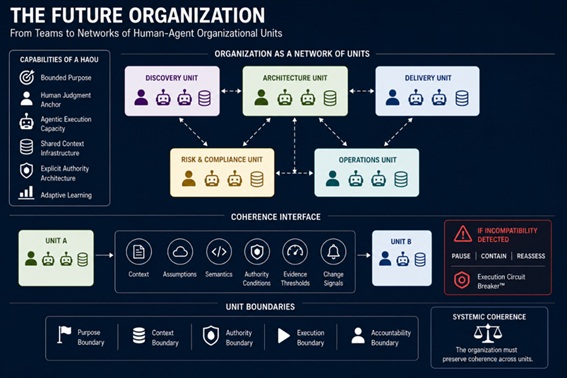 For more than a century, organizations have treated the team as one of the fundamental units of work. People are grouped around a shared objective. Roles distribute responsibility. Skills create specialization. Coordination connects individual contributions. Leadership provides direction. The model has evolved, from functional teams to cross-functional, agile, distributed, and product teams, but the underlying assumption has remained remarkably stable: Work is organized primarily by coordinating people. Artificial intelligence may be challenging that assumption. Not because AI makes teams smaller. But because the system through which work is performed is changing. And if the system is changing, perhaps the organizational unit itself is changing with it. We May Be Using an Old Category for a New Architecture The first wave of workplace AI fitted relatively comfortably inside the traditional concept of team. A human performed the work. AI assisted. The team remained fundamentally human. Its members still held most execution responsibility. Coordination remained largely interpersonal. Authority remained attached to human roles. AI was a tool inside the team. We could describe the model simply: Team + AI tools Agentic AI introduces a different possibility. Imagine a small group of humans working with an orchestrator agent and several specialist agents. One agent analyzes requirements. Another explores architecture options. Another builds. Another tests. Another reviews security. Another prepares deployment. A shared context layer maintains objectives, constraints, assumptions, and dependencies. An orchestration layer decomposes work, distributes tasks, reconciles outputs, and escalates exceptions. Authority rules determine what agents may decide, when evidence is sufficient, when humans must intervene, and when execution must stop. Learning mechanisms reconstruct agentic decisions and challenge the assumptions embedded in automated workflows. We may still call this a team. But perhaps we are using an old organizational category to describe a new organizational architecture. Because this is no longer simply a group of people using better tools. Part of the organization's execution, coordination, and authority architecture has become computational. At what point does a team with AI become something organizationally different? The Traditional Team Was More Than a Group of People To answer that question, it helps to understand why the team became such a powerful unit of organizational design. A team creates a bounded social and operational system. It usually contains a purpose. A set of members. Roles. Skills. Relationships. Coordination mechanisms. Decision patterns. And some form of shared accountability. The team works as a useful organizational unit because many of the elements required to understand how work happens are contained within it. Who performs the work? Look at the team. Who coordinates? Look at the team. Where does expertise reside? Look at the team. Who makes decisions? Look at roles and leadership. Where does learning happen? Largely through the experience of the people doing the work. The concept is not perfect. Matrix organizations, ecosystems, platforms, contractors, and distributed networks have long complicated this picture. But the team has remained a useful unit of analysis because human actors still carried most execution, interpretation, coordination, and judgment. Agentic systems disturb that assumption. When AI Joins the Workflow, the Team Does Not Necessarily Change There is an important distinction between AI-assisted work and AI-native work. If a project manager uses AI to summarize a meeting, the organizational unit has not changed. If a developer uses AI to generate code suggestions, the organizational unit has not necessarily changed. If a marketer uses AI to prepare alternative campaign messages, the organizational unit may still be fundamentally the same. AI improves individual execution. The architecture of work remains largely intact. But consider a different configuration. An orchestrator decomposes an objective into tasks. Several agents execute in parallel. Agents consume outputs produced by other agents. Shared context is updated dynamically. Some decisions occur without human approval. Exceptions are escalated according to predefined thresholds. A circuit breaker can interrupt execution when propagation risk becomes unacceptable. Humans intervene primarily where judgment, consequence, ambiguity, or accountability require them. This is not merely AI assistance. The structure of work itself has changed. Execution is distributed across human and non-human actors. Coordination is partly computational. Context becomes infrastructure. Authority is encoded. Learning must include both human experience and the deconstruction of agentic execution. The difference is not simply that AI has joined the team. The difference is that some of the functions through which the organization works have migrated from human relationships into computational architecture. Perhaps Headcount Is Becoming the Wrong Measure This creates an immediate organizational problem. How large is a team composed of three humans and twelve agents? Is it smaller than a traditional team of eight people? Headcount says yes. Execution capacity may say no. Cognitive demand may say no. Risk may say no. Coordination complexity may say no. A configuration with three humans and twelve highly autonomous, heterogeneous, interdependent agents may be more difficult to govern than a team of fifteen humans performing relatively stable work. The effective size of an AI-native work system cannot therefore be understood through human headcount alone. We also need to consider: Volume of agentic activity How much work is being generated and executed? Heterogeneity How different are the domains, tasks, and forms of reasoning involved? Autonomy How much can agents decide or execute without intervention? Interdependence How extensively do agents consume, modify, or depend on each other's outputs? Reversibility How easily can decisions and actions be undone? Consequence What happens when the system is wrong? This is where Agentic Span of Control becomes more than a supervision problem. It becomes a principle of organizational design. The question is no longer how many people report to one manager. It is how much agentic activity a human-led system can direct, understand, challenge, and remain accountable for without losing decisional coherence. And that raises a deeper question. If headcount no longer adequately describes the size of the work system, is the traditional team still the right unit for describing the system itself? What Would Define a New Organizational Unit? Perhaps the emerging unit of AI-native work should not be defined primarily by the number of humans or agents it contains. Perhaps it should be defined by the organizational capabilities that operate together within a bounded system. Consider six elements. Bounded purpose The system has an explicit outcome, mission, or domain of responsibility. Human judgment anchor Human responsibility remains identifiable where judgment, challenge, and consequential accountability are required. Agentic execution capacity Agents or agentic workflows perform work with defined levels of autonomy. Shared context infrastructure Humans and agents operate with sufficiently aligned objectives, constraints, assumptions, dependencies, and system state. Explicit authority architecture Decision ownership, autonomy boundaries, evidence thresholds, escalation conditions, override authority, and execution interruption are deliberately designed. Adaptive learning The system learns not only from outcomes, but by reconstructing agentic decisions, surfacing assumptions, challenging automated workflows, and adapting both human and agent behavior. Together, these elements describe something more than a team using AI. They describe a bounded system of human judgment and agentic execution designed to operate coherently. For now, I will call this a Human-Agent Organizational Unit. Not as a finished framework. Not as a new label searching for a problem. But as a hypothesis worth testing. A Human-Agent Organizational Unit may be emerging when bounded purpose, human judgment, agentic execution, shared context, explicit authority, and adaptive learning become structurally integrated into one operational system designed to preserve coherence. The critical point is not the presence of agents. It is the structural integration of these capabilities. A person using five AI tools does not automatically constitute a new organizational unit. A team deploying an isolated chatbot does not either. The unit becomes organizationally distinct when work, context, coordination, authority, and learning are redesigned as interdependent properties of a human-agent system. The Boundary May Matter More Than the Org Chart If such a unit exists, its boundaries may also need to be understood differently. Traditional organizations often use reporting lines to indicate organizational boundaries. But a human-agent system may require other boundaries. Purpose boundary Which outcomes belong to the unit? Context boundary What context may the system consume, modify, and preserve? Authority boundary Which decisions may humans and agents make within the unit? Execution boundary Which actions may the system perform autonomously? Accountability boundary For which consequences does identifiable human responsibility remain? These boundaries may not align with the organizational chart. Two human-agent units may share the same manager. They may use the same AI model. They may even use some of the same specialist agents. Yet if their purpose, context, authority, execution, and accountability boundaries differ, they may represent distinct organizational units. This has significant implications. Organizational design can no longer be understood only by asking: Who reports to whom? We may also need to ask: Who and what share context? Where does authority begin and end? Which agentic actions can propagate across boundaries? Where can execution be interrupted? Who remains capable of reconstructing why the system acted? The organizational chart was designed to represent human authority relationships. It was never designed to represent computational execution, shared context, machine autonomy, or agent-to-agent dependencies. Coherent Units Can Still Produce an Incoherent Organization There is another danger. Suppose organizations become very good at designing these human-agent units. Each has a clear purpose. Each has excellent agents. Each maintains shared context. Each has explicit authority. Each learns and adapts. The organization may still fail. Why? Because local coherence does not guarantee systemic coherence. One unit optimizes customer acquisition. Another optimizes risk. Another optimizes operational efficiency. Another optimizes product velocity. Each may act intelligently within its own boundaries. Their combined actions may still produce contradiction, duplication, resource conflict, or strategic drift. AI does not remove this problem. It may accelerate it. Agentic systems also introduce new forms of interdependence. An agent in one unit may generate an output consumed automatically by an agent in another. A context update may alter decisions across several workflows. A local optimization may propagate before any human recognizes its systemic consequence. Authority may be clear within each unit but ambiguous between them. This is where the Execution Capacity-Coherence Capacity Asymmetry becomes critical. Execution capacity can scale rapidly inside individual units. But organizational coherence depends on the capacity to understand and govern relationships across units. If execution scales faster than cross-unit coherence, the Coherence Gap can accelerate. Worse, orchestration layers may present clean summaries that hide unresolved contradictions between units. The organization may experience Hallucinated Coherence. Everything appears aligned. Dashboards are clean. Recommendations are consolidated. Local systems are performing. But incompatible assumptions and competing optimization logics remain underneath. Coherent human-agent units do not automatically produce a coherent organization. Organizational Design May Be Moving from Teams to Systems of Units If this hypothesis is correct, the next organizational design challenge is not simply to build smaller teams with more AI. It is to understand how bounded human-agent systems should be designed and how multiple systems should interact. A product discovery unit may combine human judgment, research agents, customer insight agents, and an orchestration layer. An architecture unit may combine senior architects with design, simulation, security, and dependency agents. A delivery unit may integrate humans with development, testing, documentation, and deployment agents. These units may not need to form a traditional hierarchy. They may operate as a network. But networks of human-agent units require explicit coupling mechanisms. Where one unit depends on another, outputs cannot be transferred without the conditions required to interpret them. Context matters. Assumptions matter. Authority conditions matter. Semantic meaning matters. Changes to any of them matter. The interface between units is therefore not merely a data interface. It is a coherence interface. A Coherence Interface must preserve the interpretability of work as it crosses organizational boundaries. If one unit changes its context, assumptions, semantics, or governing conditions, dependent units must be able to detect that change, determine whether existing dependencies remain compatible, and pause propagation when coherence can no longer be assured. The problem is not simply whether Unit B receives the output produced by Unit A. The problem is whether Unit B still interprets that output under conditions compatible with those under which Unit A produced it. This reveals a deeper possibility. The Coherence Gap may not emerge inside a unit. It may emerge at the boundary between two locally coherent units. Networks therefore create governance questions that traditional organizational structures were not designed to answer. What context must be shared across units? What context must remain bounded? When can one unit trigger execution in another? Whose evidence threshold applies? Which authority prevails when agents reach conflicting conclusions? How are changes in assumptions, semantics, or governing conditions signaled to dependent units? Where does accountability sit when a consequence emerges from a chain of actions across several units? When must an Execution Circuit Breaker stop propagation across the network? And how does the organization ensure that units coevolve rather than optimize themselves into collective incoherence? These are not questions of AI tool adoption. They are questions of organizational architecture. The Team May Not Disappear The concept of team will not suddenly become irrelevant. Humans will continue to collaborate. Relationships will continue to matter. Trust, conflict, identity, psychological safety, and leadership will remain deeply human organizational realities. But the real operational system may increasingly include actors and mechanisms that the traditional concept of team does not adequately represent. Agents execute. Orchestrators coordinate. Shared context aligns. Authority architectures constrain. Coherence interfaces preserve interpretability across boundaries. Circuit breakers contain. Learning loops adapt. Humans judge, challenge, interpret, and remain accountable for consequences that increasingly emerge from distributed systems of action. Perhaps the organizational language has not yet caught up with the organizational reality. The question is therefore not whether AI will make teams smaller. It is whether team remains the right unit of analysis when execution, coordination, context, and authority are increasingly distributed across humans and agents. For now, the Human-Agent Organizational Unit remains a hypothesis. But it begins with a question organizations may need to confront sooner than expected: If span of control is changing because the system being supervised is changing, are we still supervising the same kind of organizational unit? The team may not disappear. But it may no longer be enough to explain how work is organized. |
Posted on: July 05, 2026 09:32 AM
| Permalink |
Comments (0)


