


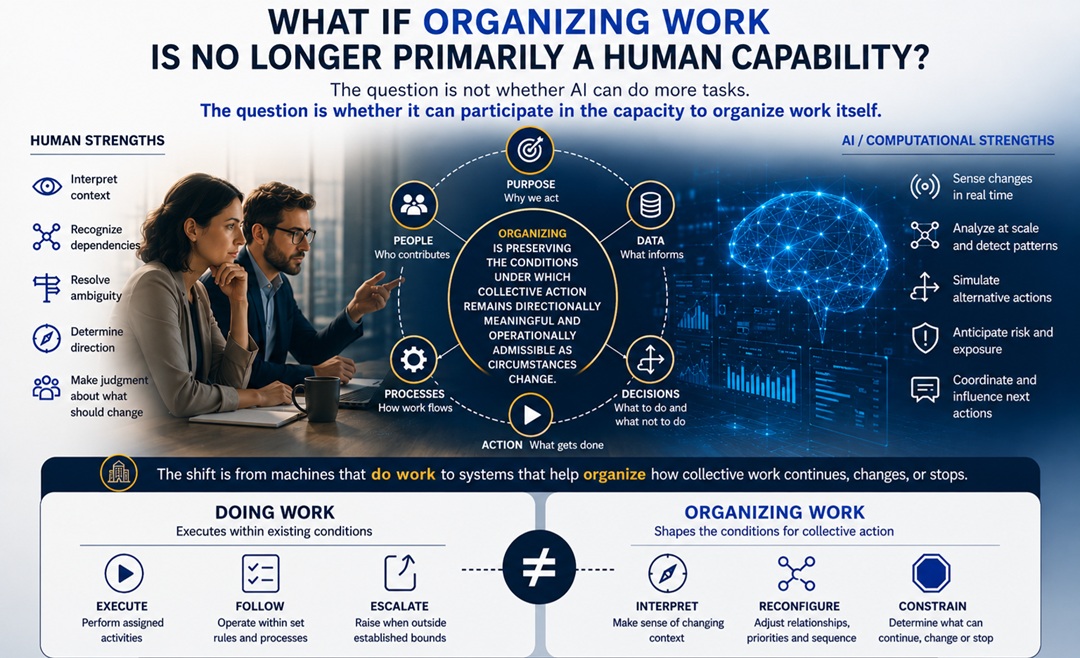
For most of organizational history, one assumption has remained remarkably stable.
Technology may perform work.
People organize it.
Machines increased physical capacity.
Software processed information.
Enterprise systems standardized workflows.
Algorithms optimized schedules, routes, prices, and inventories.
But the capacity to organize collective work remained fundamentally associated with human agency.
People interpreted context.
People recognized when priorities had changed.
People connected dependencies.
People resolved ambiguity.
People determined when action should continue, stop, or change.
People organized the work.
That assumption is becoming less secure.
Not because artificial intelligence can perform more tasks.
That matters.
But the deeper shift may be that computational systems are beginning to participate in how work itself is organized.
And if that is true, the organizational implications extend far beyond automation.
Beyond Task Automation
Much of the discussion about AI in organizations still begins with tasks.
Which activities can be automated?
Which roles will change?
Which jobs will disappear?
How much productivity can be gained?
These are legitimate questions.
But they may be anchored in an increasingly incomplete model of technological change.
Task automation assumes that the organization of work already exists.
The work has been decomposed.
Responsibilities have been assigned.
Dependencies are sufficiently understood.
Decision rights have been established.
Someone has determined what should happen and under what conditions.
Technology then performs part of that work.
Even highly sophisticated automation can remain inside this grammar.
A system may execute thousands of actions autonomously while the organizational logic governing those actions remains fundamentally human-designed and structurally stable.
Agentic AI introduces a different possibility.
A computational system may not merely execute a predefined activity.
It may interpret changing context.
Select among possible actions.
Recognize dependencies.
Revise a sequence of action.
Escalate uncertainty.
Constrain available actions.
Interrupt execution.
Or materially influence what another human or computational system can do next.
The important shift is not autonomy alone.
It is potential participation in the organization of collective action.
But that distinction requires precision.
Organizing is not merely arranging work.
Organizing is preserving the conditions under which collective action remains directionally meaningful and operationally admissible as circumstances change.
Scheduling may arrange work.
Routing may connect execution.
Automation may perform configured operations.
Optimization may select according to an objective function.
Coordination may align interdependent activities.
Orchestration may connect execution across multiple actors or systems.
These capabilities can contribute to organizing.
They are not automatically equivalent to it.
The threshold is more demanding.
A capability begins to participate in organizing when it becomes materially consequential to whether collective action can continue, change, or stop as organizational conditions evolve.
That is a fundamentally different role.
Organizing Is a Capability
We often treat organizing as if it were simply what managers do.
But organizing is more fundamental than management.
Whenever collective work occurs, some capacity must preserve a consequential relationship between purpose, capability, context, dependency, decision, and action as conditions evolve.
Traditional organizations have embedded much of this capacity in people.
Managers allocate work.
Team leaders coordinate dependencies.
Project managers integrate activity.
Experts interpret exceptions.
Executives establish direction.
Employees continuously repair the gaps between formal process and operational reality.
Organization charts rarely show this invisible work.
Yet organizations depend on it.
Someone notices that the information that mattered yesterday no longer matters today.
Someone recognizes that a formally acceptable plan no longer fits the situation.
Someone sees that two locally rational activities are interfering with each other.
Someone realizes that a local problem may create consequences elsewhere.
Someone interprets principles when existing rules did not anticipate the conditions.
Someone reconnects fragments of work that formal structure separated.
Human beings have historically provided much of the runtime capacity that keeps organizations organized.
This is why describing agentic AI merely as another category of worker may be conceptually insufficient.
The question is not simply whether an agent can perform a role.
The question is whether part of the capacity to organize collective work can become computationally instantiated.
And the word primarily matters.
This is not a quantitative claim about whether humans or AI perform more organizing activities.
It is a question of architectural dependence.
Does collective work still depend on human actors as the necessary primary locus through which organizing capacity becomes organizationally consequential?
If the answer becomes less certain, the organizational problem changes.
Doing Work Is Not the Same as Organizing Work
Consider a procurement process facing an unexpected supplier disruption.
An AI system identifies alternative suppliers.
That is analytical work.
Now suppose the system also recognizes that the disruption changes production dependencies.
It identifies which customer commitments are exposed.
It detects that accelerating one order would intensify shortages elsewhere.
It constrains actions that would increase systemic exposure.
It changes the sequence in which several activities can proceed.
It alerts a human decision-maker because a contractual threshold has been crossed.
And it materially changes what several human and computational contributors can do next.
The question is no longer only whether the system performed a procurement task.
The question is whether it participated in organizing collective action.
The distinction will not always be clean.
Nor should every adaptive algorithm suddenly be described as organizational.
Optimization is not automatically organizing.
Coordination is not automatically organizing.
Autonomy is not automatically organizing.
Orchestration is not automatically organizing.
Distributed decision-making is not automatically organizing.
A multi-agent system is not automatically a new organizational form.
The deeper change begins when computational capability becomes materially consequential to the conditions through which collective action remains possible, relevant, or acceptable.
At that point, AI is no longer simply inside the work.
It is beginning to participate in the conditions through which work is organized.
Our Organizations Were Not Designed for This Assumption
Most organizational structures still reflect a familiar logic.
Authority is attached to positions.
Responsibilities are assigned to roles.
Work is grouped into functions, departments, projects, or teams.
Coordination occurs across structural boundaries.
Managers maintain spans of control.
Escalation moves issues toward actors with broader authority.
Even agile and networked models frequently preserve a deeply human assumption.
People remain the primary carriers of organizing capacity.
Technology supports them.
Teams may self-organize, but the team remains a human organizational locus.
Networks may distribute authority, but organizational judgment remains associated primarily with human actors.
Platforms may coordinate activity, while organizational interpretation remains human.
AI is then inserted into this architecture as a tool, assistant, copilot, agent, or digital worker.
But what if the architecture itself is based on an assumption that is beginning to change?
What if computational systems become materially involved in interpreting context, recognizing dependencies, constraining action, interrupting execution, and influencing what collective work can happen next?
Adding agents to existing teams may not solve that problem.
Giving managers more agents to supervise may not solve it either.
Creating a new layer of AI orchestration may simply reproduce hierarchy in computational form.
We may be trying to integrate a new source of organizing capacity into structures designed around the assumption that organizing capacity is primarily human.
That is not merely an AI adoption problem.
It is an organizational architecture problem.
This Is Not the End of Human Organization
The argument is easy to misunderstand.
If organizing capacity becomes partly computational, this does not mean organizations no longer need human judgment.
It does not mean AI should govern organizations.
It does not mean algorithms should determine purpose, values, or legitimacy.
It does not mean authority should automatically migrate to machines.
And it certainly does not mean computational capability is inherently superior to human capability.
The question is architectural, not ideological.
If humans and computational systems can both become materially consequential to the organization of collective action, how should those capabilities be combined?
Where does authority reside when action is shaped through several human and computational contributions?
How do we preserve accountability when influence travels through paths that do not match the organization chart?
How do we prevent locally rational action from becoming systemically incoherent?
How does an organization interrupt action when no single actor fully controls the chain of execution?
How does learning travel across the system without turning one local interpretation into universal organizational truth?
These are not workforce questions alone.
They are organizational design questions.
Beyond Digital Direct Reports
One response is to extend the managerial grammar we already know.
Managers supervise human employees and AI agents.
Agents receive objectives.
Managers intervene when boundaries are exceeded.
This may be useful in many contexts.
But it may also preserve the very assumption that needs examination.
Someone still organizes the whole configuration from above.
The manager remains the organizing subject.
Computational systems extend execution capacity.
If computational capabilities increasingly participate in context interpretation, dependency recognition, action selection, constraint, and exception handling, the problem may no longer be how many humans and agents one manager can supervise.
The deeper problem is how organizational capacity should be structured when the ability to organize action is itself distributed.
From Distributed Work to Distributed Organizing Capacity
Organizations already distribute work.
That is not new.
They distribute tasks across functions.
Responsibilities across roles.
Decisions across levels.
Expertise across teams.
Operations across geographies.
Organizations also distribute cognition through people, artefacts, information systems, and shared representations.
They may generate collective intelligence.
They may decentralize decision-making.
They may enable self-organization.
They may use algorithms to allocate, monitor, or evaluate work.
These phenomena matter.
But none is necessarily equivalent to distributing the capacity to organize collective action itself.
Agentic AI may create a more difficult condition.
The organization may begin to distribute not only work, cognition, or decision-making, but the capacity to organize work.
A human recognizes a strategic constraint.
An agent detects a changing operational condition.
Another computational capability identifies an interaction invisible to both.
A human interprets an ethical implication.
A system constrains an action because continued execution would increase systemic exposure.
Another agent revises a sequence of activity because a dependency has changed.
A human intervenes because the resulting path is no longer legitimate under prevailing organizational principles.
Another part of the organization experiences the consequence before the originating group recognizes its broader significance.
No single contribution organizes the whole.
Yet collective action changes.
This is Distributed Organizing Capacity.
Distributed Organizing Capacity is the organizational condition in which the capacity to preserve, adjust, and shape the conditions of collective action is materially distributed across human and computational actors, such that no single actor continuously constitutes the necessary primary locus of organizing capacity.
The significance of this condition is not that machines become managers.
Nor is it that cognition, intelligence, authority, or decisions simply become more distributed.
It is that the capacity to influence whether collective action can continue, change, or stop may itself become distributed across actors of different kinds.
A human may interpret purpose.
A computational system may detect a dependency.
An agent may constrain an action.
Another system may identify systemic exposure.
A human may determine legitimacy.
A governed mechanism may interrupt execution.
Organizing capacity emerges through the consequential relationship between these contributions.
That creates a different organizational problem.
Hierarchy connects positions through authority.
Traditional coordination connects activities through plans, processes, and communication.
Distributed decision-making allocates decision rights.
Algorithmic management computationally mediates aspects of managerial activity.
Orchestration connects execution through routing and sequencing.
Self-organization describes the emergence of order without continuous central direction.
Collective intelligence concerns the capacity of groups or systems to act intelligently together.
Distributed cognition explains how cognitive processes can extend across people, artefacts, and environments.
Each helps us understand part of the emerging condition.
But a further question remains.
What connects distributed organizing capacity when no single actor continuously possesses the context, judgment, capability, and authority required to organize the whole?
We do not yet have a settled answer.
And perhaps we should resist answering too quickly.
The problem is not solved by saying that the system is intelligent.
It is not solved by saying that agents collaborate.
It is not solved by saying that decisions are decentralized.
It is not solved by saying that the organization self-organizes.
And it is not solved by adding an orchestration layer.
If organizing capacity becomes distributed, collective action must still remain directionally grounded.
Influence must remain governable.
Unacceptable action must remain interruptible.
Systemic incoherence must become detectable.
Accountability must remain attributable.
Learning must propagate without converting local interpretation into unquestioned organizational truth.
And the organization must be able to change without losing the conditions that make its collective action organizationally intelligible.
The problem is not simply whether the system adapts.
We need to explain how organization occurs when no single actor organizes the whole.
A Different Question for Organizational Design
Perhaps the most important question about agentic AI is not:
What work can AI do?
Nor even:
Which decisions can AI make?
The deeper question may be:
Where does the capacity to organize collective work reside?
For much of organizational practice, the answer was treated as sufficiently obvious that organizational design rarely had to confront the possibility of non-human organizing capacity directly.
Organizing capacity was associated with people.
With managers.
With leaders.
With experts.
With teams.
And with the countless human acts of interpretation, coordination, judgment, constraint, and repair that kept formal structures connected to operational reality.
That capacity is not disappearing.
But it may no longer remain exclusively, or even always primarily, human.
If that is true, an adequate organizational response will require more than assigning new roles, redrawing reporting lines, creating AI councils, or adding agents to existing teams.
It will require an architecture capable of explaining how Distributed Organizing Capacity remains directionally grounded.
How its influence becomes governable.
How unacceptable action can be interrupted.
How systemic incoherence becomes visible.
How learning propagates.
How responsibility and accountability remain attributable.
And how collective action remains organizationally intelligible when no single actor organizes the whole.
We do not yet have a settled organizational grammar for that condition.
But the question can no longer be reduced to how humans should use AI.
The deeper question is how collective work should be organized when the capacity to organize it is itself distributed across humans and computational systems.
Posted on: July 09, 2026 04:25 AM |
Permalink



