


Why Frameworks Cannot Eliminate Judgment


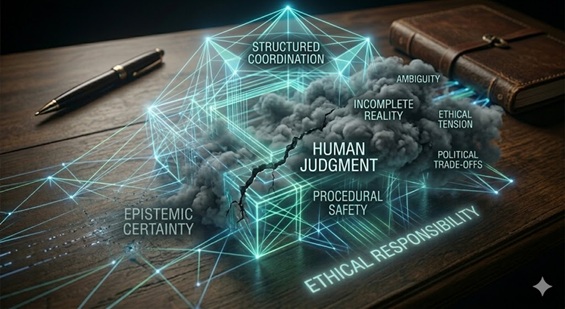 Modern organizations increasingly depend on frameworks. Governance frameworks. Delivery frameworks. Risk frameworks. Agile frameworks. Decision models. Maturity models. AI governance structures. Metrics systems. Operating models. Alignment mechanisms. And this dependence is understandable. Complexity has expanded dramatically. Organizations now operate under conditions shaped by: • Distributed coordination, • Continuous adaptation, • AI-enabled acceleration, • Systemic interdependence, • Regulatory volatility, • Stakeholder fragmentation, • Permanent uncertainty across operational environments. Under these conditions, frameworks matter enormously. They improve coordination. Increase consistency. Reduce ambiguity. Clarify expectations. Create operational language. Structure escalation. Preserve traceability. Support learning. Improve the probability of coherent execution across complex systems. But modern organizations increasingly risk confusing: • Structured coordination, with: • Eliminated uncertainty. This is where one of the most dangerous assumptions of contemporary governance begins to emerge: The belief that sufficiently sophisticated frameworks can eventually eliminate the need for difficult human judgment. They cannot. Because frameworks operate primarily within the domain of structured interpretation. Judgment operates within the domain of incomplete reality. That distinction matters enormously. Frameworks can: • Organize information, • Structure decisions, • Improve visibility, • Reduce variability, • Surface patterns, • Coordinate action under complexity. But frameworks cannot fully resolve: • Ambiguity, • Competing legitimacy, • Ethical tension, • Conflicting consequences, • Incomplete information, • Political trade-offs, • Uncertainty about futures that do not yet exist. This becomes especially important in AI-native environments. Because AI dramatically increases the organizational capacity to: • Analyze, • Predict, • Optimize, • Simulate, • Correlate, • Monitor, • Generate recommendations at scale. As a result, organizations may begin assuming that better analytics gradually reduce the necessity for judgment itself. But this assumption misunderstands the nature of decision-making under uncertainty. Because better information does not automatically eliminate: • Interpretation, • Responsibility, • Consequence, • Legitimacy, • Accountability. In many cases, greater informational sophistication simply exposes more complexity than organizations previously realized existed. This is one of the central paradoxes of modern governance: The more intelligence organizations accumulate, the more visible the irreducible necessity of judgment often becomes. This distinction becomes clearer once we separate: • Risk, from: • Uncertainty. Risk operates within partially calculable conditions. Probabilities can be estimated. Scenarios can be modeled. Trade-offs can be quantified. Frameworks perform extremely well here. But uncertainty operates differently. Under genuine uncertainty: • Future conditions may not yet exist, • Probability distributions remain unstable, • Causal relationships are incomplete, • Stakeholder behavior evolves dynamically, • Strategic consequences may emerge only after decisions propagate through the system. Under these conditions, organizations do not merely calculate. They interpret. And interpretation remains fundamentally human. This is why governance frameworks improve probability. But they do not eliminate judgment. Because judgment becomes necessary precisely where frameworks encounter their own limits. Especially when organizations must navigate tensions such as: • Adaptation vs coherence, • Legitimacy vs continuity, • Visibility vs trust, • Responsiveness vs stability, • Optimization vs resilience, • Alignment vs truth, • Short-Term pressure vs long-term viability. No framework can fully resolve these tensions automatically. At some point, someone must still decide: • Which trade-offs matter, • Which risks are acceptable, • Which consequences deserve priority, • Which legitimacy claims prevail, • Which direction the organization is ultimately willing to sustain under pressure. That responsibility cannot be outsourced entirely to: • Dashboards, • Governance structures, • AI systems, • Metrics, • Methodologies, • Procedural compliance. Because frameworks do not assume accountability. Humans do. Frameworks may structure decisions. AI systems may generate recommendations. Dashboards may increase visibility. Metrics may improve coordination. But none of them ultimately carries the ethical weight of consequence. Systems do not experience regret. Methodologies do not face moral responsibility. Algorithms do not absorb the human impact of failure. People do. And this is where modern governance becomes philosophically uncomfortable. Because many organizations unconsciously seek frameworks not only for coordination, but for procedural safety. Frameworks can create the comforting illusion that: • If the methodology was followed, • If the governance gates were respected, • If the metrics remained acceptable, • If the process appeared compliant, Then the decision itself becomes automatically defensible. But procedural defensibility is not the same thing as contextual correctness. Compliance may explain how a decision was made. It does not automatically justify whether the decision was wise under the conditions that actually existed. This distinction becomes even more important in environments increasingly shaped by: • AI-generated recommendations, • Predictive analytics, • Automated prioritization, • Behavioral optimization systems, • Continuously adaptive governance architectures. Because the more sophisticated organizational systems become, the greater the temptation to confuse: • Analytical sophistication, with: • Epistemic certainty. But organizational reality does not become fully deterministic simply because it becomes more measurable. In fact, systems thinking suggests the opposite may occur. As visibility expands: • Interdependence becomes more visible, • Unintended consequences propagate faster, • Local optimizations create systemic side effects, • Complexity itself becomes harder to stabilize coherently. This is why mature governance cannot rely exclusively on either: • Rigid proceduralism, or: • Continuous improvisation. Healthy governance requires something far more difficult: The ability to combine: • Structure, • Interpretation, • Accountability, • Contextual Awareness, • Ethical responsibility, • Adaptive judgment simultaneously. That is extraordinarily difficult. Especially under pressure. Especially under acceleration. Especially inside AI-native systems where: • Speed increases, • Ambiguity persists, • Organizational consequences propagate continuously across distributed environments. This is why the future of governance may ultimately depend less on eliminating uncertainty and more on developing organizations capable of exercising better judgment under conditions where uncertainty remains unavoidable. Because frameworks illuminate patterns. But judgment still navigates reality. And reality does not disappear simply because organizations become better at measuring it. In the next article, I will explore another emerging tension: What happens when adaptive systems become so interconnected, observable, and continuously responsive that organizations begin evolving toward cybernetic models of governance themselves? |
Posted on: June 15, 2026 05:02 AM
| Permalink |
Comments (0)
When Governance Becomes Behavioral
 Modern governance increasingly presents itself as collaborative, adaptive, and human-centered. Organizations speak the language of: • Empowerment, • Alignment, • Agility, • Participation, • Transparency, • Stakeholder engagement, • Continuous feedback. At first glance, this appears to represent a significant departure from traditional command-and-control management. And in many ways, it does. Modern organizations genuinely recognize that rigid procedural authority is insufficient for operating under conditions of: • Systemic complexity, • Distributed coordination, • AI-Native acceleration, • Continuous adaptation. But as governance evolves beyond explicit hierarchy, another transformation quietly begins to emerge. Governance itself increasingly becomes behavioral. Not merely through formal authority. But through: • Influence architectures, • Legitimacy systems, • Narrative framing, • Behavioral incentives, • Social signaling, • Metric visibility, • Perception shaping, • Continuous interpretive pressure across the organization. This is one of the least openly discussed transformations in modern organizational systems. Because governance no longer operates only through: • Rules, • Escalation paths, • Compliance structures, • Decision rights. Increasingly, it operates through shaping: • How reality is interpreted, • Which behaviors become legitimate, • Which narratives gain institutional support, • Which signals receive visibility, • Which forms of behavior become socially or operationally costly inside the system. This distinction is profound. Because organizations no longer need direct coercion to synchronize behavior. Behavior increasingly self-regulates through: • Observability, • Legitimacy pressure, • Adaptive signaling, • Social reinforcement, • Organizational narratives that define what “good behavior” looks like. Governance becomes less procedural and more behavioral. Less hierarchical and more environmental. Less explicit and more systemic. And this evolution often appears highly positive. Organizations become: • More adaptive, • More collaborative, • More responsive, • More dynamically coordinated. But this transformation also creates new governance risks that remain insufficiently explored. Because once governance begins shaping behavior continuously, the boundary between: • Coordination, and: • Behavioral engineering becomes increasingly fragile. This is where modern governance enters ethically uncomfortable territory. Especially when organizations begin optimizing not only: • Operational outcomes, But also: • Perception, • Alignment, • Engagement, • Responsiveness, • Legitimacy, • Behavioral conformity across distributed systems. At that point, governance no longer merely coordinates action. It increasingly shapes interpretation itself. This can emerge subtly. Organizations may begin: • Designing incentive systems around visible behaviors, • Reinforcing narrative conformity, • Optimizing communication for emotional alignment, • Rewarding performative responsiveness, • Suppressing friction indirectly through legitimacy pressure, • Continuously monitoring engagement signals as proxies for organizational health. Individually, each mechanism may appear rational. Collectively, however, the organization may slowly evolve toward continuous behavioral orchestration. Not necessarily because leaders seek manipulation. But because adaptive systems naturally reward synchronization under complexity. And synchronization itself increasingly depends on influencing: • Interpretation, • Legitimacy, • Perception, • Behavioral expectation at scale. This is why modern governance cannot be analyzed purely through formal structures anymore. The real architecture increasingly operates inside: • Incentives, • Visibility systems, • Communication patterns, • Narrative reinforcement, • Behavioral metrics, • Algorithmic recommendations, • Legitimacy dynamics distributed across the organization. In this environment, one of the greatest governance risks becomes performative alignment. People may begin optimizing not for: • Reality, • Learning, • Truthful interpretation, But for: • Visible legitimacy, • Narrative consistency, • Metric alignment, • Social safety inside the system. The organization appears aligned. But alignment itself may become increasingly artificial. This is where governance becomes extraordinarily delicate. Because organizations genuinely need: • Coordination, • Shared direction, • Legitimacy, • Behavioral coherence. Especially under AI-native conditions where: • Speed increases, • Ambiguity expands, • Distributed coordination intensifies, • Operational complexity continuously evolves. But organizations also need: • Dissent, • Interpretive diversity, • Cognitive autonomy, • Friction, • Ethical resistance, • Enough psychological safety for reality to remain speakable inside the system. Without these stabilizing forces, adaptive governance can gradually drift into behavioral optimization systems that prioritize: • Synchronization over understanding, • Legitimacy over truth, • Alignment over learning, • Responsiveness over reflection, • Performative coherence over authentic coherence. This creates one of the central governance dilemmas of the AI-native era: How do organizations preserve adaptive coordination without transforming governance into continuous behavioral conditioning? This question becomes even more important once AI systems begin participating directly in: • Communication flows, • Behavioral analytics, • Engagement monitoring, • Recommendation systems, • Narrative amplification, • Legitimacy signaling inside organizational environments. Because AI does not merely accelerate coordination. It can also amplify behavioral convergence at unprecedented scale. And once governance begins operating through continuous influence architectures, another risk emerges: The organization may slowly lose the distinction between: • Authentic alignment, and: • Engineered perception. That distinction matters enormously. Because healthy governance depends not merely on behavioral synchronization, but on preserving enough human sovereignty, interpretive plurality, and ethical friction to prevent the system from collapsing into optimized conformity. This is why the future challenge of governance may no longer be simply: “How do we coordinate organizations efficiently?” The deeper question may become: How do we preserve authentic human agency, truthful interpretation, and responsible judgment inside systems increasingly capable of shaping perception, legitimacy, and behavior continuously? Because governance may no longer operate primarily through authority. It may increasingly operate through the architecture of influence itself. In the next article, I will explore another emerging tension: Why frameworks, metrics, and governance structures can improve probability and coordination, yet still remain fundamentally incapable of eliminating the irreducible necessity of human judgment under uncertainty. |
Posted on: June 12, 2026 04:01 AM
| Permalink |
Comments (0)
The Hidden Return of Command-and-Control
 For years, modern organizations have operated under a powerful assumption: Command-and-control management is disappearing. Agile operating models, adaptive governance, empowered teams, distributed coordination, AI-enabled workflows, and continuous feedback systems all appeared to signal the decline of rigid hierarchical control structures. Organizations became flatter. Decision-making became more distributed. Teams became more autonomous. Governance became more adaptive. Leadership became more collaborative. At least on the surface. But beneath this transformation, something more complex may be emerging. Because while visible command-and-control structures may be weakening, organizations are simultaneously becoming: • More observable, • More measurable, • More behaviorally coordinated, • More continuously monitored than ever before. This creates an uncomfortable question: Did command-and-control actually disappear? Or did it simply evolve into forms that are less visible, more distributed, and algorithmically mediated? This question matters enormously in AI-native environments. Because modern organizational systems increasingly operate through: • Dashboards, • Telemetry, • Behavioral metrics, • Real-time analytics, • Continuous feedback loops, • Productivity tracking, • Workflow visibility, • Algorithmic recommendations, • Predictive coordination systems. Individually, each mechanism often appears legitimate. Most are introduced: • To improve coordination, • Increase visibility, • Accelerate adaptation, • Optimize performance, • Reduce friction, • Strengthen responsiveness. And in many cases, they genuinely create value. But systems thinking suggests something deeper may also be happening simultaneously. Because organizations no longer need rigid hierarchical supervision to influence behavior continuously. Behavior can increasingly be shaped indirectly through: • Visibility, • Metrics, • Incentives, • Dashboards, • Response-Time expectations, • Engagement signals, • Transparency systems, • Algorithmically amplified feedback loops. Control becomes ambient. Distributed. Continuous. And increasingly psychologically internalized by the system itself. This is one of the defining transformations of modern governance. Traditional command-and-control systems operated visibly. Authority was explicit. Hierarchy was clear. Control was identifiable. Supervision was centralized. Modern behavioral coordination systems operate differently. Instead of forcing compliance directly, they increasingly shape: • Interpretation, • Incentives, • Perceived legitimacy, • Behavioral expectations, • Adaptive responses across distributed systems. The result is not necessarily less control. In some environments, it may actually produce more pervasive forms of coordination than traditional hierarchical systems ever achieved. But because these systems often emerge gradually through operational optimization, organizations may fail to recognize the governance implications of what they are building. Especially when adaptation, responsiveness, and performance visibility become cultural virtues. This is where the tension becomes particularly important. Because adaptive governance can unintentionally evolve into continuous behavioral regulation. Not through coercion. But through: • Permanent observability, • Metric-driven legitimacy, • Performative alignment, • Social signaling, • Continuous interpretive pressure inside the system. Over time, people learn: • Which behaviors are rewarded, • Which narratives are acceptable, • Which signals create legitimacy, • Which metrics receive visibility, • Which forms of disagreement increase organizational friction. This does not necessarily eliminate autonomy. But it changes how autonomy behaves inside the system. Modern organizations increasingly operate through a form of bounded autonomy: Teams remain free to decide how to execute locally, while the broader architecture of metrics, visibility, legitimacy, responsiveness, and behavioral expectations continuously shapes what becomes acceptable, rewarded, and strategically viable inside the system. The organization may still appear decentralized. Yet behavior becomes increasingly synchronized through systemic visibility and adaptive pressure. This creates another paradox of modern governance: The same systems designed to increase flexibility and empowerment may simultaneously expand behavioral coordination and invisible control. And AI accelerates this transformation dramatically. Because AI-native systems amplify: • Sensing capacity, • Behavioral analytics, • Anomaly detection, • Predictive visibility, • Workflow monitoring, • Coordination speed, • Pattern interpretation across the organization. As a result, governance increasingly shifts from: • Supervising actions, toward: • Shaping behavioral conditions continuously. This distinction is profound. Because it changes the nature of organizational power itself. The issue is no longer merely: “Who controls the organization?” The deeper question becomes: “How does the system continuously shape behavior, interpretation, legitimacy, and adaptive response under conditions of distributed visibility?” This is where modern organizations begin approaching a cybernetic model of governance. Not necessarily because leaders intentionally seek centralized domination. But because adaptive systems naturally generate increasing pressure for: • Observability, • Coordination, • Prediction, • Responsiveness, • Synchronization, • Behavioral alignment under complexity. And under continuous operational acceleration, organizations increasingly interpret more visibility as more control capacity. But visibility and wisdom are not the same thing. Measurement and understanding are not equivalent. And continuous observation does not automatically produce healthier organizational behavior. In fact, excessive observability can generate unintended consequences: • Performative behavior, • Defensive adaptation, • Metric gaming, • Local optimization, • Legitimacy signaling, • Reduced psychological safety, • Gradual erosion of authentic organizational learning. People may slowly begin adapting not to operational reality itself, but to how reality is interpreted, measured, and legitimized inside the system. This is where modern governance becomes extraordinarily delicate. Because organizations genuinely need: • Coordination, • Observability, • Adaptive capacity, • Operational visibility. Especially in AI-native environments. But they also need: • Trust, • Autonomy, • Interpretive diversity, • Responsible dissent, • Cognitive space for authentic learning, • Enough human sovereignty to prevent the system from collapsing into continuous behavioral optimization. This is why the future governance challenge may no longer be simply balancing: • Control vs • Autonomy. The deeper challenge may become: How do organizations preserve human judgment, authentic learning, and strategic coherence inside systems that are becoming continuously observable, measurable, adaptive, behaviorally synchronized, and algorithmically mediated? Because command-and-control may not be disappearing. It may simply be dissolving into the architecture of the system itself. In the next article, I will explore another emerging tension: What happens when governance itself increasingly operates through behavioral influence, perception management, legitimacy engineering, and narrative synchronization rather than explicit authority alone? And at what point does governance stop coordinating behavior and start engineering perception itself? |
Posted on: June 10, 2026 03:24 AM
| Permalink |
Comments (4)
Adaptive Legitimacy vs Systemic Coherence
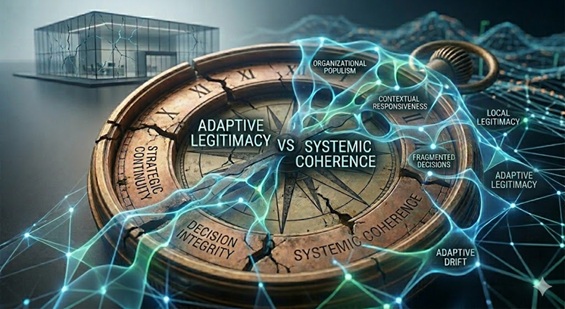 Modern governance increasingly encourages organizations to become more adaptive. Projects are expected to: • Reassess continuously, • Respond dynamically to stakeholders, • Incorporate feedback rapidly, • Adapt to changing contexts, • Evolve alongside shifting perceptions of value and legitimacy. At first glance, this appears unquestionably positive. And historically, it emerged for good reasons. For decades, organizations often operated through rigid governance structures that confused procedural stability with strategic effectiveness. Projects delivered exactly what had been approved while gradually becoming disconnected from the realities they were originally intended to serve. Adaptive governance emerged partly as a corrective to that rigidity. Frameworks such as Agile, modern PMOs, AI-enabled coordination systems, and approaches like M.O.R.E increasingly recognize that legitimacy cannot be treated as static. Stakeholders evolve. Markets shift. Operational conditions change. Value itself becomes contextual over time. Under these conditions, governance cannot remain frozen. Organizations must continuously reassess: • Whether priorities still make sense, • Whether value assumptions still hold, • Whether delivery remains strategically relevant, • Whether the system is still producing outcomes that remain legitimate for the environment in which it operates. This is where adaptive legitimacy becomes operationally important. Because organizations that cannot adapt eventually lose relevance. But this evolution introduces a tension that modern governance frameworks still struggle to address explicitly: What happens when continuous adaptation begins to erode systemic coherence itself? This question is becoming increasingly important. Because adaptive legitimacy and strategic coherence are not automatically aligned. In fact, under pressure, they can begin pulling organizations in opposite directions. Local stakeholders may demand immediate responsiveness. Teams may optimize for contextual legitimacy. Business units may continuously reinterpret priorities. Governance bodies may adjust direction reactively to preserve alignment and approval. Individually, each adaptation may appear reasonable. Collectively, however, the system may slowly lose strategic continuity. This is the beginning of adaptive drift. Adaptive drift rarely appears dramatically. Organizations do not usually collapse because a single decision was obviously catastrophic. More often, they drift gradually: • Priorities shift incrementally, • Trade-Offs become localized, • Exceptions accumulate, • Decision criteria evolve inconsistently, • Short-Term legitimacy progressively overrides long-term coherence. At some point, the organization may still appear adaptive, responsive, and operationally active while no longer moving coherently toward a stable strategic direction. This is one of the central governance tensions emerging inside adaptive organizations. Because adaptation itself is not inherently virtuous. Poorly governed adaptation can fragment systems faster than rigid governance ever did. This becomes particularly difficult in environments shaped by: • AI-enabled coordination, • Distributed decision-making, • Continuous feedback loops, • Real-Time analytics, • Increasing pressure for responsiveness. The faster organizations can sense and react, the harder it becomes to preserve shared interpretive stability across the system. And this creates an uncomfortable paradox: The same mechanisms designed to increase organizational adaptability may simultaneously increase the probability of strategic fragmentation. This tension becomes especially visible when legitimacy itself becomes increasingly localized. Different stakeholders often operate under different definitions of: • Success, • Value, • Urgency, • Acceptable risk, • Even organizational purpose. Under these conditions, governance faces a difficult question: Should organizations continuously optimize for local legitimacy? Or should governance sometimes preserve strategic continuity even when immediate stakeholder pressure pushes in different directions? This is where adaptive governance begins approaching a politically uncomfortable territory. Because excessive optimization for local legitimacy can gradually evolve into a form of organizational populism: A system that continuously adapts to immediate contextual pressures while progressively weakening long-term strategic coherence. The system remains responsive. But responsiveness alone does not guarantee viability. This is not a purely procedural problem. It is fundamentally a judgment problem. Because no framework can fully determine: • When adaptation remains healthy, • When reassessment becomes destabilizing, • When responsiveness becomes reactive drift, • When local legitimacy begins undermining long-term coherence. And this is where many modern governance conversations remain incomplete. Adaptive governance is often discussed as if flexibility itself automatically produces better organizational outcomes. But systems thinking suggests something more complex. Highly adaptive systems without stabilizing coherence mechanisms can become behaviorally unstable over time. The issue is not adaptation itself. The issue is whether the system preserves enough coherence to prevent fragmentation under continuous reinterpretation. This distinction matters enormously for PMOs, governance bodies, and leadership teams. Because the future challenge may no longer be simply enabling adaptation. The deeper challenge may be governing the boundaries of adaptation itself. Not every local optimization strengthens the whole system. Not every legitimate stakeholder request should redefine strategic direction. Not every reassessment improves organizational coherence. And not every adaptive response preserves long-term viability. This is why modern governance increasingly requires something beyond procedural compliance or continuous flexibility. It requires the capacity to sustain simultaneously: • Strategic continuity, • Decision integrity, • Contextual interpretation, • Stakeholder legitimacy, • Systemic coherence. That is extraordinarily difficult under conditions of continuous adaptation. Especially inside AI-native organizations where: • Feedback accelerates, • Options multiply, • Visibility expands, • Pressure for responsiveness becomes continuous. Because acceleration amplifies both adaptation and fragmentation at the same time. And this may ultimately become one of the defining governance challenges of the AI-native era: How do organizations remain adaptive enough to preserve legitimacy without becoming so fluid that they dissolve strategic coherence itself? In the next article, I will explore another tension emerging from this transformation: If command-and-control structures are supposedly disappearing, why are modern organizations becoming increasingly observable, measurable, behaviorally coordinated, and algorithmically managed? Has command-and-control actually disappeared? Or has it simply become less visible? |
Posted on: June 08, 2026 03:16 AM
| Permalink |
Comments (0)
From Project Integration to Adaptive Governance
 For decades, project management was fundamentally structured around one central challenge: Integration. Projects succeeded when managers could coordinate scope, schedule, cost, resources, stakeholders, risks, and delivery activities into a coherent execution model capable of producing predictable outcomes under defined constraints. This made sense. Organizations operated in comparatively more stable environments. Governance emphasized structure. Control mechanisms prioritized predictability. PMOs emerged largely to standardize coordination, preserve alignment, and reduce operational fragmentation. The core management problem was primarily mechanical: How do we integrate increasingly complex project components efficiently enough to sustain delivery? But modern organizations are no longer operating inside the same conditions. Projects now exist within environments characterized by: • Continuous technological acceleration, • Distributed decision-making, • Stakeholder volatility, • AI-enabled coordination, • Dynamic value expectations, • Regulatory fluidity, • Systemic interdependence across organizational boundaries. Under these conditions, traditional integration remains necessary. But it is no longer sufficient. The challenge is no longer simply integrating work. The challenge is governing adaptation itself. This shift is increasingly visible in the evolution of modern governance frameworks, including the PMBOK® Guide 8th Edition, adaptive operating models, AI-native organizational systems, and approaches such as M.O.R.E. The center of gravity is moving: • From process coordination, toward adaptive governance; • From procedural compliance, toward dynamic value legitimacy; • From static execution, toward continuous contextual reassessment. At first glance, this evolution appears entirely positive. And in many ways, it is. Modern governance frameworks correctly recognize that organizations cannot operate effectively through rigid command-and-control structures under conditions of continuous change. Adaptive systems matter. Feedback matters. Stakeholder legitimacy matters. Continuous learning matters. But this evolution also introduces new tensions that organizations are only beginning to recognize. Because adaptation itself creates systemic complexity. The more organizations continuously reassess: • Value, • Legitimacy, • Priorities, • Stakeholder expectations, • Success criteria, The more difficult it becomes to preserve: • Coherence, • Accountability, • Strategic continuity, • Decision integrity over time. This is where the modern governance challenge fundamentally changes. Traditional project integration was primarily concerned with coordinating activities. Adaptive governance is concerned with preserving coherence across continuously evolving systems of interaction, interpretation, and decision-making. That is a profoundly different problem. And it changes the role of governance itself. Governance can no longer function merely as procedural oversight or administrative control. Nor can it disappear entirely in the name of agility, empowerment, or adaptive legitimacy. Instead, governance increasingly becomes: • A coordination architecture, • A decision boundary system, • A coherence-preservation mechanism, • A structure for sustaining legitimacy under continuous adaptation. This distinction matters enormously. Because many organizations are currently trapped between two unstable extremes. On one side: Rigid governance systems incapable of adapting fast enough to changing operational realities. On the other: Hyper-adaptive systems that continuously reinterpret priorities, value, and legitimacy until strategic coherence itself begins to erode. Neither extreme is sustainable. Too much rigidity produces bureaucratic paralysis. Too much fluidity produces adaptive drift. And this is where modern governance becomes significantly more difficult than traditional project management models assumed. The challenge is no longer: “How do we control delivery?” The challenge increasingly becomes: “How do we continuously adapt without dissolving coherence?” And these tensions intensify even further once adaptive systems become increasingly automated. Inside AI-native organizations, the pressure for adaptation is amplified because AI accelerates: • Analysis, • Coordination, • Visibility, • Option generation, • Operational responsiveness, • Decision propagation across distributed systems. But acceleration does not automatically produce: • Judgment, • Accountability, • Legitimacy, • Strategic coherence. In many cases, acceleration simply exposes organizational fragmentation faster. AI does not eliminate governance tension. It amplifies it. As a result, governance itself is evolving from: • Process supervision, Toward: • systemic coordination under adaptive conditions. And PMOs may ultimately evolve alongside it. Not as reporting factories. Not as compliance centers. Not as administrative control structures. But as coherence architectures operating across distributed systems of decision, adaptation, and value creation. This may represent one of the most important governance transitions modern organizations will face over the coming decade. Because the future of governance may not depend primarily on how efficiently organizations integrate work. But on whether they can preserve coherent human judgment, accountability, and strategic direction while continuously adapting under conditions of systemic complexity. In the next article, I will explore one of the first major tensions emerging from this shift: What happens when adaptive legitimacy begins to challenge strategic coherence itself? Can organizations continuously satisfy local stakeholder legitimacy while still preserving long-term strategic coherence? That is the tension we will explore next. |
Posted on: June 05, 2026 03:28 AM
| Permalink |
Comments (0)


