


Guided Continuous Improvement (GCI) article is now online


|
While working with organizations to help them to learn how to improve their way of working (WoW), we’ve developed a technique that we call guided continuous improvement (GCI). Adopting an agile method such as Scrum, or a framework such as SAFe, may give you an initial start at improving your WoW you will quickly find yourself in “method prison.” The organizations that break out of method prison do so with a kaizen-based continuous improvement approach, or better yet GCI. First, some definitions:
In the article we go into the details of the technique, exploring:
We hope you find the article to be a game changer for your agile adoption efforts. |

Reiki Practices for Agile Teams
Categories:
agile,
DAD,
disciplined agile delivery,
Scrum,
Uncategorized,
DA,
Energy Healing,
post-format-quote,
Reiki,
Disciplined Agile
Categories: agile, DAD, disciplined agile delivery, Scrum, Uncategorized, DA, Energy Healing, post-format-quote, Reiki, Disciplined Agile
|
Why Energy Enhancement is Important “Your energy introduces you before you even speak” – I strongly believe in this famous quote and I am writing this article to enhance the positive energy level of every agile team, irrespective of their agile maturity level and experience. If your Enterprise is not very mature in Disciplined Agile (DA) implementation, then you need to work with a CDAC to increase this maturity. I’m not focusing on those aspects of DA implementation in this article. You can get that knowledge from the DA website, blog, any CDAC or many great books written by Scott Ambler and Mark Lines. I’m a certified Reiki Master Teacher and Disciplined Agile Coach & Instructor (CDAC & CDAI), who has been coaching and training agile teams, plus successfully healing people (in person or located thousands of miles away) by my Reiki knowledge. I’ve identified some basic Reiki practices which every agile practitioner can follow to increase their own positive energy level. No prior Reiki or Energy Healing knowledge is required to follow these time-tested practices and you can even measure the increase in this positive energy by Pendulum Dowsing, if you are interested in collecting the evidence. Background of Energy Healing and Reiki With the advancements of quantum physics, evidence supporting the concept that matter is made up of layers of energy came to light. For centuries, indigenous cultures have been positively influencing the body’s health by working with its energy fields, and many traditions around the world speak about how it can be used in medical practices. It was first observed by the eastern healers who identified seven Chakras and twelve major Meridians, or pathways of energy, in the body. They enhance the flow of energy to improve the health of the physical body. This is called Energy Healing. The word Reiki is made of two Japanese words – “Rei” which means “Universal” and “Ki” which is “Life Force Energy”. Reiki flows through all living things. It utilizes the Ki to strengthen and help others using a lot of hand techniques and specific symbols which channel the energy of the universe to heal the body, mind and spirit. With this background information, let’s explore some simple practices to enhance the positive Energy Level of your agile teams: Meditation on Five Reiki Principles (10-15 Minutes Daily)The following five Reiki principles are guidelines that everyone can live by, to promote a healthy, loving way of living.
Worry causes stress which is a major issue in our daily lives. So, for a day try to stop worrying. It will make your life peaceful which in turn, will also bring peace to others. Lowering down stress will also enhance your physical health. Just for today trust in the universal life force and it will help you in fixing your problems!
If a typical morning for you involves getting bug reports from the testers or high priority production tickets from the users, you probably default to anger. Why not just take a deep breath, relax and let it go? What will you achieve by remaining angry and increasing your own blood pressure? Nothing. All that you’ll end up with is an elevated heart rate (and more stress!) which is not good for your well-being.
We are always asking for more and only seeing what we don’t have. Let’s try for one day to be grateful for what we do have — like a job, a car, a roof over your head, good health, a family and your DA team that supports you. If you are grateful for what you have, you will attract more good. The law of attraction states that like attracts like and lack attracts lack, so stay positive and be grateful for what you have.
Doing your work honestly brings more purpose and meaning into your life. When you do your work honestly and with purpose, at the end of the day you’ll feel good about yourself and more fulfilled about your work. Just remember the following quote of quality guru Dr. W. Edwards Deming – “Quality is pride of workmanship.”
What you give out, you receive back multifold. Be nice, loving and caring to everyone, even if it’s not your favorite person in the world. We all deserve love and kindness. At the end of the day we will feel better about ourselves for bringing some light and love into someone else’s day, even if it’s just for a moment. Please note, all these principles start with “Just for today” phrase because our life is agile and every new day can be treated as a new iteration. You don’t need to plan your whole life today in Waterfall style. Just meditate on these principles and live one iteration (day) at a time. You will be much happier at the end of the day, I promise. Forgiveness Prayer (10-15 Minutes in Every Retrospective Meeting)Every team can spend 10-15 minutes in every Retrospective meeting to chant and meditate on the following forgiveness prayer:
Affirmation Slips (10-15 Minutes in Every Iteration Planning Meeting or as Needed)An affirmation is a simple, positive phrase that is meant to change our habit, belief, behavior, approach, emotion, feeling or opinion. For many people, it’s a great tool of healing and improving life. After all, it’s a tool of working with your inner self. How to make affirmation slips? Keep it as simple as possible. No need to be formal and go for fancy words or big-big affirmations. You can note down this wish on a piece of paper in clear words or use any simple affirmation related to your wish. Hold this slip between your palms and meditate for 5-10 minutes with the intention to manifest it for your highest good. To understand and explain affirmations better, here are two simple examples. I, YOUR NAME, write perfect code and delight our customers! I, YOUR NAME, catch every bug in testing and enhance the reliability of our software! Using this affirmation properly will establish a new opinion in your mind. And because our opinions create our reality (have you read/watched The Secret?), then with a bit of healing, you will be able to do your job perfectly and with pleasure. How to write affirmations? Well, there are few “rules” and some “guidelines”. First, the affirmation must be a positive phrase. So don’t use “no”, “never”, “not” and things like that. Always try to make sure that your affirmation sounds positive. Next, write affirmations for yourself, not for others. These are the basics of writing affirmation. You can also listen to a recorded affirmation or recite the affirmation, because it works, as well. My experiments with various DA teams have convinced me that these Energy Healing practices will work for your DA team as well. Even if you are not sure about the outcome or don’t know how to measure this enhanced positive energy by a Pendulum Dowser, I suggest you run it as an experiment for 2-3 iterations and observe the difference. Do share your experiences with me after conducting this experiment. May the force be with you! – Written by Dr. Sanjay Saxena, Ph.D., CDAC, CDAI, SPC4, PgMP, Reiki Master Teacher ([email protected]) |
Terraforming: Evolving Your Agile Workspace
Categories:
agile,
Scrum,
Kanban,
lean,
Choose your WoW,
#ChooseYourWoW,
terraforming,
workspaces,
Teams
Categories: agile, Scrum, Kanban, lean, Choose your WoW, #ChooseYourWoW, terraforming, workspaces, Teams
|
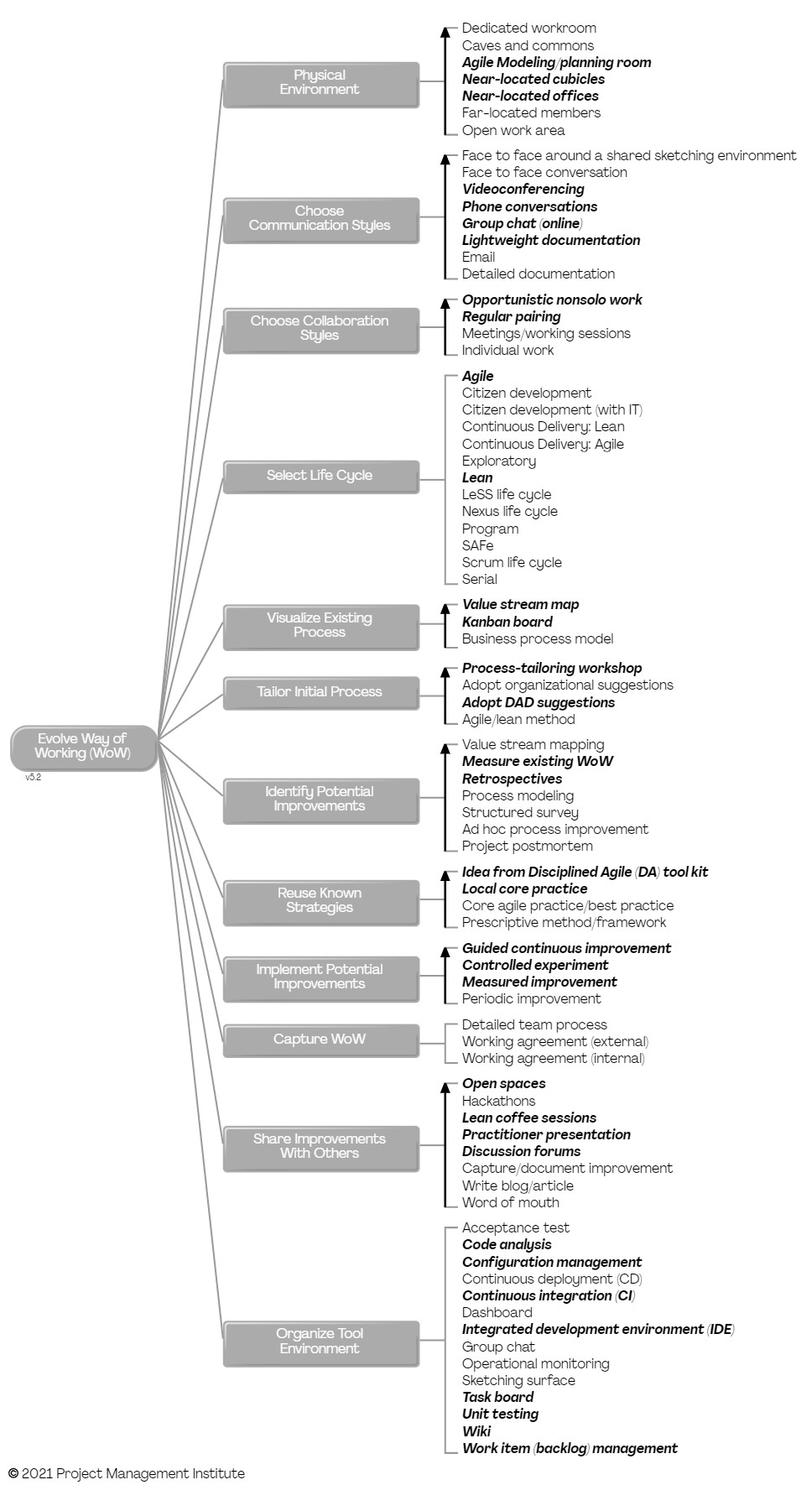
Terraforming is the act of making an environment suitable for human habitation. Terraforming has been popularized in science fiction as the act of evolving a planetary ecosystem, but in our context terraforming is the act of evolving your team’s physical workspace to make it more habitable for you to work. Doing so in an important enabler for improving your way of working (WoW). The Evolve Way of Working (WoW) process goal, the diagram for which is shown in Figure 1, involves several decision points that are pertinent to terraforming. In Disciplined Agile (DA) our philosophy is that teams should choose and evolve their WoW over time as they learn, and an important aspect of doing so is to recognize that you should be able to evolve your physical as well as virtual workspace. Figure 1. The Evolve Way of Working (WoW) process goal diagram (click to expand).
As you’d expect, you have choices available to you. In Figure 1 there are three decision points relevant to terraforming:
We’ve found that a great strategy for a company is to make physical things such as furniture and whiteboards readily available to teams. Something as simple as a room full of (currently) unused furniture that a team can simply take from, or contribute things they’re no longer using into, goes a long way to providing flexibility. And of course allowing teams to buy what they need, when they need it, is also crucial. Smart organizations realize thatone of the best investments they’ll ever make is to spend a few thousand dollars on furniture and whiteboards to enable a team of people earning five or six figure annual incomes to improve their WoW.
Ideas for this blog was adapted from the book Choose Your WoW! This book is a handbook overviewing hundreds of agnostic techniques and strategies that agile and lean teams may decide to experiment with to see how well they work in the situation that they face. |

Disciplined Agile Goes to India
|
Mark and I are lucky enough to spend a few weeks in India this March. In addition to speaking at Agile India 2019 we’ll also be running several Disciplined Agile workshops and a user group presentation one evening. Here is our schedule in both Pune and Bengaluru. Pune:
Bengaluru:
If you’re based in India we hope you can make it out to one or more of these events. If you have colleagues in India please pass this along to them as this may be a great chance for them to learn about DA from the source! |

Please don't call yourself a
Categories:
agile,
DAD Book,
Scrum,
Kanban,
lean,
Continuous Improvement,
Choose your WoW,
#ChooseYourWoW,
LeSS,
SAFe
Categories: agile, DAD Book, Scrum, Kanban, lean, Continuous Improvement, Choose your WoW, #ChooseYourWoW, LeSS, SAFe
|
Please don’t call yourself a “Disciplined Agile shop”. It is the kiss of death. I was recently having a discussion with a client about visiting them on an upcoming visit to the UK. At one point in the past they had proudly declared themselves a Disciplined Agile “shop”. The senior exec that I spoke with told me “We have moved on now from DA to SAFe”. Upon further discussion he admitted that SAFe is being used on just a few initiatives, but that they had sent lots of people to SAFe training. The inference seemed to be that since they had previously taken DA training, but had now taken SAFe training that they have now changed “shops”. Ironically while a lot of budget was committed to SAFe training and related consulting, most of the work done at this organization actually used other agile and lean lifecycles such as Scrum and Kanban. You know, DAD stuff. Why is it that our industry has an obsession with labelling themselves as a type of “shop”, when the reality is that they will likely use a variety of approaches depending on the context? You could be building something from scratch, extending a solution, or implementing a commercial off the self package. You could be in a straightforward situation, or building defence or life critical systems. Our industry has become extremely fragmented, with organizations trying to put themselves in a certain box such as Scrum, SAFe, Scrum/XP, LeSS, DAD, Kanban, Spotify, and it goes on and on. So let’s stop doing this. Unfortunately, Disciplined Agile (aka DAD) has gotten lumped in with scaling frameworks such as SAFE, LeSS, Nexus etc, when the reality is that DA is not a purpose-built framework for scaling situations exclusively, like a true scaling framework. It is, rather, a rich and flexible toolkit than can be used to apply fit-for-context strategies for your unique situation for initiatives of all sizes and types. If you need to apply them at scale, you can. But our preferred approach is to descale where possible rather than apply a prescriptive recipe to a large and risky problem. When we take a closer look at different types of shops, we see a lot of MethodBut. For example, ScrumBut is where teams use Scrum but they don’t do retrospectives or some other ceremony. Or teams use SAFe but management doesn’t buy in to doing quarterly 2-day big room planning sessions. Practitioners in these “shops” are ostracized and may be excommunicated from their religion for not following one of their prescribed ceremonies. Disciplined Agile’s core principles include context counts, choice is good and pragmatism. While we believe that skipping parts of a method early in your adoption is likely a mistake, as your teams mature and understand options that can make them more efficient we support the idea of being freed from the “method prisons” (as described by Ivar Jacobson) so that they can optimize their WoW (Way of Working). This essentially is why the DA “toolkit” was created. It contains hundreds of strategies to help you to make better decisions on your journey to high performance agility.
As you can see from the diagram, regardless of what framework or method you are using, there will likely be strategies that supplement your approach which are not described in the method recipe(s) that you have chosen. DA is a toolkit of ingredients, to enable you to be a better chef. If you don’t know what is in the pantry, and which combinations will delight the unique preferences of your guests/stakeholders, then you probably won’t meet your potential as a Michelin Star Chef. We have come to realize that the methods/framework industry is a moving target. Waterfall shops, then RUP, then SAFe, then….? There will be more frameworks, indeed it seems that we learn of a new one every few months. As consultants seek to differentiate themselves, and have something new to sell, or organizations fail in their agile adoption and look for the “next big thing”, new frameworks/recipes will continue to emerge, with related training programs and certifications.
At Disciplined Agile, we are beginning to make a concerted effort to separate ourselves from the toolkits, as we really shouldn’t be competing with them. It is not DA or . It should be DA and . So our recommendation is to take a DA workshop to expand your pantry of ingredients, and learn how to be a better cook. Or a good starting point is to read the Choose your Wow! book (Ambler/Lines). But please, don’t call yourselves a “Disciplined Agile shop”. |




