





.jpg)


.png)



Guessing is not a strategy: How to build decision velocity with AI and real-time data
June 10, 2026 | Live Webinar

Disciplined Agile 5.5 Released
Choose Your WoW! Second Edition Is Now Available
Requisite Agility applied in Project Management
Disciplined Agile and PMBoK Guide 7th Edition
#ChoiceIsGood, #ChooseYourWoW, #ConsumableSolution, #ContinuousImprovement, #CoreAgilePractices, #experiment, #Experimentation, #GuidedContinuousImprovement, #Kaizen, #LifeCycles, #ProcessImprovement, #TealOrganizations, Adoption, agile, agile adoption, Agile Alliance, Agile Business Analyst, Agile certification, agile data, agile governance, agile lifecycle, agile metrics, agile principles, agile transformation, Agile2018, Agile2019, Agile20Reflect, AgileData, Analogy, announcement, Architecture, architecture, architecture owner, Articles and publications, Asset Management, Atari, Backlog, Barclays, being agile, benefits, bi, blades, book, Branching strategies, Browser, Business Agility, business intelligence, business operations, capex, Case Study, Certification, certification, charity, Choose your WoW, CMMI, cmmi, Coaching, Collaboration, Communications Management, Compliance, Compliancy, Conference, Construction, Construction phase, Context, Continuous Improvement, coordination, COVID-19, Culture, culture, Cutter, DA, DAD, DAD Book, DAD discussions, DAD press, DAD roles, DAD supporters, DAD webcast, DADay2019, Data Management, database, dependencies, Deployment, Development Strategies, DevOps, disaster, Discipline, discipline, Disciplined Agile, disciplined agile delivery, disciplined agile delivery blog, Disciplined Agile Enterprise, disciplined devops, Documentation, Domain complexity, dw, DW/BI, Energy Healing, Enterprise Agile, Enterprise Architecture, Enterprise Awareness, enterprise awareness, Essence, estimation, Evolving DA, Executive, Experiment, facilitation, FailureBow, feedback-cycle, finance, Financial, FLEX, Flow, foundation layer, Funding, GCI, GDD, Geographic Distribution, gladwell, global development, Goal-Driven, goal-driven, goals, Governance, GQM, Guideline, Hybrid, Improvement, inception, Inception phase, India, information technology, infosec, Introduction, iterations, Kanban, large teams, layer, lean, Lean Startup, learning, Legal Project Management, LeSS, Lifecycle, lifecycle, Manifesto, mark lines, marketing, MBI, Metaphor, Metrics, metrics, mindset, Miscellaneous, MVP, News, News and events, Non-Functional Requirements, non-functional requirements, Non-solo development, offshoring, Operations, opex, Organization, Outsourcing, outsourcing, paired programming, pairing, paper, People, People Management, phases, Philosophies, Planning, PMBoK, PMI, PMI and DA, PMI Chapter, Portfolio Management, post-format-quote, Practices, practices, Principle, Process, process improvement, process tailoring, Product Management, product owner, Product Owners, productivity, Program Management, Project Management, project-initiation, Promise, Quality, quality, rational unified process, Refactoring, Reiki, Release Management, release management, Remote Training, Remote Work, repeatability, requirements, Requirements Management, research&development, responsibilities, retrospectives, Reuse, Reuse Engineering, ride for heart, rights, Risk Management, Risk Management, Risk management, Roles, RUP, SAFe, sales, Scaling, scaling, scaling agile, Scheduled Workshops, SCM, scorecard, Scrum, ScrumMaster, SDLC, Security, security, self-organization, SEMAT, serial, skill, solutions software consumable shippable, Stakeholder Management, strategy, Support, Surveys, Teal organizations, team development, Team Lead, team lead, Teams, Technical Debt, Teleconferencing, Terminology, terraforming, test strategy, testing, time tracking, Tool kit, Toolkit, tools, traditional, Transformation, Transition iteration, transition phase, Uncategorized, Upmentors, Using PMI Standards, value stream, velocity, vendor management, Virtual Training, Workflow, workflow, workspaces


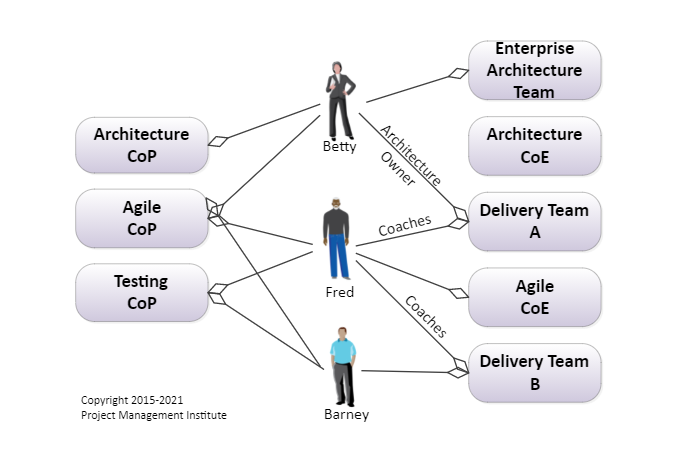
| When your organization chooses to transition to more agile and lean ways of working you quickly discover that this effort needs to address all aspects of your organization, not just your solution delivery teams. Many transformation efforts invest in agile team coaches, which is a very good thing to do, but will often shortchange other areas of coaching in the belief that they’ll figure it out on their own. It may work out that way, but even when it does this is an expensive, slow, and error-prone approach. In our experience it’s far better to get help from an experienced Enterprise Coach. An Enterprise Coach coaches “beyond the team” to help senior managers and leaders to understand and adopt an agile and lean mindset. As you will soon see, this requires a similar yet different skill set than what is required for team coaching. In this blog we work through three key concepts: Types of Agile CoachesAs you see in the following diagram we like to distinguish between several types of coaches:
Skills of An Enterprise CoachThe skills of an Enterprise Coach include:
Supporting Other CoachesEnterprise Coaches support other coaches in several important ways:
There is of course a lot more to agile coaching that what is covered in this short blog. Our goal with this writing was to overview the role of Enterprise Coach and show how it fits into the overall scheme of things. |
|
A common question that we hear a lot is “Why choose Disciplined Agile Delivery (DAD) over Scrum?”, so we’ve written this blog to summarize our response. The short answer is that DAD addresses the myriad of issues that Scrum chooses to leave to you. To see what we mean, the official Scrum Guide is less than 20 pages compared to the 400 pages of the Choose Your WoW! 1st Edition – DAD clearly goes into greater detail than Scrum, detail that your organization will need to spend a lot of time and money figuring out on your own with Scrum as your process base. We believe you can do a lot better than that. At a high-level, the primary reason to adopt DAD over Scrum is that you will greatly increase the chance that your process improvement efforts will be successful, and you will do so in such a way that it will be quicker and less expensive in the long run. This is because DAD takes a holistic, context-sensitive approach to solution delivery as opposed to Scrum’s prescriptive and narrow approach. Let’s explore the many reasons why you should adopt DAD over Scrum:
Reason #1: DAD Extends ScrumThe question “Why choose DAD over Scrum” doesn’t make a lot of sense to us because DAD extends Scrum to address all of the process issues that Scrum leaves up to you. As we describe below, DAD addresses all aspects of agile (not just management and collaboration), it explicitly supports a full delivery lifecycle (not just Construction), and it goes beyond software development to address solution delivery. Scrum is important, and it encompasses a lot of great ideas, but in practice it proves to be a very small part of the overall agile picture. We’d like to say that it’s the tip of the iceberg, but the tip of the tip of the iceberg would be a lot closer to the mark. For more thoughts on this topic, see the blog Disciplined Agile Extends Scrum.
Reason #2: DAD Addresses All Aspects of Agile Solution Delivery
The focus of Scrum is on change management and collaboration, important things but not actually sufficient for software development. Scrum purposefully does not address architecture, programming, design, testing, governance, analysis, documentation, and many other important issues. Scrum suggests that you start with it as a core and add in what you need, which is a boatload of time-consuming work in practice because Scrum simply doesn’t address the full range of issues that you actually face. It will take you months, and sometimes years, of effort to evolve to a right-sized process that works for your team. Worse yet, Scrum will require more coaching (which is expensive), and more experimentation (important, but expensive and time consuming so you to be smart about it) than if you were to start with a more robust strategy such as DAD. As you would expect, DAD takes a more intelligent approach to process right-sizing than Scrum does. DAD suggests that you start with something a lot closer to what you actually need, thereby saving a lot of time and money. Why should you have to figure out how to take a streamlined approach to solution delivery when thousands of other organizations have already done that? Instead, why not leverage their hard-earned learnings and start with something more robust? DAD encapsulated those hard-earned learnings.
Being empirical, DAD reflects our observations of what teams actually do in practice to succeed at solution delivery. DAD is a hybrid framework that adopts strategies from a wide range of sources, including Scrum, XP, Agile Modelling, Kanban, Unified Process, and many others. More importantly DAD does the “process heavy lifting” that Scrum doesn’t do and puts these things into context, showing you how everything fits together, giving you choices, and addressing important issues such as what to do when and to what extent to do it. In short, DAD doesn’t leave you hanging the way that Scrum does. We like to say that DAD takes the mystery out of agile solution delivery. For more thoughts on this, see There is More to Agile Transformations than Implementing Scrum.
Reason #3: DAD Focuses on Solution Delivery, Not Just Software DeliveryThe fundamental observation is that as IT professionals we do far more than just develop software. Yes, software is clearly important, but in addressing the needs of our stakeholders we will often:
DAD shows how to do all of these things in a streamlined manner, going beyond the “potentially shippable software” mantra of Scrum to the more robust concept of producing consumable solutions. Our experience is that the focus on potentially shippable software makes it harder for teams to see the bigger picture, to work in an enterprise aware manner that results in the development of high-quality solutions that delight customers and will stand the test of time.
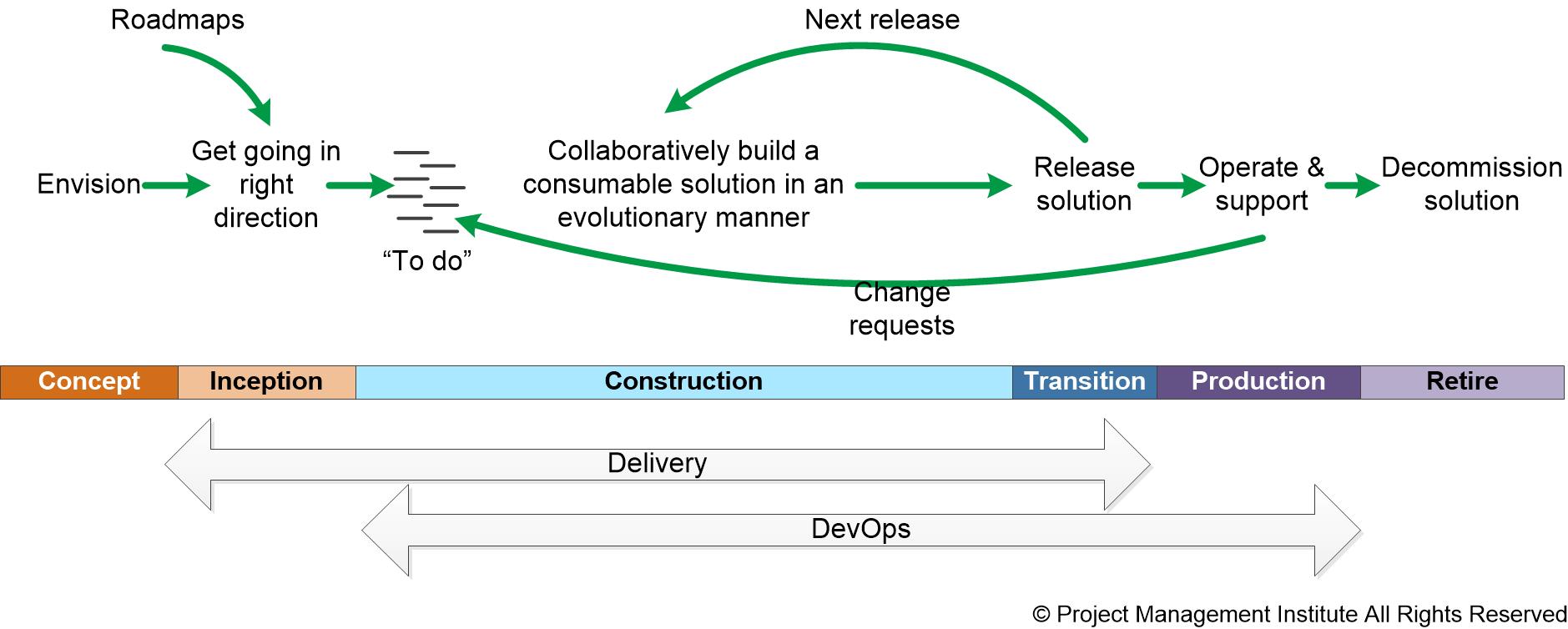
Reason #4: DAD Explicitly Supports a Full Delivery LifecycleDAD supports the full delivery lifecycle, supporting up to three phases (Inception, Construction, and Transition) where needed (the two project-based lifecycles, the Scrum-based Agile lifecycle and the Kanban-based Lean lifecycle need all three phases whereas the two continuous delivery lifecycles and the lean-startup-based Exploratory lifecycle do not, more on this later). As you can see in the picture below the DA tool kit supports a full systems lifecycle that reflects the complete lifecycle from concept (idea) to eventual retirement (decommissioning).
The following diagram depicts the Scrum lifecycle. There are a lot of really great ideas here, but this lifecycle clearly isn’t complete. How do you initiate a Scrum team? How do you release software into production (or the marketplace)? The focus here is just on Construction, which is important, but it is not the full picture.
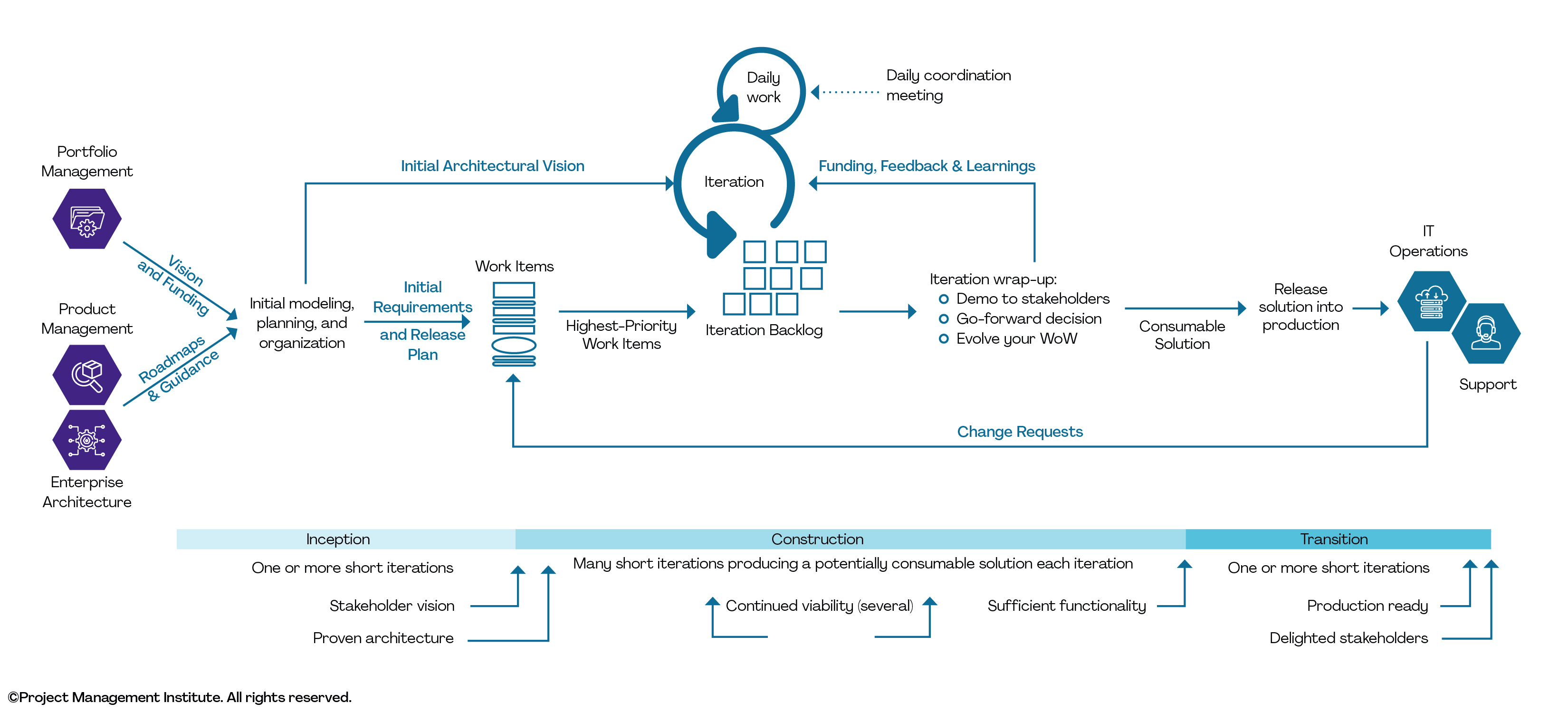
The following figure overviews DAD’s Scrum-based Agile lifecycle. As you can see the Scrum Construction lifecycle is at the heart of it but DAD isn’t limited to just what the Scrum folks want to sell you. Instead DAD takes an approach that is Enterprise Aware in that it covers from beginning to end what solution delivery teams face and it puts the delivery lifecycle into context.
Note that in the DA toolkit we choose to use different, more understandable terminology than Scrum does (but feel free to use whatever terms that you like, because DAD isn’t prescriptive), and prefer to depict a more robust version of the backlog than Scrum does (many Scrum adherents now take a similar approach). The important point is that DAD chooses to explicitly support a full, Scrum-based lifecycle that reflects the realities of enterprise-class solution delivery. Once again, DAD strives to take the mystery out of agile solution delivery.
Reason #5: DAD Provides More Options Than Just ScrumBecause Scrum isn’t the only agile game in town, DAD supports five full delivery lifecycles so as to give teams viable choices. DAD does this because solution delivery teams face different situations, so one lifecycle will not fit all, reflecting the DA principle Choice is Good. DAD includes severa; lifecycles:
Even when you start with the Scrum-based agile lifecycle you will find that a team eventually evolves away from it, as overviewed in the diagram below. This happens because agile teams own their process, and part of that ownership is the adoption of continuous improvement strategies such as retrospectives where a team strives to identify potential improvements, communities of practice (CoP) where people explicitly share their learnings, and of course purposeful experimentation where teams discover what works for them in practice.
It’s important to note that management can become very concerned with the philosophy that solution delivery teams should choose, and then tailor as needed, a lifecycle that reflects the context of the situation that they face (see the principle Context Counts). Many organizations make the mistake of assuming that teams must follow the same lifecycle so that management may govern them consistently. In DAD we show that assumption to be false – DAD has the same light-weight risk-based milestones across the five lifecycles (when and if they apply to that lifecycle). These milestones are summarized in the diagram below. This enables consistent delivery team governance without taking on the risk (and cost) of inflicting the same processes inappropriately across teams.
You may find the blog How Do You Choose Between Software Lifecycles? and the article Lean IT Governance to be interesting reads.
Reason #6: DAD Provides Explicit Tailoring AdviceScrum is prescriptive, giving you one way of doing things. For example, when it comes to addressing changing requirements Scrum has a single way of doing so called a Product Backlog which is managed by a Product Owner. This is a great approach which has its advantages and disadvantages. But, it is only one of several ways to do so. DAD takes a more robust approach, depicted in the goal diagram for the Address Changing Stakeholder Needs goal. DAD supports Scrum’s Product/Requirements Backlog strategy, but it also supports the work item pool approach from Kanban, a work item list strategy (which some Scrum adherents choose to adopt, although typically still call it a backlog), and even a formal change management approach (applicable in regulatory environments). Each of these strategies has advantages and disadvantages and each one of which makes sense in some situations and is a rather bad idea in others. Instead of prescribing a single strategy, which may make sense for the context that you face or it may not (how would you know when you don’t know what your actual options are?), DAD instead provides you with choices and walks you through what you need to consider when making those choices. Of course there’s a bit more to it this, you can see that there are several decision points to consider, including how you go about prioritizing work, when you accept changes (if at all), how stakeholders will interact with the team (egads!, Product Owners are only one way to do so and might not be the best way), and how you go about eliciting requirements from stakeholders.
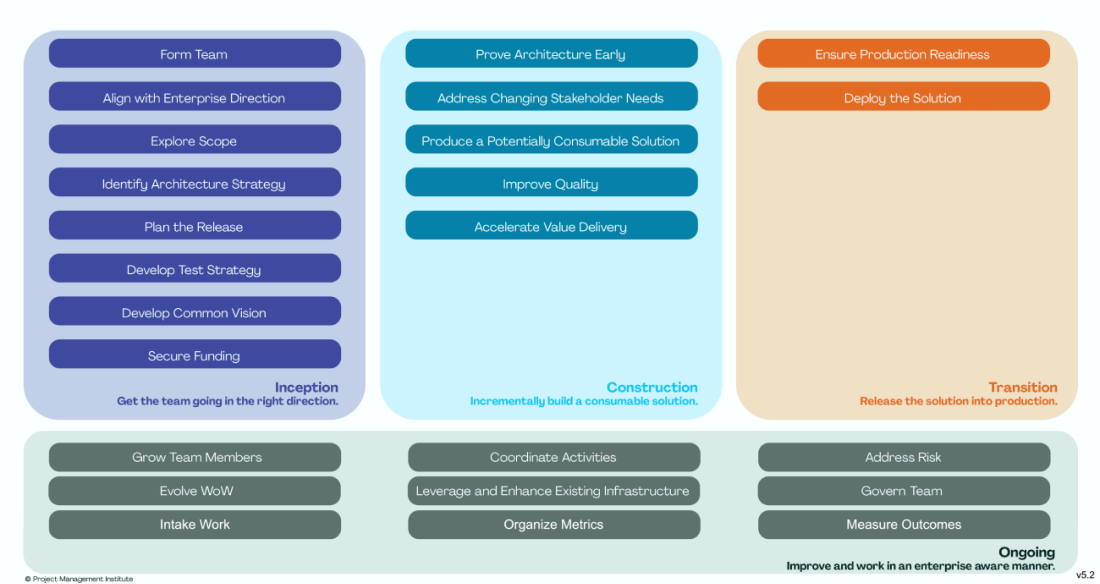
DAD organizes agile solution delivery into a collection of process goals, depicted below. Each of the process goals are described with a goal diagram such as the one above, walking you through the choices that you have (we believe that Choice is Good). DAD also puts each practice/strategy into context by indicating its advantages and disadvantages (we also believe that Context Counts) so that you can make intelligent choices. Not only does this approach get you going in the right direction early on, helping you to avoid costly mistakes, it also helps you to make better decisions in retrospectives and thereby improve your ability to improve your process. Once again, DAD takes the mystery out of agile solution delivery.
Reason #7: DAD Reflects the Realities of Enterprise AgileModern enterprises face a myriad of challenges, including having existing non-agile cultures, existing non-agile processes, legacy systems and data sources, and significant technical debt. Furthermore, your organization likely has multiple teams that range in size, geographic distribution, organizational distribution, and other scaling factors (see DAD is Scalable for a more detailed discussion). The point is that in enterprise-class settings, very likely the situation that you face right now, that the environment is neither pristine nor ideal. The implication is that you might not have the luxury of taking a pure agile approach, at least not immediately, but instead you must make do the best you can in the situation that you face. You must adopt strategies that reflect the context of the situation that you are in, and yes, you should push the boundaries whenever you can. This is why DAD offers choices, suggesting that you be pragmatic and choose the best strategy that you can right now and be prepared to learn and improve later on. For example, consider the process goal Address Changing Stakeholder Needs. When you see a decision point that has an arrow beside the list of choices – in this case Manage Work Items, Accept Changes, and Stakeholder Interaction With Team – that’s an indication that the strategies towards the top of the list are generally more effective than the strategies towards the bottom. When you first form an agile team a very common problem is that it’s difficult to find someone with the skills and authority to be a Product Owner (PO). Many teams find that they need to make do with a business analyst at first, which in general isn’t as good as having a PO (as you can see in the goal diagram above) as Scrum prescribes. It’s not ideal, but it’s the best that you can do right now. Hopefully, in time, you will be able to grow someone into the PO role and thus work in a more agile manner. Having said that, having a PO (the Scrum approach) isn’t as effective, generally, as taking an Active Stakeholder Participation approach (an Agile Modelling strategy). In short, to address the realities of enterprise agile DAD prefers pragmatism over purism – do the best you can given the situation that you face, and be prepared to continuously improve and get better over time.
Reason #8: DAD is Scalable and Provides Real Advice For Doing SoDisciplined Agile Delivery (DAD) provides a foundation from which to scale agile strategies both tactically and strategically. Tactical agility at scale is the application of agile and lean strategies on individual DAD teams. The aim is to apply agile deeply to address all of the complexities, what we call scaling factors, appropriately. These scaling factors are summarized in the following diagram. It is interesting to note that Scrum is geared towards the simple end of these six scales, the ends towards the centre of the radar chart. Although this is very good advice, why wouldn’t you want to keep things as simple as possible, as numerous agile scaling studies have found (see the November 2016 study for our most recent) agile teams do in fact commonly face situations that aren’t that simple. Once again, the DA toolkit prefers pragmatism over purism and provides you with choices to help address these scaling challenges actually faced by agile delivery teams – DAD takes the mystery out of agile solution delivery.
Strategic agility at scale refers to the application of agile and lean strategies across your entire organization. The goal is to be adaptable, to be able to react and better yet create opportunities in the marketplace to delight your customers. To do this you require adaptability at the individual, team, group, and enterprise levels and adaptability in your process. This is why the Disciplined Agile® (DA™) tool kit is more sophisticated than the agile software development frameworks you may be familiar with. With DA we choose to address the actual challenge that you face, not just part of the challenge. As a result, DA distinguishes between four process layers:
Reason #9: DAD Certification is Respectable (Because You Need to Actually Earn It)The Disciplined Agile Certification Program is based on the principles that certification must be earned, it must be meaningful, and must be measurable. The DA certifications are:
Parting ThoughtsA lot of people want to do Scrum, and rightfully so because there are some great ideas there. But even when you’re “doing Scrum” the reality is that Scrum is only a very small part of the overall picture. A very small part. Once you recognize this to be true, you quickly realize that you’re much better off to adopt a robust framework such as Disciplined Agile so as to help gain lightweight guidance through your process choices. This will not only increase your chance of success at adopting agile strategies it will also reduce the cost and time required to do so because DAD takes the mystery out of agile solution delivery.
|
|
Lynn will soon be blogging about the results so I’m not going to dive into that here. I suspect that her blog post will be very interesting. What I’d like to do here is share a few thoughts about what I observed:
I’m very happy to see that Lynn is actively trying to bridge the agile and data communities, helping us to learn from each other. This is something she’s been doing for years and doing it quite well. My experience is that both communities would benefit greatly from more collaboration with each other. |
|
As you know the Disciplined Agile (DA) toolkit supports several delivery lifecycles – Agile, Lean, Continuous Delivery: Agile, Continuous Delivery: Lean, Exploratory, and Program. We do this because solution delivery teams face different situations, so one lifecycle will not fit all. This begs the question of when would a team adopt each lifecycle? That is the focus of this blog. This blog explores the following topics:
What Lifecycles Does DAD Support?The delivery lifecycles we will explore are:
What Criteria Should You Consider When Choosing a Lifecycle?The following table compares the lifecycles, suggesting when you would choose to follow each one.
Who Should Choose the Lifecycle?The team. They will often do this with the guidance of an experienced Disciplined Agile coach, particularly when they are new to DA. It’s tempting to have your portfolio management team to make this choice, and they may often make a (hopefully solid) suggestion when the first initiated an endeavour, but in the end it needs to be the choice of the team. As you see in the table above there are common considerations for when to use each lifecycle, but the primary considerations are always the skill and preferences of the team itself.
Related Reading |
|
We recently published a collection of articles overviewing the seven principles behind the Disciplined Agile (DA) toolkit. The article is entitled Principles Behind the Disciplined Agile Framework and it in turn is supported by detailed articles, one for each principle:
We hope that you find these articles insightful. |