


Project Management

Disciplined Agile

by , , , , , ,
This blog contains details about various aspects of PMI's Disciplined Agile (DA) tool kit, including new and upcoming topics.

About this Blog

RSS

View Posts By:

Tatsiana Balshakova
Mark Lines
Mike Griffiths
James Trott
Bjorn Gustafsson
Curtis Hibbs
Scott Ambler

Past Contributors:

Joshua Barnes
Michael Richardson
Daniel Gagnon
Valentin Tudor Mocanu
Kashmir Birk
Glen Little
Klaus Boedker

Recent Posts

DA 5.6 is released

Disciplined Agile 5.5 Released

Choose Your WoW! Second Edition Is Now Available

Requisite Agility applied in Project Management

Disciplined Agile and PMBoK Guide 7th Edition

Categories

#ChoiceIsGood, #ChooseYourWoW, #ConsumableSolution, #ContinuousImprovement, #CoreAgilePractices, #experiment, #Experimentation, #GuidedContinuousImprovement, #Kaizen, #LifeCycles, #ProcessImprovement, #TealOrganizations, Adoption, agile, agile adoption, Agile Alliance, Agile Business Analyst, Agile certification, agile data, agile governance, agile lifecycle, agile metrics, agile principles, agile transformation, Agile2018, Agile2019, Agile20Reflect, AgileData, Analogy, announcement, Architecture, architecture, architecture owner, Articles and publications, Asset Management, Atari, Backlog, Barclays, being agile, benefits, bi, blades, book, Branching strategies, Browser, Business Agility, business intelligence, business operations, capex, Case Study, Certification, certification, charity, Choose your WoW, CMMI, cmmi, Coaching, Collaboration, Communications Management, Compliance, Compliancy, Conference, Construction, Construction phase, Context, Continuous Improvement, coordination, COVID-19, Culture, culture, Cutter, DA, DAD, DAD Book, DAD discussions, DAD press, DAD roles, DAD supporters, DAD webcast, DADay2019, Data Management, database, dependencies, Deployment, Development Strategies, DevOps, disaster, Discipline, discipline, Disciplined Agile, disciplined agile delivery, disciplined agile delivery blog, Disciplined Agile Enterprise, disciplined devops, Documentation, Domain complexity, dw, DW/BI, Energy Healing, Enterprise Agile, Enterprise Architecture, Enterprise Awareness, enterprise awareness, Essence, estimation, Evolving DA, Executive, Experiment, facilitation, FailureBow, feedback-cycle, finance, Financial, FLEX, Flow, foundation layer, Funding, GCI, GDD, Geographic Distribution, gladwell, global development, Goal-Driven, goal-driven, goals, Governance, GQM, Guideline, Hybrid, Improvement, inception, Inception phase, India, information technology, infosec, Introduction, iterations, Kanban, large teams, layer, lean, Lean Startup, learning, Legal Project Management, LeSS, Lifecycle, lifecycle, Manifesto, mark lines, marketing, MBI, Metaphor, Metrics, metrics, mindset, Miscellaneous, MVP, News, News and events, Non-Functional Requirements, non-functional requirements, Non-solo development, offshoring, Operations, opex, Organization, Outsourcing, outsourcing, paired programming, pairing, paper, People, People Management, phases, Philosophies, Planning, PMBoK, PMI, PMI and DA, PMI Chapter, Portfolio Management, post-format-quote, Practices, practices, Principle, Process, process improvement, process tailoring, Product Management, product owner, Product Owners, productivity, Program Management, Project Management, project-initiation, Promise, Quality, quality, rational unified process, Refactoring, Reiki, Release Management, release management, Remote Training, Remote Work, repeatability, requirements, Requirements Management, research&development, responsibilities, retrospectives, Reuse, Reuse Engineering, ride for heart, rights, Risk Management, Risk Management, Risk management, Roles, RUP, SAFe, sales, Scaling, scaling, scaling agile, Scheduled Workshops, SCM, scorecard, Scrum, ScrumMaster, SDLC, Security, security, self-organization, SEMAT, serial, skill, solutions software consumable shippable, Stakeholder Management, strategy, Support, Surveys, Teal organizations, team development, Team Lead, team lead, Teams, Technical Debt, Teleconferencing, Terminology, terraforming, test strategy, testing, time tracking, Tool kit, Toolkit, tools, traditional, Transformation, Transition iteration, transition phase, Uncategorized, Upmentors, Using PMI Standards, value stream, velocity, vendor management, Virtual Training, Workflow, workflow, workspaces

Date

Viewing Posts by Scott Ambler

How do you convince senior management to become more agile?

linkedin twitter facebook Request to reuse this  

Puzzled manager

We’re often asked how do you convince senior management to accept new agile ideas and strategies.  Examples of such ideas include:

Why is This Important?

There are three reasons why it’s important for agile coaches, and Team Leads/ScrumMasters for that matter, to know how to convince senior management to support new ways of working:

  1. You need their support.  There are many aspects of an agile transformation that an agile coach doesn’t have the authority nor the resources to change.  As a result you need to collaborate with others and very often earn the support of the people who do have the authority and resources.
  2. Agile transformations are complex.  Agile transformations are about more than just transforming software development teams.  The 2016 Agility at Scale study found that 96% of agile teams need to collaborate with other teams external to them to get their job done.  The implication is that these other teams that they are collaborating with – including your business stakeholders, governance team, data management, internal audit, security group, and many others – need to at least be able to interact with your agile teams in a reasonably flexible manner if not work agilely themselves.
  3. Agile transformations are fragile.  If you want to transform your IT department, and more importantly your organization, then you’ll need to transform all aspects of the department/organization.  All it takes is one or more groups to refuse to work in an agile manner and suddenly your transformation is at risk.  The implication is that you need to get good at convincing others to support your efforts if not change themselves.

Why is This So Hard?

There are many reasons why senior management may be reticent to consider this change that you believe to be very important:

  • They have other priorities that you may not be aware of.
  • They have many other issues to deal with, this is just one of them.
  • They may be very happy with the status quo and don’t recognize the problem.
  • There are other people advising the exact opposite.
  • There are people who are entrenched in the existing way of working, and that may include senior management.
  • They will need to convince their peers regarding the benefits of the change and they may not know enough to be able to do so, or may not have the political capital to effect the change.
  • Change can be disruptive and it may jeopardize their existing commitments which incidentally might be tied to their compensation plan.
  • The manager realizes that this change has greater ramifications than you may believe.

The Seven “Easy” Steps For Convincing Someone to Support Change

Here is an approach that we’ve had work in practice for us.  You will very likely need to work through all of these steps, pretty much in order, to be successful.  These steps are:

  1. Pick your battles wisely.  Ask yourself whether this issue is the most important thing that you need help with from this person.  There will be only so much willingness to invest time and effort in supporting the changes that you believe to be made, and not all requests are going to be supported.  As Rod Bray, CDAC, likes to say: “Choose the hill that you’re willing to die on.”
  2. Know the topic and the language around it.  Chances are that you will need to be able to explain whatever it is that you’re asking for help on, what the trade-offs are, why its better than the current approach, and what the impact of the change will be.  To do this you will need to understand the trade-offs are of the current approach and understand the issues and language of the topic.  For example, if you’re asking for help to change the way that IT projects are funded, are you able to speak intelligently about the existing annual-based budgeting process, project-based funding, and perhaps even the implications of CAPEX/OPEX?  Or, if you’re asking to improve the current approach to IT governance, do you understand the existing governance process, what it’s trade-offs are, and what the potential impacts of applying traditional governance to agile teams may be?  If you don’t have this fundamental understanding of the topic then you will very quickly sound like you don’t know what you’re talking about, so why would management want to support you?
  3. Plan the conversation.  Although you very likely have some very great ideas, if you spring them on others they will very likely be threatened by them at first (human beings are psychologically wired to treat surprises as threats).  A better approach is to first ask permission to discuss a new idea that you have, and even share an overview of the idea beforehand so that they can think about it a bit, before you get together to seek their support.
  4. Explore their concerns.  Once you’ve pitched your idea to them they will very likely want to discuss the trade-offs with you, in particular the impact on other groups and the time and effort required to support your change.  The implication is that part of your preparation before you make your pitch should be to think about what concerns they may have with your suggested approach so that you have arguments to counteract any concerns.
  5. Ask them to share their actual experiences.  It is very common for people to become attached to ineffective ways of working.  This sounds strange on the surface, but people are like this.  Whenever we run into someone who believes in a strategy that we know to be ineffective – fixed price funding, documentation-based governance, detailed up-front modeling, significant amounts of manual testing to name a few – we ask them how well it’s working for them in practice.  Very often they’ll tell you about the positives, but if you know the topic (and better yet the history of that strategy within your organization) then you can start exploring the negative aspects with them too.  It’s particularly useful to be able to bring up several past projects where that strategy was applied yet it didn’t work out so well in practice. The point is to help them to recognize that their favored strategy isn’t working as well as they’d like, and that there is a need to rethink your current approach.
  6. Educate them.  Walk them through the trade-offs, both good and bad, of your suggested approach.  Be prepared to discuss the trade-offs of the current strategy, and in particular relate those trade-offs back to the experiences that they just told you about.  You may often discover that they didn’t realize that there are other options available to them and that they’ve been ignoring the problems with their existing approach.  Help them to understand that they have a better choice available to them.
  7. Convince them to run a small experiment.  Making a large, whole-scale change is scary.  If the new approach doesn’t work out then you’ve got a serious problem to deal with and the manager who sponsored the change may be punished for it.  But, running a small, contained experiment to see if the new strategy works in your environment isn’t very threatening and better yet is a fundamental risk management strategy.  So start small, get a visible win, learn from the experiment, and the roll out the change more widely.  It is important that you “negotiate” the changes as they will be more likely to try it if you let them know that the change is an experiment and they will have the opportunity to revert back if the expected benefits do not materialize.  Note that some organizations are leery of running “experiments” but are very willing to run “proof of concepts (PoCs)” – go with the terminology that works in your organization.

We wish that we could tell you that we’ve had a 100% success rate with this strategy.  Sadly we haven’t.  We have done very well with this, but sometimes it doesn’t always work out the first time.  Or the second time, and sadly sometimes not even the third time.  Your goal should be to get them thinking about new ways of working and to give them the time that they need to decide to support you.

Posted by Scott Ambler on: March 22, 2017 06:18 PM | Permalink | Comments (0)

Do Agile Teams Pay Down Technical Debt in Practice?

Categories: agile, Scrum, Technical Debt

linkedin twitter facebook Request to reuse this  

Technical debt is “a concept in programming that reflects the extra development work that arises when code that is easy to implement in the short run is used instead of applying the best overall solution”. Technical debt can be compared to monetary debt in that if it is  not repaid, it can accumulate ‘interest’, making it harder to implement changes later on.  Important questions to ask are “How common is it for agile teams to run into technical debt in practice?” and “When they do run into technical debt, are they paying it down?”

The following diagram summarizes responses to our question from our 2016 Agility at Scale study around technical complexity.  As you can see 84% of agile teams are working with legacy functionality and 51% with legacy data sources (so yes, the vast majority of teams are working in environments that are likely to have some form of technical debt).  More importantly, 38% of teams are actively paying down functional technical debt and 32% are paying down data technical debt (48% are paying down one or the other).

Technical Debt in Practice


Related Posts


Posted by Scott Ambler on: March 13, 2017 05:01 PM | Permalink | Comments (1)

Can You Outsource and Still Be Agile?

Categories: agile, Scrum, scaling, Outsourcing

linkedin twitter facebook Request to reuse this  

We often hear that agile software development is fine for small co-located teams, but that you couldn’t possibly take an outsourcing approach with agile.  The customer organizations would love to do agile but are convinced that vendors are unable to do so, and the vendor organizations typically say they’d love to be agile but that the customers don’t ask them to work that way.  It’s a fair question to ask if agile and outsourcing are being combined in practice, so we decided to look into this issue.

The following diagram summarizes the responses to our question from our 2016 Agility at Scale study around whether agile teams were organizationally distributed (one of the tactical scaling factors potentially faced by agile teams).  As you can see, over half of agile teams are organizationally distributed in some way, with 58% of agile teams including contractors, consultants, or outsourcers in some way.  Interestingly, about one agile team in six includes outsourcing.

Agile and outsourcers, contractors, and consultants

Answering the question of how to be successful at agile and outsourcing is worthy of a detailed article in its own right, something we’ll do in the near future.  Until then, here are some initial thoughts based on our observations at multiple organizations around the world:

  1. It starts with procurement.  If you want a service provider to provide a team that is capable of working in an agile manner then that is what you need to procure.  A traditional procurement process that is looking for a team to work from a detailed requirements specification up front, that is expected to focus on development and then hand off their work for another team to perform “final testing”, is pretty much hobbled from the very beginning.  It is very possible, and highly desirable, to have a procurement process that is capable of procuring agile software development services.  In fact, there is a wealth of knowledge out there about agile contracting if you choose to look into it.
  2. The customer must work in an agile manner.  There are several key strategies to support this:
    • Negotiate how you will work together up front.
    • Take a light-weight, evolutionary approach to requirements.
    • Provide a technical roadmap.
    • Fly a few key people to the service provider.
    • Consider co-locating your Product Owner with the service provider.
    • Provide your development guidelines to the service provider.
    • Actively govern the team.
    • Respect the service provider.
  3. The service provider must work in a disciplined agile manner.  There are several key strategies to support this:
    • Be trustworthy.
    • Be truly transparent.
    • Have one-week iterations/sprints.
    • Include code analysis tools in your builds.
    • Provide the customer access to your team’s automated dashboard.
    • Align your culture to that of the customer.

We will write a more detailed article that expands on these points in the near future.  Stay tuned!

Related Posts

Posted by Scott Ambler on: March 03, 2017 05:23 AM | Permalink | Comments (0)

Do Agile Teams Take on Hard Problems?

linkedin twitter facebook Request to reuse this  

We often hear that agile software development is fine when you face a simple problem, but that agile isn’t sufficient for more difficult problems.  Of course this falsehood is promoted by people who have little or no agile experience, or who have been involved with a failed “agile adoption” (usually these teams adopted ad hoc strategies thinking they were agile).  Anyway, we decided to look into whether agile teams are taking on hard domain problems in practice.

The following diagram summarizes the responses to our question around agile teams and compliance from our 2016 Agility at Scale study.  As you can see, 40% of respondents indicated that their agile team faced either complex or very complex problems, and that a further 38% faced medium complexity.  Interestingly, only one in eight respondents said that their team faced a straight forward problem.

Agile and Domain Complexity

The bottom line is that agile strategies, and in particular disciplined agile strategies, are in fact applicable for taking on complex problems.  More importantly, this is happening in practice around the world on a regular basis.

Related Posts

Posted by Scott Ambler on: February 19, 2017 02:53 PM | Permalink | Comments (0)

Do Agile Teams Face Regulatory Compliance?

Categories: agile, Scrum, Compliancy, scaling

linkedin twitter facebook Request to reuse this  

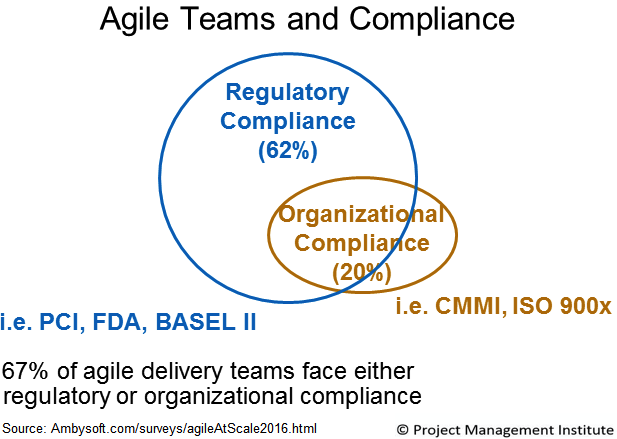
We often hear that agile is great for simple situations but as soon as you face compliancy issues that it doesn’t work.  Is it possible to be agile when you face regulatory compliance, such as PCI and FDA compliancy?  Is it possible to be agile when you face organizational compliance, such as working in a CMMI regime?  Important questions that we decided to look into.

The following diagram summarizes the responses to our question around agile teams and compliance from our 2016 Agility at Scale study.  As you can see, 62% of respondents indicated that their agile team faced some form of regulatory compliance, 20% some form of organizational compliance, and 15% said both.  In fact, two-thirds of agile teams operate under one or more compliancy requirements.

For further reading about compliancy, please read our detailed blog posting Agile and Regulatory Compliance.

Related Posts

Posted by Scott Ambler on: February 15, 2017 08:40 PM | Permalink | Comments (0)
ADVERTISEMENTS

"One morning I shot an elephant in my pajamas. How he got into my pajamas I'll never know."

- Groucho Marx

ADVERTISEMENT

Sponsors