







Guessing is not a strategy: How to build decision velocity with AI and real-time data
June 10, 2026 | Live Webinar

Disciplined Agile 5.5 Released
Choose Your WoW! Second Edition Is Now Available
Requisite Agility applied in Project Management
Disciplined Agile and PMBoK Guide 7th Edition
#ChoiceIsGood, #ChooseYourWoW, #ConsumableSolution, #ContinuousImprovement, #CoreAgilePractices, #experiment, #Experimentation, #GuidedContinuousImprovement, #Kaizen, #LifeCycles, #ProcessImprovement, #TealOrganizations, Adoption, agile, agile adoption, Agile Alliance, Agile Business Analyst, Agile certification, agile data, agile governance, agile lifecycle, agile metrics, agile principles, agile transformation, Agile2018, Agile2019, Agile20Reflect, AgileData, Analogy, announcement, Architecture, architecture, architecture owner, Articles and publications, Asset Management, Atari, Backlog, Barclays, being agile, benefits, bi, blades, book, Branching strategies, Browser, Business Agility, business intelligence, business operations, capex, Case Study, Certification, certification, charity, Choose your WoW, CMMI, cmmi, Coaching, Collaboration, Communications Management, Compliance, Compliancy, Conference, Construction, Construction phase, Context, Continuous Improvement, coordination, COVID-19, Culture, culture, Cutter, DA, DAD, DAD Book, DAD discussions, DAD press, DAD roles, DAD supporters, DAD webcast, DADay2019, Data Management, database, dependencies, Deployment, Development Strategies, DevOps, disaster, Discipline, discipline, Disciplined Agile, disciplined agile delivery, disciplined agile delivery blog, Disciplined Agile Enterprise, disciplined devops, Documentation, Domain complexity, dw, DW/BI, Energy Healing, Enterprise Agile, Enterprise Architecture, Enterprise Awareness, enterprise awareness, Essence, estimation, Evolving DA, Executive, Experiment, facilitation, FailureBow, feedback-cycle, finance, Financial, FLEX, Flow, foundation layer, Funding, GCI, GDD, Geographic Distribution, gladwell, global development, Goal-Driven, goal-driven, goals, Governance, GQM, Guideline, Hybrid, Improvement, inception, Inception phase, India, information technology, infosec, Introduction, iterations, Kanban, large teams, layer, lean, Lean Startup, learning, Legal Project Management, LeSS, Lifecycle, lifecycle, Manifesto, mark lines, marketing, MBI, Metaphor, Metrics, metrics, mindset, Miscellaneous, MVP, News, News and events, Non-Functional Requirements, non-functional requirements, Non-solo development, offshoring, Operations, opex, Organization, Outsourcing, outsourcing, paired programming, pairing, paper, People, People Management, phases, Philosophies, Planning, PMBoK, PMI, PMI and DA, PMI Chapter, Portfolio Management, post-format-quote, Practices, practices, Principle, Process, process improvement, process tailoring, Product Management, product owner, Product Owners, productivity, Program Management, Project Management, project-initiation, Promise, Quality, quality, rational unified process, Refactoring, Reiki, Release Management, release management, Remote Training, Remote Work, repeatability, requirements, Requirements Management, research&development, responsibilities, retrospectives, Reuse, Reuse Engineering, ride for heart, rights, Risk Management, Risk Management, Risk management, Roles, RUP, SAFe, sales, Scaling, scaling, scaling agile, Scheduled Workshops, SCM, scorecard, Scrum, ScrumMaster, SDLC, Security, security, self-organization, SEMAT, serial, skill, solutions software consumable shippable, Stakeholder Management, strategy, Support, Surveys, Teal organizations, team development, Team Lead, team lead, Teams, Technical Debt, Teleconferencing, Terminology, terraforming, test strategy, testing, time tracking, Tool kit, Toolkit, tools, traditional, Transformation, Transition iteration, transition phase, Uncategorized, Upmentors, Using PMI Standards, value stream, velocity, vendor management, Virtual Training, Workflow, workflow, workspaces


|
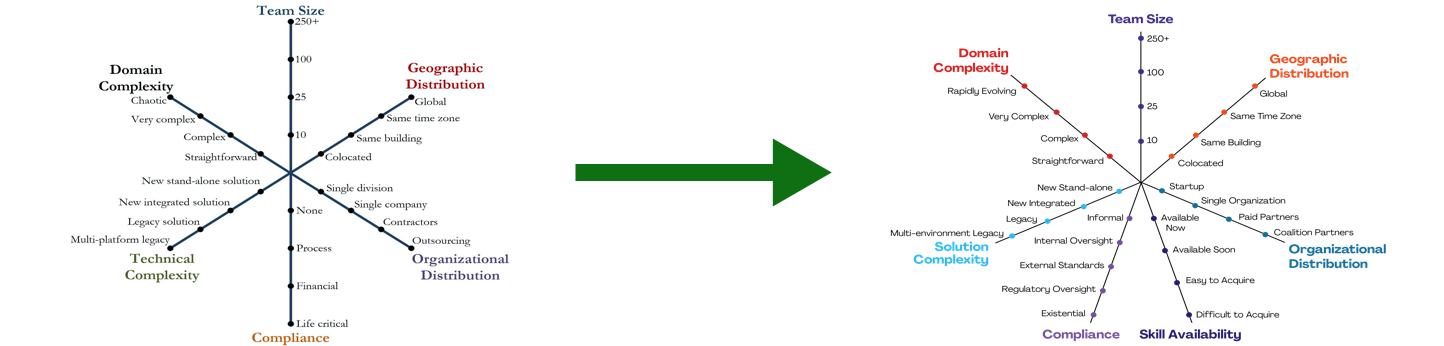
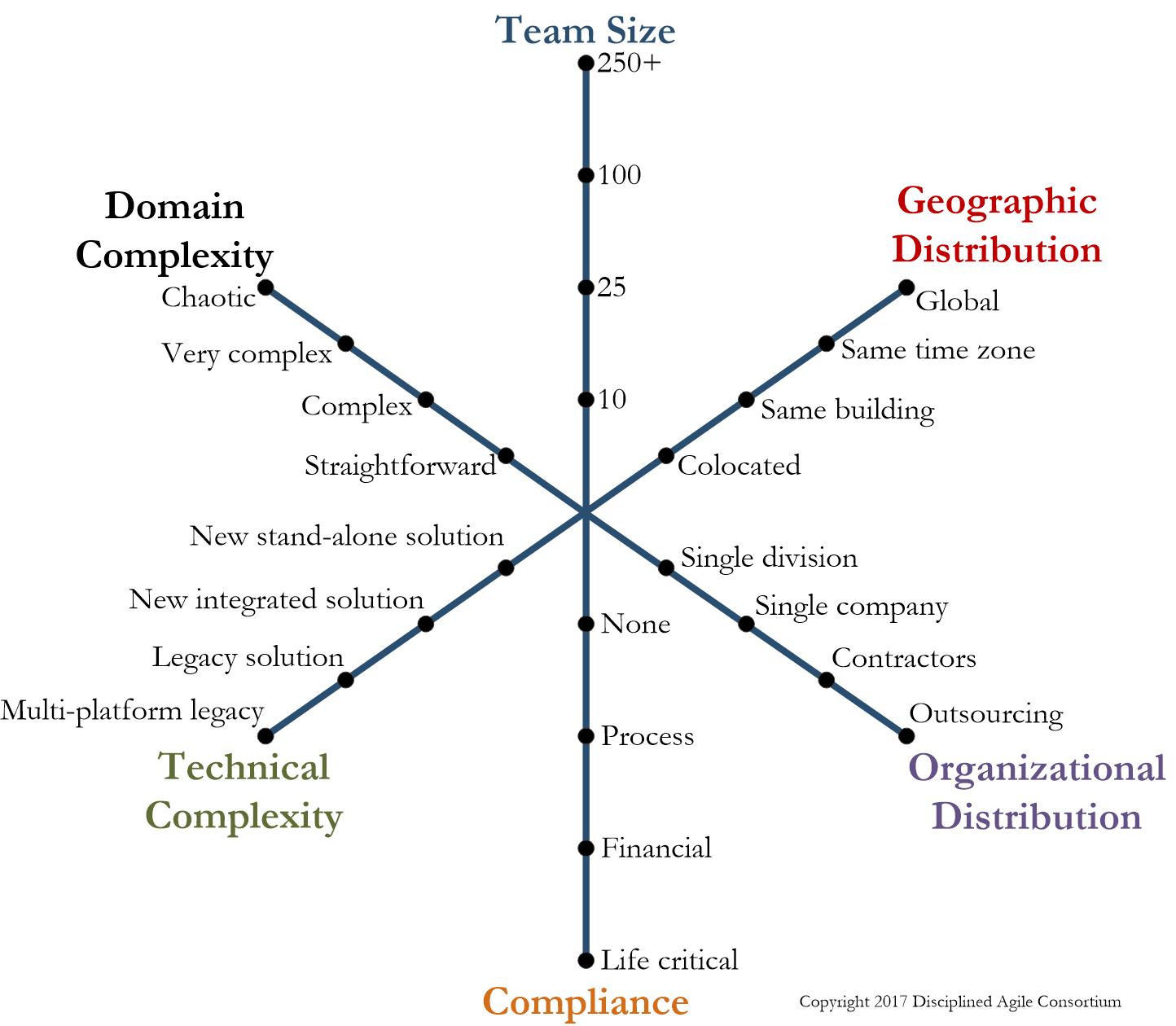
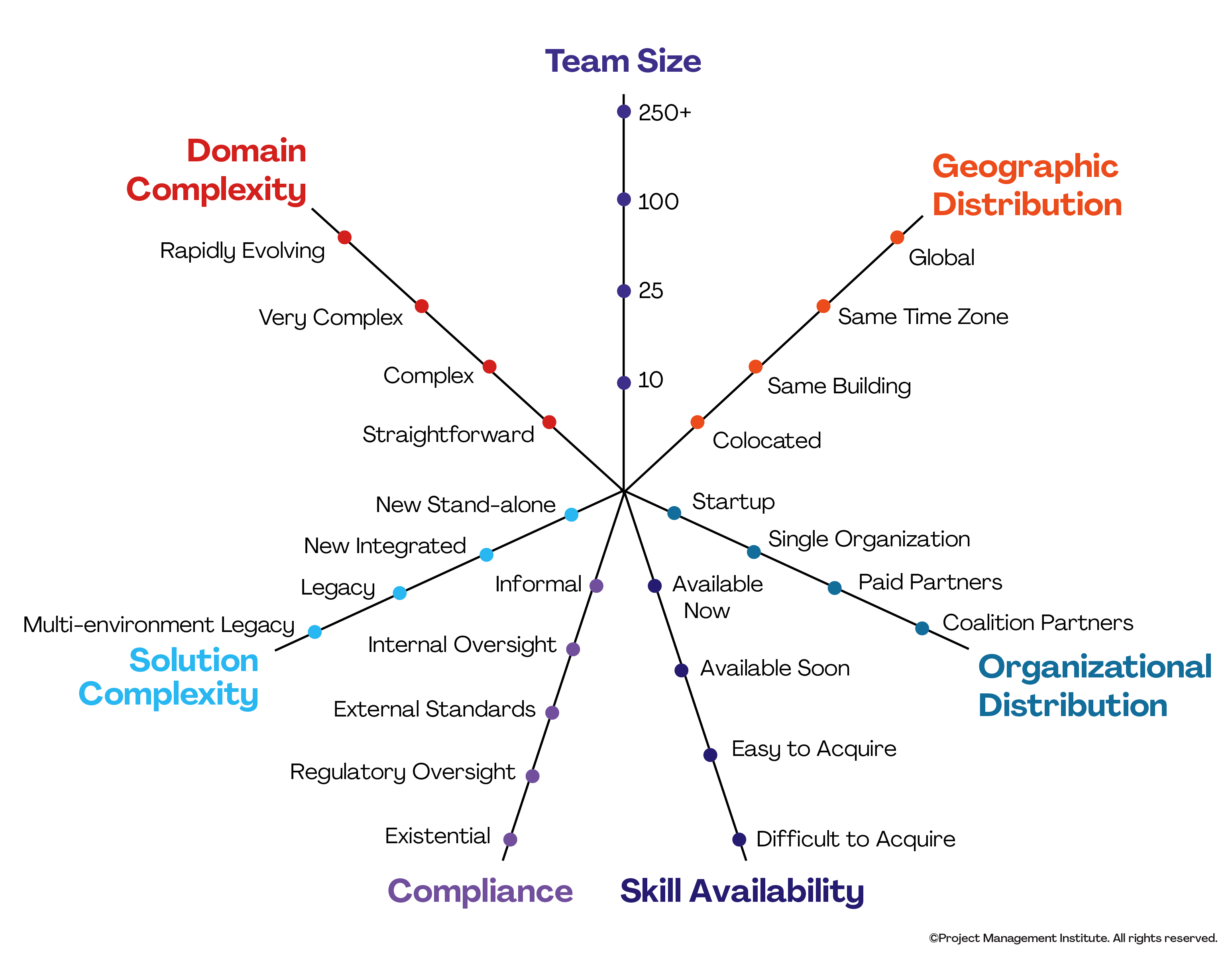
We've have recently updated our thinking around the tactical scaling factors that we apply in DA to help understand the context faced by a team or organization. Figure 1 depicts the original scaling factors and Figure 2 the new scaling factors. Below we discuss what changed and how this can affect anyone taking a Disciplined Agile (DA) certification exam.
Figure 1. The (original) scaling factors of the SDCF.
Figure 2. The scaling factors of the SCF.
What's Changed?The changes we made were motivated by our experiences applying the scaling factors outside of IT teams. Originally these scaling factors were described by the Software Development Context Framework (SDCF) which we evolved into the Situation Context Framework (SCF) in late 2020. Here is what has changed:
Implications for DA Certification ExamsAs you can see in Scaling Factors we have made it clear that the exam will test you for knowledge about the original version for now (in Figure 1) and that when we update the courseware and exam to reflect this update we will let you know. In general our intent is that whenever material on the web gets ahead of what is being tested for that we'll make it clear that this has happened. More on this in a future blog posting.
Further Reading
|
|
February 2021 will be the 20th Anniversary of the meeting from which the Manifesto for Agile Software Development, or more colloquially the Agile Manifesto, emerged. To celebrate this, the Agile20Reflect Festival will be held around the world during the month of February. The festival is a collection of agile learning events around the world, where each event is run by a local group such as a PMI chapter. This is a great opportunity for PMI members to learn more about agile, and for PMI Chapters to host an event for their members as part of the festival. This blog is organized into the following topics: The EventsGood things to know:
Potential Ideas for an EventHere is a list of event ideas that should get you thinking about what your chapter can do:
The above list is just a start. If you have other ideas that you'd like to share, please do so (see below).
How to Organize an EventThis is what I suggest you do:
Let's Work TogetherTime is short, so we need to collaborate to make this successful. Let's take advantage of the Disciplined Agile discussion forum on LinkedIn to collaborate. Here's how we can use it:
|
| This blog posting has been replaced with Risk-Based Milestones. You may also be interested in How Disciplined Agile Teams Address Risk.
|
|
Quick answerThe term predictive is deceptive.
Detailed answerIn the Disciplined Agile (DA) tool kit we use the term traditional or serial, rather than predictive or waterfall, to refer to the classic/linear ways of working. We feel that predictive is deceptive, more on this in a minute, and waterfall to be insulting (albeit still in common use within the IT community). Furthermore, we're starting to move away from using traditional as we're now seeing a generation of practitioners who feel that some of the older agile approaches, in particular Scrum, are traditional ways of working. There are several reasons for why we feel the term "predictive" to be deceptive:
In short, we know that "predictive" is a deceptive term for a large category of projects and suspect this to be true for other project types. As a result the only use of the term predictive in DA is to tell you that we don't use it.
|
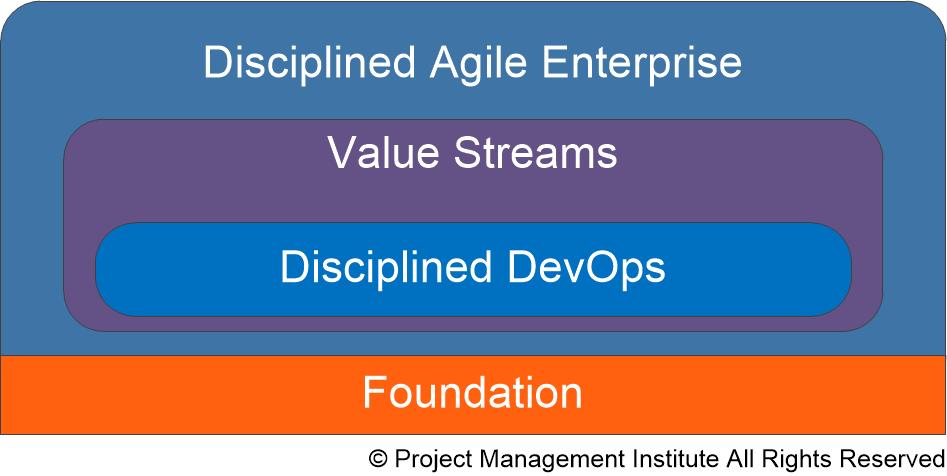
| A Disciplined Agile Enterprise (DAE) is able to sense and respond swiftly to changes in the marketplace. It does this through an organizational culture and structure that facilitates change within the context of the situation that it faces. Such organizations require a learning mindset in the mainstream business and underlying lean and agile processes to drive innovation. The DAE layer is one of the four layers of the Disciplined Agile (DA) tool kit, overviewed in Figure 1. These layers are: Foundation, Disciplined DevOps, Value Streams, and Disciplined Agile Enterprise (DAE). This blog focuses on the DAE layer. Figure 1. The layers of the DA tool kit.
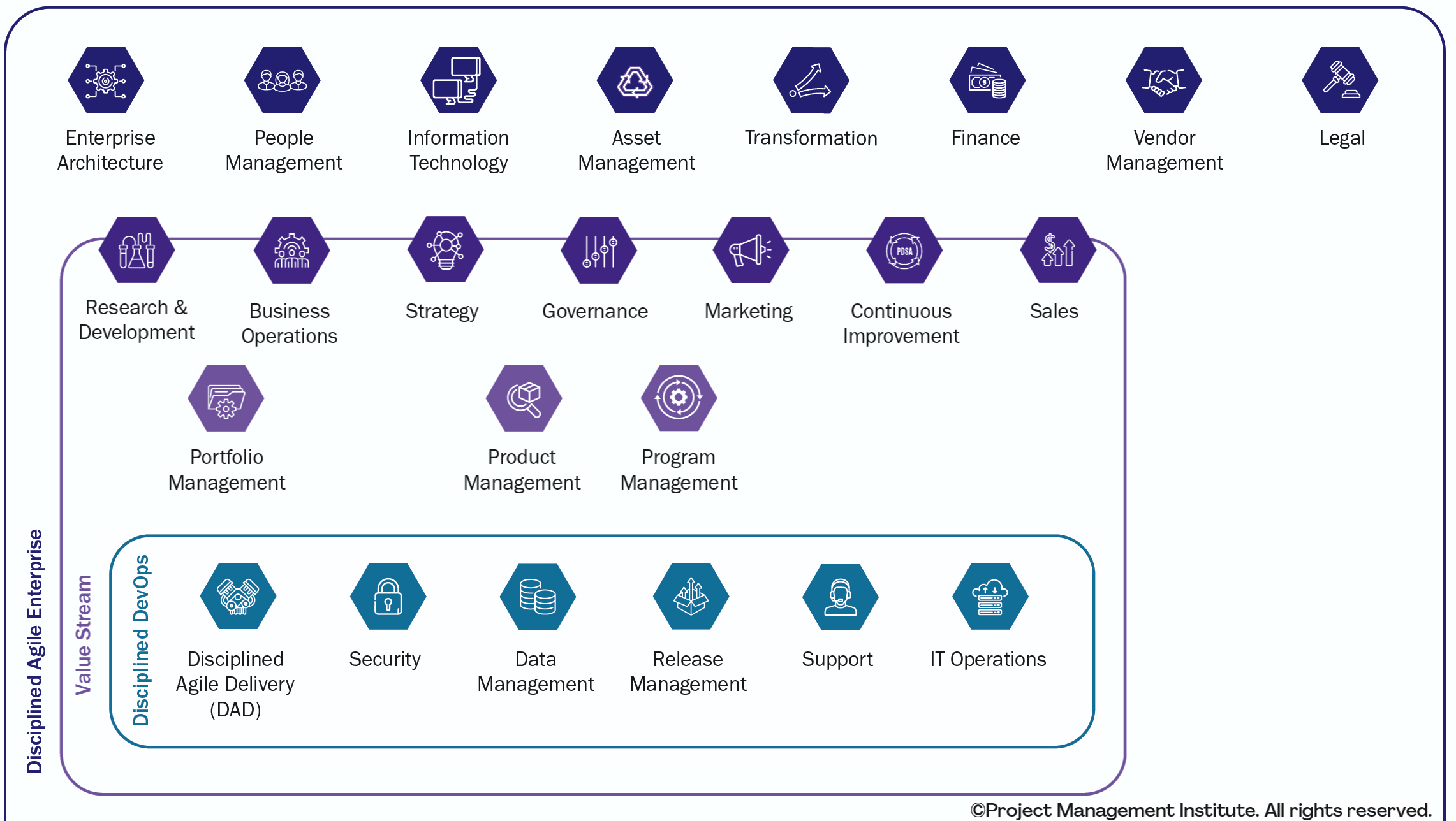
The Disciplined Agile Enterprise (DAE) layer encompasses the capabilities required to guide your organization, to coordinate the teams/groups within your organization, and to support the value streams offered by it. Figure 2 summarizes the DA tool kit and Figure 3 overviews the process blades that are specific to the DAE layer. Several process blades of the DAE layer - Research & Development, Business Operations, Strategy, Governance, Marketing, Continuous Improvement, and Sales - are shared with the value streams layer. The are "shared" in that the scope of these process blades may focus on both the entire organization and specifically on individual value streams. For example, a financial institution may execute an organization-wide marketing strategy as well as specific strategies for their retail and corporate value streams. Figure 2. The Disciplined Agile (DA) tool kit.
Figure 3. The process blades specific to the DAE layer. Expanding upon the value streams layer, the DAE layer adds the following blades:
Asset managementThe asset management process blade addresses the purposeful creation (or rescue), management, support, and governance of organizational assets. This includes financial, inventory, contractual, risk management, and strategic decisions of these organizational assets. Enterprise architectureThe enterprise architecture (EA) process blade overviews how a Disciplined Agile EA team will work. An agile enterprise architecture is flexible, easily extended, and easily evolved collection of structures and processes upon which your organization is built. The act of agile enterprise architecture is the collaborative and evolutionary exploration and potential capture of an organization’s architectural ecosystem in a context-sensitive manner. The implications are that enterprise architects must be willing to work in a collaborative and flexible manner and that delivery teams must be willing to work closely with enterprise architects. FinanceThe finance process blade addresses a collection of potentially competing goals, such as ensuring cash flow within your organization, ensuring your money is being spent well, taxes are minimized, spending is properly tracked and recorded, and legal financial reporting is being performed properly. All of this will be performed in a manner that is compliant with applicable financial regulations, such as Financial Accounting Standards Board (FASB) and International Accounting Standards Board (IASB) guidelines. Information technologyThe information technology (IT) process blade encapsulates the activities required to provide IT capabilities to the rest of the organization. This includes managing information technologies, data resources, applications, and IT infrastructure. LegalThe aim of the Legal process blade is to ensure that your organization works within the parameters of the law of any and all legal territories in which you operate. Your legal team will work closely with your vendor management people on (Agile) contracts; with your people management team to ensure that their strategies reflect the local statutes and to help educate staff in legal concerns; with your marketing team to guide what they’re legally able to promise; with your strategy team to ensure the direction they're taking the organization is legally viable; and with governance to understand the legal implications of applicable regulations. People managementThe aim of the people management process blade is to attract and retain great people who work on awesome teams. People management goes by many names, including human resource (HR) management, human relations (HR) management, talent management, staff management, people operations, and work force management to name a few. This process blade addresses strategies for forming teams; helping people to manage their careers; training, coaching, and educating people; human resource planning within your organization; managing movement of people within your organization; reward structures; and governing people management efforts. TransformationThe transformation process blade captures advice for how to redefine, and then reengineer, your organization. This includes understand the current context, identifying the desired future, identifying how to measure the success of the transformation, identifying a likely strategy for moving towards the desired state, and then executing on that strategy. Throughout a transformation you will constantly gauge your progress and the desired target state and adjust according. This process blade leverages the advice of PMI's Brightline Initiative. Vendor managementThe aim of the vendor management process blade, sometimes called supplier management, is to help obtain and then manage offerings (products, services, and intellectual property) from other organizations. To do this your vendor management team will collaborate with other parts of the organization to help them understand their needs (if any), identify potential vendors that can fulfill those needs, work with legal to develop appropriate contracts, address vendor-related risks, help monitor and manage vendors, and eventually close out any contracts. |
|
"In Italy for thirty years under the Borgias they had warfare, terror, murder, bloodshed - but they produced Michelangelo, Leonardo da Vinci, and the Renaissance. In Switzerland they had brotherly love, 500 years of democracy and peace, and what did that produce? The cuckoo clock." - Orson Welles, The Third Man |